Howard Megdal

The GOP needs a brokered convention

New rules mean Romney's rivals can save the party from an unpopular nominee

  • more
    • All Share Services

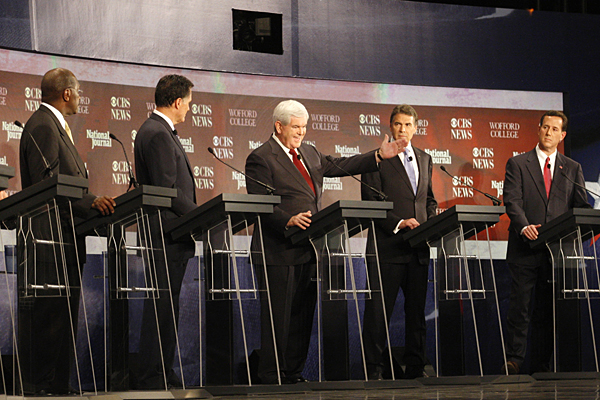
The GOP needs a brokered conventionMitt Romney and the candidates of the Not Mitt Romney movement (Credit: Chris Keane / Reuters)

It has been a tumultuous year for those eager to handicap the 2012 GOP race for president. The leaders in the national polls have included Donald TrumpMike HuckabeeSarah PalinChris ChristieRick PerryHerman Cain and now Newt Gingrich. This weekend the former House speaker became the sixth Republican candidate to lead an Iowa caucus poll.  And all the while, Mitt Romney has loomed as the realist’s choice to become the party’s nominee.

But all of these polls and pronouncements have overlooked the most popular choice for the Republican Party’s  presidential nomination: no one. As Republicans make their way toward their quadrennial meeting  in Tampa, Fla., which opens on Aug. 27, 2012, the lack of consensus may be building toward a historical surprise: a brokered convention. Such an event hasn’t been this likely in decades.

It is true that neither party has seen a multi-ballot vote to nominate a presidential candidate in more than a half-century. Adlai Stevenson won the 1952 Democratic nod on the third vote, and no Republican has required more than one round since Thomas E. Dewey in 1948, also on the third ballot.

However, a combination of the lack of strength within the current field, the inclinations of current GOP primary voters, the recently changed 2012 GOP rules, and even the best interests of the party itself all point to a strong possibility that there will be no presumptive nominee ahead of the convention.

Let’s start with the field itself. Mitt Romney has been the likeliest nominee in the eyes of many, given his stellar fundraising and organization. He finished second to Sen. John McCain, the 2008 nominee, and his challengers have self-destructed, one after another. Despite antipathy from some within the party, why shouldn’t Romney be next, just like McCain or 1996′s choice, Bob Dole?

The reasons are legion, of course. Since John McCain was defeated by Barack Obama, GOP politicians from Charlie Crist to Mike Castle, Lisa Murkowski to Jane Norton have discovered that even in statewide campaigns, it is nearly impossible to win a Republican nomination without earning the love, or at least avoiding the enmity, of the far right.

Romney has certainly internalized that lesson, dutifully signing Grover Norquist’s pledge and repudiating Obamacare in the strongest possible terms. Yet his tenure as Massachusetts governor, complete with a healthcare reform program that served as a template for Obama’s Affordable Care Act, serves as a deal-breaker for the conservative voters he’ll need when Iowa starts voting on Jan. 3, 2012. Romney remains stuck at about 25 percent in the polls, meaning three out of four Republicans reject him. With six weeks to go, Romney is running out of time to convince the voters to fall for him, and not for lack of trying.

Nor has the predicted stampede of GOP establishment heavyweights to Romney’s side come to pass. George Will called Mitt Romney “the pretzel candidate” last month; Bill Kristol declared in his most recent column that Romney was not “inevitable” but, in fact, very “evitable.”

Less noticed, but no less important, is the new GOP voting system, which is set up for early primary and caucus states to vote first, followed by all other proportionally allocated delegate states next. From April 1 on, the winner-take-all primary and caucus states will vote. That means a weak front-runner can earn victories in early states without taking a commanding share of that state’s delegates, while several challengers can lose, but still rack up a decent delegate total.

Ron Paul, for instance, is often overlooked by the media as a factor because his ceiling of support in the polls appears to be between 10 and 15 percent. But since his floor of support isn’t far below that, he will be able to pick up a chunk of delegates who won’t be available to  Romney. The same will be true for Michele Bachmann and Rick Perry if they stay in the race — and the latter has plenty of cash still on hand.

For the very earliest states, this was true in 2008 too. The early primaries and caucuses allocated delegates proportionally, so winning them meant less in terms of amassing convention delegates, and more in terms of building a sense of momentum for the next round of voting in states that were nearly all winner-take-all. For example, McCain’s 5-point win over Romney in New Hampshire on Jan. 8, 2008, yielded only a 7-4 delegate edge.   But his victories later that month in South Carolina by 3 points and Florida by 5 points captured 75 of the two states’ combined 81 delegates.

No such mechanism exists for any candidate in the 2012 race. Thanks to the new GOP rule,  any primary or caucus held before April 1 must allocate delegates proportionally.

So when McCain won nine of 21 states on Super Tuesday (Feb. 5), with more than 50 percent of the vote in just three of them, the winner-take-all system gave him 608 of the 1,081 delegates at stake on the day. That meant total delegate haul — more than 56 percent of those available — was greater than his share of the vote in any single state that day. It also meant he received more than 57 percent of the delegates he’d need to be nominated in a single day. The result? Mitt Romney quickly called it quits, while Mike Huckabee continued on, but without any real attacks on McCain. The GOP race was over on Feb. 5.

This year will be different. The first winner-take-all primaries are Maryland, Wisconsin and Washington, D.C., on April 3. That means 1,163 of 2,380 delegates will be selected before a single winner-take-all primary is held.

The mathematical implications are stark. Take Missouri, for example, which votes on March 17, 2012, meaning its delegate will be allocated proportionally.  Back in 2008, Missouri was winner-take-all. On the GOP side, John McCain edged Mike Huckabee and Mitt Romney in a tight three-way contest, 33 percent to 32 percent to 29 percent. Despite the narrow win, McCain took all 58 of Missouri’s delegates.

Fast forward to 2012. If  Mitt Romney performs as well in Missouri as McCain did in 2008, a big if, he would gain fewer than 20 delegates from the state. More to the point, the candidates collectively known as “Not Mitt Romney” would gain 38, making Not Mitt Romney the big winner.

But Not Mitt Romney won’t be on the ballot, right? Well, yes and no. Several candidates who aren’t Mitt Romney are likely to be on the ballot in all 50 states. If a majority of the party agrees on nothing more than Not Mitt Romney, the real Mitt Romey cannot enter April with a majority of delegates. If Romney is able to climb to even 30 percent nationally in the pre-April states — something he hasn’t done in a single national poll — and wins a corresponding percentage of the vote, he would still have only 349 delegates. That means he would need to capture 868 of the 1,217 winner-take-all delegates to capture the nomination through the primary process. His only hope is that the other candidates have dropped out.

But why should they? The Not Mitt Romney candidates would need to win just 350 delegates after April 1 to deny him a majority of delegates. How Romney avoids that fate is even less clear. Even he wins every state in the Northeast and the West where he is strongest, he still has a big challenge.

Romney is  a tough sell in the South and the Midwest.  In Ohio (66 delegates, June 12), for instance, Romney trailed Herman Cain last month, 34 percent to 19 percent; he was the second choice of just 13 percent of other voters. Romney lagged in third place last month in West Virginia (31 delegates, May 8), Nebraska (35 delegates, May 15) and North Carolina (66 delegates, May 8), trailing both Cain and Gingrich. In those states polls show Romney winning 16 percent, 13 percent and 17 percent of the vote, respectively. Those four states alone represent 187 of the 350 the Stop Romney forces will need — again, assuming Romney can even manage 30 percent of the vote through March 31.

There will be another 386 delegates chosen by voters in seven states: Wisconsin (42 delegates, April 3), Indiana (46 delegates, May 8), Arkansas (36 delegates, May 22), Kentucky (36 delegates, May 22), South Dakota (28 delegates, June 5) and Montana (26 delegates, June 5), and California (172 delegates, on June 5) where he trails Gingrich. The Not Mitt Romney forces would only need to win 163 (42 percent) to deny Romney a first ballot victory.

And, if they do, why exactly would the party leaders step in to save Romney’s nomination? Rather than settle for a nominee incapable of generating enthusiasm, they could use the convention to find a candidate more in tune with the Republican voters.

The GOP leadership and the rank and file would have the opportunity to nominate a compromise candidate who hasn’t been in the race at all: John ThuneChris Christie or Jeb Bush, someone who can cite Romney’s unpopularity and moderate record as the basis for breaking their previous vows not to run. Suddenly, the Democrats would face a fresh conservative face who would receive just two months of scrutiny before Election Day.

And running against a president saddled with mediocre approval ratings, whose reelection prospects seem largely buoyed by his uninspired opponents, the Republicans would go into the general election with a sense of dynamism, not disappointment. A brokered convention in Tampa is shaping up the GOP’s best-case scenario.

Dukakis on Obama, Palin and what might have been

He still can't believe he let the GOP walk all over him in 1988 -- and fears his party is forgetting the lesson

  • more
    • All Share Services

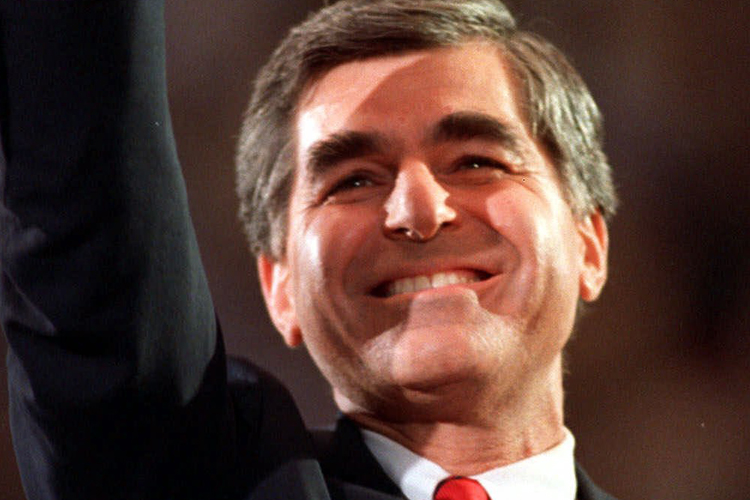
Dukakis on Obama, Palin and what might have beenMichael Dukakis at the 1988 Democratic National Convention.

It turns out that one of the first people to figure out that George H.W. Bush’s famous “Read my lips: no new taxes” declaration would come back to haunt him in 1992 was Michael Dukakis — who came to the realization in December 1988, just a month after losing the presidential election to Bush.

“He really didn’t believe it,” he recalls. “He and I met in early December (after the election), at the vice president’s house. He was nice enough to invite me down.”

During their campaign, Dukakis had brought up a contentious issue — more vigorous enforcement by the IRS — and in their post-election meeting pointed out to Bush that the proposal could raise $110 million immediately.

“He said, ‘I really have to talk to Jim — meaning Baker — about this, because if I raise taxes my first year, they’ll kill me.’

“So, I’m sitting there,” an amused Dukakis continues, “still somewhat bruised, and I’m listening to this guy who’s been going all over the United States telling people to read his lips, and I’m thinking, ‘This guy thinks his commitment is for 12 months!

“Well, I didn’t say anything — the election was over. Well, by God, he raised them his second year, and we all know what happened.”

More than two decades after the Democrats’ 1988 standard-bearer suffered a shellacking, to use the in-vogue term, Dukakis is both self-effacing about the shortcomings that led to his national defeat and passionate about the ways he believes the Democratic Party can “focus on connecting with an overwhelming majority of Americans that seem to agree with us on fundamental issues, but are voting for other people.”

The former Massachusetts governor (he held the post for three terms between 1974 and 1990) spoke with Salon about topics past and present in a wide-ranging interview in his office at UCLA, where he spends his winters as a visiting professor of public policy. (He and his wife, Kitty, spend the rest of the year back in Brookline, Mass., in what he describes as “the governor’s mansion — half of a brick duplex.”)

For Dukakis, now 77, the loss to Bush represents both a personal failing and a simple miscalculation. It also serves as a Rosetta stone for understanding the successes and failures of his party nationally ever since.

Of the Bush campaign’s sharp attacks — which were punctuated by the notorious “Willie Horton ad” — that helped erode what was once a 17-point lead for the Democrat, Dukakis now says, “I did a lousy job of dealing with that. The first big mistake I made was making a decision I wasn’t going to respond to the Bush attack campaign. You cannot do that. Now, how you do it, how you turn an attack campaign into a character issue on the guy that’s doing it — which, ideally, is the best way to deal with it — it’s not easy.”

Dukakis is quick to point to the successes enjoyed by both Bill Clinton and Barack Obama — and just as quick to contrast them with his own shortcomings. He credits Clinton with countering attacks far more intense than the ones he faced, and points out that Obama gave as good as he got in 2008.

“When you say to me, ‘What were you thinking?’ ” Dukakis says, then pauses, shrugging his shoulders and seemingly incredulous at the thought that he unilaterally disarmed against Bush. “I don’t know. I’m a positive guy, I tried to run a very positive campaign in the primary, I thought people were tired of all the polarization we were getting under Reagan — but, in retrospect, to let Bush get away with all that stuff was just ridiculous, and nobody’s fault but my own.”

That you’re likely to hear a similar lament from Democrats in 2011 is just one example of how Dukakis believes his party — and his country — is guilty of ignoring history. He points to failure to organize a genuine grassroots campaign at the precinct level in ’88 — even though that kind of organizing had been crucial to his successful campaign to win back the Massachusetts governorship in 1982 — and argues that Democrats made the same mistake in last year’s midterm elections, despite Obama’s own success with grassroots organizing in 2008.

“Look at the congressional races,” he says. “How many candidates of my party did serious, precinct-based campaigns? Damn few of them. Which is one of the reasons why we got skunked. Now why, after Obama’s brilliant demonstration of how effective this was in ’08, every single Democratic member of Congress wasn’t out there developing a precinct-based organization — and as I’ve said a million times, it’s not rocket science; it’s a precinct captain, and six block captains in every precinct, making personal contact with every single voting household — why didn’t they do it? You’ve got all these consultants running around, who have never rung a doorbell in their life, and they don’t seem to take it seriously.”

It is fascinating to consider what a Dukakis victory in 1988 might have done to the trajectory of modern political history — and, as the man himself concedes, it probably wouldn’t have been pretty for his party, at least in the short term.

“Would we have gone into a recession, even if I’d been elected?” he asks. “Probably. I mean, the seeds were sown under Reagan. How can you have an economic policy like Reagan’s and not confidently predict there’s going to be a recession afterwards? If I’d been elected, we’d certainly have attacked the economic issues largely as Clinton did. With considerable success.”

In other words, the immediate political result of a Dukakis presidency might have been an acceleration of the “Republican Revolution,” in which the GOP swept to power in the House for the first time since the Eisenhower era. Instead of playing out in the 1994 midterm elections under Clinton, it might have occurred in 1990 under Dukakis.

In the public mind, Bill Clinton represented a break from Dukakis’ liberalism, but Dukakis says his administration would have looked a lot like Clinton’s did.

“A lot of my policies, my approach to them, would have been very similar to Clinton’s,” he contends. “I would have emphasized a national rail passenger system and heavy emphasis on infrastructure — though he was quite good on both those issues, I’m a bit of a fanatic when it comes to this stuff. And the health plan I would have proposed would have been very much the Nixon health plan.”

And maybe — just maybe — he could have gotten such a plan through Congress, which two decades ago was still populated with a chunk of moderate, pragmatic Republicans, like the late Rhode Island Sen. John Chafee. The more ideologically dogmatic GOP of today, Dukakis notes, “isn’t exactly Chafee and company,” but he still thinks it’s worth it for Obama to reach across the aisle.

“You make the effort,” he says, “and if folks just don’t want to sit down and come to a reasonable conclusion, you just go out and say, ‘The single most important priority is getting this economy back on track and getting people back to work, and what these guys are doing is going to have a profound effect on that.”

Of course, this isn’t to say that Obama shouldn’t also begin defining the Republican opposition now in advance of next year’s presidential race. Dukakis suggests that Obama steal a page from the playbook of Clinton, who began running television ads in the summer of 1995.

“I mean, [Clinton] had poor Dole on the floor, bleeding, a year in advance,” Dukakis says. “I think, given the opposition he’s likely to face, the corporate money pouring in, I’d make it an issue. I’d make the Koch brothers an issue — where’s that money coming from? I’d turn that into a plus, and early.”

Ask him about the Tea Party and the woman who is arguably its most prominent public face — Sarah Palin — and Dukakis reacts with bewilderment.

“I just don’t know,” he says. “I was asked to sit on a panel with a young Tea Party guy. And it was the first chance I had to sit down and listen — much of what he said was just factually inaccurate, didn’t make a lot of sense. And I’m somebody who’s a great believer in sitting down with folks. But I think you have to lay out the facts, see if you can get agreement on, if not the facts, at least on the problem.”

He does, however, see a potential silver lining for Democrats in the emergence of the Tea Party.

“It may get them into very big trouble politically, come 2012,” he says. “If [Palin] gets nominated, and she gets badly beaten, as I suspect will probably happen, then the Republican Party has no one but itself to blame.”

Nor does Dukakis have much regard for the nominal GOP frontrunner, Mitt Romney, his fellow former Bay State governor.

“Remember, he was governor for about a year and a half, effectively,” Dukakis says. “I don’t know what to say about Romney. He isn’t his old man (former Michigan Gov. George Romney), I’ll tell you that, who I thought a lot of. I don’t know what motivates Romney — what his pollster told him last night?”

He’s also unimpressed with Indiana Gov. Mitch Daniels, who is now being touted as something of a pragmatic GOP dark horse.

“Some reporter called me and said, ‘This guy Daniels, he’s emphasizing competence.’ And I said, ‘Wasn’t he George [W.] Bush’s OMB director his first two years? Wasn’t he the architect of this crackpot fiscal policy that now has given us a $14 trillion national debt? I mean, he’s a bright guy, I like him, but give me a break, will you?”

What the precise outcome will be is anyone’s guess, but next year’s presidential election will end with only one winner — and many losers, all of whom will suddenly have something in common with Dukakis. When he suffered his defeat in ’88, Dukakis sought counsel from Walter Mondale, who had suffered an even bigger defeat as the Democrats’ nominee four years earlier.

“It takes awhile,” he says. “Fritz used to say that he’d wake up at 2 o’clock in the morning and he’d keep a stack of books next to his bed, and he’d just read. Look, it was very disappointing, and I was disappointed in myself. Because it was a winnable election, and I blew it.”

Continue Reading Close