James Pinkerton
Shooting the messenger
Conservatives should hail former counterterrorism chief Richard Clarke, but instead they're smearing him.
Conservatives, ever suspicious of Big Government, should love a whistle-blower — unless, of course, hes former counterterrorism czar Richard Clarke. The Washington Times calls Clarke “a political chameleon who is starved for attention after years of toiling anonymously in government bureaucracies.” For neoconservative columnist Charles Krauthammer, Clarke is “a liar” and “not just a perjurer but a partisan perjurer.” According to Ann Coulter, Clarke is a racist. Exiting the known world and entering into her own fantasyland, Coulter depicts Clarke musing about Condoleezza Rice: “the black chick is a dummy,” whom Bush promoted from “cleaning the Old Executive Office Building at night.”
This ad hominem defamation is obviously intended to discredit the man in order to discredit his argument. But such low tactics arent usually attempted against a man whose allegations are corroborated by others, including the implicated parties — and, most palpably, by events themselves.
Clarke testified that George W. Bushs national security team underestimated the terrorist threat prior to 9/11 — an assertion that has been vouchsafed by the administration itself. Deputy Secretary of State Richard Armitage told the 9/11 commission that “even though you’re on the right track, you can get run over if you’re not going fast enough.” With the benefit of “hindsight,” he continued, it was plain that “we weren’t going fast enough.” Even Krauthammer was forced to concede after the hearings that the Bush “did not distinguish himself on terrorism in the first eight months of his presidency.”
In other words, the Bushies themselves have pled no contest to this particular Clarke charge. But of course, the boss had long ago offered a nolo contendere plea. In Bob Woodwards 2002 book, “Bush at War,” the 43rd president confessed that he was not “on point” prior to 9/11. Indeed, Clarke has taken to reciting Bushs own words. On Sundays “Meet the Press,” Clarke quoted him saying that anti-terror “was not an urgent issue for me. I didn’t feel a sense of urgency.”
Still, Vice President Dick Cheney sneered that Clarke “clearly missed a lot of what was going on.”And yet all of us, of course, were witness to counterterrorism malpractice on a bewildering scale. We all saw Americas national defenses fail on 9/11. We all saw, too, that Bush then switched enemies, moving away from al-Qaida to invade a locked-down, secular Arab police state. We listened to Deputy Secretary of Defense Paul Wolfowitz declare Iraq to be the “central front” in the war on terror. Now we are seeing al-Qaida attacks all over the world — without any help from the imprisoned Saddam Hussein. Indeed, last week the Pentagon announced that 2000 Marines will be moved from Iraq to Afghanistan to nab bin Laden, two years too late — but maybe just in time for November.
Meanwhile, inconsistency is another fault being pinned on Clarke. Richard Lowry, editor of National Review, and Romesh Ratnesar of Time claim that Clarke has contradicted himself. Articles headlined “Clarke’s Self-Immolation: Auditioning for the Dishonesty Czar” and “Richard Clarke, at War with Himself” are based on the premises that a) one always says the same thing in public as in private e-mails; b) one gives ones own personal observations in the workplace, especially when working for the executive branch of the federal government; and c) one always tells the same anecdote using precisely the same words. If any American has ever committed any of these three truth-demeanors, please step forward now.
Others, despairing of nailing Clarke, wish to dismiss the hearings themselves. Ralph Peters, writing in the New York Post, fumes that the 9/11 hearings were “poorly timed,” adding, “The worst election-year sin is the focus on past errors, real or purported, and the lust to assign blame. Whats done is done.” Such magnanimous logic, of course, explains why the Republicans never, never pursued the cases of Whitewater and Paula Jones in the run-up to the 1994 elections, and never pushed the Monica Lewinsky allegations in time for the 1998 midterms. Of course: “Whats done is done.” Peters concludes that “the message our bickering sends to al Qaida and its sympathizers is that Americans are divided and can be defeated.” For openers, that overlooks the context of the 9/11 attacks, when America was relatively united politically, but blissfully unprepared homeland-security-wise. Peters simply presumes that Bushs political well-being matters most now.
As he said on Sunday, Clarke knows he is up against the full might of the Bush administration and its political allies, some doing their work on government time, some not. But he has the armor of his own career achievements. On “Meet the Press,” he read aloud to Tim Russert the handwritten note that Bush gave him as he resigned barely more than a year ago: “You will be missed. You served our nation with distinction and honor.” Indeed, his secret weapon seems to be his willingness to be open. Upping the stakes in his White House war, the veteran bureaucrat now wants his total paper trail declassified and released — while his White House antagonists want to leak only unflattering and distorted snippets.
In a battle between Clarkes full disclosure and the administrations parsed and edited truth, its hard to see Clarke losing — although, of course, the Rove-Neocon Polemical Complex will pummel him forever.
The A-word
Is everyone who fails to follow Bush guilty of "appeasement"?
The day after the Madrid terror bombing, the neoconservative press — should we call it the “neocontern”? — rushed to offer its cloying embrace to Spain. “We Are All Spaniards Now,” proclaimed the New York Sun. Of course, the real object of the neocon word blitz wasn’t to soothe the Spanish, but rather to propagandize Americans; the neocons don’t really care about Spain. Instead, the real target of their faux internationalist solidarity was the home audience, who might be starting to suspect that “Operation Iraqi Freedom” is boomeranging.
Continue Reading CloseDeconstructing David Brooks
The New York Times columnist translated Bush's "Meet the Press" debacle for those who missed its hidden wisdom. Now let's translate Brooks.
“Like most of us, President Bush doesn’t have the facility for perfectly expressing his situation in conversation. But if he did, he might have said something like this to Tim Russert in the interview broadcast Sunday …” So David Brooks began a remarkable column in Tuesday’s New York Times.
In other words, if the president faltered, or failed to convince, or otherwise deviated from the neocon line, surely it was but a trip of the tongue, not a rebellion of the mind. So like a frustrated Cyrano de Bergerac shoving his blundering frontman aside, Brooks proceeds to voice the heartfelt thoughts that tantalizingly didn’t come out of the president’s mouth, although they so obviously should have. For the right words are words to move the hearts of patriots to love and to conquest.
Continue Reading CloseIf Jenna Bush is a pothead, is it news?
The media has been silent about the National Enquirer's recent allegation that the first daughter is a marijuana user. Is the press giving the drug war's commander in chief a break?
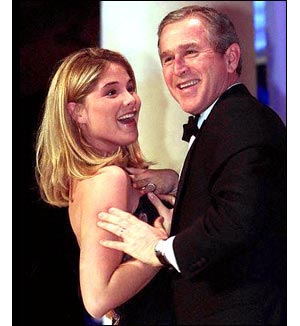
Should Jenna Bush, the 19-year-old daughter of the president, be in jail? Or at least be arrested? That’s a conclusion to be drawn from a recent report in the National Enquirer that asserts she smokes marijuana. After all, some 600,000 Americans are arrested every year for marijuana possession — including about 13,000 teenage girls. Some would say, of course, that Jenna Bush shouldn’t be hassled for allegedly smoking pot, but then maybe nobody else should either.
The charge that Jenna smokes marijuana is found in the Enquirer’s March 20 issue; the tabloid quotes two unidentified fellow students, one of whom says, “Jenna came over one night and we all did some doobies together. I wouldn’t say she’s a major pothead but she likes to toke up when it’s around.” Can unnamed sources be trusted? The answer to that question usually depends on the reputation of the publication.
Continue Reading Close