James Verini

All eyes on San Diego

If a liberal women's studies professor can win a congressional seat in this conservative bastion, November could be a GOP nightmare.

  • more
    • All Share Services

All eyes on San Diego

Made up of sleepy beach towns basking in the sun just north of San Diego, the California 50th is surely one of the most placid congressional districts in the country. But nobody would have known that Friday evening at the community center in Carlsbad, where emotions were running high. As surfers stepped off a gorgeous beach nearby, Democrat Francine Busby and Republican Brian Bilbray were exchanging barbs in their last debate before Tuesday’s special election, an election “brought to you,” as the moderator put it, “by congressional corruption.” The district’s previous representative, Randy “Duke” Cunningham, was in prison.

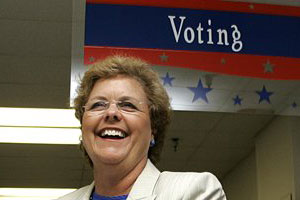
“I’m running to restore honesty and integrity to the representation of this district and in this country,” said Busby, 55, a school-board official and local professor of women’s studies.

“I believe that the amnesty of 11 to 12 million illegal aliens is absolutely absurd and disruptive,” countered Bilbray, also 55, a former congressman and lobbyist.

For most of the evening, the two talked past each other. Finally, Busby, in a fit of frustration, said, “We talk about healthcare and he talks about immigration. We talk about education and he talks about immigration. Immigration is an important issue but it is not the underlying issue.”

But before Busby could go on, a man in his 50s from the almost entirely white, AARP-aged audience stood up and yelled out, “Yes, it is!” And thus a conservative heckler in sandals summed up the race, and, it may prove, the entire Democratic effort to recapture Congress.

The eyes of Washington are glued on San Diego, where a race this competitive — polls show Busby and Bilbray running neck and neck –shouldn’t even be happening. Voters in the dependable conservative redoubt line up as 46 percent Republican and 31 percent Democratic. After all, Camp Pendleton, the Marine base, sits to the north. The Miramar Naval Air Station (“Top Gun”) is a few minutes’ drive from the community center. This is the part of the state that gave California Proposition 187 — the overturned initiative that attempted to deny illegal immigrants social services — the Republican congressman who launched a recall of Democratic Gov. Gray Davis, and the vigilante border patrol group, the Minutemen. If a liberal women’s studies professor can win here, the Republicans know November could be a nightmare.

Essentially, both candidates are running single-issue campaigns. Busby’s gong is ethics, vague but effective. Bilbray’s is immigration, effective but tricky.

As Busby wouldn’t allow the crowd in Carlsbad to forget, corruption in Washington is rampant. Cunningham, after all, took over $2 million in bribes and evaded $1 million in taxes. Indeed, what she has going for her is a lack of connection to Washington and an endearing wholesomeness. She looks and sounds like the sort of women who would bring fresh-baked cookies, not talking points, to a debate. Local Democrats are excited if for no other reason than a Democrat has a shot at winning the 50th. And the higher-ups in Washington have sprung into action. The Democratic Congressional Campaign Committee has backed Busby’s run with $2 million, and Sen. Dianne Feinstein, House Minority Leader Nancy Pelosi and presidential hopeful Mark Warner have all campaigned with her.

Not to be outwitted, the Republican brain trust behind Bilbray has decided that if the Democrats’ silver bullet is ethics, theirs will be immigration, particularly for candidates in border states. So just as Busby brought everything back to Cunningham, Bilbray brought everything back to the border. A Democrat harping on character and a Republican talking about issues? There’s a switch for you. The Republican National Congressional Committee has shoveled $4.4 million into Bilbray’s campaign. And Vice President Dick Cheney came to California to campaign with Bilbray. Local Republicans, however, don’t appear terribly enthusiastic about Bilbray, an affable candidate whose main appeal to many voters seems to be that he is a fellow surfer.

At the same time, Republicans have their fingers crossed. They need to see how far they can take immigration, and how far it will take them. The problem is that in California, where there are an estimated 2 million illegal immigrants, immigration is much more than a political point-getter. It is an epochal issue. It turns hundreds of thousands into the streets. It can break a state party, as California Republicans learned the hard way when Proposition 187 created a huge backlash against them. But what Bilbray has going for him — what may end up hurting Busby, whose views on immigration are moderate — is the fact that in the 50th, even Democrats often hold strongly anti-immigrant views.

“I’m voting for anyone who doesn’t have a Latino name,” John Lee, a car mechanic at a Shell gas station in downtown San Diego, told me. “I don’t want to encourage any sympathy with these people who are coming here and taking our jobs and our money.” Lee said that on other social issues, he was moderate, even liberal. Indeed, Lee readily admitted, he was gay. “I’d like to get married,” he said. “But if it comes down to gay marriage or immigration, I’ve got to choose my priorities.”

The GOP’s stronghold in the 50th is in the sprawling tract-house cities of Escondido and San Marcos, where an agricultural past, a large retired military presence, and snowbirds from the Midwest and South have made for a historically conservative outlook. Here tirades against amnesty are to be expected. But even in the more lefty coastal enclaves, in Carlsbad and La Jolla and Encinitas (the latter is where Busby’s storefront headquarters is located), it’s not uncommon to hear anti-immigrant ideas. You can sit in a Mexican restaurant near the beach, and listen to a bunch of middle-aged surfers talk blithely about how they hate George Bush but also how they see the appeal of deportation. This, as one of the hardworking Mexican waitresses brings their guacamole and Coronas.

The bad news for Republicans, however, is that immigration has become not a unifier for the party, but a wedge. It seems it’s every man for himself where cheap Mexican labor is concerned. Proof of this came just a few days before the debate. After Bilbray attacked Busby for supporting Sen. John McCain’s moderate legislation, which creates a guest worker program and paths to citizenship, McCain abruptly canceled a campaign appearance with Bilbray.

Bilbray is not a recent convert to the issue of immigration. After representing the 49th district from 1994 to 2000, he became a lobbyist for the Federation for American Immigration Reform, a close-the-border advocacy group. Even so, he faces a spoiler in the Tuesday election in Independent Bill Griffith, a math teacher, and a hard-liner on immigration endorsed by the Minutemen. Griffith claims Bilbray, whose campaign catchphrase is “Proven Tough on Illegal Immigration” (his lawn signs are no-nonsense too, reading “Secure Our Borders”), is not tough enough.

Bilbray, in fact, is a moderate Republican. In the April primary, he beat a host of far-right candidates for the ticket. He is pro-choice, gets a mere 71 percent lifetime rating from the American Conservative Union, a C+ from the National Taxpayers Union, and a big fat F from the NRA. While in Congress in the 1990s, he was known for crossing the aisle and once stood beside Bill Clinton at a gun control rally, according to the San Diego Tribune.

Yet he remains firmly on the right over immigration. And “immigration is an issue on which [Bilbray] does well,” said Jon Fleishman, a former executive director of the California Republican Party who now writes the conservative political blog FlashReport. “Conservatives’ worry is that he’s good on immigration because he’s paid to be.” Bilbray has painstakingly distanced himself from President Bush, who’s become a liability to Republicans seeking both hard-right and swing votes. He did not mention Bush in his debate with Busby and has not referred to him on the campaign trail.

Still, Washington has kept a close eye on the race, and this may end up helping Bilbray. When I visited Bilbray’s headquarters, in a tidy building in an office park in northern San Diego — Republicans usually seem to favor office parks over storefronts — a van-load of campaign volunteers from Idaho had just arrived. (They were extremely concerned about immigration, and not of the Canadian variety.) The party’s last-minute extra efforts appeared to be paying off. Bilbray signs littered medians and intersections in the 50th, while Busby signs were hard to come by.

As of the debate, the race was too close to call, with Busby and Bilbray both polling at 45 percent. But a cloud descended on the Busby campaign over the weekend, when a recording of the candidate speaking to a Latino crowd in Escondido began circulating on the AM talk shows. In it, Busby tells the crowd they don’t need papers to vote. She corrects herself, saying, “You don’t need to be a registered voter to help.” The story ran in the San Diego Union Tribune Monday. In a race that may come down to a few hundred votes, this is the kind of last-minute gaffe that could tip the balance.

If Bilbray prevails, Democrats may take some comfort in the gains made by Busby. In a district where Republicans far outnumber Democrats, it’s a start. Besides, June 6 is only the first race. The two will square off again in November for the full two-year term.

How Emmy works

Ever wonder why your favorite shows never get nominated but "The West Wing" always does? Here's why

  • more
    • All Share Services

How Emmy works

The atom-hoisting goddess that is Emmy has always assumed a back-of-the-shelf position to her bossy big-screen cousin, Oscar. But she has slowly, in the past decade or so, inspired a similar type of lust among the networks and studio executives who hope her shine will rub off on their shows.

No one, in fact, has used her to greater effect than HBO, the leader in both Emmy nominations and wins in recent years, which will have spent between $2 million and $3 million in its Emmy campaign this year, according to the trade magazine Broadcasting & Cable, far ahead of its competitors.

How, then, to explain the sad case of HBO’s “The Wire”? In some ways, the much-vaunted gritty urban crime drama is exactly the sort of product Emmy should love. It was a surprise slew of Emmys, after all, that in 1981 catapulted “Hill Street Blues,” the archetypal modern copera, from the brink of cancellation to TV nirvana. And then there were the recent perennials “NYPD Blue,” “Law & Order” and “The Shield.” Emmy has a serious thing about cops.

Still, “The Wire’s” first two seasons went by with nary an Emmy nomination, despite sheer adoration from critics. And this year — in spite of a career-making curtain bow from Idris Elba, as a brilliant crime lord and would-be Trump named Stringer Bell (and Salon’s hectoring of Emmy last year) — it garnered just one nomination, for writing.

So what causes some shows to win, and others, like the “The Wire,” to go sorely undervalued? “There’s a level of visibility you need to reach to get an Emmy,” said Lawrence O’Donnell, an Emmy-nominated writer for “The West Wing.” “‘The Wire’ just never achieved it.”

David Simon, the creator of “The Wire,” agreed. He also indicated that even if HBO had offered him a specially tailored Emmy campaign, he wouldn’t have cared. “I don’t consider the Emmys to be particularly precise measurement of anything other than a show’s cultural popularity,” Simon said, from the set in Baltimore. “I don’t think an Emmy is going to convince anyone who’s not with us already that they should watch the show.”

But Simon and O’Donnell are not entirely right. The fact is that bad ratings and a lack of popularity do not disqualify a show from Emmy consideration. And Emmys can definitely bring new eyeballs. Partly because of its gloominess and novelty, “Hill Street Blues” was ranked 87th out of 93 prime-time shows its first season, before it was a big surprise Emmy winner. “Cheers” was likewise at the bottom of the heap until it won for outstanding comedy series. More recently, “Arrested Development,” the frenetic comedy whose ratings were bad enough to put it on Fox’s cancellation short list for its first two seasons, has been helped somewhat by Emmy nominations and a win last year. Then there are those shows — “Mad About You,” “Moonlighting” — that become Emmy darlings despite never moving beyond a niche audience.

But what most of the above-cited shows have in common — what “The Wire” lacks — are major industry figures to stand behind them when the executives are hovering with axes drawn. A powerful producer may be the biggest boon of all when it comes to getting an Emmy nomination. “Hill Street Blues” was created by the cop-drama guru Steven Bochco, who had already been writing “Columbo” and producing TV for 10 years. “Cheers” had the comedy shaman James Burrows, who was coming off his work on a series of critical darlings: “Taxi,” “Mary Tyler Moore,” “The Bob Newhart Show” and “Laverne and Shirley.” “Arrested Development” has Hollywood heavy-hitters Brian Grazer and Ron Howard behind it.

Of the three series not belonging to HBO that are nominated for outstanding drama this year, the category that would have included “The Wire,” Grazer is behind one (“24″), John Wells, an Emmy perennial, another (“The West Wing”), while the only upstart nominee, “Lost,” belongs to J.J. Abrams, one of the most ballyhooed young producers in Hollywood because of his success with “Alias” and “Felicity,” who’s now directing major Hollywood films (“Mission Impossible: III”).

These big-cheese producers attract other big-cheese producers, writers, directors and crew who have been in Hollywood for a long time and know a lot of Academy members. Indeed, most of them are members themselves. It’s likely that these veterans have been nominated and even won before. Hollywood is a small world; TV, even smaller.

“If we see David Kelley’s or John Wells’ name down there, a lot of us will think: Well, gee, I really like ‘The West Wing.’ It’s as good as it is because of John Wells. I’m just voting for him,” said O’Donnell, a former Senate staffer and political pundit.

For producers as prolific as Wells, in other words, output and reputation alone can bag a good bloc of votes. (Wells is O’Donnell’s boss on “The West Wing.”) Hollywood’s incestuous atmosphere also leads to a kind of competitive collusion. Since Emmys are given out for particular episodes, not entire series, producers, directors and writers with clout will push for their own work to be nominated, even when they know those episodes are not the best examples of their show.

Stephen J. Cannell, who produced “The Rockford Files,” “The A-Team,” and “Wiseguy,” summed up the attitude this way: “The executive producer wrote that one, so it’s his favorite, so he puts it in.” The studios that produce the most shows are also a major power in deciding which shows get nominated, often by engaging in what’s known as “bloc voting”: encouraging the many academy members employed by the studio or affiliated with it to vote for shows produced by that studio. For a company like Warner Bros., which has thousands of employees, myriad production deals with independent producers, and more than 30 shows on the air, bloc voting can be an overwhelming force in the process.

“I ran an independent production company for a long time and we just didn’t have enough votes to get nominations,” Cannell said.

Recently, what many Emmy nominees also have in common are marquee guest stars from the film world. Featuring Sean Penn or Steve Buscemi, say, seems to be an almost sure-fire way of securing a trophy. “Will & Grace,” a Burrows show and nominee for best comedy year in and year out — while its ratings have slipped, the show still leads with 15 Emmys this year — has become a veritable clearinghouse for cameo one-offs. (“Arrested Development” has given this phenomenon a fetishistic, hall-of-mirrors touch; Liza Minnelli and David Cross on the same set? Isn’t that one of the signs of the Apocalypse?)

“The only way to guarantee an Emmy is to hire Betty White,” said a network marketing executive, only half-joking. White has won six times over 30 years.

Spinning out the ploy further and further, shows now hire season-long guest stars for the express purpose of getting an Emmy along with more attention, often making a nominating campaign part of the deal with the actor. When Glenn Close was improbably hired for the cast of “The Shield,” it was widely expected that F/X would make it a point of pushing for an Emmy for her. And, sure enough, she is nominated.

Networks can also garner Emmy nominations with savvy marketing. Showtime has proven that this year with its new show “Huff,” in which Hank Azaria plays a troubled psychiatrist. It is by no means a “Deadwood”-size, much less a “Sopranos”-size, hit. But in February of this year, months before the nominations, Richard Licata, Showtime’s vice president of corporate communications, sent out the entire season of “Huff” in fancy packaging to voters. Licata invited reporters to the set and suggested story ideas. He pushed the lead actors to the late-night talk show circuit. He made it known, well before the second season was even in production, that Angelica Huston would be coming on the show.

Licata’s efforts paid off in spades: Despite so-so viewership and middling reviews, “Huff” was nominated for seven Emmys.

“A lot of executives feel that someone else will take care of it,” Licata said of Emmy campaigning. “They figure it doesn’t really make a difference.”

Licata said he begins his Emmy work at the end of December and doesn’t stop until the awards are given out the following September. He admits that getting the award is incidental.

“It’s about branding the network — creating an identity,” he said.

Continue Reading Close

The tale of “Red Scorpion”

The strange Hollywood interlude of the most scandal-ridden man in Washington.

  • more
    • All Share Services

The tale of

Before fallen lobbyist Jack Abramoff assumed his role as the most scrutinized man in Washington, he had a brief career as a budding Hollywood producer. He made just one movie, the 1989 Cold War bomb “Red Scorpion.” With its blatant propaganda, its collaboration with the apartheid South African government, and financial misdealing, it’s notable, even for Hollywood, for being one of the seamiest productions in recent memory.

Last week, Abramoff was arrested by the FBI after a grand jury indicted him and a partner on fraud charges (he’s out on $2.2 million bail). In Washington the Senate Indian Affairs Committee has been holding hearings on whether Abramoff, 46, bilked millions out of tribes he represented, and a joint task force is picking through his personal papers, including his credit card records, which show Abramoff purchased trips for members of Congress (including Tom DeLay). His days in the Capitol, it seems, are numbered. (Abramoff’s spokesman, Andrew Blum, responded to inquiries from Salon for this article with a written “no comment.”)

But long before he became the poster boy for the Beltway’s back door, the young Jack Abramoff was at a crossroads. It was 1987, he was in his late 20s, and the presidency of his political hero, Ronald Reagan, was winding to a tarnished close. The Iran-Contra hearings covered the front pages, and Oliver North, whom Abramoff knew and admired, was about to be indicted. The Republicans were disillusioned, and after years of service to the party — as chairman of the College Republicans from 1981 to ’85, he’d mentored Grover Norquist and Ralph Reed, had worked for one right-wing think tank, and founded another — Abramoff apparently was no longer sure he wanted to go into politics full time.

So he took a detour, doing what any other kid from Beverly Hills might when finding himself at a loss: He decided to try his hand at show business. Why not? Hollywood was no more than Washington for good-looking people, as the saying goes, and Abramoff, a student government officer and a football player at Beverly Hills High School, class of ’77 (he graduated from Brandeis University in ’81), was smart and charismatic and, if not actor handsome, at least physically imposing enough to be a producer. Through his father, a high-up executive at the Diners Club, he’d rubbed shoulders with some of L.A.’s elite.

Abramoff moved back to Los Angeles from Washington after finishing Georgetown Law School, and he and his brother, Robert, formed a production company, Regency Entertainment. They set to work on an action picture, a story about a rogue Soviet Spetsnaz soldier who is sent to quell a rebellion in a fictional African country — one that very closely resembled Angola — only to find that he sympathizes with the rebels. “Red Scorpion,” starring Dolph Lundgren, would be released in April 1989. The Abramoff brothers raised $16 million for it — the sources of the funding remain unknown — an impressive sum for a B-picture with an unproven star. It made a poor impression on audiences and critics. “The movie’s reflective moments belong to Mr. Lundgren’s sweaty chest,” wrote Stephen Holden in the New York Times.

But the story behind “Red Scorpion” is far more captivating. The film was to be a manifesto for Abramoff; a Rambo-like morality tale and a grand indictment of communism — his Reagan Doctrine parable in action-packed Technicolor. And in the process of conceiving of and making it, Abramoff helped groom an African despot, rose to high levels in the K Street food chain, and got to play international spy.

“There was some indication even in those days that he was not the sort of person who would feel overly constrained by the rules,” said Jeff Pandin, who worked closely with Abramoff in the 1980s.

The roots of “Red Scorpion” took hold in the early 1980s, when interventionist-minded folk in Washington had an array of global conflagrations to obsess over. The mujahedin were battling the Soviets in Afghanistan and the Contras were fighting the Sandanistas in Nicaragua. Some circles felt the United States was not doing enough to help them. The gripe heard in the office of CIA chief William Casey and among Oliver North’s cabal in the National Security Council was that Reagan was not fully Reagan when it came to foreign policy. A cottage industry of think-tank intellectuals and private crusaders sprouted up to build support for one or another set of freedom fighters. Abramoff was among the most active.

In Angola, the rebel group du jour, the National Union of Total Independence for Angola, or UNITA, had been taking on the Soviet- and Cuban-backed government since the 1970s. UNITA’s leader, a savvy warlord named Jonas Savimbi, had become a darling of the right. Savimbi received millions in aid and had even retained Washington lobbyists to press his case. Abramoff was interested in Angola, too. So was Lewis E. Lehrman, the millionaire behind the Rite Aid drugstore chain and the founder of the right-wing group Citizens for America, who made an unsuccessful run for governor of New York in 1982. Through Republican circles, Abramoff met Lehrman at some point in the early ’80s, and in 1985 Lehrman hired him. Abramoff came to Lehrman with an idea: What about a convention of disparate anti-communist rebel leaders, put together and paid for by Americans? It screamed of Abramoff’s cartoonishly outsized ambitions and worldview, and Lehrman liked it.

Jack Wheeler, a California entrepreneur and anti-communist activist who enjoyed deep entree in Washington at the time, had met Abramoff through the College Republicans in 1984. He immediately took to Abramoff, who had charmed him with a story about scandalizing fellow members of a Beverly Hills athletic club by wearing a T-shirt that read “I’d Rather Be Killing Communists.”

Wheeler and Abramoff began discussing the idea of the rebel convention. “The whole point of the Reagan Doctrine was to fight the phenomenon of communism, and if one regime fell, they’d all fall,” Wheeler said. “No Afghan knew where Nicaragua was, and no Contra knew where Angola was.”

Amazingly, they made it happen, and quickly. In the first week of June 1985, mujahedin, Contras and Laotian rebels joined Savimbi and his men in Jamba, Angola, UNITA’s jungle headquarters, for the Democratic International, as Lehrman had titled the event. For several days they commiserated and compared notes, huddling together in thatched huts and signing an anti-Soviet pact. Wheeler organized transportation, and Abramoff dealt with the money and logistics from Lehrman’s end. Lehrman himself read a letter of support from Reagan and handed out framed copies of the Declaration of Independence. It received some press coverage. Abramoff had pulled off his first far-right adventure.

In the eyes of many in the administration, particularly in the State Department, Abramoff and groups like Citizens for America were only serving to subvert years of careful negotiation. “These people were trying to undercut and divert official policy,” said Chester “Chet” Crocker, assistant secretary of state for African affairs from 1981 to 1989. “Our policy worked because we got Castro to decide the jig was up and go home — not because of the conservative activists.” (Cuba began pulling out of Angola in 1989.)

Loved or hated, Citizens for America was short-lived. Not long after the Democratic International — or the Jamboree in Jamba, as it was pejoratively known — funding for the group dried up. “Lehrman pulled the money out all of a sudden, and then Jack dropped out of it, and that was that,” Wheeler said. “Then Jack went to make his movie.”

According to Pandin, who went to work for Abramoff in 1986, Abramoff and Lehrman had had a falling out. “He was always looking to push the envelope,” Pandin said. “It was seen among Jack’s friends as a coup — he got stabbed in the back by people who weren’t comfortable with him.” When contacted by Salon, Lehrman submitted a short statement via a representative: “I was recruited by President Reagan to set up Citizens for America in 1983. It was a voluntary, part-time position which I held for about three years. Among the paid staff, Jack Abramoff came in well after CFA was started, was there only for a short while, before his termination.”

But Lehrman may have also gotten cold feet because it had become clear by the mid-1980s that Savimbi was not a paragon of democratic ideals. There were allegations of murderous purges in his own ranks. It is commonly agreed in Washington that it was Savimbi himself, and not the government of Angola, who in July 1991 had UNITA’s envoys to the United States and the United Kingdom, Tito Chingunji and Wilson dos Santos, and their families, killed.

Crocker described Savimbi, who was killed in 2002, as “a brilliant military warlord who operated by the gun, lived by the gun, and died by the gun and ultimately had a failure of judgment, like warlords often do.”

Others are less charitable. “He was the most articulate, charismatic homicidal maniac I’ve ever met,” said Don Steinberg, ambassador to Angola during the first Clinton administration.

With Citizens for America disbanded, and law school done, Abramoff moved to Los Angeles. He came up with the premise for “Red Scorpion” and hired Arne Olsen, a young screenwriter with no credits to his name, to write it. The Abramoffs told Olson they wanted to base the fictional African country in the film, Mombaka, directly on Angola, and the rebel leader on Savimbi. Olsen said he churned out a baldly propagandistic script.

“It definitely was an anti-Soviet thing,” Olsen said. “It was an easy target.”

Of the Abramoff brothers, he said, “This wasn’t their profession, what they’d do for the rest of their lives. It was a lark. They wanted to get a message across, but at the same time they were going for exploitation and of course trying to make some money.”

Initially, the movie was set to shoot in Swaziland, but at the last minute Abramoff moved the production to Namibia, which was occupied by South Africa’s apartheid government. Congress had passed (over Reagan’s veto) the Comprehensive Anti-Apartheid Act in 1986, making it very frowned-upon, when not illegal, to do business with South Africa or its proxies. This did not seem to bother Abramoff, who planned to use South African Defense Force vehicles and equipment on the set and soldiers as extras. By 1988, when shooting started on the film, Abramoff likely had connections in the South African government. For a decade, after all, South Africa had been Savimbi’s main backer, and according to Crocker and others, Abramoff would not have been able to put together the Democratic International without extensive help from the SADF.

But Abramoff’s plan backfired: it was not long before anti-apartheid activists were protesting at the “Red Scorpion” set, and Warner Brothers, who had signed on to distribute the film, pulled out.

James Glickenhaus, whose company, Schapiro Glickenhaus Entertainment, ended up distributing “Red Scorpion” after Warner Brothers jumped ship, said he was not aware of the help provided by the SADF, but he was aware of the controversy over the location. “Look, had the film been made in Nazi Germany, I wouldn’t have distributed it,” he said. “But I personally felt upon investigating that the Namibian government was more simpatico than the South African government.”

The movie seemed like an opportunity to turn a buck — if not win any awards. “There’s some fish for eating and some fish for buying and selling,” Glickenhaus said. “This was a fish for buying and selling.” In typical Hollywood tradition, Glickenhaus threw a party for the film at Cannes, his feelings about its quality notwithstanding. The Abramoff brothers came, but, he said, they “looked totally out of place.”

The actor Carmen Argenziano, who played the villainous Cuban colonel, said he knew that many of the men playing Russian and Cuban soldiers were actual SADF soldiers. There were also rumors going around the set that some of the funding for the film, not just props and extras, was coming from South Africa.

“We heard that very right-wing South African money was helping fund the movie,” Argenziano said. “It wasn’t very clear. We were pretty upset about the source of the money. We thought we were misled. We were shocked that these brothers who we thought were showbiz liberals — Beverly Hills Jewish kids — were doing this.”

But there was a lesser-known connection between the apartheid regime and Abramoff.

In the late 1980s, some conservatives in Washington saw P.W. Botha’s apartheid government in Pretoria as the last bulwark against communism in Africa. Certain Reagan domestiques had even gone to work for it. “The South African government was the only one that was, shall we say, anti-communist,” said Stuart Spencer, who’d help run Reagan’s 1980 and ’84 campaigns and later became a lobbyist for Pretoria.

Abramoff seems to have shared the sentiment. In 1986, he founded the International Freedom Foundation, whose stated goal was “to foster individual freedom throughout the world by engaging in activities which promote the development of free and open societies based on the principles of free enterprise.” More specifically, among the IFF’s aims were to oppose the Anti-Apartheid Act and other sanctions and to urge greater support in Washington for Pretoria and less support for the African National Congress, the party that would come to power in 1994 under Nelson Mandela. At its height, around the time “Red Scorpion” was released, the IFF employed about 30 young ideologues in offices on G Street in Washington, Johannesburg, London and Brussels. Churning out reports and presentations (for one such presentation on the Contras, it borrowed the slide show that North had used to raise money for his arms-deal network, according to Pandin), the IFF attracted notable members such as Sen. Jesse Helms, R-N.C., and Rep. Dan Burton, R-Ind.

“It was meant to be a way to institutionalize the contacts he’d made abroad — people who were interested in anti-communist stuff, democracy building, that kind of thing,” said Pandin, who held directorships at the IFF from its inception until it shut down in the early 1990s. “We were skeptical of the ANC,” he went on. “We did not want to see the U.S. imposing sanctions on South Africa.”

The IFF, however, could not claim impartiality on the subject. It was, in fact, clandestinely funded by the SADF’s military intelligence arm, according to former U.S. officials, ANC documents, and reports published in U.S. and U.K. According to a 1995 Newsday report, the IFF received up to $1.5 million a year from the SADF from 1986 through 1992, as a part of Operation Babushka, a smear campaign meant to discredit Mandela and the ANC by portraying them as allied with communist regimes. An SADF intelligence chief also told the Newsday reporters that the SADF helped fund “Red Scorpion.”

“We knew that the IFF was funded by the South African government,” Herman Cohen, who ran Africa operations for the National Security Council, told Salon. “It was one of a number of front organizations.”

“I would not be shocked if some of the money they were raising in the Johannesburg office was coming from those kinds of channels,” Pandin said, referring to the SADF.

Pandin recalled that Abramoff enlisted Russell Crystal, the head of the IFF’s Johannesburg office and an advisor to F.W. DeKlerk, to be an informal producer on “Red Scorpion” (whether this meant Crystal helped fund the film, Pandin did not remember). But Pandin says Abramoff refused to compensate Crystal afterward. “It wasn’t a good experience,” Pandin said of the film. “A lot of people didn’t get paid. Russell wasn’t entirely enamored of Jack after that.”

“Jack was always looking for angles and ways to do interesting things until people slowed him down,” he said, obliquely, when asked whether Abramoff, who resigned from a day-to-day position at the IFF in 1987 but remained a chairperson and closely oversaw operations, knew of the connection to the SADF. “He needs somebody to cool him down sometimes. Left to his own devices he’d be inclined to go a little crazy.”

“Maybe he should have paid more attention in some of his law school classes and spent less time making movies.”

Peter Roff, who is listed as Abramoff’s personal assistant in the credits of “Red Scorpion,” said he worked for Abramoff out of the latter’s Washington office during the time of the production in 1987 and ’88. Roff, however, recalled doing more work for the IFF than for the film. Indeed, he only vaguely remembered the name Regency Entertainment. He never went to L.A. or to the set in Africa. But Roff, who worked on George H.W. Bush’s ’88 campaign, claimed he too was unaware of the source of the IFF’s funding.

“I thought he was an exceptional person,” he said of Abramoff. “Creative, good person to work for, very encouraging of my ambitions to be part of something that helped make the world a better place.”

The SADF stopped funding the IFF in 1992. Apartheid had come to an end. By 1994, the organization closed its doors.

Asked by Newsday about the South African government’s connections to the IFF and “Red Scorpion” in 1995, the last time he seems to have entertained questions on the subject, Abramoff called the allegations “outrageous.”

When, inevitably, “Red Scorpion” was released, it was no study in nuance. Directed by Joseph Zito, whose previous credits had included the Chuck Norris movies “Missing in Action” and “Invasion U.S.A,” the dramatis personae consist of scheming, cackling communists on the one hand — the Russians not only tear apart the rebel village with attack helicopters, but also randomly gas a band of peaceful Bushmen and their animals — and noble guerrillas on the other, and the barely intelligible Lundgren in between. The action sequences have all the panache of a subpar “A-Team” episode.

There are some inspired moments, such as the climax, when Argenziano’s character, Col. Zayas, is left groping for his own dismembered arm, which clutches a live grenade (he doesn’t reach in time). There is also a rousing speech delivered by the token freewheeling American, a foul-mouthed, boozing journalist played by M. Emmet Walsh: “As a matter of fact, in America, an American can swear whenever, wherever and however much he or she fucking well pleases!” he yells at Lundgren. “A little something called freedom of speech, which I’m sure you Russians aren’t real familiar with!” In another nice touch, the closing credits roll over Little Richard’s “All Around the World,” remixed to include machine-gun and exploding-bomb sound effects.

If only things were as jovial off the set. They weren’t. Actors went unpaid; Argenziano said that although he was paid his initial salary, he has never received a residuals check for “Red Scorpion.” The manager of one of the major cast members, who did not want to be named, said that, according to her client, many of the actors and crew were never paid at all.

“I just wanted to get the hell out of there,” Argenziano said. “It was a very hard shoot. We were all worn out, so no one made a stink.”

Glickenhaus, who knew of crew and cast going unpaid, claimed that despite its poor box office receipts, “Red Scorpion” did well in video, television and foreign sales. Nonetheless, at some point prior to its release in April 1989, the Abramoffs and Regency found themselves in enough debt that the film went into the possession of Performance Guarantees, a completion bond company.

Abramoff also borrowed money from friends that he never repaid. During the production, he took a $50,000 personal loan from Ralph Nurnberger, a Georgetown professor and consultant. Nurnberger and Abramoff later worked together (from 1999 to the end of 2000) at Preston Gates Ellis. Abramoff has still not repaid the loan.

Remarkably, there was a “Red Scorpion 2.” It went straight to video in 1994 and did not star Lundgren. Abramoff is listed as an executive producer, but he had only a nominal connection to the film, according to its other producers. But by then, Abramoff had decided politics and not political movies were his true calling, and he was back in Washington, a lobbyist at Preston Gates (the lobbying firm run by the father of Microsoft founder Bill Gates). Now, of course, his decades-long ascent into Republican power circles is coming to a crashing end. Investigators are combing through every aspect of his life. He has become Washington’s summa persona non grata, disowned even by Rep. Tom DeLay, R-Texas, for whom he is alleged to have purchased a trip to Scotland.

After Jack returned to Washington, Robert Abramoff stayed in Los Angeles and continued to produce films. He is now a full-time lawyer. Reached at the offices of Burgee & Abramoff in Woodland Hills, he refused to speak about his brother or “Red Scorpion.” “It’s a family matter and I prefer not to comment on anything,” he said.

Continue Reading Close

Missionary man

Tom Cruise has become a top proselytizer for Scientology. Is it because of a new private conviction, or a new public role for the church itself?

  • more
    • All Share Services

Missionary man

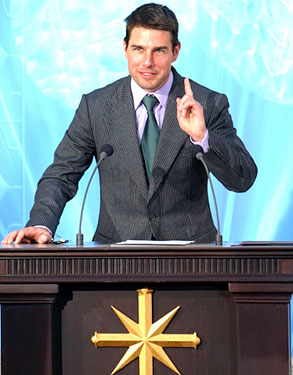
In the course of just a few months, Tom Cruise has made an astounding public leap: He has transformed himself from one of the world’s biggest movie stars into one of the oddest. It’s not just his sudden romance with and engagement to actress Katie Holmes, which has not yet managed to shake the air of improbability. There is also the matter of Cruise’s sudden outspokenness about, and even proselytizing for, the controversial Church of Scientology, to which he’s belonged for roughly 20 years.

Regarding the romance — who can explain love? It’s a mystery, particularly in Hollywood, and we’re unlikely to ever get the particulars about Cruise and Holmes. But the buzz in some Scientology circles is that Cruise may have reached one of the highest echelons of the Church of Scientology. While not a lot is known about this level, known cryptically as OT-VII, Scientology observers say that attaining it could explain Cruise’s behavior in recent months.

And that behavior has been mesmerizing: from putting up Scientology tents on movie sets to blasting Brooke Shields for using antidepressants, to promoting the church’s drug-treatment programs and, generally, to hectoring anyone who challenges him. On Friday’s “Today” show, after gentle prodding from Matt Lauer, he scolded, “You don’t know the history of psychiatry. I do.” Even his romance with Holmes has had a public Scientology veneer; Holmes has announced that she is taking Scientology courses and has added a new member to her entourage: a Scientology advisor who reportedly tells everyone she’s Holmes’ best friend.

According to experts and the church’s own literature, OT-VII (“OT” stands for Operating Thetan, “thetan” being the Scientology term for soul) is the penultimate tier in the church’s spiritual hierarchy — the exact details of which are fiercely guarded and forbidden to be discussed even among top members. It is where a Scientologist learns how to become free of the mortal confines of the body and is let into the last of the mysteries of the cosmology developed by the church’s longtime leader, science fiction novelist and “Dianetics” author L. Ron Hubbard. This cosmology also famously holds that humans bear the noxious traces of an annihilated alien civilization that was brought to Earth by an intergalactic warlord millions of years ago.

Lee Anne De Vette, Cruise’s publicist and sister, refused requests to comment for this article. And when asked about Cruise, Ed Parkin, vice president of cultural affairs for the Church of Scientology, said only, “We do not discuss the personal religious experiences of our members with the press.” Parkin also would not confirm or deny details of the OT teachings. Responding to questions about them, he wrote: “Scientology, which means ‘knowing how to know,’ is a religion based on the works of L. Ron Hubbard (1911-1986). Scientology addresses people as immortal spiritual beings. It gives them tools they can apply to their lives to improve conditions.”

But one Scientologist who left the church in 2003 after 30 years — and who had reached the OT-VII level and become a member of the church’s governing Sea Org — said it was his understanding that Cruise was very near completing, if he had not already completed, the OT-VII level. The former Scientologist would speak to Salon only on the condition of anonymity.

A current Scientologist who has reached the level OT-V, and who also spoke on the condition of anonymity, said that considering the amount of time Cruise has been in the church, an OT-VII status seems probable. And Stephen Kent, a professor of sociology at the University of Alberta who has published articles on Scientology and Hollywood, also said that Cruise’s behavior strongly suggests OT-VII.

Cruise is acting as though he “feels he’s more in control over his environment and can convince more people to look into the organization,” Kent said. “In the high OT levels one supposedly gains the skills to master one’s universe. One is removing countless entities that have been holding people back. Cruise feels that he has freed himself from thousands of errant thetans, and he seems to be in a kind of euphoria he hasn’t experienced before.”

J. Gordon Melton, the author of “The Church of Scientology” and director of the Institute for the Study of American Religion in Santa Barbara, Calif., confirmed the details of the OT teachings. “It’s basically a variation of the Gnostic myth about souls falling into matter and the encumbrances that come with that,” Melton said. “In the OTs, you’re finding out that you’re a thetan, that you’ve come into bodies before. Part of what you’re trying to learn is exteriorization — how to get out of your body. You also learn that you carry a lot of encumbrances from past lives.”

Melton, however, said that he did not believe public outspokenness about the church necessarily indicates a particular rank. The eight OT levels form the last and highest order in the intricate hierarchy Hubbard developed beginning in 1950, when his “Dianetics” was published. He named the hierarchy “the Bridge to Total Freedom.” Scientologists can only enter OT once they’ve gone “Clear,” meaning they have passed through the lower orders of the church and been shown that their personal inhibitions and flaws are the result of innumerable traumatic experiences built up over trillions of years of reincarnation.

A Scientologist becomes “Clear” by taking multiple courses and through copious “auditing,” a process in which they are counseled and encouraged by a more advanced church member to relive past traumas, with the help of an E-Meter, a device that Scientologists claim monitors brain activity. Before they’re allowed to continue on to OT, a rigorous screening process and background check are conducted, according to Melton and others. Reaching the highest OT levels usually takes from a decade to three decades, the current and former Scientologists say. Lower estimates for the total cost of this are around $30,000, but some people claim to have spent several hundred thousand dollars. The current Scientology member tells Salon he pays several thousand dollars a year for the services.

That’s a small investment if you’re Tom Cruise, who now demands $20 million per movie, or some of the other marquee names affiliated with the church, including actors John Travolta and his wife, Kelly Preston, Kirstie Alley and Jason Lee, musicians Beck, Lisa Marie Presley and Chick Corea, and Fox News anchor Greta Van Susteren. Celebrity Scientologists, like other Scientologists, do not publicly reveal their rank. But despite their vagueness on the subject, celebrities play a crucial role in the church’s image and its marketing of itself. According to Kent, beginning in the 1960s L. Ron Hubbard issued explicit directives for the church to recruit celebrities.

“There was a whole series of policies that talked about celebrities as opinion-makers,” Kent said. “He suggested to get celebrities on their way up or their way down. To get them on the way up meant, if they became famous, they might attribute their success to Scientology. On the way down meant if their careers get saved they could do the same.”

Also, said S. Scott Bartchy, director of the Center for the Study of Religion at UCLA, “They’re looking for high-profile people to say positive things about them, because they are so eager to be considered a legitimate religion, and because of all the problems they’re having abroad.” Germany, for example. And academics apparently have their own appeal: Bartchy said that high-ranking Scientologists had approached him and sent him materials in an attempt to “woo” him. (When asked about this, Parkin wrote Salon: “Professor Bartchy has told us that he gets many questions from students about Scientology and that he was happy to receive the information we have provided to help him answer them. I think you are mischaracterizing what, if anything, he may have told you to put your own spin on it. Professor Bartchy has always been very cordial with the people from the Church with whom he has spoken.”)

Cruise, who is 42, has been a member of the church since around the time of Hubbard’s death in 1986. (His first marriage, from 1987 to 1990, was to actress Mimi Rogers, also a Scientologist. His second marriage, from 1990 to 2001, was to Nicole Kidman, who is not a Scientologist.) Until recently, however, he almost never discussed his membership publicly.

That started to change a few years ago, when Cruise co-sponsored a Scientology detoxification center near ground zero in Manhattan. Last year, he had a Scientology tent set up on the set of “War of the Worlds.” He began openly boosting Narconon, the church’s drug rehabilitation program. And then last December, he was presented with the Freedom Medal of Honor by David Miscavige, chairman of the board of the Religious Technology Center, one of the church’s elite committees and, according to Melton and others, Hubbard’s hand-chosen successor.

This spring, Cruise kicked things into high gear. He Zorba-ed Oprah’s couch, and then he worried about his “Endless Love” costar Brooke Shields’ mental health, criticizing her publicized use of antidepressants to battle postpartum depression and implying they might have caused her career to decline (Scientologists strongly oppose the use of antidepressants and other behavior-modifying drugs). He plopped a Details reporter on the back of his futuristic new motorcycle and sped her to three different Scientology facilities, where he extolled the faith — for six hours. In an interview he and Steven Spielberg gave to the German paper Der Spiegel in April, Cruise defended Scientology, saying: “I’m a helper. For instance, I myself have helped hundreds of people get off drugs. In Scientology, we have the only successful drug rehabilitation program in the world.”

Then he burst into full Tom Joad mode: “If someone wants to get off drugs, I can help them,” he declared to the interviewer. “If someone wants to learn how to read, I can help them. If someone doesn’t want to be a criminal anymore, I can give them tools that can better their life. You have no idea how many people want to know what Scientology is.”

When he was asked by Entertainment Weekly this month why he’d suddenly become so vocal, he insisted: “What choice do I have?” Then he declared: “People are being electric-shocked. Kids are being drugged. People are dying.” In the same interview he supported the Scientology claim that psychiatry is a “Nazi science” and advanced several erroneous myths, which the E.W. editors helpfully pointed out in brackets:

“Jung was an editor for the Nazi papers during World War II. [According to Aryeh Maidenbaum, the director of the New York Center for Jungian Studies, this is not true.] Look at the experimentation the Nazis did with electric shock and drugging. Look at the drug methadone. That was originally called Adolophine. It was named after Adolf Hitler. [According to the Dictionary of Drugs and Medications, among other sources, this is an urban legend.]”

Cruise may now feel free to counsel others with a rare degree of authority. But sadly, Holmes may not be able to benefit much: The church forbids its OTs, even celebrities like Cruise, to discuss what they’re learning with lower members. Indeed, OTs are not allowed to discuss their secret knowledge even with each other.

Asked why he couldn’t discuss the details of OT teachings with anyone, including his peers, the current Scientologist said: “It’s confidential. And that’s the way that Mr. Hubbard wanted it. They’re not ready for it.”

The church claims that it has as many as 10 million members worldwide, but critics have suggested the actual number is far less. Melton said that the number of OT-VIIs and OT-VIIIs is in the hundreds. After years of study and introspection, achieving OT is supposed to create the kind of euphoria Kent referred to.

“The OT levels improve a person’s life,” said the current OT-V Scientologist, who did not want to be named. “All I know is I went through it and it changed my life dramatically. There is so much ‘case’” — a Scientology term meaning, essentially, mental blockage — “a person has. Reactivity, aberration, things that are not you. The Bridge gets rid of all that stuff. I have the ability to show love to anyone — from presidents down to bums. I can show love for anyone because I admire that being.”

OTs are also warned that any vacillation from the courses and auditing can be dangerous. “Beginning with OT-III, you’re taught that if you don’t follow the prescribed steps precisely, you could become very sick,” said the former OT-VII member. He stressed that he was not a critic of the church but had left because of personal differences.

Adding to all that stress is a series of very heavy theological revelations that begin with OT-III. The central creation story, according to Melton, Bartchy, Kent and the former member, is this: About 75 million years ago, a nefarious intergalactic warlord called Xenu rounded up the inhabitants of numerous planets, killed them, and brought them to Earth, then set off a chain reaction of cataclysmic volcanoes (the volcano pictured on the “Dianetics” cover was Hubbard’s favorite symbol for the notion of breakthrough and self-actualization), which dispersed their thetans into the atmosphere. These thetans now fester inside the bodies of all humans. They are to be located in specific body parts and summoned out.

“Part of the problem is how literally that is to be understood,” Melton said. “There are those who take it quite literally and those who don’t take it literally at all.” Then there is the problem of the church’s alleged treatment of OTs who have attempted to abandon the faith. Celebrity or not, an apostate Cruise might run into trouble.

“I doubt that Travolta or the other celebrities know what I know from people of how they’re treated when they try to leave,” Bartchy said. “What is probably told to the celebrities is that these are just very disgruntled people who aren’t to be taken seriously.”

Melton said only, “If you were a high-ranking member and simply said, ‘I’m quitting, bye,’ they look on you with a certain amount of animosity.”

How does the church respond to such criticism? “I am aware that a small cadre of anti-religious extremists are trying to generate hostility against Scientology by disseminating lies about it,” Parkin wrote in response to questions about the OT teachings and church policy. “This little group of insignificant people are the only ones in the world who are obsessed with extracting and altering out of context bits of esoteric data about Scientology and using it to create prejudice against Scientology through reporters such as yourself who buy into their agenda.”

If all of this is not too much to bear for Holmes or others contemplating Scientology as a religious choice — as it seems not to have been for Cruise — the process, at his level anyway, may prove quite enjoyable. According to “What Is Scientology?” a book put out by Bridge Publications, the church’s lucrative publishing arm, part or all of OT-VII and OT-VIII must be performed in the church’s headquarters in Clearwater, Fla., or aboard the Freewinds, a ship that houses parts of the church’s upper management. Happily, the weather makes up for the deprivations of sea life: The Freewinds is usually docked off the Caribbean island of Curaçao.

But should either of them decide to leave Scientology one day, Cruise and Holmes may also find themselves in a contractual bind. Scientologists are strongly encouraged to sign covenants of faith. And these aren’t contracts for the uncommitted; according to Melton, Kent and the current Scientologist, the most fervent covenant — which is common — has a duration of 1 billion years.

Continue Reading Close

It’s the incompetence, stupid

Forget MoveOn and ACT -- the real downfall of the Democrats was the Kerry campaign itself. A volunteer speaks out.

  • more
    • All Share Services

In his Dec. 15 Salon article, “The Revolution Failed — for Now,” Farhad Manjoo spotlights the “lack of coordination” between the Kerry campaign and the celebrated liberal third-party groups, MoveOn.org and America Coming Together. Lack of coordination? Let me tell you about the disorder and complacency inside the Kerry-Edwards campaign itself. Look no further for why Democrats lost the election.

I put in 300 volunteer hours in the campaign, making phone calls and knocking on doors in tightly contested swing states in the Southwest, both of which Bush took, and in a Los Angeles call center that aided the state campaigns in Ohio, Florida and Iowa. In an attempt to recruit Democratic volunteers, I made hundreds of phone calls; all but a handful of people claimed to be too busy to do even a few hours work for Kerry. This, despite many of them admitting to being scared as hell for the future of our country (not to mention that they were answering their home phones at, say, 2 p.m. on a Wednesday).

Most of the Kerry supporters I met on the campaign trail, meanwhile, were really just Bush-haters. The lack of knowledge or even curiosity about Kerry, his career and his proposals, was astonishing. Almost no one working alongside me had the slightest inkling of Kerry’s policy initiatives (clearly laid out on his Web site). No one knew what he’d done in the Senate. Many volunteers, even some paid staffers, didn’t know how long he’d been a senator. In the Bush offices I visited, posters of the president and vice president were plastered all over the walls, as were posters of Ronald Reagan (strangely, or maybe not so strangely, in one office the Reagan posters outnumbered the Bush posters). But in the four Kerry-Edwards offices there was not so much as a snapshot of either man on public display.

The one thing everyone did know? Kerry was not Bush. For most, that was enough.

In the big Southwestern city operation where I spent the most time, a city that was the main population center of its state, and where Kerry’s future would hinge on making direct contact with a few thousand urban and suburban swing voters, the campaign was haphazard and impotent. While the operations and press staff sat at their computers, tracking metrics and trying to spin reporters, no one seemed to want to take responsibility for the hundreds of callers and door-to-door canvassers who, like myself, were actually talking to those crucial voters.

The precinct captains, whose job it was to decide which precincts to target, and to divvy those precincts up and shuttle canvassers to them, were for the most part poorly paid kids in their early 20s, just out of high school or still in college. They, too, seemed to have only the vaguest idea of who Kerry was or why they working for him, outside of a nameless dread of the future. They were committed but left largely unguided and, it appeared to me, uninspired by their superiors, and they had none of the unshakable confidence I saw among the Bush team. The result was that they goofed off a lot. And who could blame them? After spending half the night putting together address lists, they were met the next morning by bands of mostly untrained, uninformed canvassers.

No one bothered to brief the ground troops on how to be persuasive or to even get sufficient fact-sheets into their hands. And they didn’t take it upon themselves to get educated. I routinely toured neighborhoods with canvassers who were struck dumb when a door opened and an undecided voter asked for specifics.

“But what does Kerry want to do about unemployment, exactly?”

“Um, ah, um…”

“How many people have lost their jobs in the last four years?”

“Ah, um, oh…”

Of course, there were answers to those questions. Kerry proposed tax credits for new jobs created by manufacturers. He wanted to introduce Buy American guidelines in the defense industry and penalize American companies outsourcing jobs overseas. Bush oversaw the loss of about 1.2 million private-sector jobs and allowed 4 million Americans to descend below the poverty line. These facts, which took about two minutes to find out, had the power to sway undecided voters — I know, because I swayed many with them.

Perplexed, I approached a volunteer coordinator and expressed my concern. The party doesn’t have the time or money to train callers or canvassers, is what I was told. But this clearly wasn’t true. This particular office was awash in paid staffers who seemed to have nothing to do.

The problem was just as bad in the phone banks. It’s over the phone that a campaign finds wings, it’s where you begin polling undecided voters who will later be deluged by “persuasion” calls, mailings and front-door visits. Only weeks before the elections, the state campaign in Ohio, for example, had not finished the task of identifying where potential support lay. Worse, the persuasion callers were, like the canvassers, often clueless. I spent many hours next to men and women whose idea of an appeal was a factually questionable five-minute harangue about Bush’s “oil-garchy” or Dick Cheney’s stock portfolio. Kerry was rarely mentioned.

Meanwhile, “constituency outreach” didn’t seem to be designed to exploit Kerry’s advantages. Democrats have traditionally relied on organized labor for the base of their volunteer efforts, and this year was no different. But in a country where unions are becoming increasingly irrelevant — less than 10 percent of the private sector workforce is any longer unionized — this seems a losing strategy.

Despite all signs pointing to a massive left-leaning youth turnout, the campaign’s presence at the three major Southwestern state universities I visited was nil. Perhaps the Kerry people figured that the 18-24 vote was in the bag. But you should never rely on such assumptions, as the Democrats’ increasingly poor showings among minority voters showed. At one major state school, a few volunteers and I were hastily enlisted to counter a Bush rally. While the Republicans had arrived early and set up tents on a lawn and attracted crowds with hot dogs and carnival games — Toss a cream pie at Kerry! — we taped Kerry signs to a folding table and handed out lapel stickers.

At the University of New Mexico, I went to help fill out the crowd at a Chris Heinz rally on a grassy knoll by the dorms. Heinz was a popular “surrogate” on the campaign, crisscrossing the country to plug his stepfather. (He was especially popular among young women; his nickname among them in one of the offices was “Crazy Hot Chris Heinz.”) But little advance work had been done and at a school with almost 25,000 students, about 50 people showed up to hear him speak. The whole thing was nearly upstaged when a group of undergraduates, carrying a Bush banner and smacking flip-flops, came and protested.

While certain offices seemed to have more resources and people than they knew what to do with, other crucial areas were inexplicably undercut. In Las Cruces, N.M., one of largest cities in the state and a key to Kerry’s chances there (he ended up losing New Mexico by a superable 6,000 votes), there was only a skeleton crew, and key staff were arriving just weeks before the election.

The Bush campaign was far better choreographed. First in Ohio and then in other swing states, Karl Rove and Ken Mehlman raised a highly organized, direct-marketing-style ground army, much of it volunteer, with strict accountability and clearly defined tiers right down to the people getting coffee. Rather than bring in precinct captains, they endeavored to find natives with ties to the community. They did it in large part by studying Al Gore’s 2000 campaign.

Still, the Kerry staffers I spoke with — from the operations chiefs to the press crew to the precinct captains — were possessed of a kind of wishful confidence, based not on any particular allegiance to the senator but on what E.M. Forster would have called panic and emptiness. No one could imagine a Bush win. The prospect was unthinkable. How could America reelect him? It couldn’t. So it would elect Kerry. It must. Such went the tortured logic.

“It’s going to be a landslide!” people said. I’d ask why and be met with a well-worn refrain about unprecedented numbers of voters and slipping approval ratings in Iraq.

“Why do you think he’s going to win?” I asked a staffer with whom I shared a hotel room. To this day I have no idea what his job was.

“Bush’s numbers are terrible,” he said.

This may have been true, but the Bush campaign seemed suffused with an unflappable drive and couldn’t have cared less about their candidate’s numbers or, for that matter, policy record. Theirs was a “faith-based” campaign in more ways than one.

Probably the best characterization of the Democrats’ bungling came from the only truly dedicated precinct captain I worked with. (He spent his downtime in the phone banks or going door-to-door.) At a Bill Clinton rally just days before the election, we had been waiting nearly two hours and the Comeback Kid still hadn’t shown up. There were interminable pauses during which no one came to the podium. Soft jazz crackled out of the speakers. The crowd was tired and antsy.

“I don’t think you’d see the Republicans doing this,” I said. The precinct leader shook his head in disgust and laughed the laugh of the damned. “Evil or incompetence — those are your choices,” he said.

Continue Reading Close

Battleground: New Mexico

Going door to door in the Land of Enchantment, where Hispanic voters could tip the election either way.

  • more
    • All Share Services

Battleground: New Mexico

Las Cruces is a quiet, dusty city near the southern border of New Mexico, and it is where I found myself in the first days of October, exhausted, unpaid, knocking on doors for the Kerry-Edwards campaign in this crucial battleground state.

My job was to seek out registered Democrats and Independents, and, if they had plans to punch a hole for anyone but Kerry — besides Bush, New Mexicans, an independent-minded lot, might go for Libertarian candidate Michael Badnarik or Ralph Nader — to try to convince them otherwise. Al Gore, after all, won the state by just 366 votes in 2000, after a retired schoolteacher named Chuck Davis found a box of uncounted ballots beneath a table in a polling station.

New Mexico is a battleground state in more ways than one. It represents a kind of collision of past and future, a land upturned by immigration while holding fast to the military and ranching, where nuclear physics is perfected and cow patties are sold. In New Mexico, laboratories such as the one at Los Alamos and military installations annually receive hundreds of millions of federal dollars, a price that goes up when a Republican is in the White House. A third of the population, meanwhile, qualifies for Medicaid.

Although New Mexico has only five electoral votes, it has done a good job of holding on to its crucial status for two reasons. First, because this election may come down to no more than five electoral votes. Second, because New Mexico represents the raw edge of voting in the U.S. and both parties know it. With a population that’s 42 percent Hispanic — the highest percentage of Hispanics in the country — the state is not so much a melting as a boiling pot, being wrenched from one side of the stove to the other by the competing appeals of old-school liberals and God-and-country conservatives.

Las Cruces is at the bottom of the pot. Its name roughly translates as the Place of the Crosses and is derived from an incident in the 1830s involving a caravan of Anglos and some murderous Apaches. Its most famous son is Pat Garrett, the sheriff who caught Billy the Kid and either tried him or shot him, depending on whom you talk to. Geronimo hid out in the foothills here.

All of which is fitting: Las Cruces could prove to be the graveyard of either the Bush or Kerry campaign. The race will come down to Las Cruces and Albuquerque, most political experts here agree. But Las Cruces’ allegiances are harder to pin down.

On the one hand, the White Sands Missile Range sits just east of the city, and Holloman Air Force Base is also nearby, making the area home to a lot of conservative old pilots and military personnel. Farmers, ranchers, oil- and gasmen, many of whom like to say they live in “Little Texas,” still abound.

On the other hand, in Doña Ana County, where Las Cruces sits, 40 percent of the electorate is Hispanic, according to Brian Sanderoff, president of Research and Polling Inc. in Albuquerque. And many of the area’s newly registered voters, he told me, are not only Hispanic but young. Like many states this election season, New Mexico has been registering 18- to 24-year-olds in record numbers. But while fully 85 percent of the Hispanic voters are registered Democrats in this county, that is by no means a guarantee of how they will vote.

“Ethnicity is just as strong a predictor as party in this state,” Sanderoff said. “There are more undecided Hispanics than Anglos this year — and that’s rare. What makes this race different is that Bush is targeting Hispanics in this race to an unprecedented degree.”

Indeed. Darren White, head of the Bush reelection campaign in Bernalillo County, where Albuquerque is the seat (he’s also county sheriff), put it succinctly: “How do you get to the Hispanic voters? Family values. Partial birth abortion and gay marriage are big right now. Also taxes. Many of these people have owned the land they live on for generations and don’t want government involved in their lives. They have a ‘get off my back and out of my wallet’ kind of mentality.”

White said his office is concentrating on faith-based organizations — read “churches.” But so are the Democrats. Santiago Juárez, a member of the nominally nonpartisan group Re-Visioning New Mexico, has been working with the diocese in Las Cruces on a program called Faithful Citizenship. In efforts to get young Hispanics interested in voting, he’s put on street fairs and low-rider shows. For an event last weekend, he rented a stretch Cadillac Escalade.

“What I tell them is, you can’t get everything right now, but like the Rolling Stones said, if you work real hard, you might get what you need,” Juárez said. “And what you need right now is to be engaged. We have to understand that our people are new to the democratic process. Rich white males have been doing it for hundreds of years. We’ve only been doing it for a few years.”

Late one afternoon, as the sun set into the dramatic peaks of the nearby Organ Mountains, I knocked on a door at a rundown Pueblo-style apartment complex in the middle of Las Cruces and was greeted by a friendly woman in her 30s named Yolanda. A daughter of Mexican immigrants and a lifelong Democrat, Yolanda admitted that she was still, just weeks before the election, undecided.

“I’m thinking about Bush,” she ventured.

“Why?” I asked her.

She didn’t really know, Yolanda admitted. She had recently gotten her degree in accounting but wasn’t able to find an accounting job, and had seen no tax-refund check. She had a brother shipping off to Iraq. Her healthcare costs had gone up. She worried about the state of the public schools her younger siblings attended, and she’d watched tuition at New Mexico State University, where she worked as an administrative assistant, go up precipitously.

She realized that where all of these worries were concerned, it might behoove her to choose the Democratic ticket.

And yet in Yolanda’s voice I sensed an admixture of forces: fear for her brother, ambivalence and, yes, a good deal of complacency when it came to gathering information. “Maybe I should just stick with what I know — the guy who’s already the president,” she said. This was a common enough sentiment. I encountered it all over New Mexico, in Nevada, Ohio and Iowa.

So I went over the numbers with her. It had become a mantra: 1.6 million private sector jobs lost since Bush took office; 4 million more people living below the poverty line; healthcare premiums up 55 percent; $89 billion worth of tax cuts awarded to the top 1 percent of income earners. Over 1,000 men and women dead in Iraq, $130 billion in taxpayer money spent, and nary an exit strategy.

She nodded and kept saying, “It’s terrible, it’s terrible.”

Yolanda was with me. I could feel it.

Then I noticed a gold crucifix hanging from her neck. Sure enough, it was not long before she asked, “What’s John Kerry’s stance on abortion?”

“He’s pro-choice,” I said. I could see some of the light in her eyes go out. Clearly, she was anti-abortion. I changed the subject as soon as possible, and, blessedly, she did not come back to it.

Finally, I shook her hand and looked her imploringly in the eyes and said: “I hope we can count on your support in November, Yolanda.”

I walked to the next house, knowing that the same internal debates consumed Yolanda that consumed so many other young Hispanics in Las Cruces, N.M., and the Southwest: Should she listen to her priest or her party official, vote her religious conscience or her social one? Would it help her brother to stick with President Bush or go with a candidate who promised to get him home sooner?

While Las Cruces is essential to the campaign, the Kerry forces are massed principally in Albuquerque, 240 miles to the north. Political experts say a big percentage of swing voters in New Mexico — the X factor — will be conservative Democrats, and it is these Democrats who’ve been targeted by the Albuquerque crew. Which was apparent right away.

In Las Cruces, the campaign office was located in an old bank building tucked behind a plaza. Money was short and the staff was green. But the Albuquerque headquarters seemed to look over the city like a beacon. It was next to the University of New Mexico campus, at the top of a hill, in a large, free-standing, white cinderblock building. In front sat a campaign bus with a Kerry-Edwards banner draped over it.

I arrived on a Sunday and inside the open, airy office was abuzz. Campaign higher-ups stalked in and out of open offices. A bespectacled man with a “Students for Kerry” pin led a seminar on door-to-door canvassing while volunteers perched at folding tables, archaic white corded phones — the kind you get at RadioShack for $8.99 — pressed to their ears. On the walls, sign-up sheets stretched to the ceiling: “Doctors for Kerry,” “Veterans for Kerry,” “Christians for Kerry.”

The crowd was eclectic, to say the least. There were grandmothers, burly union guys, stately Hispanic men in suits, single moms with or without their kids, rock-climbing dads, yuppie preppies and middle-aged Navajos. Downstairs the young, attractive press staff spun away, trying to sell the local TV stations on an impending Chris Heinz appearance. Old pickups, SUVs, hybrid sedans and station wagons rubbed against each other in the immense dirt parking lot.

After two days of toiling away, I decided to check out the rival camp across town. The atmosphere there was decidedly different. As had been the case in several cities, including Las Vegas, in which I’d campaigned, the Bush-Cheney ’04 office in Albuquerque was on an affluent edge of town, situated in a black-glass office park. Its neighbors included a software company of some sort and a healthcare company of some sort. Applebees was the convenient lunch option.

Inside, the much-vaunted money gap between the Republicans and Democrats became glaringly obvious. New Dell computers and freshly installed black cubicles lined the room. There were nameplates. Everybody was unfailingly polite, even those who’d noticed the Kerry-Edwards bumper sticker on my car outside.

What the office lacked was spirit and bodies. Two elderly women sat at the phones, looking hungry, while a few well-quaffed functionaries in pleated pants and button-down shirts typed at impeccably clean desks. What the office possessed, which the Kerry offices often lack, was an air of supreme confidence. Victory seemed to be a foregone conclusion on this side of town. I didn’t meet Sheriff White, but while I was standing there, something he told me kept ringing in my ears. “It’s not rocket science,” he’d said. “The candidate that gets the most voters to the polls wins.” He added: “This is a bare-knuckle fight for me.”

With these words in mind, and the monolithic Bush machine chugging away silently before me, I got indignant and frightened and decided to hightail it back to my side of the aisle and get canvassing.

That afternoon, folders and clipboard in hand, I ventured into a dilapidated neighborhood bordered on one side by a highway and on the other by the desert. Many Albuquerque neighborhoods are home to old Hispanic families, who trace their roots to the conquistadors. This was one of them. However, it was not the sort of place I would have liked to be after dark, or even in waning light.

Some people I talked to thanked me profusely; others cut me off with a curt “Not interested,” and closed the door. Some yelled when I mentioned Kerry’s name. “Hell no!” “You got to be bullshitting me!” Those visits, needless to say, ended quickly. Others moaned when I mentioned Bush. “Are you insane? I detest that man!” Those visits ended quickly too. I encountered a Colombian firefighter named Ramon who, despite all the cuts being made to firehouses across the country and the fact that the war in Iraq was sapping his department of first responders, had pledged himself to Bush for one reason: He knew homosexuality to be evil.

Still, as I continued to canvass New Mexico and talk with the state’s political scientists, I had to conclude that the smart money here was on Kerry. Registered Democrats outnumber Republicans by nearly 200,000 — a ratio of 1.6-to-1 — and nearly half of all the 140,000 newly registered voters are Democrats (25 percent were Republicans). What’s more, experts on both sides agreed, about 65 percent of the state’s huge bloc of Hispanics could now be counted on to vote Democratic. And ultimately that could tip the scales toward Kerry.

Jose Z. Garcia, a professor of political science at New Mexico State University in Las Cruces, felt the Hispanic vote would come down to loyalty. “Hispanics born into Hispanic families are born into the Democratic Party too,” he said. “Family values are strong here, and extended family is more prevalent. You’re loyal to your family and to your party.” Indeed, Hispanics in New Mexico are intensely loyal to Mexican American Gov. Bill Richardson, who served as chair of the Democratic National Convention this year.

That evening, as dusk waned, I knocked on the door of a house that belonged to a man named Juan, a barrel-chested, bearded veteran who worked as a janitor at the local elementary school. He’d come from Mexico as a child and had voted in every election since 1968, he said proudly. We talked about his years in the Navy and it struck me that he could have been Yolanda’s father.

He asked me what I thought about Kerry — what I really thought, not what I’d been told to think. I told him I thought Kerry was a good man, that he’d make a good president, that I’d been following his career for years and believed in him. I told Juan that I wouldn’t be volunteering my time to walk mile after mile through the streets of Albuquerque if I didn’t believe John Kerry could help people like him and me.

Juan looked at me and smiled.

“You really think that?” he asked.

“Yes,” I said.

“Good,” he said, still smiling. He shook my hand and went back inside without another word.

Continue Reading Close