Jay Weiner

The woman who could save ESPN

Mary Jo Kane has long criticized sexism in sports. Now, the media critic is entering the belly of the beast

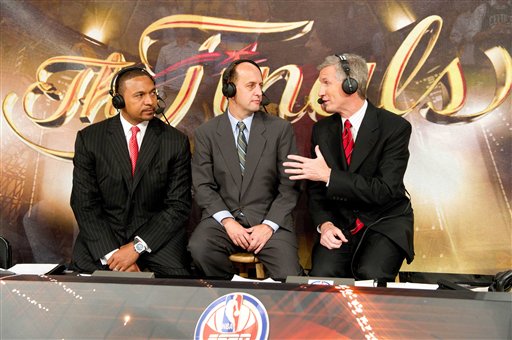
In this image provided by ESPN, commentators Mark Jackson, left, Jeff Van Gundy, center, and Mike Breen are shown on the ESPN set during an NBA basketball game between the Los Angeles Lakers and Boston Celtics at the Staples Center in Los Angeles, June 3, 2010. With Jeff Van Gundy and Mark Jackson linked to coaching openings, how long can ABC keep its trio together? (AP Photo/ESPN, Scott Clarke) ** NO ARCHIVING, NO SALES **(Credit: AP)

When it comes to sports and media and guy stuff, ESPN is the big, hairy monster. It’s a towel-flicking electronic locker room with a big sign on the door that seems to say, “For Boys Only!”

When it comes to sports and media and gender issues, Mary Jo Kane is among the nation’s most outspoken critics of the sexualized imaging of women athletes — what was Venus Williams wearing!?!? — and a dogged chronicler of scant coverage of women’s athletics on sports pages and TV channels.

A University of Minnesota professor and director of the Tucker Center for Research on Girls & Women in Sports, Kane is the author of such page-turning journal articles as “Sexual stories as resistance narratives in women’s sports: Reconceptualizing identity performance” and “Expanding the boundaries of sport media research: Using critical theory to explore consumer responses to representations of women’s sports.”

So, who’da thunk that the good professor would be asked inside the macho ESPN tent?

Kane has joined an advisory panel that will guide the ESPN behemoth on its future coverage of women’s sports and women athletes. In fact, ESPN is in the process of launching a new business and digital platform called espnW . . . which stands for ESPN women.

Kane may be wandering into the belly of the beast, but that’s OK with her. She has long offered presentations to any who would listen or watch about how the major media powers — such as Sports Illustrated, TV networks and now ESPN — regularly devote time and space to women’s sports via provocative, heavily heterosexual images to, theoretically, attract male fans.

At one of Kane’s lectures years ago, a woman stood and said: “This is horrible. What are you going to do about it?”

Deer-in-headlight-like, Ph.D. Kane stammered and replied: “What am I going to do about it? Well, I’m an academic. I can’t tell you what to do about it. I’m just going to tell you about the problem.”

Two decades later, still critical of the role the mass media has played in poorly promoting women’s sports achievements, Kane now finds herself in the lofty position of being asked by ESPN “what I think it might take to build an audience, about how they should portray women’s sports, where I can say, ‘You’ve got it all wrong — sex doesn’t sell women’s sports.’ “

In her view, by refusing to regularly emphasize women athletes’ dedication and mental toughness — instead selling beauty and jiggling — TV networks are alienating the exact fan base for women’s sports they should be seeking: girls, women and fathers with daughters.

ESPN, the highly profitable collection of TV channels, websites, magazines and book publishing, formed espnW last year. From Sept. 30 to Oct. 2, espnW will conduct a brainstorming session with about 30 experts on women’s sports — coaches, athletes, scholars — to “provide advice and insight to the espnW team, particularly as it pertains to our content and editorial focus,” espnW vice president Laura Gentile told MinnPost in an e-mail.

Gentile said that espnW won’t be a television network in the “foreseeable future,” but rather a website, a mobile property and a social networking space.

In a recent interview at the Paley Center for the Media, Gentile’s boss, ESPN president George Bodenheimer, said about 30 percent of ESPN viewers are women. He said espnW is designed to attract high school girl athletes to “grow the next generation of female sports fans.” After all, 3.1 million girls played high school sports in 2009, an untapped market for ESPN.

“People always want to think that we’re just a male-oriented company and we largely sell our advertising that way,” Bodenheimer said at the Paley Center. “[But] don’t get into a room and say that women aren’t sports fans. The meeting will end ugly.”

But that meeting couldn’t be any uglier than a stunning report (PDF) released last month about the declining coverage over the past decade of women’s sports by ESPN. (Let’s not single out ESPN; coverage in local media outlets also seems to be suffering as staffing declines, space and time are reduced and resources are consolidated so news organizations regularly send six reporters to, say, a Vikings game and often none to a Gopher women’s basketball game.)

In the study, professor Michael Messner of the University of Southern California and professor Cheryl Cooky of Purdue found that ESPN’s signature SportsCenter news show devoted only 1.4 percent of its airtime coverage to women’s sports, down from 2.2 percent in 1999 and 2.1 percent in 2004. Even the amount of time women’s sports scores and news received on the bottom-of-the-screen crawl was reduced.

Messner and Cooky observed some progress over time, finding less “sarcastic humor” about women’s sports and a reduction of the portrayal of women athletes in demeaning ways. But, they noted, “this may in part reflect that women in any form were increasingly absent from the broadcasts.”

One property that ESPN does promote is the NCAA women’s basketball Final Four every March. For that event, ESPN promotes athletic competence, teamwork, strategies, rivalries, stars, coaching battles.

“Duh,” said Kane, “they promote women’s college basketball the way they promote men’s college basketball. It is the most successful thing they do with women’s sports all year . . . It’s not promoted in terms of girly-girl. It’s promoted as a serious sport. And I believe that is why women’s college basketball is so successful.”

Kane plans to tell espnW’s developers all that and more in the coming months as she hopes to push ESPN’s guys into opening the door to their long-held exclusive electronic treehouse.

Get over it, Republicans: Al Franken won

Fox News is pushing a right-wing Minnesota group's "report" on the state's 2008 Senate election

Norm Coleman and Al Franken

This originally appeared at MinnPost.

I have watched from afar — and with lots of bemusement — the recent dust-up over the alleged number of supposed felons who may have registered and perhaps voted on Nov. 4, 2008, in Minnesota’s U.S. Senate race.

After all, my life has been immersed in the Al Franken-Norm Coleman recount for nearly two years — first, covering all of the twists and turns of the recount for MinnPost, and then writing my book, “This Is Not Florida: How Al Franken Won the Minnesota Senate Recount.” It’s now completed and will be released in a few months. Had I the chance, I would have made this current controversy a tiny footnote in my conclusions.

One point I make in the book is that various panels of judges and even former Sen. Coleman’s lawyer in court said there was no widespread fraud in the election.

Still, Minnesota Majority, a very conservative “watchdog” group, released a report (PDF) on June 28 that claims a lot of things. But when you get to the bottom line, the group seems to be saying that according to its research, 341 felons in Hennepin and Ramsey counties who should have been ineligible to vote actually cast votes in the Franken-Coleman election.

The report, flawed in the opinion of most legal analysts, got legs and wings and Internet echo chamber reverberations from — who else? — Fox News last week, and then other news organizations chased it, and right-wing blogs jumped on it, and the Minnesota Republican Party called for a statewide investigation and Coleman called Franken “an accidental senator” and Gov. Tim Pawlenty said there was “credible evidence” that the alleged felons who maybe voted possibly could have flipped the election’s final result. Breathless.

Franken, if you remember, won by 312 votes.

Let’s drill down a little bit. First, let’s look at the reporting. Fox News, which has its agenda, of course, topped its online story with this screaming headline: “Felons Voting Illegally May Have Put Franken Over the Top in Minnesota, Study Finds.” Fox News also quoted Ramsey County prosecutor Phil Carruthers as saying that as his office looks into the matter, “There is a good chance we may match or even exceed their numbers.”

But days later, Star Tribune reporter Kevin Diaz — a former colleague whom I tend to trust more than Faux News — quoted Carruthers as saying of the Minnesota Majority investigation: “Overwhelmingly, their statistics were not accurate.” Hmmm. Something changed.

Now, let’s take one key stat that Minnesota Majority focuses on, that 341 alleged felons from heavily Democratic Hennepin and Ramsey counties voted. For the moment, take that at face value.

That would mean, based on voter turnout numbers, about 70 percent of them (240) would be from Hennepin and 30 percent (101) would be from Ramsey. Taking into account the percentages for Franken, Coleman and others in each of those counties, Franken would net 51 votes.

Remember, he won by 312. Let’s take away those 51 in this silly game. That still isn’t enough to switch the result.

The report has been the stuff of high-level discussion at the Election Law Blog, run by respected professor Rick Hasen at Loyola Law School in Los Angeles. There, professor Michael P. McDonald of George Mason University shoots down the Minnesota Majority report when answering Hasen’s opening question: “Did enough illegal felons vote in Minnesota to tip the balance to Al Franken?”

A few other things: What makes anyone think felons would vote only for Franken? Indeed, it was Franken’s legal team during the recount’s election contest trial that raised the prospect that felons voted in the election; Franken’s lawyers found one such voter in a northern Minnesota county who voted for Coleman. Dare I ask: If Franken opened the door on such an avenue, why didn’t Coleman’s lawyers pursue this felon-voting issue then? They had their chance. And why does the Minnesota Majority report focus on the core-city counties?

In my book, you will see a handful of flubs made by both sides in the recount legal battle.

Several things gnaw at me in this story:

1. First is the implication that if voter ID cards were used on Election Day, felons wouldn’t be able to vote. This is a long-standing Republican issue to limit voting among the disenfranchised. Republican gubernatorial candidate Tom Emmer has used this controversy to call for picture IDs for voters. But guess what? Convicted felons have driver’s licenses. They have photo IDs. Voter photo IDs wouldn’t halt felons from voting. This Minnesota Majority report is being used for other political reasons.

2. I don’t mean to be disrespectful, just instructive, but I’d like to comment on the comments of Sen. Coleman and Gov. Pawlenty. As we know, Coleman won the 2002 Senate election 11 days after incumbent Sen. Paul Wellstone was killed in a plane crash. Polls showed Wellstone was going to win that election. For Coleman to call Franken “an accidental senator” is tragically ironic, for there are some who believe Coleman was the original accidental senator.

As for the governor, he has spoken three times about the recount, and he’s been a bit fast and loose with his facts. First, in the early days of the recount, he spread — on Fox News — the completely untrue story about Minneapolis ballots that were supposedly being driven around in the alleged trunk of an unknown and nonexistent elections official. He spoke of this days after it was reported that the story was a fable.

Later, in a call with reporters, he overstated by thousands of percentage points the increase of absentee voters in 2008, trying to say that Franken won the election because of that.

In fact, Franken won the recount by 49 votes before absentee ballots were counted.

Now, there are his comments — on Fox News — about the Minnesota Majority report and how it’s “quite possible” felon voting tipped the election. The facts aren’t there.

3. The central fact that real felons whose voting rights were legally taken away and not restored might have voted in 2008 — that is serious. That matter should be examined closely by state and county officials. There’s no argument there.

4. If there is any doubt that the 2014 Franken reelection campaign against anyone — Pawlenty? — is going to be nasty and heated and ugly, this latest scuffle confirms it. Franken will forever be a target for the Republicans, and if it is close again, be certain that Republican recount strategies and legal tactics will be different from those of 2008-09.

You can read how they did this time round in “This Is Not Florida.” But be assured the Coleman-Franken recount and legal fight — a huge defeat for the Republicans — will be a rallying cry for the GOP in any future recount tussle.

Jay Weiner writes about politics and sports business issues. His book, “This Is Not Florida: How Al Franken Won the Minnesota Senate Recount,” will be published this fall. He can be reached at jweiner [at] minnpost [dot] com.

Continue Reading Close
www.salon.com/writer/jay_weiner/index.html