Jodi Greenbaum

Everything you’ve got

How to turn a little food into sustenance.

  • more
    • All Share Services

Everything You’ve Got

1 pound ground beef

1 cup rice

1 cup boiling water

1 beef bouillon cube

1 cup frozen or canned mixed vegetables

sliced tomato (optional)

garlic powder

salt

pepper

Brown meat. Drain. Add rice, water, seasonings and vegetables. Cook 20 minutes.

Jam Roll

2 cups flour

1 teaspoon salt

3/4 cup margarine

1 cup sugar

5 tablespoons milk

Jam

Mix ingredients for dough. Shape into a rectangle. Spread with jam. Roll up. Cut into slices. Bake at 350 degrees for 25 minutes.

Rich food, poor food

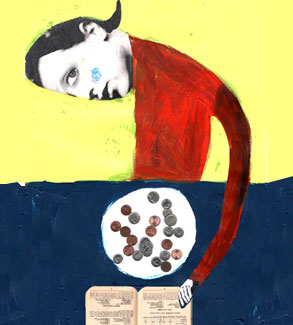
Why are there no recipes for what to cook when you have nothing at all?

  • more
    • All Share Services

Rich food, poor food

I don’t remember a lot about my childhood. The details of day-to-day living are long obscured. But I do recall the steaks. Every Friday night, we would eat thick, sizzling steaks in dimly lit restaurants. It was a ritual for our family. Even now I can see the red vinyl booths and the tasseled menus we read in the flickering candlelight. My father tipped generously. He always knew the waitress, the owner and whoever was playing the piano.

After the steaks, my father’s third scotch and my mother’s 10th cigarette, he would invariably call over some employee, a smiling woman whose tired lines were partially obscured by the dark of the restaurant.

“Tell Charlie he doesn’t pay you enough,” my father would say, his voice a slurred mixture of the Texas orphanage he grew up in and the phony Eastern prep school accent he’d mastered over the years.

We’d marvel at the fresh 20 he was giving away.

Not everyone we knew ate in such restaurants. Many of our friends didn’t eat out at all. We knew we were different, and lucky, and set apart from the kids whose parents made them order hamburgers on the rare occasion — a birthday, a holiday — that they were allowed to dine out at all.

We could order anything we wanted.

We both wore black patent leather shoes, my younger sister and I. We sat up straight, one hand in our laps at all times. We sipped Shirley Temples.

I felt rich. We weren’t.

I never imagined that my life would change. It did.

As such stories go, and I’ve heard enough of these stories to know, my family’s dismal descent into poverty was ordinary. My father drank, lost his job and disappeared. In my mind, there’s color television poor, with a car that runs and some hope; and then there’s wondering-where-your-next-meal’s-coming-from poor. Even with my mother and I working full time, we were in the latter category.

My first job involved stuffing envelopes at a dining card company, where I made $1.35 an hour and my mother made 30 cents more for typing. We went to work at 4 p.m. and got off at 11. Before graduating from high school, I also worked as a bus girl, a cashier, a salesgirl and a teacher’s aide. If I had an evening off, I took baby-sitting jobs. Homework got fit in, late at night, if at all.

After we lost our house, and moved in with two other families, my mother had this grand idea that if we returned to our old neighborhood, everything would be all right. This meant that we could pay the rent, but we couldn’t eat. Only one of the families came with us, but soon left. From the outside, our two-story rental, offered to us by a friend of my mother’s at a charitably cheap price, looked like every other house up and down the block. Inside, we were dead broke. Some days, I think, we lived on air.

Christmas was the best time. Neighbors came by with little disposable tin trays loaded up with home-baked cookies and slices of gingerbread. I don’t think they had any idea how much these gifts of food meant to us. One particularly bad year a friend gave us a bucket-sized basket of nuts and oranges, with chocolate candy kisses thrown in, too. We couldn’t believe our good fortune. Somebody must have known our situation, though, because one holiday, a local Girl Scout troop delivered some presents to our doorstep. I got an Avon sachet cream. It came in a small red jar. I was thrilled.

Thrilled, that is, until I remembered that I’d been a Girl Scout myself at one time.

In less than two years I’d gone from being someone who gave charity, to someone who received it.

During the time we lived in our rental with another fatherless family, I remember watching the woman grimly fry up chicken livers for her three children. “We’re poor,” she’d say. She’d say this two or three times. All the while her kids would be crying. I can’t say I blamed them.

In our family, I did a lot of the cooking. I never wanted our dinners to seem poor and pathetic. My specialty was the “Everything You’ve Got” meal. If I had hamburger I browned some, and added rice, frozen vegetables and anything else that was available.

Since I rarely had eggs around, for dessert I’d mix up margarine, sugar, flour and milk and turn it out into a rectangle. Then I’d spread jelly over it, roll it up, bake it and slice it.

But sometimes, we had nothing.

I can remember standing in Ralph’s grocery with only $1, trying to figure out the best way to feed three people dinner, fast. The answer: a can of Campbell’s bean soup and a package of corn tortillas. I had change left over.

It was the ’70s. Nobody I knew gave much thought to poverty. In my high school, there was only one person not attending the speech and debate team’s potluck dinner. The coach, a redhead, was furious. I kept quiet as she screamed. “Why? Why? Why?” I wondered if she was wearing a wig, her hair was that red, that perfectly set in a tight flip.

There was hardly enough food in my house for me, much less enough to make a dish that would serve eight. Sometimes though, life offers surprises, good ones. Neighbors, anonymous angels, had left two bags of food in our garage. Among the goodies I found when I got home were eggs, cake mix and margarine. When I sailed into the school auditorium that night I was ecstatic. Friends called out, surprised, happy to see me. Nothing was good at home, but it didn’t matter. I had a dish of food in my hands. I was like everybody else. It was the best day of my high school life.

So many years have passed since then, but still I wonder why there are no cookbooks for poor cuisine, no recipe to see you through such times. I imagine that the footnotes to such a book would graphically depict not only the nutritional value of beans and rice, but the secret sources of wealth.

Mix half a cup of beans with carefully watered dreams and add a new wardrobe and some confidence, my magic cookbook would say. Everyone who ate this dish would be able to hold her head up high when she walked into a job interview or a neighborhood bank. She’d know where to sit, and who to talk to. The language of numbers, the high-rise world of success, would not be foreign.

When I was in my 20s, with a nice career and the bad years behind me, I’d sit at the bar that served as a table in my apartment, slowly eating my dinner. The cupboard doors would be wide open. I’d watch the cans of corn and tomatoes, nearly mesmerized by the stack of tuna next to the small plastic bags of rice and beans.

Today, I’m the only woman I know who actually enjoys grocery shopping. Up and down the gleaming aisles I go. There must be a million choices. I shop in a place where a guy comes by and instantly replaces the last can taken. It’s the Disneyland of food stores. What fun. I’m a long way from Desperation City. Once in a while, I do think about that girl desperately studying every soup can, looking for something filling, something cheap.

She’s gone.

But I do know there’s someone out there just like her. There are, in fact, too many people out there like her, hungry and hoping. Maybe in another town, another store. Perhaps the next aisle over. Who knows? Maybe I’ll bump into her.

If I did, I could only pray that she will be lucky, too.

Continue Reading Close

Pink ladies, pupus and rumaki

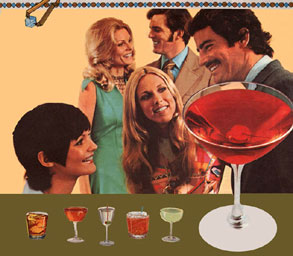
The only party libations worthy of Sinatra, the Supremes and a beehive blond with thick eyeliner and a Kool cigarette, doing the twist.

  • more
    • All Share Services

Pink lady
In a blender, mix 1 1/2 ounces gin, 1 1/2 ounces applejack, 1 ounce lemon juice, one teaspoon sugar or sugar syrup, one teaspoon grenadine, one egg white and one cup of ice. Serves two.

Pupus
Mix 1 cup sliced black olives, 1/2 cup green onions, 1 1/2 cups shredded cheddar cheese, 1/2 cup mayonnaise, 1/2 teaspoon curry and salt to taste. Spoon onto English muffins. Broil. Cut into quarters and serve.

Rumaki
Marinate 1/2 pound chicken livers in 1/2 cup soy sauce and a minced garlic clove for several hours. Combine each chicken liver with a canned water chestnut and wrap in bacon. Secure with a toothpick. Broil.

Dinner at 8

Where, oh where, are the children who can mix a decent vodka gimlet?

  • more
    • All Share Services

Dinner at 8

In my family, we had dinner at 8. Growing up, I labored under the somewhat romantic, and probably false, notion that this was civilized. Six o’clock dinners were for people who thought Sizzler was the place to go for a steak, tuna casseroles were haute cuisine and fruit salad was the stuff that came in small cans, sweetened by a syrupy sauce that never could quite mask the cold, metallic taste.

What did my own mother serve? There were meatloaves and steaks, and her prized fried chicken recipe. Nothing really spectacular. But by the time dinner rolled around at 8, whatever it was sure tasted great to a couple of hungry kids.

Why did we eat so late? My mother was an artist, or thought so for a while, and she would do anything possible to separate herself from the crowd she called “the cotton-dress mothers.”

Needless to say, what my mother wore while she was cooking mattered more than anything she served. Her dresses were always short, often low-cut and usually worn with sexy black pumps (though I do recall a pair of lovely, pale pink, T-strapped heels).

For years I’ve been searching for a black pinstriped, white-collared crepe dress like the one my mother wore. While there was nothing businesslike about it, it did command a certain sort of wistful respect. And I recall with fondness a fetching yellow knit dress of my mother’s that bubbled out a tiny bit and came back in, and was so, so short that some of the older kids asked me if my mother was a hippie. That was 1967. I’d been asked if she was a beatnik in ’62.

She smoked, of course. Especially while she cooked. She also drank, white wine, and some mixed drink or another. At one time there was a flurry of frothy green and pink concoctions, following the arrival of a mustard-colored blender from the S&H green stamps store. But as making these drinks required getting out the blender, plugging it in and having all the ingredients on hand, that phase passed rather quickly.

My father continued to drink his scotch — straight up, that was the rule. That was also the reason, I suspect, that we didn’t eat dinner until 8. My parents were big believers in the cocktail hour.

The cocktail hour really took off during the heady Eisenhower years. Later, across our nation’s suburbs and cities, men and women, too old to take part in the Vietnam War or the attendant protests, shouldered their growing responsibilities at home with a nightly bourbon and water. Men in ties and their eager wives, not yet in the workforce, showed up with their bottles of booze and bowls of powdered onion dip. They came for good, cheap fun — the only kind available.

Think of rumaki and pink ladies, Sinatra and the Supremes and a beehive blond with thick eyeliner and a Kool cigarette, doing the twist. There was always a table for the liquor and an endless supply of 45s. More often than not, the kids got by with chips for dinner.

Sometimes the cocktail hour would stretch till almost dawn. The next morning we’d find a sea of empty bottles and the cat licking the remains of a chopped liver spread. Once I spent several hours walking a neighbor’s tipsy toddler after he’d discovered the discarded drinks before his sleeping parents awoke.

You get the idea.

While the popularity of cocktail parties had waned by the time Richard Nixon waved goodbye to the nation from a helicopter on the White House lawn, the fun was officially over when Jimmy Carter did away with the two-martini lunch.

Yet, from all appearances, cocktails are making a big comeback. Witness actress Sarah Jessica Parker and her gal pals on “Sex and the City” ponying up to some of New York’s best bars to order their favorite drink — a cosmopolitan, of course. Goodbye white wine; hello dear old-fashioned. Everywhere you look, people are enthusiastically ordering their parents’ and grandparents’ drinks. You’d think they’d just discovered booze.

But for all the popularity of hard liquor, invitations to cocktail parties remain scarce. I suspect it’s the food. Or more specifically, fear of fixing food. Small food.

Appetizers exist for one reason: They allow your guests to drink without getting thoroughly plastered. Forget fancy, five-step recipes requiring any last-minute preparations that take you from your company. In the ’60s, they knew how to keep it simple.

My father used to serve a cheese board with olives and Ritz crackers topped by little anchovies. He knew that salty food kept people drinking. And drinking kept people happy. Then everybody ran off to dance the 12-step, again and again.

If my parents drank too much, we didn’t notice. The times were loud and boisterous, and we, the smallest witnesses, were along for the ride. People dropped in at all hours. They drank, and they laughed, and we laughed along with them. Outside there were assassinations, an unpopular war and burning cities. The world was changing fast. Maybe the cocktail-party crowd decided if they couldn’t help, they would hide. But then everyone was young, even our parents.

Where, oh where, in this age of carpool coddling, are the children who can mix a decent vodka gimlet, cheerfully pass around trays of hors d’oeuvres and play chopsticks on the piano to a roomful of their parents’ drunken friends?

Having reached the cusp of middle age, I am perhaps drunk myself on the nostalgia of my youth, blissfully recalling a sweet time that never was. Yet who hasn’t stood, Cheever-esque, on the edge of a cocktail hour, believing before the first shy toast that life is good, as good, in fact, as it will ever get?

Continue Reading Close