Jonathan Foreman

The Nazis, er, the Redcoats are coming!

The savage soldiers in "The Patriot" act more like the Waffen SS than actual British troops. Does this movie have an ulterior motive?

  • more
    • All Share Services

The Nazis, er, the Redcoats are coming!

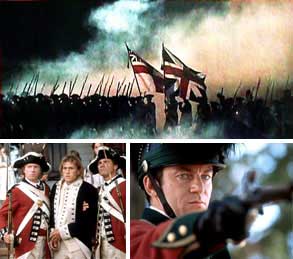
The week before “The Patriot” opened in the United States, the British press lit up with furious headlines. “Truth is first casualty in Hollywood’s War,” read one in the Daily Telegraph. Another story, about the historical model for Mel Gibson’s character was titled, “The Secret Shame of Mel’s New Hero.” The accompanying articles complained that the new Revolutionary War epic portrays British redcoats as “bloodthirsty and unprincipled stormtroopers” and “bloodthirsty child-killers.”

The prizewinning historian and biographer Andrew Roberts called the film “racist” in the Daily Express, and pointed out that it was only the latest in a series of films like “Titanic,” “Michael Collins” and “The Jungle Book” remake that have depicted the British as “treacherous, cowardly, evil [and] sadistic.” Roberts had a theory: “With their own record of killing 12 million American Indians and supporting slavery for four decades after the British abolished it, Americans wish to project their historical guilt onto someone else.”

I can only imagine how much angrier Fleet Street’s pundits will be after they have actually seen the movie. “The Patriot” will not open in England until August, but when it does, Brits will see a supposedly authentic historical epic that radically rewrites the known history of the Revolutionary War. It does so by casting George III’s redcoats as cartoonish paragons of evil who commit one monstrous — but wholly invented — atrocity after another. In one scene, the most harrowing of the film, redcoats round up a village of screaming women and children and old men, lock them in a church and set the whole chapel on fire. If you didn’t know anything about the Revolution, you might actually believe the British army in North America was made up of astonishingly cruel, even demonic, sadists who really did do this kind of thing — as if they were the 18th century equivalent of the Nazi SS. Yet no action of the sort ever happened during the war for independence, but an eerily identical war crime — one of the most notorious atrocities of World War II — was carried out by the Nazis in France in 1944.

As a film critic for the New York Post, I found “The Patriot” well made and often exciting. But I also found it disturbing in a way that many weaker, dumber films are not. It’s not just that it willfully distorts history in a manner that goes way beyond the traditional poetic license employed by Hollywood, it’s the strange, primitive politics that seem to underlie that distortion.

“The Patriot” is a movie that doesn’t “get” patriotism — in either a modern or the 18th century sense of the word. The only memorable, explicit political sentiment voiced comes when Gibson’s character makes the rather Tory comment that he sees no advantage in replacing the tyranny of one man 3,000 miles away for the tyranny of 3,000 men, one mile away. The deliberate lacuna demonstrates a total lack of understanding of, or even a kind of hostility to, the patriotic politics that motivated the founding fathers.

You could actually argue without too much exaggeration that “The Patriot” is as fascist a film (and I use the term in its literal sense, not as a synonym for “bad”) as anything made in decades. It’s even more fascist than “Fight Club,” that ode to violence, barely repressed homoeroticism and the rejection of consumer capitalism.

“The Patriot” presents a deeply sentimental cult of the family, casts unusually Aryan-looking heroes and avoids any democratic or political context in its portrayal of the Revolutionary War. Instead of such context, it offers a story in which the desire for blood vengeance — for a son shot by a British officer — turns Gibson’s character into a “patriot.” Meanwhile, the imagery piles up:

  • In one scene towheaded preteens are armed by their father and turned into the equivalent of the Werwolf boy-soldiers that the Third Reich was thought to have recruited from the Hitler Youth to carry out guerrilla attacks against the invading Allies.

  • In the film’s most exciting sequence, Gibson is provoked by the foreigner into becoming one of those bloodied, ax-wielding forest supermen so beloved in Nazi folk-iconography: an 18-century equivalent of the Goth leader Arminius (aka Hermann the German) who annihilated two Roman Legions in the Teutoburger Forest.

  • The black population of South Carolina — where the film is set — is basically depicted as happy loyal slaves, or equally happy (and unlikely) freedmen.

    But the most disturbing thing about “The Patriot” is not just that German director Roland Emmerich (director of the jingoistic “Independence Day”) and his screenwriter Robert Rodat (who was criticized for excluding British and other Allied soldiers from his script for “Saving Private Ryan”) depict British troops as committing savage atrocities, but that those atrocities bear such a close resemblance to war crimes carried out by German troops — particularly the SS in World War II. It’s hard not to wonder if the filmmakers have some kind of subconscious agenda.

    In one scene in “The Patriot,” the British regulars murder wounded American POWs. In another, they order the execution of an American soldier captured in uniform. Both were common occurrences on the Eastern Front of World War II, but such war crimes by regular troops “never happened” in the Revolutionary War, says American Heritage magazine editor Richard Snow. (Of course, irregular militias, terrorist bands allied to both sides and Indian proxies did do some very nasty things.) And, sure, spies and traitors, such as Nathan Hale (American) and Major John Andre (British), were hanged. But regular troops on both sides observed the law of war that distinctions should be made between the former categories and uniformed combatants. “['The Patriot'] is inventing a context of atrocities when what really happened was much more interesting,” he says.

    Snow says he understands the outrage in the British press. “I think that [they] should be upset. I would be pretty sore if I saw a British production of Shaw’s ‘Devil’s Disciple’ and it had Americans bayonetting the wounded after the Battle of Bennington.”

    The most outrageous of “The Patriot’s” many faults is the way Emmerich and Rodat show the British troops committing a war crime that closely resembles one of the most notorious Nazi war crimes of World War II — the massacre of 642 people (including 205 children) in the French village of Oradour sur Glane on June 10, 1944. The film mimics the horrible event with clear accuracy and turns it into just another atrocity committed by redcoats in 1780.

    At Oradour, the Waffen SS “Das Reich” division punished local resistance activity by first shooting all the men and boys. Then they rounded up the women and children, locked them in the town church and set it afire. (You can see Oradour today exactly as it was just after the Nazis carried out the ghastly mass-murder — the French have left it to remain an empty memorial.)

    There was one major case of British regulars burning a town during the Revolution. It was Groton, Conn., and the troops were under the command of Benedict Arnold. But the houses they burned were empty. Yet in “The Patriot” fictional British dragoons do exactly the same as the real life SS did at Oradour. They lock scores of civilians, most of them women and children, into a church and set it afire. According to both historian Thomas Fleming and Snow, no such incident took place during the Revolution. As Snow says, “Of course it never happened — if it had do you think Americans would have forgotten it? It could have kept us out of World War I.”

    By transposing Oradour to South Carolina, and making 18th century Britons the first moderns to commit this particular war crime, Emmerich and Rodat — unwittingly or not — have done something unpleasantly akin to Holocaust revisionism. They have made a film that will have the effect of inoculating audiences against the unique historical horror of Oradour — and implicitly rehabilitating the Nazis while making the British seem as evil as history’s worst monsters.

    Of course, Emmerich and Rodat would probably counter that they’re just trying to show how nasty war can be. But the fact remains that in the real Revolutionary War the regular armies of neither side behaved in this way — even in South Carolina in 1780 — and only the Brits are shown committing unprovoked acts of bestial cruelty.

    So it’s no wonder that the British press sees this film as a kind of blood libel against the British people. To understand the import, just imagine a hugely successful foreign film (French, British, Chinese) about the Vietnam War that depicted Americans using thousands of Vietnamese children for medical and scientific experiments.

    If the Nazis had won the war in Europe, and their propaganda ministry had decided to make a film about the American Revolution, “The Patriot” is exactly the movie you could expect to see — minus the computer-generated effects, of course. (Doubters should take a look at Goebbels’ pre-Pearl Harbor efforts at inflaming isolationist Anglophobia.)

    It’s just as well for Sony-Columbia that Emmerich, Rodat and Gibson didn’t make a film that painted the French, the Chinese or even the Arabs into ur-SS war criminals. If they had there would probably be official government protests, popular demonstrations and boycotts. But they have still told a big lie about the war that brought the United States into existence, one that feeds an even greater lie about the war and the enemy the U.S. and Britain fought half a century ago. It’s a shameful way to make money.

    And it’s particularly insidious when a film that goes to such lengths to avoid anachronism in Revolutionary period clothing, weaponry and battle tactics takes such license with the nature of the war. In the past, Hollywood has played with historical details in order to make a narrative more compelling or the look of a film more appealing. But it has been an unwritten rule of the American film industry that you try to hew vaguely to the generally accepted account of how things were in the past.

    It’s hard to define, but there is clearly a point where dramatic and poetic license shade into something much more sinister. If you made a film in which the slave trade was shown as two-sided with Africans shown as raiding Europe for slaves to bring to America, or one in which Jews were shown provoking pogroms by drinking the blood of gentile children, you would have passed that point, even if such films were exciting, well acted and starred Gibson.

    I don’t blame Gibson so much; he’s only an actor and it’s no surprise when actors either willfully or ignorantly overlook historical accuracy for a good role. (Especially when they receive $25 million for their trouble, as Gibson did for “The Patriot.”) But I’d like to introduce Emmerich and Rodat to the families of those massacred at Oradour.

  • Race and silence in Central Park

    The media's refusal to acknowledge the incident's ethnic dimension keeps hidden the kind of behavior many black and Latin women must confront all the time.

    • more
      • All Share Services

    Race and silence in Central Park

    Whether it was New York Police Chief Howard Safir excusing his officers’ inaction by saying they couldn’t be everywhere or the pages of commentary and punditry that refused to confront the ethnic and cultural dimension of the incident, the orgy of dishonesty in the aftermath of Puerto Rican Day was almost as dismaying as the Central Park “wilding” itself.

    It became savagely comical as more and more photographs and videos of the alleged perpetrators were published in the papers and on TV. Even as newsfolk waxed concerned about our society’s shocking tolerance of violence against women, egged on by gleeful spokespersons from organizations like NOW, everyone pretended not to notice that nearly all the guys who soaked, stripped and molested up to 50 women in the park were Puerto Rican and black.

    In its patronizing, racist way, the media pretended it had just seen the manifestation of some kind of generalized social problem — a conclusion unfair both to the wider society and Puerto Ricans and black communities. Much of the behavior caught on video may be shocking stuff for New York Times writers and most of its readers, but it’s par for the course in many Manhattan neighborhoods north of Central Park.

    It’s ironic that the Times, which has accused Mayor Rudy Giuliani and the NYPD of trying to impose the “values of Mayberry” on a culturally diverse city, should see it as shocking that subcultures exist in New York with very different notions both of gender equality and the kind of behavior that is appropriate in public places. (Especially ironic is the Times’ wannabe enthusiasm for gangsta rap as an authentic but harmless expression of ghetto culture.) But then this incident, which gave Central Park South a taste of life as it is lived by black and Hispanic women in many of the city’s poorer neighborhoods, is exactly the kind that illustrates the conflicts between feminism and multiculturalism.

    Our dishonest refusal to deal with cultural difference — a phrase nowadays inflected with scrupulous neutrality as if some cultures were not, in some respects, much less vile than others — makes it much harder to figure out exactly what happened on that humid Saturday evening and why.

    If you watch some of the amateur videos of the wilding all the way through, you see that more was going on than simply another manifestation of the beastliness of men. Several of the videos show that, before things got really nasty, scantily dressed women went through the gantlet of water-sprayers and grabbers again and again.

    But then you see other women running through the same gantlet who clearly don’t want to play the game, or who realize to their horror that the game has changed — no longer playful; it’s rougher, angrier, more sexual and assaultive. And finally, there were the truly terrifying attacks on French and English tourists: brutal attacks that were rapes in all but the technical, legal sense of the word.

    There are questions to be asked here. Did things get ugly when the crowd first turned its attentions on people who weren’t down with the kind of aggressive flirtation that is the norm in parts of Harlem, but beyond the pale outside Zabar’s? Was particularly violent attention paid to middle-class women or white women (or skimpily dressed women)?

    Then there’s the whole issue of police inaction. All sorts of troubling questions remain not just unanswered, but unasked, because they touch on issues of ethnicity and class.

    We know for certain — because so many street cops have said so to journalists in defiance of Safir and the brass — that the NYPD had implicit instructions not to be “provocative.” In other words, they knew to tolerate a certain level of criminality: littering, public drunkenness, public marijuana smoking.

    This may well be a standard instruction at all of New York’s ethnic parades, although security was tightened up at the St. Patrick’s Day parade after a young man was beaten to death in a drunken brawl on 59th Street in 1997.

    But it seems that a normal, prudent tolerance of minor infractions morphed into something much more disturbing: a refusal to enforce the law and protect the public safety. What we don’t know is whether the refusal was the product of cynicism, cowardice or a police culture gone awry.

    What were the cops thinking? Was it class resentment: “Why should we risk our hides to protect some yuppie Rollerblader who pays $3,000 a month for a one-bedroom apartment?” Was it a conviction that the wilders weren’t really doing anything wrong? “After all,” they might have thought, “boys will be boys, and these girls in their skimpy halter tops were asking for it.” Perhaps that was combined with a sense of “this is how these people behave.”

    It wasn’t all that long ago, after all, that pre-Giuliani cops were under explicit orders to enforce the law differently with different communities: Officers were told loud boombox playing in the streets or on the subway was a legitimate expression of certain cultures, even if it was technically against the law.

    Some of the officers may have been thinking along the lines of Daryl Gates’ LAPD when it withdrew from the streets at the beginning of the Rodney King riots: Let’s show white Manhattanites exactly what the Thin Blue Line is shielding them from. Let’s show them what they have to be afraid of if we’re not allowed to do things the way we want to. In other words, perhaps the city was being punished for the “anti-cop hysteria” that followed in the wake of the Amadou Diallo, Abner Louima and Patrick Dorismond attacks. (Translation: If you yell at us for shooting unarmed black “suspects,” we won’t do our jobs.)

    Some conservatives (and cops) argue that the (mostly white) cops would have had to wade through a huge crowd (of Puerto Ricans) to stop the violence. It would have been very dangerous and probably have provoked a riot, they argue. In other words, the well-being of up to 50 women had to be sacrificed in order to prevent greater violence with a more explicit racial subtext.

    It’s an argument that forgets that the maintenance of public order — ensuring that it is safe for a woman to walk safely down the street — should be the primary role of the state in a civilized society.

    It’s irrelevant that such a task is dangerous: Everyone who becomes a cop knows that it can be a hazardous job. Nor should the cops have desisted from their duty just in case rescuing those women provoked the Great Central Park Riot of 2000. If it takes strong force to maintain the rule of law, or gunfire to protect even one woman being sexually assaulted in a public park, then it should be used.

    If New York is too fearful of race riots to maintain order during ethnic parades, then either such parades should be banned or the ethnic composition of the NYPD should be radically changed to reflect the makeup of the community.

    Continue Reading Close

    Why Howard Safir must go

    Rudy Giuliani's police commissioner has offered nothing but knee-jerk support for police officers who have killed three unarmed black men in 13 months. He should resign.

    • more
      • All Share Services

    To Mayor Rudy Giuliani’s most obsessive critics, the latest shooting by New York police of an unarmed black man is news almost too good to be true.

    The killing of Patrick Dorismond by an undercover cop — the third unjustified police homicide of a black man in 13 months — is all the “proof” they need that the city’s much-vaunted reduction of crime rates depended on brutally repressive, racist policing.

    It’s not true. But this latest police killing is indeed a tragedy, one that’s been handled with stunning ineptitude by Police Commissioner Howard Safir. And that’s why it’s time for Safir to resign.

    If he doesn’t, Giuliani should replace Safir just as President Truman replaced Gen. George Patton in 1945. It’s poor management, rather than a flawed policing philosophy, that’s at the root of the police department’s series of disasters: Crucial parts of the department have remained psychologically and tactically on a war footing even though the war is over. Both the police and their critics have a dangerous tendency to forget that New York is not the city it once was.

    The combination of sophisticated computer analysis of local crime patterns, enforcement of “broken window” quality-of-life laws and aggressive drug and gun enforcement initiated by former Commissioner William Bratton worked wonders in the New York that he and Giuliani inherited from David Dinkins. But the NYPD is a big and cumbersome human machine that must be operated at precisely the right intensity if its functioning isn’t to erode public trust or worse, to actively undermine public safety.

    The person whose delicate job it is to calibrate and control the machine must be someone who understands the peculiar culture of the police department — a culture molded by class and ethnic identity mixed with the effects of life on the street — without becoming so absorbed in the institution that he loses sight of the public interest.

    Safir has failed in this regard. He has consistently struck the wrong tone by coming to the immediate defense of officers involved in controversial incidents (often in ways that are reprehensible) — as when he revealed the juvenile arrest record of Dorismond, a move made with Giuliani’s approval. But despite his knee-jerk defense of officers, he has never been popular among the rank and file.

    At the same time, he shows no sign of understanding, as Bratton did, that certain effective police tactics can only be used with extreme delicacy. Bratton’s street crime unit was a small and genuinely elite force. It was composed of officers who had enough street smarts to tell if a man was carrying a gun just by the way he walked and who had sufficient experience to know how to defuse a volatile situation without the use of deadly force.

    Safir, desperate to maintain a sharp drop in crime statistics, expanded the SCU to three times its original size. And the second, considerably less elite manifestation of the unit was involved in a series of problematic incidents before it was effectively disbanded in the wake of the Amadou Diallo shooting.

    Safir’s Robert McNamara-like obsession with law-enforcement statistics has certainly percolated downward, with disastrous results, if the early reports about “Operation Condor” turn out to be true. Condor is the problematic anti-drug effort that prompted a cop disguised as a lowlife to approach Mr. Dorismond in Midtown and ask him where he could buy drugs, prompting a fight that led to the man’s death.

    It’s also telling that Safir has acknowledged, correctly, that the habitual rudeness and disrespect that characterizes so many police encounters with the public alienates working-class and minority communities that might otherwise favor aggressive law enforcement. Safir consistently cites his laughable “CPR” (standing for courtesy, professionalism and respect) program as a great reform. But he has completely failed to convince enough of the 40,000 men and women under his command that bullying and discourtesy together undermine their effectiveness.

    Even if the apparent rash of atrocities by New York’s Finest were all merely a matter of bad luck and bad timing — rather than symptoms manifested by an institution that has failed to adjust to its own success — it would be reason enough for Safir to go. (Napoleon famously demanded that his generals above all be lucky — and Safir is not only tone deaf and nasty when it comes to dealing with the public and the press, he’s also unlucky.)

    The mayor has to realize that the longer his tin-eared commissioner stays at the helm of the nation’s largest police department, the more we will see policing strategies that are, on the whole, sensible and tolerable, falling into disrepute, imperiling public safety in the future.

    But Giuliani’s absolutist notion of loyalty will probably ensure that Safir stays in office — even if it means crippling his own bid for a Senate seat. Just as Giuliani has excommunicated close friends who expressed the slightest criticism of his administration, so he has stayed faithful to those like Safir whose fidelity is unwavering and unquestioning.

    Continue Reading Close

    Rudy's right and Rosie's wrong

    New York's feisty mayor is the best thing that ever happened to the city's homeless.

    • more
      • All Share Services

    Rudy's right and Rosie's wrong

    What passes for an urban policy debate in New York can look surreal after a trip north of Central Park.

    At the Ready, Willing and Able shelter on 155th Street and Frederick Douglass Boulevard in Harlem, a former homeless crack addict I’ll call Tom walked me through immaculate, pleasantly furnished dormitories where books and telephones were kept by the beds.

    He took me to the computer room where men were quietly studying for the G.E.D. He showed me the room where members of the program have their urine tested twice a week. There was no violence, no drugs and none of the filth and chaos that everyone remembers from the thousand-bed armory shelters in the 1980s.

    Those were the days when the Coalition for the Homeless monitored conditions in the mega-shelters, steadfastly ensuring that there was three feet between each bed and at least one shower for every 15 people — even if no one felt safe enough to use it. Lately the advocacy group has joined with talk-show host Rosie O’Donnell and other Celebrity Friends of Hillary Rodham Clinton to excoriate Mayor Rudy Giuliani for his policies on the homeless.

    The barrage of criticism has eclipsed revolutionary improvements in the way New York deals with the homeless. Whatever you may think of the mayor’s dubious record on police brutality, media and free speech, it is Rudy Giuliani who has brought that revolution about by implementing the suggestions of a 1990 report authored for then-Mayor David Dinkins by Housing Secretary Andrew Cuomo, who was working for the alternative housing nonprofit H.E.L.P.

    Sure, people are aware that there are fewer vagrants, panhandlers and muttering schizophrenics in Gotham these days. And though most have no clue how or why that came to be, they’re generally so pleased by the change that Clinton and Co. have probably picked a losing political strategy. It’s telling that only 1,000 people turned up at a demonstration against Giuliani’s homeless policy in Union Square in early December.

    And even with the mayor’s strange genius for attracting negative publicity, the more New Yorkers learn about his genuinely humane and effective homeless policy, the more damaging it will be for Clinton if she makes it an issue in her New York Senate campaign.

    With the help of the nonprofit organizations that now run 90 percent of New York’s shelters, many homeless are getting their lives together and joining the mainstream. And when New Yorkers discover that the homeless haven’t been chased out of town by the New York Police Department or packed into penitentiaries (though far too many mentally ill people do end up at Rikers Island, rather than in the asylums and halfway houses where they belong) but are instead rejoining the community of those who live according to the social compact, it will only help Giuliani’s political prospects.

    Yet it’s the very programs that have most helped the homeless — drug testing, work requirements and other programs that help acculturate them into the mainstream — that make the Coalition for the Homeless and its allies wax hysterical. If you believe their most recent sallies, you’d think that requiring work from able-bodied, mentally healthy people in the city’s shelters was the ultimate unspeakable act of a monstrously uncaring city government.

    You also might be bamboozled into thinking the city’s homeless policy is the product of financial stinginess. Yet New York now spends $800 million a year on the homeless — with $438 million budgeted for the Department of Homeless Services and another $360 million that gets filtered through other agencies. And under Giuliani, even as the number of people on the streets has shrunk, the city’s budget for helping the homeless has grown beyond what was spent under the supposedly more compassionate Mayor David Dinkins.

    The most recent salvo in the battle between the mayor and the alliance of Clinton supporters and advocacy groups came from federal Housing Secretary Andrew Cuomo, who since endorsing Clinton has apparently disavowed his own report, which was the foundation for Giuliani’s policies.

    In late December, Cuomo took control of the $60 million the federal government provides New York for its homeless programs. The housing secretary said his decision to resume control was a response to a recent federal court ruling that the city “improperly” blocked funds to the activist group Housing Works. But despite the mayor’s often deserved reputation for punishing groups that criticize him, Housing Works actually lost its funds because it may have misappropriated a half-million dollars in 1998 grant money. (The organization denies any theft but cannot account for the missing $500,000.)

    When the Doe Fund introduced its Ready, Willing and Able program in Harlem in 1996, the organization was picketed by the Coalition for the Homeless. Activists slammed the Doe Fund as “racist” and compared its program to “slavery.” (It was, of course, the Coalition that had supervised the shelter in the halcyon days before the Doe Fund took it over, when crack was openly dealt in the parking lot and hallways.)

    The homeless themselves tend to take a less theoretical approach to their situation. When I asked trainee Frank Simmonds, who lived on the streets for two years and used to hustle tourists at Kennedy airport for crack money, if he thinks the program is like slavery, he told me that the question is insulting, in fact crazy. “Work gives you your dignity back,” he said.

    It’s one of the two phrases you hear from everyone at RWA, especially from the majority of staff members who themselves are graduates of the program. The other is, “I was tired,” meaning tired of life on the street.

    When I arrived at the shelter, work crews wearing the program’s blue-and-white uniforms were heading out into vans, having had their breakfast and attended the morning’s Alcoholics Anonymous and Narcotics Anonymous meetings.

    Since the program was first established in Brooklyn in 1990, Ready, Willing and Able workers have cleaned hundreds of blocks in Manhattan, and much of the program’s noncity funding comes from businesses and individuals who heard about the program from the men sweeping the sidewalks on their streets.

    The Doe Fund pays trainees a salary that starts at $5.50 an hour. Out of that salary they must pay $50 a week in rent and another $15 for meals; $30 is withheld for savings that are returned when a trainee graduates from the program. Many trainees are able to save additional money during their year to 18 months in the program, and if they manage to put aside $1,000 or more by graduation, Doe offers matching funds — provided over a period of several months, with mandatory drug testing prior to disbursements.

    The shelter stresses getting trainees ready to join the work force, by teaching basic life skills such as punctuality, workplace behavior and writing a risumi. Combined with drug testing and counseling that continues for five years from the time trainees enter RWA, the program has been a success. Some 62 percent of those who entered RWA
    between 1994 and 1996 graduated from the program and still held jobs three years later, according to a study commissioned by the Doe Fund.

    It’s a particularly remarkable achievement when you consider that RWA’s clientele is considered the most intractable segment of the homeless population: single men with histories of addiction and incarceration. The program is always full. And though there’s a waiting list to enter RWA, an “alumnus” who’s fallen back into the old habits can always get a bed.

    Since many of the people who run the shelter once participated in the program themselves, there’s no soup-kitchen unease, no resentment against white upper-middle-class volunteers handing out alms to less fortunate black folks. The people who work there have been on the streets and in the jails, and their belief in the program is the most impressive thing about the place.

    According to them, the reason RWA works is that it allows people to regain the kind of dignity and self-respect that is impossible to find on the street — or through the kind of no-strings-attached charity favored by the Coalition for the Homeless and the rest of those who have dissed the Giuliani administration for its homeless policy.

    But the story that had Rosie O’Donnell (and other celebrities who just happened to be pals of Hillary Clinton) really savaging the mayor was the accusation that City Hall’s newest homeless policy will cause children to be torn from the arms of loving parents and down-on-their-luck poor folks to freeze to death in the snow.

    Giuliani’s idea is merely to bring those who refuse work and day care for their kids over a long period of time to the attention of child protective services. His theory is that an able-bodied parent who refuses to work, despite the provision of a job and day care, could well be a less than adequate parent and should probably be checked out. A similar homeless policy has been in place in Suffolk and other New York counties for two years and not a single child has been taken away from its parents.

    Here’s the dirty little secret of homeless advocacy groups: Although they’ve pushed the public to accept their definition of “homelessness” as being the lack of a home, the vast majority of people dwelling in the streets of America’s big cities have multiple problems, not merely the lack of shelter. We use the term “homeless” to describe very different kinds of people: old-style drunks and bums, schizophrenics pushing shopping carts, panhandling crack addicts, the relatively small number of eccentrics who like the free life of the open road and people who’ve lost jobs and for one reason or another can’t find anywhere to stay except a free shelter.

    For years the Coalition for the Homeless and its fellow travelers have tried to depict the average “homeless” New Yorker as an ordinary, respectable, working woman who has lost her apartment after being downsized. But it turns out that the majority of “street people” are actually mentally ill, drug abusers or both, rather than hapless victims of economic dislocation. Even the Coalition now admits that 40 percent of the homeless population is mentally ill — an estimate that is almost certainly conservative.

    Finding new ways to help the homeless who suffer with mental illness or drug addictions, and then acculturating them to function in mainstream society, would therefore seem to make more sense than just warehousing them.

    Yet warehousing the homeless is exactly the policy favored by the advocates who have attacked the Giuliani administration and have long claimed that the problem is merely one of “shelter” — as if it’s merely the high cost of housing in New York that forces people to sleep under highways and in tunnels. But when destitute Guatemalan immigrants who barely speak Spanish, let alone English, can find and pay for shelter — however less than ideal it might be — that argument crumbles. It’s clear that the problems of the homeless are behavioral, cultural, even spiritual — not just a matter of lacking shelter.

    As a powerful recent article by Heather MacDonald in the Manhattan Institute’s City Journal pointed out, when the homeless outreach program of Times Square Business Improvement District (BID) tried to coax its 200 or so local homeless folk into temporary housing and generously subsidized permanent housing, most of them refused. Only 37 even agreed to visit the BID’s “respite center.”

    Yet when the Giuliani administration orders the NYPD to enforce laws against sleeping on the streets and to draw the homeless into shelters or hospitals, it’s attacked for depriving these unfortunates of their rights. But no genuinely compassionate society allows mentally ill people to starve or freeze.

    As George McDonald, founder of the Doe Fund, points out, his program is designed to mirror the everyday routines of working, getting paid and paying rent. His critics rant about “dead-end jobs,” as if cleaning the sidewalks or serving food is more demeaning than accepting handouts from charities, begging from passersby, or lying in your own filth on city streets.

    It’s understandable why the educated upper middle class who work in the nonprofit sector might have no sense of the dignity of such simple labor. But it isn’t fair to allow elitist contempt to govern the way we treat our vulnerable homeless population. As the former Marxist historian Gareth Stedman Jones once wrote — and I’m quoting from memory — in “Outcast London,” “Bourgeois philanthropy like bourgeois social-science invents its victims so as to sustain its practice.”

    Continue Reading Close