Katherine Ozment

Mommy, what’s a vagina?

One minute I'm cleaning up Legos with my 3-year-old daughter. The next minute I'm conducting an impromptu anatomy lesson and desperately hoping not to flub it.

  • more
    • All Share Services

Our 6-year-old son, William, and 3-year-old daughter, Jessie, have been taking baths together ever since she graduated from her daily dip in the kitchen sink. About a year ago, in a stunt deemed normal by most parenting manuals, she up and reached for her brother’s member, which had been floating beneath the surface of the water like a mystery to be unraveled.

And then she did it again. And again.

These frequent incursions would send William into a tizzy of giggling, squirming and (he’ll kill me one day for writing this) positioning himself so she would do it again. Coming off the tail end of the evening witching hour, I would be sitting on the floor at the threshold of the bathroom — one ear aimed to the room across the hall where “Hardball” blared from the TV, the other in the direction of my kids — when I’d note a peculiar tone to their laughter. It would sound higher pitched and more joyful than normal.

“What’s going on?” I’d yell, summoning my inner Archie Bunker, knowing full well what was going on.

“Jessie’s grabbing my penis!” William would yell back, snort-laughing as water splashed around the tub.

So long, Chris Matthews.

I’d rush to the tub and tell Jessie she shouldn’t touch William’s privates because they were, well, his privates. Soon, I’d find myself so awash in vague euphemisms and instructions that I’d just stare at them dumbly, then tell them it was time to get out.

But knowing William didn’t really mind his sister’s incursions, I had to come up with a reason for him to stop making himself so readily accessible. I crafted the half-baked explanation that he should discourage her from touching him, or she might start grabbing the penises of all the boys in her preschool class and then she wouldn’t have any friends. (I made a mental note to use the same argument in a different context years hence.)

That seemed to sober him up, and over time, her interest in his penis ebbed, eventually dying down altogether. At least I thought so.

The other night, we were in the playroom, cleaning up toys before bed, when Jessie looked down at herself and said, apropos of nothing, “I wish I had a penis.”

My heart stopped beating, I dropped the handful of Legos I’d just scooped up and Sigmund Freud, complete with pipe and pocket watch, crashed through our ceiling to land on the couch, where he sat staring at us with a raised eyebrow. Thoughts of Jessie’s feelings of inadequacy, of penis envy, of adolescent confusion and despair flooded my mind in a tangle of maternal angst and worry. What can I say to this child to fend it all off, at least for a day?

I took a deep breath and said, in my most upbeat mom voice, “Well, you don’t have one of those, but you do have something verrry special.”

I could feel William freeze in rapt attention behind me. Whatever could I be talking about?

Jessie looked at me quizzically and said, “I do? Where?”

“There,” I said, nodding to her nether region.

Her eyes widened.

“What is it?” she asked, with the kind of anticipation one usually reserves for the opening of a much-touted gift.

I must pause here to say that, although I grew up post-sexual revolution, my parents were unmistakably pre-sexual revolution. The closest anyone in our house ever came to anatomical correctness was to utter the words “tonsils” or “appendix.” Even now, at 40, such language doesn’t roll easily off the tongue. I inherited from my mother, as she did from hers, a decided reluctance to name names. I can’t even remember when or how I learned the proper terms for the parts of my body. All of which leaves me in a bit of a pickle when it comes to teaching my own kids about their bodies. With no clear role models to summon from my past, I long ago realized I’d have to wing it.

I just didn’t know I’d be winging it so soon, with my toddler, on the playroom floor. But what could I do? I stiffened my spine, looked Jessie in the eye, and said, “You, Jessie Joan, have a vagina.”

At that she smiled wide and proud, as if shocked by her good fortune, though I don’t think she had any idea what I was talking about. But it didn’t seem to matter.

The next moment, Jessie walked over to William, put her hands on her hips and, swaying back and forth, sang to the tune of nana-nana-boo-boo: “I have a vagina! I have a vagina!”

I’d done it! I’d had my first sex talk with my daughter and hadn’t flubbed it. She was buoyant as ever in her body. She could name her private parts without shame or hesitation. And her strong sense of self had remained intact. I knew that as mother and daughter we had many more miles to travel, and some would be rocky. But at least we were off to a good start.

Later that night, William taunted her by saying, “Jessie, do you know where your vagina is?” But she didn’t take the bait. With a blasé air I’ve spent my whole life longing for, she patted her hoo ha and said, “Yes, I do. My bajina is right here.”

The family jeans

Since high school, I'd battled my curvy body into "skinny" jeans. But it wasn't until I wrestled my young daughter's round belly into stylish, slim pants that I knew the fashion madness had to stop.

  • more
    • All Share Services

The family jeans

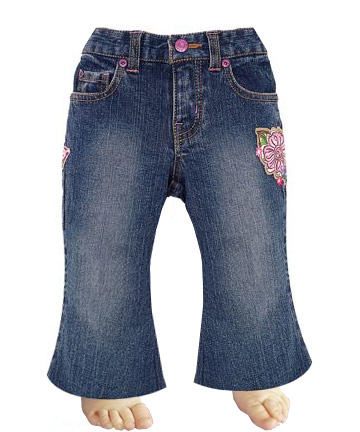
Most mothers have a certain look in mind for their children, and mine for my 1-year-old daughter, Jessie, is of a stylish tomboy. Which is why last winter, I ordered her a pair of bluejeans with front pocket flaps, embroidered designs and a slight flare at the ankle.

On the first day she was to wear them, I dressed her as I always do — hoisting up the jeans over her dimpled thighs and edging them over her diaper. But when I went to close them, the zipper wouldn’t budge. Unlike Jessie’s other pants, the jeans did not expand to accommodate her melon-size belly. It was an image I’d seen before: the uncloseable zipper of jeans I wear only at my thinnest, that unbridgeable gap in the pants we dub our “skinny jeans.”

I encountered my first skinny jeans in high school. Under the tutelage of my best friend, Hazel, who had the bone structure of a gazelle, I bought a pair of Levi’s 505s and tapered them to fit like a second skin. They were so tight at the ankle that I could barely take them off. But they looked good, and, wearing them to parties, I started to get noticed by boys. Home at night, I’d wiggle out of them by hopping around my room on either foot until I collapsed on my bed to peel them off. Only then would I see the long, red imprints of the tapered seam running down each leg. I’d put on my pajamas and revel in the reclaimed ability to breathe. Those jeans were my first encounter with the potential pleasure, power — and pain — of fashion.

When I couldn’t pull up Jessie’s zipper, I turned her over like a present I was unwrapping to check the size on the tag: 18 months, three months older than her actual age. At her last doctor’s appointment she’d come in at the 95th percentile for height but only 50th for weight. (And I admit I felt a momentary thrill about her improved prospects for a happy life should she maintain such proportions.) Yet, even with those numbers, Jessie’s baby body looks like a miniature polar bear — all rear end and stomach. I adore her shape, but mostly I love the unselfconscious way she parades it. When she’s standing at the bathtub, squealing as she waits for me to wash her, I want to hold on to her naked expression of joy forever. Sometimes I put my cheek against her back and nuzzle it, just to feel her soft, plump skin.

I cuddled her older brother, William, when he was a baby too, but while William’s body awes me, I sensed his difference from me from the moment I learned he’d be a boy. When he was born, I felt as if a life moved through me and into the world. When Jessie was born, I felt that a part of myself had broken off and begun to grow on its own. Her body even reminds me of mine — the thick, powerful thighs, full bottom and soft belly. But she is a former self — the person I was before I knew the word “fat” and how important it is to hide it.

Still, Jessie isn’t overweight. Why didn’t her jeans fit? I held them up and saw that the waist pulled in unforgivingly and the outer edges curved out at the hips, then tapered down to the ankle, where they flared out. They were nothing like William’s pants, which hung straight down from his waist like twin tree trunks. And then I realized with a small, sick feeling that the jeans had been cut to mimic the curves of a grown woman. Without meaning to, I’d bought my daughter her first pair of skinny jeans. Whose fault it was — society’s, my own — didn’t matter. There we were: a mother, a baby girl and a pair of form-fitting jeans.

I’m not proud of what I did next. In my defense, I did what I’ve done all my life when faced with a pair of too-tight jeans: I altered the playing field to make them fit. I stood Jessie up on the bed, and as her stomach flattened out, I pulled the zipper up in one quick motion and snapped the pants closed before she could exhale.

An hour later, I took them off.

I couldn’t stand the look of her, the waist of the jeans cutting into her belly like a corset. I whisked her into her bedroom and unsnapped the waistband, not sure which of us was more relieved.

I’ll never forget the mark on Jessie’s belly when I freed it. It was simultaneously strange and familiar — a reddish, weblike band of indentations. Since high school, I’d seen variations of that pattern etched on my own stomach and thighs. But it looked raw and menacing on her baby-white skin, like sharp tracks in snow.

I threw out my skinny jeans years ago, when I realized they’d never work on the body I was born with. Jessie will someday have to figure out what kind of shape she has — gazelle, penguin or something in between. And maybe she’ll have her own skinny jeans, but I hope not for long. For now she lives without the burden of too-tight fashion. It suits her. By the time I’d fished her sweatpants out of a drawer and threw the new jeans in a box for Goodwill, the marks had already begun to disappear.

Continue Reading Close

Nursing my fears

When the world is asleep and I am feeding him with my body, I want to protect my boy from everything that could hurt him. But my memories keep getting in the way.

  • more
    • All Share Services

Nursing my fears

When I was growing up we had a milk box on our front porch. It was made of aluminum and insulated with white plastic. Every week four tall, rectangular bottles of milk would appear in the box. They would always come early enough in the morning that no one in my family saw who brought them. I remember how you could almost tell when the box was full. It seemed more solid, like a filled-up cube, and the lid didn’t make such a hollow sound when you opened it. The bottles grounded it, kept it from floating off into the yard and down the street. Years later, after my father moved out, my two older brothers started riding motorcycles and smoking pot, and my mother was buying milk at the store on her way home from work, the box remained on the front porch, empty and unused. Sometimes the lid would blow open in the wind. Sometimes dried leaves would gather in the bottom of it.

Our son is hungriest at 3 a.m. and it’s then that his tiny mouth takes to my breast like a piston. His body lies across my lap, the only movements his jaw and throat, the only sounds his gulping and panting, like he can never get enough. I try to imagine him all grown up. I think: Someday you’ll be 6-foot-2 like your dad and you’ll tell me to leave you alone, and I’ll want to tell you about these nights. I’ll want to say: While the whole world slept, I fed you with my body.

A week after our son is born my mother tells me she doesn’t remember what my brothers and I were like as babies, that she was so depressed during her 18-year marriage that the period is a blur. I can only imagine what those years were like. I imagine she cried waiting for my father to come home from work and after faculty dinners when she couldn’t think of anything interesting to say. I imagine exhaustion enveloping her like heavy sheets. I imagine she didn’t have the energy to talk when she fed me, that she held a bottle to my mouth and just stared at the chaos and emptiness around her.

The milk often appears in little drops, like pearls, on the tips of my nipples. That is the most surprising thing of all, standing in the bathroom after a shower, my breasts blooming with white liquid. The first time it happened, I couldn’t resist pressing the milk to my finger and tasting it. It was sweet and thick and vaguely oily, like custard before it gels. It felt like an accomplishment the likes of which I’d never before achieved. Now I see our son’s body lengthen, his fingers and toes grow pudgy, his chest become a small, fat barrel, and I think: I did that.

I was about 6 when my brothers and I held a secret meeting in the basement. They wanted to send our parents on a “second honeymoon” to save their marriage. It was the first I’d heard of any problem, but they, a 13-year-old and a 15-year-old, could tell something was wrong. The second honeymoon never came about, and in retrospect it was a desperate dream of boys trying to be men. A year later our father moved into an apartment, and the centripetal force that had kept our family together began to give way, leaving each of us to spiral from the center, which we would orbit from some great, broken distance for the rest of our lives.

I become convinced that my milk is causing our son’s colic. Sometimes he suckles frantically for five minutes, then pulls away, shrieking. I begin to think of my sweet, rich milk as acid, burning his tiny stomach. My husband sits on the floor beside the rocking chair and counsels me coolly. He says to keep trying, it will get better, and I both love and pity him for this optimism. As my nipples bleed and burn, I suck my tears as far into me as I can. I chatter as he nurses. I sing lullabies I can’t remember all the words to. I smile hard, all teeth. This becomes my goal: To shelter our baby from my pain.

In time my nipples begin to heal, the burning giving way to the lapping sensation of his small, soft tongue. Around four months, the colic goes too. Nursing now feels like a hard-won battle, but beneath my triumph lingers an anxiety borne of his frequent and startling shifts in mood. I watch other mothers holding their babies with such calm and ease as ours squirms from me like an oiled seal, his tiny hands clawing the air as his head slams from side to side. I begin to worry, secretly, that he is mad.

When I was 19 my brother Matt killed himself. Lay himself in prayer across a railroad track in the woods near his apartment, tons of racing steel an unfathomable kind of mercy. He had been diagnosed as manic-depressive in college and then began a near-decade-long slide into complete psychosis. But, despite the horror of those years, it was a nightmare he had when I was 5 and he was 12 that haunts me most.

I wake in the middle of the night. Matt is screaming in the bedroom across the hall. Urgent footsteps, then a tender slice of light beneath my door. I peer out. My parents are at the foot of his bed. They are trying to comfort him, but he is sitting upright, screaming. “The dogs!” he cries. “They’re biting me with their fangs!” It is the first time I know he is not well. The first time I see my parents’ helplessness. My father tells me to go back to bed. Matt’s nightmares become our family secret.

My husband reads to our son every morning after I’ve woken to feed him and gone back to bed. I lie there and listen to them in the other room: my husband playing out characters in books I’ve long since forgotten, our son cooing, laughing, and roaring in response. When they are done, my husband carries him into our bedroom and swoops down to present him like a gift.

During night feedings our son’s blue eyes are wide as quarters. They stare up at me as his small O of a mouth envelops my aureole. I look into his eyes and tell him how good his life will be. I tell him he has a mother and a father who will love and protect him with every ounce of their lives. That we will always be a family, and he will always have enough. But he is only 6 months old. He has yet to have a need unmet, to know a promise broken. And so he watches me with the steady gaze of a wise, old man. As if he has already figured out that I’m the one who’s thirsty.

Continue Reading Close