Liz Sidoti

Obama officially launches re-election bid

President makes announcement through email and website, 20 months before 2012 election

President Barack Obama gestures while speaking at a UPS facility in Landover, Md., Friday, April 1, 2011. (AP Photo/Evan Vucci)(Credit: AP)

President Barack Obama formally launched his re-election campaign Monday, urging grass-roots supporters central to his first White House run to mobilize again to protect the change he’s brought over the past two years.

The official start of his second White House bid comes 20 months before the November 2012 election.

“We’ve always known that lasting change wouldn’t come quickly or easily. It never does,” the Democrat said in an e-mail to supporters announcing his candidacy. “But as my administration and folks across the country fight to protect the progress we’ve made — and make more — we also need to begin mobilizing for 2012, long before the time comes for me to begin campaigning in earnest.”

He told them he was filing the necessary paperwork with the Federal Election Commission, and directed them to his new campaign website where a launch video featured clips from supporters talking about their continued backing of the Democrat.

“I don’t agree with Obama on everything but I respect him and I trust him,” Ed from North Carolina says, delivering what’s certain to become a key part of the president’s pitch as he tries to re-energize liberals who have criticized some of his policies and independents who have fled from him in his first term.

Obama’s announcement comes just weeks after the commander in chief directed U.S. military operations to a third major warfront, Libya, and days after the post-recession economy showed more signs of a rebound with a report that the still high unemployment rate had fallen to 8.8 percent.

Widely expected, the procedural step of launching a campaign was planned to coincide with the second fundraising quarter of the year. Filing paperwork will allow the president to begin raising money in earnest for what advisers hope will be a record-breaking haul of more than $1 billion for his campaign, which is based in Chicago. That begins this month; he’s slated to visit major money venues of Chicago, New York and Los Angeles in the coming weeks.

Obama faces no primary challenger.

On the other side, the race for the GOP presidential nomination is just getting under way; more than a dozen Republicans are considering seeking the chance to challenge Obama in the next election. Only a few have taken the initial steps toward a candidacy, though several more are expected to this month. It’s a wide open race with no clear front-runner.

Nevertheless, Obama said he’s not taking anything for granted.

“We’re doing this now because the politics we believe in does not start with expensive TV ads or extravaganzas, but with you — with people organizing block-by-block, talking to neighbors, co-workers, and friends. And that kind of campaign takes time to build,” he said in the e-mail.

“So even though I’m focused on the job you elected me to do, and the race may not reach full speed for a year or more, the work of laying the foundation for our campaign must start today,” Obama added. He directed them to the new red, white and blue website for what he said was “a campaign that’s farther-reaching, more focused, and more innovative than anything we’ve built before.”

The website features Obama’s new campaign logo — 2012 with the rising sun in the background, a version of his 2008 campaign logo — and announces that the campaign is kicking off.

“We’re opening up offices, unpacking boxes, and starting a conversation with supporters like you to help shape our path to victory, and this is where you say you’re in,” it says, urging people to organize and donate.

The video is a montage of testimonials from a demographically diverse group of backers who intend to stay involved in this campaign.

“It needs to reflect the changes that we’ve seen in the last two-and-a-half years,” says Katherine from Colorado. “Then we had an underdog senator. Nobody thought that he had a chance. And now he’s the president.”

Gladys from Nevada adds: “We’re not leaving it up to chance” and “It’s an election that we have to win.”

——

Online: www.barackobama.com

A novice no more, Romney focuses on Obama, economy

Former Massachusetts governor hopes to silence naysayers as he gears up for presidential bid

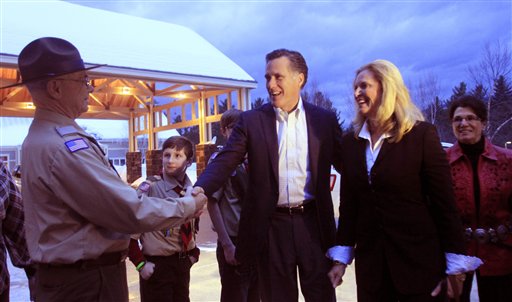
Former Massachusetts Gov. Mitt Romney, center, and his wife, Ann, are greeted Saturday, March 5, 2011, in Bartlett, N.H. Romney was the keynote speaker at the Carroll County Republican Committee Lincoln Day Dinner. (AP Photo/Jim Cole)(Credit: AP)

This time, Mitt Romney has a clear pitch: I’m the strongest Republican to challenge President Barack Obama on the country’s single biggest issue — the economy.

“He created a deeper recession, and delayed the recovery,” Romney said Saturday, previewing his campaign message before Republicans in this influential early nominating state.

“The consequence is soaring numbers of Americans enduring unemployment, foreclosures and bankruptcies. This is the Obama Misery Index, and it is at a record high.”

“It’s going to take more than new rhetoric to put Americans back to work — it’s going to take a new president,” said the former businessman and Massachusetts governor, essentially offering himself up as the best — if not only — solution.

But will GOP primary voters buy it?

Specifically, will this argument from the once-failed GOP presidential candidate be strong enough to convince conservatives who dominate the nominating contests that they should overlook their unease about him: his signing of a Massachusetts health care law similar to Obama’s unpopular nationwide one, as well as his reversals on social issues and his Mormonism?

This is the central question of Romney’s all-but-announced second White House bid.

An answer will come over the next year.

He’s virtually certain to enter the race this spring, though campaign signs posted along the road leading to the New Hampshire hotel where he spoke this weekend may have gotten a bit ahead of him. They said “Mitt Romney for President” and suggested this theme: “True Strength for America’s Future.”

He and his aides insisted they were leftovers from 2008.

Never mind the other signs: Romney lapel pins in the shape of New Hampshire. They dotted the audience, and at least one adviser was overheard all but confirming to attendees that Romney was running again.

In his first campaign, Romney struggled to explain to Republicans why he would give the party the best chance to win the White House.

He never settled on a single campaign message. He embraced social issues even though financial ones were his forte. He picked big and small fights with opponents — specifically front-runner John McCain. He floundered as he tried to convince voters that he was a hard-core conservative, even though he had governed a Democratic bastion as a moderate.

Today, Romney is a different candidate in a different time.

Back then, he was little known and fighting to be heard. Now, he weighs in on the national debate only when he has something to say. He’s the closest thing to a front-runner in a GOP field that lacks one.

It’s a blessing that he’s universally known. It may be a curse because GOP opponents are likely to come after him hard.

In the last race, the top issues — war and immigration — didn’t play to his strengths. Now, stubbornly high unemployment, slow economic growth and budget-busting deficits are voters’ chief worries.

It’s no doubt a much better fit for this successful businessman who co-founded a venture capital firm and helped rescue failing companies.

In the 2008 campaign, Romney stood out by relentlessly attacking McCain and other opponents. He struggled to outline what he stood for and how he would govern. Now, he’s focused on assailing Obama on the economy as well as selling his own credentials and ideas for long-term prosperity. In doing so, he’s drawing a more subtle contrast with his GOP challengers.

Compared with the feeling-his-way campaign of 2008, Romney’s advisers say writing his book “No Apology: The Case for American Greatness” helped him focus on the topics he cares most about and crystalized his thinking about running for president.

But there’s this political reality: Romney’s best chance to win the nomination rests with economic issues, and the remnants of the recession give him the chance to emphasize his business credentials. He can’t let the race again be defined by cultural topics or he risks losing because many conservatives still don’t trust the sincerity of his conversions on gay rights, abortion and other issues.

His appearance Saturday night at the Carroll County Lincoln Day Dinner at a northern New Hampshire hotel both provided a template for his upcoming campaign and showed how Romney has evolved as a candidate.

Scripted to the point of coming off as stiff in his first run, Romney now is clearly more comfortable doing the retail politicking that primary voters demand. He worked the room with ease, shaking hands and chatting up well-wishers with an almost neighborly air. His tie — ever present in 2008 — was gone. His hair — always perfectly coifed — flopped over his forehead.

And he didn’t seem to care.

With his wife, Ann, by his side, Romney took the stage and immediately deviated from his prepared remarks to share a few lighthearted stories about living part time in the state. He reminisced about his last campaign in New Hampshire. He noted that his wife was trying to push him to run.

“When we were driving in here, we saw these old Romney for president signs … I don’t know where they came from,” Romney said. Then he joked that his wife may have pulled them from his garage.

Then he launched into what can only be described the central case for a candidacy.

“I like President Obama, but he doesn’t have a clue how jobs are created,” Romney said, noting that Obama has never run a business.

Romney reminded his audience that he spent much of his life in the private sector. “I know how jobs are created and how jobs are lost. I have helped guide more than one enterprise that was in crisis.”

He said “turnarounds work when the leader focuses on what’s most important.” He then tried to make the case that Obama did just the opposite.

“He delegated the jobs crisis to (Democratic congressional leaders) Nancy Pelosi and Harry Reid and he went to work on his own liberal priorities,” including a climate change plan and a health care overhaul. “The next president must focus on what’s most important: getting Americans back to work.”

Romney explained what he said he stood for: lower taxes for companies, a smaller bureaucracy, a ceiling on federal spending. He called for repealing the health overhaul that conservatives view as a symbol of costly government overreach.

The issue is an obvious political vulnerability for Romney; Obama’s law was modeled in some ways after one that Romney signed in Massachusetts.

Romney addressed it head-on with an argument voters are likely to hear often.

“Our experiment wasn’t perfect — some things worked, some didn’t, and some things I’d change,” he said. But, he added, “One thing I would never do is to usurp the constitutional power of states with a one-size-fits-all federal takeover.”

It’s not his only hurdle.

Many conservatives, particularly in Iowa and South Carolina, still view his religion skeptically and don’t trust him on social issues. That helps explain why his focus is heavily on New Hampshire — where fiscal conservatives are the key electorate — as he gears up for an economy-focused campaign.

With primary voting set for February 2012 if not earlier, Romney has less than a year to make his case — now that he has one.

Continue Reading Close

Governors tell feds to avoid government shutdown

As a federal government shutdown looms large, many states worry what it would do to their fragile economies

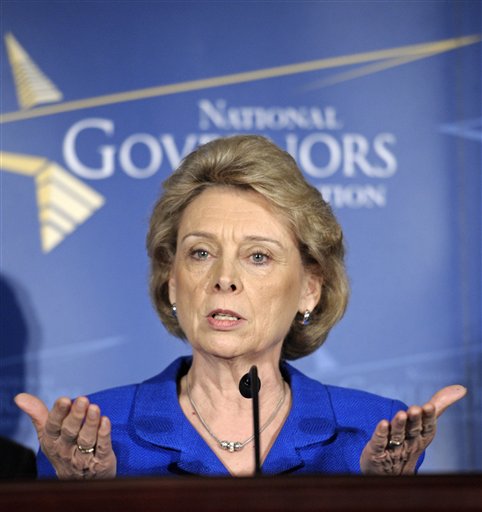
National Governors Association (NGA) Chair, Washington Gov. Christine Gregoire gestures during a news conference at the association's winter meeting in Washington, Saturday, Feb. 26, 2011. (AP Photo/Cliff Owen)(Credit: AP)

Their states on the brink of financial catastrophe, governors pleaded Saturday for the divided federal government to avoid doing anything that would hamper the tenuous economic recovery back home.

Their message to Washington: prevent a government shutdown, abstain from spending cuts that dramatically will affect states and end even preliminary discussions about allowing states to declare bankruptcy.

“Anything that Congress does that will undermine our recovery is quite troublesome to us,” said Washington Gov. Christine Gregoire, head of the National Governors Association, as she opened the bipartisan group’s winter meeting. “We’re asking for cooperation.”

“We don’t need a hiccup now in our recovery,” she added. “We are fragile.”

States have made $75 billion in budget cuts and raised taxes by $33 billion over the past two years to make up for budget shortfalls caused by the recession. Governors drained reserve cash funds and oversaw several rounds of severe budget cuts, so much so that Republicans and Democrats alike now are focused on how to completely remake state governments.

The overall economic situation in states is improving.

“Recovering, not recovered,” as Massachusetts Gov. Deval Patrick, a Democrat, put it.

High unemployment persists. Even more dire budget situations are to come.

Over the next two-and-a-half years, states face an estimated $175 billion more in budget gaps that they have no choice but to fill. The hole is caused partly because an initial infusion of cash from President Barack Obama’s economic stimulus law, as well as extensions of that money, will dry up in June. States received $103 billion in Medicaid money and $48 billion in education dollars to soften the recession’s blow.

Gregoire and the NGA’s vice chairman, Gov. Dave Heineman, R-Neb., recently met with House and Senate leaders as well as Health and Human Services Secretary Kathleen Sebelius, and asked them to be mindful of how the loss of the money, as well as further spending cuts, could hurt states.

The warnings come just as the Commerce Department reported that state and local responses to the fiscal crisis were undercutting the national recovery, slowing economic growth. Governors said the report only proved their point.

“For two years, governors have said when we cut we impact the recovery,” said Gregoire. “We know we have to make the cuts, but we can ill afford to have Congress on top of that cutting us more because the result will slow the recovery in our home states and in the nation.”

Arkansas Gov. Mike Beebe, a Democrat, noted that unlike the federal government, states are required to balance their budgets. Noting the painful cuts, he said, “We don’t have any choice.”

To ease the pain, Maine Gov. Paul LePage, a Republican, urged the federal government to loosen regulations that he says are hindering the recovery.

“We can help our states and we can slow down the layoffs of a lot of the private sector jobs if the states are given flexibility,” he said.

The governors met in Washington as Republicans who control the House and Democrats who run the Senate are in a high-stakes debate over the federal budget and trillion-dollar deficits.

GOP leaders have faced pressure from a contingent of newly elected tea party-supported lawmakers to cut spending even deeper than originally planned, setting up a clash with the White House and Senate Democrats over legislation necessary to keep the government running past this coming Friday’s deadline.

There have been signs in recent days that the two sides are moving toward a compromise on spending cuts that would prevent a shutdown, at least for now.

But the progress did little to mollify governors, who sounded the alarm about a shutdown.

“It will definitely impact every state,” said Beebe. Most states, he said, don’t have the money needed to offset the loss of federal dollars targeted to the work force and children.

Also of concern to the governors was talk about allowing states to declare bankruptcy as a way of handling their growing piles of debt.

Some congressional Republicans, conservative groups, and potential GOP presidential candidates such as former House Speaker Newt Gingrich and former Minnesota Gov. Tim Pawlenty have floated the idea. But House Majority Leader Eric Cantor, R-Va., has spoken out against the idea, an indication it’s not going anywhere.

“We have been clear,” Gregoire said. “We don’t even want the subject discussed, let alone to move it forward.”

Governors are worried about the potential effect on the municipal bond market. They also said it would increase interest rates and mean higher costs to state government.

Connecticut Gov. Dannel P. Malloy, a Democrat, said it was “one of the most dangerous discussions we’ve had in a long time” and called any such proposal “the height of insanity.”

Still, at least one broke ranks.

“It should be a discussion,” said Mississippi Gov. Haley Barbour, joining other likely 2012 GOP contenders.

With Congress reconvening next week, the coming days will show just how much — if at all — lawmakers heed the governors’ warnings.

Continue Reading Close

Dems choose Charlotte for 2012 convention

Obama prepares to "aggressively compete" on traditionally conservative land, hopes of refueling grassroots vibe

Democrats head to Charlotte, North Carolina for National Convention after refusing bids from three Midwestern cities.

Democrats plan to hold their 2012 nominating convention in Charlotte, N.C., selecting to fete President Barack Obama in a newly competitive presidential battleground in the conservative-leaning South.

The selection signaled that Obama plans to aggressively compete in traditionally Republican states that he won during his first presidential campaign by cobbling together a diverse cross-section of voters. And the apparent theme — The People’s Convention — indicated that the president will try to rekindle the grass-roots flavor of his ground-breaking 2008 bid.

In choosing Charlotte for the party’s 46th convention, the Democratic National Committee rejected bids by a trio of Midwestern cities hit hard by the recession: Cleveland, Minneapolis, and St. Louis.

First Lady Michelle Obama disclosed the selection to campaign supporters in an e-mail Tuesday, another step in the president’s recent efforts to ramp up his re-election preparations.

“Charlotte is a city marked by its southern charm, warm hospitality, and an ‘up by the bootstraps’ mentality that has propelled the city forward as one of the fastest-growing in the South,” she said. “Vibrant, diverse, and full of opportunity, the Queen City is home to innovative, hardworking folks with big hearts and open minds. And of course, great barbecue.”

She signaled that the gathering would be “a grassroots convention for the people” and promised to finance the convention differently than has been done in the past but provided no specifics on either point.

“This will be a different convention, for a different time,” she said.

A personally popular incumbent, Obama is virtually assured of being nominated again; he faces no serious primary challenger.

In an e-mail to backers, DNC Chairman Tim Kaine answered speculation that Obama would choose a different running mate for 2012, saying the party was looking forward to nominating both Obama and Vice President Joe Biden for a second term.

Democrats will hold their convention the week of Sept. 3, 2012. A week earlier, Republicans will nominate their candidate in Tampa, Fla., another important presidential state, after a primary fight to sort out a potentially crowded GOP field.

North Carolina officials estimate the convention will attract an estimated 30,000 to 35,000 delegates, media members and political leaders.

“The economic and reputational significance of being chosen for this honor cannot be overstated,” said Duke Energy Corp. CEO Jim Rogers, a co-chairman of the Charlotte In 2012 organizing committee.

North Carolina Gov. Beverly Perdue said in a statement that the event will boost North Carolina’s economy while showcasing the state.

“Today’s decision is fantastic news for North Carolina regardless of your political party,” she said.

In St. Louis, Mayor Francis Slay’s chief of staff, Jeff Rainford, said the decision came down to which city would go further in helping Obama carry states in the South.

“They clearly made the decision based on electoral politics, not who is the best place to hold a convention with excellent hotels and restaurants,” he said.

——–

Associated Press Writers Mike Baker in Raleigh, N.C., and Jim Salter in St. Louis contributed to this report.

Continue Reading Close

Fearing rout, Obama, Dems reach to female voters

Women likely to vote now split fairly evenly between the two parties, but a lot remain undecided

In a last-ditch effort to prevent electoral disaster, President Barack Obama and Democratic allies are vigorously wooing women voters, whose usually reliable support appears to have softened.

From blunt TV ads to friendlier backyard chats, they’re straining to persuade women that it’s the Democrats who are on their side and it’s in women’s vital interest to turn out and vote in the Nov. 2 elections that could give Republicans control of one or both houses of Congress.

In Seattle on Thursday, Obama told local women and others that “how well women do will help determine how well our families are doing as a whole.” Accompanied by women who own businesses, he spoke in a family’s backyard about the economy’s effects on women and outlined ways he said his policies have helped them.

Later, trying to rekindle the enthusiasm of his presidential race, he all but ordered thousands of cheering supporters at a packed University of Washington arena to get out and vote, even though he’s not on the ballot. Hoarsely shouting over the applause, he said, “If everybody that voted in 2008 shows up in 2010, we will win this election. We will win this election. But you’ve got to come out and vote.”

Campaigning for one of the Democrats’ female senators, Patty Murray, who is in a tight re-election fight, Obama attracted a bigger crowd than the 10,000 who could fit into the arena. The others moved to an overflow area set up in the university’s football stadium, and the president ran through the stadium tunnel onto the field to greet them.

With the elections less than two weeks away and Democrats fearing big losses, candidates, party allies and others are joining Obama in seeking women’s votes by hitting Republican opponents — in ads, mailings and speeches — on issues such as abortion rights. In every corner of the country, they are arguing that the GOP would erase progress American women have made under Democratic control of the White House and Congress.

The latest Associated Press-GfK poll underscores the Democrats’ concern: Women long have leaned toward Democrats but, at a time of great economic unrest, those who are likely to vote now split fairly evenly between the two parties, 49 percent favoring Democrats, 45 percent Republicans. That’s a significant drop from 2006 when Democrats had a double-digit edge. The current margin mirrors 1994, the year of a Republican wave that swept Congress.

Men usually break for Republicans, and they broadly favor the GOP this year, too.

Women could hold the key for Obama and his party as Democrats look to minimize expected widespread losses at all levels of government in a year when, particularly on the Republican side, female candidates top ballots in statewide races in Connecticut, South Carolina, California, New Hampshire, New Mexico and elsewhere.

Hope for the Democrats: A lot of women are undecided, and more than a third who are likely to vote say they could still change their minds before the election.

With that in mind, the White House, Democratic candidates and outside groups are reaching out to female voters.

Making it personal, Obama told the backyard group on Thursday he’s determined to make sure that girls get as good an education as boys, particularly in math and science.

“As a father of two daughters, this is something that I spend a lot of time thinking about,” he said.

He presented two women — Christina Lomasney, a physicist and president of a local metals company, and Jody Hall, who has five cupcake shops in the Seattle area — who praised the government for business help.

Besides the president, first lady Michelle Obama has campaigned on Democrats’ behalf with a particular focus on women. She recently pleaded for their votes during a New York fundraiser that partly benefited the Women’s Leadership Forum. She was flanked by Vice President Joe Biden’s wife, Jill, and actress Sarah Jessica Parker of “Sex and the City.”

Mrs. Obama reminded the crowd that her husband had named two women to the Supreme Court and that the first piece of legislation he signed as president was the Lilly Ledbetter Act to help women achieve equal pay.

Across the country, Democratic candidates and their allies are reaching out to women, mostly by casting their Republican opponents — some of them women as well — as out-of-step with their concerns.

The head of EMILY’s List, Stephanie Schriock, recently warned voters in a speech that a Republican takeover of Congress — and Republican John Boehner as House speaker — would mean “a dangerous world.” The organization, dedicated to electing women who favor abortion rights, had hundreds of female volunteers calling women in California urging them to vote for Sen. Barbara Boxer.

In Nevada, a new ad by the Service Employees International Union assails Senate Democratic Leader Harry Reid’s GOP challenger, saying Sharron Angle would force a rape victim who was impregnated to have the baby, and her ideas would hurt women’s ability to get college loans, find jobs and have Social Security.

Elsewhere, Democrats have hammered Republican Ken Buck in Colorado’s Senate race over claims of a woman who says Buck once refused to prosecute a case in which she said she had been raped. In Kentucky’s Senate race, Democrat Jack Conway, trailing his GOP opponent in the polls, has an ad running that asks: “Why did Rand Paul once tie a woman up?” — a reference to an allegation of a college prank. And Washington Sen. Murray is assailing Republican Dino Rossi with an ad that accuses him of wanting to “turn back the clock” on abortion rights.

On Election Day a week from Tuesday, women could make the difference in a couple of dozen extraordinarily close congressional races scattered across the nation, and in a half dozen neck-and-neck Senate contests that could determine whether Republicans rise to power, among them Washington state, Nevada, Colorado, Illinois, West Virginia and Pennsylvania.

Women also could affect governors’ races from coast to coast, including the biggest prizes of the year in Ohio, California and Florida.

Top Democrats publicly shrug off the notion that women are fleeing the party, but the intense focus by the White House and candidates on this generally reliable constituency shows a concern.

“One of the issues that separates us from the Republican Party is our advocacy on these issues,” said White House senior adviser David Axelrod. “There is a very strong case to be made for the advocacy that we’ve shown and for our belief that getting fair treatment for women, whether it’s in the workplace, in the health care system, in obtaining capital in order to start or expand businesses.”

To promote that position, Obama’s National Economic Council released a report on “Jobs and Economic Security for America’s Women” — detailing small-business loans, child care tax credits and other programs aimed at women — and top aide Valerie Jarrett made the rounds on morning talk shows to promote his policies.

“Strengthening opportunities for women in our economy is a key focus of the presidents economic agenda,” Jarrett wrote the White House blog.

For Democrats, the challenge over the next days is great.

Women are less tuned into the election than men, with just 54 percent of women who are likely to vote saying they have a great deal of interest compared with 67 percent of men, according to the AP-GfK poll.

Still, nearly half of women say they want to see Democrats retain control of Congress, compared with 41 percent who would prefer the GOP. Men are the reverse.

Women likely to vote also are more apt than men to say they trust Democrats more than Republicans — or they trust the two parties the same — on most issues tested, including creating jobs.

And 54 percent of women likely to vote say they’d like to see their own House member re-elected. It’s a good sign for Democrats in a Congress where they outnumber Republicans.

——

AP National Political Writer Liz Sidoti reported from Washington. AP Deputy Polling Director Jennifer Agiesta contributed to this report.

Continue Reading Close

Primary results: McCain wins; Murkowski in jeopardy

Slew of incumbents win challenges

Her re-election quest suddenly in jeopardy, Alaska Sen. Lisa Murkowski struggled to avoid becoming the latest incumbent lawmaker to be fired. She fought against a political novice with the backing of Sarah Palin and tea party activists in a stunningly tight Republican primary race.

With 98 percent of election day precincts counted, Murkowski trailed political newcomer Joe Miller by 1,960 votes out of more than 91,000 counted. The race was too close to call, with as many as 16,000 absentee votes and an undetermined number of provisional or questioned ballots, remaining to be counted starting on Aug. 31.

Murkowski would be the seventh incumbent — and fourth Republican — to lose in a year in which the tea party has scored huge victories in GOP Senate primaries and voters have shown a willingness to punish Republican and Democratic candidates with ties to Washington and party leadership. Miller is a Gulf War veteran and self-described “constitutional conservative.”

It also was an outsider’s night in Florida’s GOP primary for governor, with big-spending upstart Rick Scott toppling veteran insider Bill McCollum, the state’s attorney general who had the support of national party chiefs.

Five states — Arizona, Vermont and Oklahoma also voted — held nominating contests Tuesday, 10 weeks before the general election. The races highlighted dominant themes of this volatile election year, including anti-establishment anger and tea party challenges from the right.

Elsewhere, the establishment prevailed.

Veteran GOP Sen. John McCain of Arizona easily cinched his party’s renomination — and likely re-election this fall — by dispatching an opponent with tea party support. Rep. Kendrick Meek cruised to the Democratic Senate nod in Florida against a wealthy political newcomer. And a slew of Republican and Democratic members of Congress withstood primary challenges.

But Murkowski’s unexpectedly tough battle and Scott’s victory underscored the unpredictability of this election year ahead of November, when control of both houses of Congress will be at stake.

The 2010 midterm elections already have seen six incumbents lose. Sen. Robert Bennett, R-Utah, was ousted by his party. Sen. Arlen Specter, D-Pa., and Reps. Alan Mollohan, D-W.Va., Parker Griffith, R-Ala., Bob Inglis, R-S.C., and Carolyn Cheeks Kilpatrick, D-Mich., failed in primary bids.

Now Murkowski might.

Appointed in 2002, she is seeking her second full term and was expected to coast to re-election.

Miller initially looked like a long shot, but he started to gain steam as the primary approached. He drew the backing of the Tea Party Express, a California-based group that’s run ads, held rallies and questioned Murkowski’s conservative credentials. Also, Palin, the former Alaska governor, and her husband, Todd, rallied behind Miller in the final days, lending their name to get-out-the-vote efforts.

The race also had personal overtones.

Palin trounced Murkowski’s father, Frank Murkowski, in a 2006 GOP gubernatorial primary that launched the 2008 vice presidential nominee’s national political career. And when Palin abruptly resigned her governor’s post last summer, Lisa Murkowski said she was “deeply disappointed that the governor has decided to abandon the state and her constituents before her term has concluded.”

Alaska, with a sparse population over the largest land area of any state by far, is difficult to poll, making for an unexpected primary night and unpredictable outcome. The GOP primary winner will be favored in November over Sitka Mayor Scott McAdams, who won the Democratic nomination.

In Florida, Scott’s financial might and criticism of his opponent as a typical tax-raising politician proved too much for McCollum, a former congressman, in the bitter GOP gubernatorial race.

Scott, who made a fortune in the health care industry and spent $39 million of it blanketing the state with TV ads, resonated with GOP voters as a “conservative outsider” who could run state government like an efficient business and reduce taxes. He overcame accusations that he was in charge when his former hospital conglomerate paid $1.7 billion to settle federal Medicare fraud charges.

That issue is likely to come up again as he faces Alex Sink, the state’s chief financial officer, who sailed to the Democratic nomination.

The peril establishment candidates face was not lost on McCain, who was at the pinnacle of the GOP hierarchy just two years ago as the Republican presidential nominee.

“I promise you, I take nothing for granted and will fight with every ounce of strength and conviction I possess to make the case for my continued service in the Senate,” McCain told supporters in Arizona, quickly focusing on the fall campaign in his bid for a fifth term.

In the toughest Senate primary of his career, he spent more than $20 million. He aggressively cast former talk radio host and ex-Rep. J.D. Hayworth in a negative light while countering the challenger’s efforts to capitalize on early tea party backing and anti-Washington sentiment among voters.

Also in Arizona, the son of former Vice President Dan Quayle won the Republican primary for an Arizona congressional seat. Ben Quayle emerged from a crowded field in the fight for an open seat in a Republican-leaning district in the Phoenix area.

Vermont Democratic Sen. Patrick Leahy, first elected in 1974, coasted to renomination for what is likely to be a new term in November.

In Florida’s Democratic Senate race, Meek defeated Greene, a real estate tycoon whose links to boxer Mike Tyson and former Hollywood madam Heidi Fleiss drew headlines. The four-term congressman now faces Republican Marco Rubio, who easily secured the GOP nod, and Gov. Charlie Crist, a former Republican who is running as an independent.

The general election campaign got under way immediately — and it promised to be ugly.

“Floridians want leaders who will fight for them all the time, not just when it helps their own political career or advances an extreme philosophy,” Meek said after his victory, poking both Crist and Rubio without naming them.

Crist ridiculed “the same old partisan politicians who have brought the people’s work to a halt.” It was a not-so-subtle suggestion that his opponents were just that.

And the tea party-supported Rubio slapped at his rivals, saying, “If you like the direction that America is headed, if you think Washington is doing the right things, then there are two other people that are going to be on the ballot, and you should vote for one of them.”

Continue Reading Close

Page 1 of 2 in Liz Sidoti