Mark Ebner

Like a “Virgin”

Director Sofia Coppola talks about her film adaptation of "The Virgin Suicides," her proud father and Vincent Gallo's sex life (sort of).

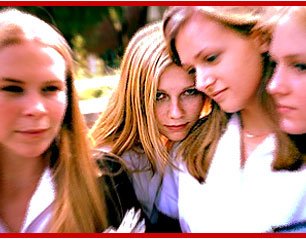
The Virgin Suicides,” based on Jeffrey Eugenides’ acclaimed novel, is a suburban tale about five teenage sisters and the tragic domino effect set off when the youngest kills herself. Kathleen Turner and James Woods play the upstanding, if oppressive, mom and dad, healthily concerned about their daughters and questioning of their own parenting skills. Partly told through the collective narration of several goofy boy-suitors who find the family and the suicides of the title somewhat difficult to comprehend, screenwriter and director Sofia Coppola’s first feature develops into a dark, ethereal — and at times dreary — fable that challenges the banal stories seen in other cookie-cutter comic teen love movies.

Coppola, best known as Francis Ford Coppola’s daughter and for her lackluster performance in “The Godfather Part III,” was attracted to Eugenides’ novel for its classical feel, the way the author placed the story squarely in the 1970s but made it seem almost timeless. But from the earliest pairing of Coppola and the movie, which played here at Sundance and will open in April, the cheap shots and personal attacks against the director have been unusually vicious, even by Hollywood standards. Those closest to Coppola, however, have helped deflate the criticism. Woods — an actor notorious for not getting along with his directors — has been calling Coppola one of the top five talents he’s ever worked with. “She’s like all good writer-directors,” Woods said at a Sundance dinner celebrating the film. “Like Oliver Stone.”

Coppola arrived for our interview flashing a killer white smile and a flawless diamond engagement ring. Nervous and press-shy, she came off like a slightly over-privileged, arty girl next door — not unlike the untouchable young women in her picture.

James Woods told me that you were one of the top five directors he’s ever worked with.

I’ve heard him say that. I’m not agreeing, but he’s very encouraging.

How does it feel to be ranked with Oliver Stone, Harold Becker, Sergio Leone and Martin Scorsese?

It’s pretty nice. Very nice of him. Whenever I feel down, I go and talk to Jimmy. I’m so insecure. I’m excited that he is so supportive of the movie. It’s nice when you’re a first-time director and you have someone like that, you know?

With “Virgin Suicides,” have you finally found your mitier?

Directing? Yeah, I think so. I spent most of my 20s worrying, “Oh no. I don’t know what I want to do” and “I’ll try this and try that.” It’s really huge to find something that you really enjoy, something that you can really contribute something to. And I really love doing it, and I feel like it’s something that combines so many other things that I love.

Things like?

Things like photography and music and design. You get to do all of them.

How old are you now?

28.

Your marriage [to director/actor Spike Jonze] came along with your career breakthrough. Are you happy? Is it all good?

Yeah, it’s been an exciting year, and I’m glad that my husband has been successful with his film ["Being John Malkovich"]. We both shot at the same time, but you know, it’s been exciting to have been a part of that. And now to have our premiere after working so long on this movie, to finally get to show it to people — that’s exciting.

How did you come to such a fulfilling stage in your career?

This is the first time I’ve really stepped up to bat and put myself wholeheartedly into something and really tried to do things. This movie is the most I’ve ever put myself into something. And I’m so vulnerable about that. I went to art school. I was studying liberal arts, and then I went off and did “Godfather III.” And then after that I went to Cal Arts [California School of the Arts] and studied fine art. And I got into photography because my friends were photographers. I think I’m curious, and I would ask questions. We were always making little short films, and I made video movies as a kid. I was always interested in that, but having my dad being a such a huge figure in that area, it probably took me longer to come to the idea that I could direct.

What have been the disappointments in your life?

I don’t know. I mean, definitely I’ve had disappointments. I think a lot of it came with not knowing what I wanted to do, and trying to figure out my identity.

You mentioned “fear.” Was that debilitating for you?

I think it’s scary to put yourself out there, especially when your family is in the public eye. But I mean, at some point you have to forget all that.

And you’ve succeeded?

I don’t know. I just sort of put all that aside, and felt so strongly about making this movie.

Going back to 1994, when you were doing that short-lived television show “High Octane,” it seemed a strange marriage between Comedy Central and that particular show. Had it gone past the four episodes that aired, it might have succeeded as some decent journalism.

It wasn’t really a comedy show, but someone had a production deal through [Comedy Central], and so we got financing and a deal through them. At one point, they [network executives] actually said, “Well, it needs to be funnier.” Well, it wasn’t meant to be a comedy show. The idea was to make a video magazine, and we had access to people — we could get Martin Scorsese to come on and talk to us about his favorite films. On talk shows people are promoting things, but we just wanted to have a video magazine of stuff that we were interested in.

Around that time, you and Zoe Cassavetes were into the ’70s thing. And that seems to have rubbed off into your movie. Why the ’70s?

I kind of lost my interest in the ’70s because I did costumes on the movie “The Spirit of ’76″ back in ’89. And back then it was really funny to us. You know, people dressing outlandishly. But for this story, the book took place in the ’70s and I wanted to be accurate. And because of the memory aspect, I didn’t want to make it contemporary. But I tried to — I wanted the whole ’70s style to be in the backdrop and more subtle — as opposed to, you know, that joke about orange bellbottoms that’s been done a million times. And I thought that the story had a kind of timeless quality that I wanted to work with. I loved using all that stadium rock.

Yeah. The band 10cc was choice. It was really mesmerizing in that while it seemed to defy “period,” at the same time, it took me back under the bleachers in 1976. It also doesn’t isolate it to a period that other generations can’t identify with.

I think that even the kids in the movie identified with it.

You were obviously compelled by the book. What other books are on your top shelf?

“Lolita” was one of my favorite books. That was one of the books that I read when I was younger that made me want to read. It was so funny and great. I love Nabokov. And then, you know — “Madame Bovary,” “Of Human Bondage” … I always liked the classics. I like classics and epic love stories. And then when I read “The Virgin Suicides,” it was a classic, and you don’t read that many contemporary ones that feel like that.

You design clothing now?

Yeah. I have a company with some friends. We make clothes, and I did costume design when I was younger.

Does the “daddy’s girl” stigma surrounding this project bother you?

Of course I suspect that, and it concerns me how I’m going to be seen. I can’t pay too much attention to that, but I hope people see the film for what it is outside of that.

I was hearing things like “Hey. Look for Spike’s fingerprints all over that film.”

That’s stupid. Well, maybe people think if you’re a girl — well, I don’t want to make a statement like that. Look, we were making different films at the same time.

Your father visited the set. Was he helpful, or was he just a proud father?

He was just a proud father, and beforehand he was helpful. I mean, we talked a lot about filmmaking. He gave me tips beforehand. He emphasized not using a video assist. Instead, he suggested that I stand by the camera. He does that.

Were there any frightening moments during production?

Yeah, when I saw my first rough cut.

Given the overt subject matter of suicide and using glamorous girls, do you worry about how troubled youth might respond to the film?

Well, the story is not really an exploration of suicide. It’s not really about that. It’s using it as a metaphor for these boys, you know? Confusion, and the loss of innocence, and growing up. It’s not in a realistic style. I think it’s clear that it’s not real, and that we tried to make it abstract.

But it’s unfortunate that so many teenagers today live in, and live out, dangerous fantasies.

Yeah, I think that’s a big problem in our country today. But I don’t think the movie is about that, and I think that kids know it’s metaphorical.

Do you think that there’s a moral responsibility in making even a fictional film like
that?

Sure. Of course I would never want to make anything that I thought would be harmful. But they say that the biggest problem with suicide is that nobody talks about it. It’s a taboo subject. So, you know, maybe if people start talking about it, it won’t be such an under-the-table topic. My emphasis wasn’t to make it about that. And I liked that the book left it unanswered, because there are so many things in life that you can’t explain. No matter how hard you look, you can’t find an explanation for it. And I think that’s what I liked about the story.

Tell me if this is true or not. Tell me straight. Are you doing a documentary on [actor/director/underwear model] Vincent Gallo’s love life and his lovers? Male and female?

Um …

C’mon …

Um, not officially. I don’t want to say anything right now, but I’m talking to him about doing a portrait.

It’s such a wild idea though. Have you shot anything?

I don’t want to talk about it. I would if you weren’t a reporter.

Who wants short shorts?

Short films are popping up all over the Net, and at Sundance 2000, they're hotter than at any time since Wile E. and the Road Runner were driven out of movie theaters.

One of the hottest topics in the film world is that shorts are back, and not just as camp-kitsch echoes of 1976 biology class or nostalgic memories of the days when movie theaters actually played something besides commercials before the feature started. AtomFilms, one of the Internet’s premier short-film hubs, hosted its Sundance party in a mountaintop condo on Monday night. Over the canapi tray, I caught up with Patrick Lynn of MediaTrip.com, a player in the brand new world of short-film marketing who showed up in Park City with a million bucks to spend.

Can you explain why short films are getting such phenomenal attention right now?

Well, the real phenomenon is that short films now have an excellent life. On the Internet, on cable, on television — you name it. It’s their day in the sun.

Many dot-com businesses seem to be parking on “real estate” for the future, while they wait for technological innovation to catch up to them. Short films are different — they’ll actually work on the Internet at its current speed, right?

Well, the good thing is that the Internet is the lean-forward medium. Television is the lean-back medium, and that’s where the whole convergence is going to come from.

Excuse me, but what are you talking about?

When you’re on your computer, you’re leaning forward. You’re paying attention. You’re paying closer attention than you would to your television — where you’re with your remote, clicking back and forth between six or seven channels.

You’ve been around the block as a feature film buyer and seller at festivals. How is it different as a short-film buyer?

There’s been a lot of talk about how there’s going to be a big bidding war for short films. That hasn’t really materialized yet. A lot of short filmmakers don’t consider the Internet right now, when they should. They make the films for a reason, and one of the main reasons is to get some exposure. Now, another reason is to get some money up front. With the Internet, that can totally happen.

What have you acquired for MediaTrip.com recently?

We just picked up a film called “Los Gringos” that has the most amazing animation I have ever seen. It takes the “Toy Story” animation and CGI [computer-generated images], and takes them 10 steps further. They’ve got the skin tone down; they’ve got the finger movements down, the swing of a rifle — it’s all very human. There is nothing comparable to “Los Gringos.”

Did the huge success that porn filmmakers had in switching their medium to the Internet point the way for other kinds of filmmakers?

Absolutely. Nobody admits to watching porn, but it’s a billion-dollar industry. Everybody is watching the porn industry, because the porn industry knows how to make money. And everyone is watching how they’re making money, and stepping back and saying, “Now, how can we make money with short films? How can you get someone to pay to watch stuff on the Internet?” I mean, obviously it’s easier with porn. With short films it’s a little bit different, but at least there’s a mechanism in place to make that money.

Will we ever see the day when shorts will play in movie theaters again?

Well, the thing about exhibitors right now is that they’re screening the ads. That stuff brings in cash. A short film doesn’t necessarily bring in cash. I think, in the future — if it’s an “event” short film, you can help sell a feature by bringing in people that may want to see the short film.

Have you picked up anything else here at Sundance?

Right now, just “Los Gringos.” But I’m looking seriously at about five others, including films from [spinoff festivals] Slamdance, NoDance and SlamDunk. All of them have great short films. The hottest title this year is a short called “Moses vs. Godzilla.” It’s fucking hilarious.

Do you really believe that watching movies on the Internet is the wave of the future?

Well, I’ve been to Sundance before as a seller and a buyer. This time, as a buyer for the Internet, I totally feel like I’m ahead of the curve. A lot of people are still hesitant. I’ve got one thing to say to them: Get used to it.

Continue Reading Close

Killer's kicks

Christian Bale and director Mary Harron talk about yuppie killers, Bret Easton Ellis' novel and forbidden sex in the dark satire "American Psycho."

Mary Harron’s giddy dark comedy “American Psycho” is more entertaining than Bret Easton Ellis’ novel was controversial. Adapted by Ellis with Guinevere Turner and set in 1987 Manhattan, the film revolves around narcissistic Wall Streeter Patrick Bateman (Christian Bale). Bateman is the embodiment of the soulless yuppie, a man who works out to a tape of “The Texas Chainsaw Massacre,” revels in brand names and delivers trite lectures on the talents of Whitney Houston before his murders. Bale plays the slasher sociopath like Pierce Brosnan soused on a Tom Cruise cocktail. He’s perfect in the role, originally offered to Leonardo DiCaprio for his post-”Titanic” comeback.

The film, which will open wide in early April, picked up a dreaded NC-17 rating, supposedly because of a sex scene between Bateman and two prostitutes. It’s likely that they bristled at the sex position, which features the trio in a love train, with Bale watching himself in the mirror as he brings up the rear.

After the Sundance premiere, Harron (“I Shot Andy Warhol”) and Bale (“Velvet Goldmine”) fielded questions from a roomful of reporters.

Can you discuss the ratings board decision?

Mary Harron: I certainly feel that this thing with the ratings board is about the blank expression of the girls in the sex scene … I was very concerned with emphasizing the boredom of these girls. The blankness, and their indifference to it.

Christian Bale: That was a real choice because, in the book, they had the girls having multiple orgasms, and screaming …

Harron: I saw that as a Penthouse Forum fantasy. I mean, these were girls for hire. They’re not going to be sexually turned on by a client.

I find it hard to believe that the ratings board is sophisticated enough to try and judge a film by the expression on someone’s face. It’s my understanding that if there’s sex being conducted from behind, that implies forbidden anal sex, and they actually apply “three-stroke” penalties and such. Did any of that come up in your review process?

Harron: Rear entrance sex came up. It did.

What’s the scenario in a meeting like that?

Harron: I haven’t had any direct contact with the ratings board. We’re appealing it, and I will have to file an explanation about what I’m trying to do. And it’s difficult. It’s kind of complicated, but if there’s one thing it’s not — it’s not erotic. You know? It’s really about this sex for hire.

Did the SCUM Manifesto [the Valerie Solanis tract at the center of "I Shot Andy Warhol"] influence you in making this film?

Harron: Well, you know, I have to say that in some ways, Valerie Solanis would probably approve of “American Psycho” because it is a very harsh view of all these guys’ behavior. It’s not laudatory. It satirizes them viciously.

Do you think that we’re in a different era now as far as your portrayal of these Wall Streeters goes?

Harron: I have to say, I don’t regret setting it in the late ’80s. Because the thing about the late ’80s is that guys like that were really princes, and they were really revered. Everyone regarded the Wall Street guy and the stockbroker as a hero.

What attracted you to Bret Easton Ellis’ book?

Harron: I did feel that it was seriously misunderstood. The people who were attacking it, um, weren’t allowing for the fact that it was a satire on Wall Street, and on these young Turks. I mean, you can argue about the level of violence in the book, and how much of it should or shouldn’t be there, but I don’t think you can say it’s endorsed in the pages. To me then, it becomes an issue of representation. How much you write about it, how much you show. I thought the book was hilarious.

Will you be satisfied as a filmmaker if the movie comes off to audiences as a brutally dark satire? The way you perceived the book?

Harron: I think it is. But, to me, most of the murders are terrible, and you can’t make them comic. The murder of [Bateman's co-worker] Paul Allen is comic. But the murders of the homeless guy and the two women — they’re not played for comedy. You can’t. They’re not comic. And the murder of Paul Allen is only funny because he and Bateman are so loathed.

Bale: There is always something a little bit comedic, even though it is upsetting. Not so much with the homeless guy he murdered …

[To Bale] What attracted you to the role? Could you identify with the character?

Bale: Mainly, I was very surprised by the script. Mary had sent it to me, and I read it, and I hadn’t read the book yet. And I found the script hilarious, when I really wasn’t expecting it to be. It was so sort of opposite of anything I’d ever done before.

What was your favorite scene to act in?

Bale: The murder scene of Paul Allen [he hacks him to death with an ax] was one of the most enjoyable, but it also became one of the most crazy ones we were doing because I was on like 20 cappuccinos.

Were you secretly smiling about the irony of the despicable character being named “Paul Allen” — the co-founder of Microsoft?

Harron: That was the worst thing that happened. They wouldn’t let me use “Paul Owen.”

Who is “they?”

Harron: The legal department of Lion’s Gate. They said, “There’s a Paul Owen in the New York phone book, and he won’t give us permission to use his name.” Which was ridiculous. So they gave me a list of names and I said, “Oh. Well, Allen sounds like Owen.” I must have been the only person in the world who didn’t know who Paul Allen was. And no one said, “Did you get permission to use that name?” And I was like, “It’s too late, we already shot with it.” That’s horrible. I felt so bad.

What was it that made up your mind about using Christian?

Harron: What I was looking for was a complexity. When I met with Christian and I watched his face, it wasn’t a difficult decision. He reminded me of Lili Taylor in the sense that there was a lot below the surface. He had a sense of mystery and depth in his face. And I hadn’t sensed that with anyone else.

What kind of a film would it have been if you had worked with DiCaprio?

Harron: You know, I can’t say, and it’s not because he’s not a good actor. It would have been a very, very huge budget film [DiCaprio was reportedly offered $20 million to star], and that would have been a mistake. You know, money matters, and if you go up in the stratosphere on your budget then you have no control over it.

What was your budget?

Harron: It was under $10 million.

How did you prepare for the role, Christian?

Bale: I would say that the best source for research was the book. There were so many great details in it. It was informative, but at the end of the day it sort of just confirmed that I didn’t really need to go into any in-depth analysis. And also, the strange thing with this character is that because Bateman is performing the whole time — there was, you know, with most characters, there’s a great fear of showing, revealing that you’re performing. You know, you want to be as naturalistic as possible. With this, I didn’t have to hide that very much. Even when he’s by himself, there is no Bateman there. At all. So, it was a strange sort of mental preparation.

Will this movie change your career? Catapult you into stardom?

Bale: That could well be true, but I have been involved in other films where we sort of had that anticipation. It really didn’t sort of pay off.

What films?

Bale: “Velvet Goldmine.” There was a lot of excitement previous to it being released, and then, you know, I think it was Miramax not putting their money where their mouth was. Nobody knew it was actually released.

What about “Empire of the Sun?”

Bale: Well, I went a little bit insane after that because I couldn’t stand it so much and I wanted to get the hell away from it. I was just too young. So, obviously, I would love if, after “American Psycho,” I wouldn’t have to wait another year and a half to get to make another movie that I really want to make.

Continue Reading Close

Sundance postcard

Film premieres and opening night jitters -- our correspondent files his first festival dispatch.

For Sundance Film Festival veterans in the know, the best two days are the day before and the day after. Sadly, no snow fell on a serene Sundance eve, but Park City’s soon-to-be congested Main Street was navigable and condo hot tubs remained invitingly empty beneath a starry sky.

The erstwhile silver-mining town has come to resemble a Hollywood back lot in the two decades since Gentleman Bob Redford hatched his idea for a quaint independent film showcase. But this year’s film lineup still looks promising — the ancillary Burger King advertising, dot.com-a-rama and digi-overload notwithstanding. The lack of buzz around Park City on Day 1 was a good thing, but the industry rumors and half-truths are already flying.

To begin with, it’s been reported in the trades that heavyweight Miramax honcho, Harvey Weinstein is ill and hospitalized with a bacterial infection, preventing him from attending the festival this year. Of course the babbling fountain of gossip claims that the Weinstein is a lot sicker than the trades are letting on. Miramax flatly denies the rumors.

Whether he’s punching out acquisition weasels from other studios, or dropping obscene amounts of dough on obscenely awful films, Weinstein has always cut a colorful profile in Park City. Amid the cacophonous guesswork, a Miramax competitor suggested to me that Weinstein’s underlings will go on a boundless spending spree in the next two weeks to prove that the company can function like him — without him. I’ll leave that one alone, and hope for a speedy recovery instead. After all, what would Quentin Tarantino be doing these days without at least one friend on the planet?

On to opening night. Perhaps to appease the great Mormon state of Utah and top-dollar festival sponsor AT&T, programmers played it safe this year by premiering Gurinder Chadha’s “What’s Cooking?” — an interconnected tale about fractured family values. The setup focuses on four diverse Los Angeles families as they prepare to celebrate Thanksgiving. Unfortunately, the setup takes too long. Forty-five minutes into the film, it was difficult to track what the hell was going on with the Jewish, African-American, Latino and Vietnamese families. Not enough tension either. Robert Altman bored similarly with the laborious first act of last year’s festival opener “Cookie’s Fortune,” and he’s definitely to blame for the steady stream of interwoven story-line cinema clogging almost every art house artery these days.

If “What’s Cooking?” makes middle America hungry, TromaDance might whet some sick soul’s appetite. Yep, Lloyd Kaufman, the carny barker of indie cinema and creator of sludge like “The Toxic Avenger” and “Sgt. Kabukiman NYPD,” is bringing to Park City a one-day affair billed as “A Film Festival for the People” on Jan. 28. I’ll probably be there. Hell, he’s not charging …

Slamdance is back for its sixth year, featuring the return of The Filmmakers’ Lounge and a new feature called Anarchy, which is programming a slate of online short films for Slamdance.com. Of the satellite festivals, I’ll be looking at NoDance, SlamDunk, etc., but I’ll definitely be going deep inside LapDance. Conceived by Jason McHugh in 1998, this multimedia extravaganza (now merged with CrapTV.com) promises mayhem, music, the antics of “South Park” madmen Matt Stone and Trey Parker and, of course, porn stars.

With all the madness, I’m predicting that the central controversy at LapDance will probably surround filmmaker Glasgow Phillips (“One Hand Clapping”), a guy who, in my opinion, totally pussied out during a recent publicity campaign. The director had promised to broadcast a trailer of his ultimate bad-taste film, “Human Number,” on Christmas Eve. During the holiday season, he leaked a rumor that there would be a “live sacrifice” online at the stroke of midnight. Instead, he backed out — blind to the “Blair Witch” marketing possibilities — claiming that he was scared of bad press and an FBI crackdown. Now, he says he’ll premiere the film at LapDance on Jan. 27.

For Phillips’ crimes of cowardice, I’ll spoil what really happens in the trailer. A girl — the director’s girlfriend, Heather Waters — is strapped to a dental chair and forced to recite Proverbs 13. When she fucks up, her throat is cut in what is reportedly the most authentically gruesome mix of digital effects ever mastered. We’ll see …

Continue Reading Close

Star sickness

Celebrities speaking out about their afflictions can raise awareness and money.

Celebrity is a fleeting thing, fragile and impermanent. And health, like elusive fame, can vanish in an instant, leaving the subject weakened and bereft. Stardom and illness have united in banquet halls and the halls of Congress to raise money for and awareness of everything from Alzheimer’s to osteoporosis. Disease-stricken celebrities have put a familiar face on infirmities that otherwise hovered below the high-profile funding radar.

Until recently, for instance, Parkinson’s disease was just a shaky blip in the National Institutes of Health’s budget, despite the more than 1 million victims of the neurological illness. In 1998, the NIH research funding for Parkinson’s was $41 million (or $41 per person afflicted), compared with the more than $1,600 per person that is being spent to find a cure for the 980,000 citizens currently infected with HIV. Cancer, in its various forms, afflicts 8 million in the United States; as of 1998, cancer research receives $368 per person.

But the way the NIH’s budgetary pie is sliced may be changed by the presence of Doc Hollywood: Michael J. Fox. For eight years, Fox — who jump-started his career in the “Back to the Future” movies and currently stars in the ABC sitcom “Spin City” — hid his Parkinson’s disease from the public, passing off the tremors as Lyme disease or fatigue. When he finally came out, sufferers of Parkinson’s breathed a sigh of relief. Maybe with a star on board, they could get the notice they needed to help increase the funding for treatment and research.

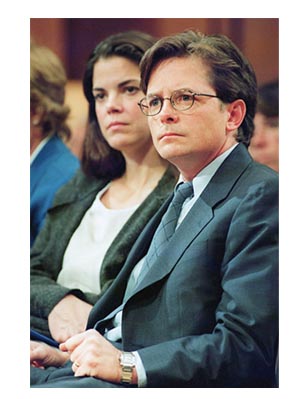
On Sept. 28, 1999, an impassioned Fox spoke before Sen. Arlen Specter and the Senate appropriations subcommittee. “What celebrity has given me is the opportunity to raise the visibility of Parkinson’s disease and focus attention on the desperate need for more research dollars,” declared Fox. “I was shocked and frustrated to learn the amount of funding for Parkinson’s disease is so meager. Compared with the amount of federal funding going to other diseases, research funding for Parkinson’s disease lags far behind.”
When members of the Parkinson’s Action Network (PAN) had spoke before the House Appropriations Committee, almost half the seats were empty. But when Fox appeared, the House was full.

Fox wasn’t the first celebrity to stump before Congress in the hope that a disease that afflicted them or loved ones would be awarded an increase in federal funding. After viewing videotaped testimony from actor Christopher Reeve, the Senate Health Committee in March approved a $1 surcharge on motor vehicle fines to pay for spinal cord research. Reeve, who was traveling and unable to appear in person, told lawmakers that the surcharge would raise more than $2.6 million a year for spinal cord research.

And then there was the appearance of the glamorous Elizabeth Taylor, who spoke out poignantly for HIV and AIDS research dollars. Her pleas were bolstered by the work of AIDS activists like the group Act-Up, who took to the streets, marching and disrupting political meetings. The dividend: well over a billion and a half dollars of NIH money distributed in 1998. And the fact that famous fixtures like Rock Hudson, tennis star Arthur Ashe and Robert (Mike Brady of “The Brady Bunch”) Reed had died of AIDS — or that basketball star Magic Johnson has the disease — didn’t hurt when it came to opening the federal pocketbook.

But celebrities are just part of the whole lobbying strategy. As PAN’s Michael Claeys points out, stars cannot do it by themselves. “The impact a celebrity has for one disease or another does help to make the issue more real. It’s helpful, but not the whole package,” he explains.

The grass-roots package includes letter writing, visits by non-stars to Washington to meet with office holders and continued pressure by constituents on their elected officials, which in the case of Act-Up was substantial. Famous folk are just the icing on the cake — but if fans get motivated behind a star and lobby Congress, more government dollars might be dropped on that celebrity’s favorite cause.

“If you’re not the squeaky wheel, you’re not getting the funding,” says Parkinson’s Action Network’s Phyllis Rosenfeld. To that end, actors and others with illnesses have been trotting down the red carpet to meet and greet the press and Congress.

The executive director of the Autism Society of Los Angeles, Frank Paradise, has worked for a variety of fund-raising agencies over the past 25 years, including AIDS Project Los Angeles. He explains, “Actors traditionally never really could be used to promote fund-raising, until the entertainers [like Elton John] came out to do concerts. That was the forum for actors to come out and speak.” But, he continues, there is still some hesitation. “It’s real easy for celebrities to come out for a disease when their friends are touched. It’s a harder pull when it comes close to home. ‘My mother or my aunt has it, but I won’t say I have had a mastectomy toward helping breast cancer research,’ is the commonly held position.”

Fear of losing one’s livelihood because of an illness often keeps celebrities in the closet over their afflictions. David Lander, best known as Squiggy from the 1970s sitcom “Laverne and Shirley,” hid his multiple sclerosis for 15 years, worried that he would lose jobs if his illness became public. On several occasions he was fired from a show and confronted by producers, he says: “They thought I was drunk, and I was relieved when they told me they thought I was an alcoholic. Hey, I thought, let them think I had a drinking problem. At least they didn’t know I had MS!”

Now Lander traverses the fund-raising circuit, appearing around the country for the MS Dinner of Champions, making personal appearances and attending MS conventions — even stopping in to visit the laboratories that manufacture the drug he takes to help control his symptoms. He looks forward to dropping in on Congress next year to help increase MS research.

The now-outspoken Lander has a few words of wisdom for diseased celebrities — especially the rather morose MS-er Montel Williams, who believes multiple sclerosis is a death sentence. “When you have the bully pulpit, you have to be careful. People will listen to you because you’re that guy on TV.” But, he also stresses, by putting his familiar face on MS, he has helped to raise money from the private sector and to show that MS is not a death sentence at all.

Lander jokes, “I got MS as a career move.” The fully mobile actor also makes a point of letting people in the industry know that his diagnosis was that he would never walk again. “When I tell them that my first thought was, ‘How many roles are there for a 36-year old Jew in a wheelchair?’ they get these looks on their faces like, ‘What if someone said that to me? What would my future be?’”

The “What if it were me?” thought prompts many celebrities to pump up the volume for research into diseases like AIDS, breast and prostate cancer as a prophylactic. However, one hidden killer lags far behind in funding and star power. Hepatitis C infects one in 50 Americans, yet receives only one-tenth the per-patient funding going to HIV/AIDS research. Naomi Judd is hoping to change that. She is spokeswoman for the American Liver Foundation and has founded her own organization, the Naomi Judd Foundation.

A country music queen, Judd was working as a registered nurse in 1983 when she pricked herself with a hepatitis C-infected needle. The retrovirus took hold, and by 1985 the singer was experiencing symptoms. Then, after a liver biopsy in 1995, she endured a successful drug regimen.

“I’m sort of the poster child for hepatitis C,” explains Judd, an admitted clean freak. “I’ve never smoked a cigarette, I’ve never drank a beer, I’ve never done IV drugs. I’ve been monogamous. I’ve never had a blood transfusion, I don’t have tattoos, I have no pierced body parts and I’m a health care worker. I’m female, I’m white, I’m middle class, I’m reasonably intelligent.”

Judd is hoping her image will turn Congress into liver lovers, since the hep C epidemic needs to be eliminated and the funding increased. And despite the disease’s presence throughout the United States and around the world, not a lot of folks are willing to step to the plate and speak out, no doubt because hep C is falsely perceived as a disease that affects only those who are unlike Judd — the pierced, the promiscuous and the perverse.

Drugs and alcohol came to a political forefront when Betty Ford admitted she had a drinking problem, and went on to found the Betty Ford Center. Nancy Reagan went one better, donning a flak jacket and storming a drug house with DEA agents in a war against drugs photo-op. Attempts to save America from drugs and alcohol have beaten a timeworn path to Capitol Hill, but when it comes to saving the children, celebrities prefer to focus on illnesses that affect kids.

One of the most devastating childhood illnesses is autism. Frank Paradise says that celebrities have their value in different ways. “They can give you things for auctions, they can do PSAs” (public service announcements). But others go the extra mile. “Actor Anthony Edwards [of "ER"] has an autistic child. He’s taken an intellectual tack — testifying for more research and funding from Congress. In his own way, he’s taken the cause to another level. But, again, there aren’t very many who would do that.”

In fact, celebrities’ changing lifestyles can conflict with fund-raising efforts. Case in point: Sylvester Stallone. While he was married to his first wife, Sasha, Stallone was active in working for autism, doing benefits and making PSAs. Since the superstar divorced the mother of his autistic child and remarried, he has ceased fund-raising for autism, according to Paradise. “With Sylvester Stallone it’s a tug of war. He did a couple of benefits and we haven’t heard from him since he split up with Sasha. Sasha was more helpful. When Sasha was pushing him, Sylvester Stallone did PSAs and a lot of fund-raisers for [autism].”

And Stallone isn’t the only star making himself scarce around autism. “There are probably more celebrity kids with autism than we know about,” speculates Paradise. Stars in denial fear image-ruining P.R. when affliction hits, and often decline to reach out to an organization.

PAN’s Rosenfeld contends that with the film and media culture, the public feels that they know somebody who has come into their living rooms. “When something happens to them, it’s the tribal instinct. This gives an opportunity for people to feel connected to a famous person. The statistics and numbers don’t mean as much until you put a face on it.”

By putting their best faces forward in Congress, celebrities hope to have an effect on their pet afflictions — not just by meeting the policy makers, but by taking a public stance. PAN’s Claeys explains that Michael J. Fox’s appearance, like that of other celebrities, served a two-fold purpose, “It’s helped raise awareness and publicity. Politicians are aware of publicity. And while Michael’s visit hasn’t translated into specific money yet, it was a tremendous help. Politicians are people, and they tend to be more interested when celebrities speak out. The attention of the press and public is brought into greater focus. And there are those voters who are now motivated and focused. And that will get attention. Politicians have two jobs, to serve the public interest and to stay in office.”

And nothing does both those jobs better than fighting sickness while shaking hands with stars. Charles Robbins — press secretary for Sen. Arlen Specter, R-Pa., who chairs the Senate Appropriations Subcommittee on Labor, Health and Human Services and Education and Related Agencies — says that he has seen the effect of celebrities on hearings. “There is in fact a greater turnout, the media comes out.” And while celebrities help focus attention on an issue, Robbins says, “You can’t make the jump that their appearances help increase funds for a specific illness.”

But celebrities do help increase the number of cameras and microphones that appear. When Specter came to Beverly Hills for a 1996 field hearing on how best to allocate federal medical research dollars, Specter acknowledged the camera crews from several television stations and syndicated shows like “Extra.”

“We had a similar hearing on this same topic in Philadelphia, and it didn’t attract much attention. But we have a different situation today,” he said in a UPI report. Along with meeting Paula Poundstone to discuss AIDS and Victoria Principal to talk about about domestic violence, the senator heard from “Seinfeld’s” Jason Alexander, “China Beach’s” Dana Delany and Bob Saget, star of “Full House” — all three of whom wanted to make sure the senator allocated funding for research into scleroderma. Scleroderma, which hardens the skin and affects internal organs, afflicts Alexander’s sister and caused the death of Saget’s sister. Saget had just completed producing and directing a TV movie “For Hope,” loosely based on his sister’s battle with scleroderma, that starred Delaney.

The celebrity show of force was important, said Alexander in the UPI article, because scleroderma was such a little-known disease — despite the fact that it affects 550,000 Americans, most of whom are women in their child-bearing years. “The people who gather funding are not well versed in [scleroderma], so you kind of need people to draw enough attention to it. And in this country, in this day and age that tends to be celebrities. We are all personally affected by it. It’s a personal concern.”

That day in 1996, Sharon Monsky, founder of the Scleroderma Research Foundation said that the effect celebrities have is usually intangible. “But today there was real money on the table, and these guys made a difference. [Specter] has power to direct money to research that will literally save many, many lives. And these celebrities helped us make an impact.”

And what an impact they made. Eighteen months later, in December 1997, the first specialized center of research in scleroderma was established at the University of Texas Health Science Center in Houston through a grant from the National Institute of Arthritis and Musculoskeletal and Skin Diseases, part of the National Institutes of Health. Total funding for the four-year grant was $3.5 million, which includes support from the NIH Office of Research on Women’s Health.

Others argue that funding shouldn’t be affected by celebrities or personal interest. Rep. John Porter, R-Ill., is the chairman of the House Appropriation Subcommittee on Labor, Health and Human Services and Education and Related Agencies, and thus Specter’s counterpart in the House. Though his wife suffers from diabetes, Porter refuses to earmark specific funds for research into that or any other disease. “As a matter of principle, congressman Porter will not set aside funding of research into specific afflictions, even though it could impact his wife’s illness,” says spokesman David Kohn. Additionally, states Kohn, Porter feels that politics should not be inserted in the spending of NIH research dollars; he believes that the NIH has a peer review process for research grants, and that the institutes understand how best to spend their funding. Porter strongly opposes specifying how the NIH should spend its budget, feeling that to do so would interfere with the NIH and its processes: “Congress should not put political judgment before scientific and medical judgment,” Porter says.

“But once a bill goes from the House and gets to the Senate,” explains Kohn, “Earmarks get added. There is real human suffering at the heart of [the senators'] efforts. It’s not just vanity. With the best of motives, senators work on issues that affect them, their constituents or members of their families. They try to make a difference and advance the work within a specific disease. The constituent factor plays into any decision by Congress, but the celebrity factor is overblown.”

“It’s an actual reality that celebrities are given an odd kind of royalty in our world,” commented Saget at 1996 congressional field hearings in Beverly Hills. “And this is one of those times that I say, ‘Thank God for celebrity,’ because you get people from government who actually sit down and listen to you because they like you. They know you’re at least pseudo-intelligent. You may not be a genius, but at least they acknowledge your presence.”

And that presence can resonate far beyond the television set, into research labs and hospitals around the nation.

- – - – - – - – - – - – - – - – - – - – -

MATCH THE STAR WITH THE SICKNESS

The following celebs are either afflicted with and/or raise awareness for a specific disease.

1. Kenny Rogers a. HIV
2. Mary Tyler Moore b. autism
3. Ann Jillian c. erectile dysfunction
4. Doug Flutie d. hepatitis C
5. Debbie Reynolds e. diabetes
6. Magic Johnson f. breast cancer
7. Bob Dole g. osteoporosis
8. Muhammad Ali h. Parkinson’s

ANSWERS: 1d; 2e; 3f; 4b; 5g; 6a; 7c; 8h

Continue Reading Close