The day that Raymond Azar was taken by force to Bagram was a quiet day in Kabul. There were no attacks and the sun was shining.
Azar, who is originally from Lebanon, is the manager of a construction company. He was on his way to Camp Eggers, the American military base near the presidential palace, when 10 armed FBI agents suddenly surrounded him.
The men, all wearing bulletproof vests, put him in handcuffs, tied him up and pushed him into an SUV. Two hours later, they unloaded Azar at the Bagram military prison 31 miles northeast of Kabul.
As Azar later testified, he was forced to sit for seven hours, his hands and feet tied to a chair. He spent the night in a cold metal container, and he received no food for 30 hours. He claimed that U.S. military officers showed him photos of his wife and four children, telling him that unless he cooperated he would never see his family again. He also said that he was photographed while naked and then given a jumpsuit to wear.
A need for this sort of place
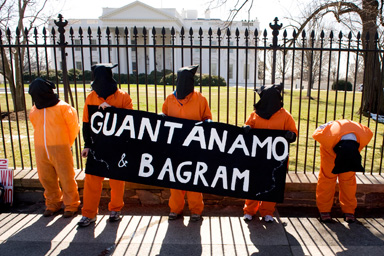
On that day, April 7, 2009, President Barack Obama had been in office for exactly 77 days. Shortly after his inauguration, Obama had ordered the closing of the Guantánamo Bay detention center and ordered the CIA to give up its secret “black site” prisons. He wanted to shed the dark legacy of the Bush years — there should be no torture anymore, no more secret kidnapping operations of terrorism suspects, no renditions. At least, that was what Obama had promised. He did not mention Bagram in his speeches.
Azar was in Kabul on business. His company had signed contracts with the Pentagon worth $50 million for reconstruction work in Afghanistan. On April 8, Azar was placed onto a Gulfstream and flown to Virginia to face charges. He was accused of having bribed his U.S. Army contact to secure military contracts for his company, and he was later found guilty of bribery.
It was a classic case of corruption, which is not the sort of crime for which a suspect is normally sent to a military prison. No one can explain to Azar why he was taken to Bagram, where the U.S. military treated him like a terrorism suspect and, in doing so, inadvertently provided him with an insight into a world it normally prefers to keep under wraps.
Bagram is “the forgotten second Guantánamo,” says American military law expert Eugene Fidell, a professor at Yale Law School. “But apparently there is a continuing need for this sort of place even under the Obama administration.”
From the beginning, “Bagram was worse than Guantánamo,” says New York-based attorney Tina Foster, who has argued several cases on behalf of detainee rights in U.S. courts. “Bagram has always been a torture chamber.”
And what does Obama say? Nothing. He never so much as mentions Bagram in any of his speeches. When discussing America’s mistreatment of detainees, he only refers to Guantánamo.
Classified location
The Bagram detention facility, by now the largest American military prison outside the United States, is not marked on any maps. In fact, its precise location, somewhere on the periphery of the giant air base northeast of the Afghan capital, is classified. It comprises two sand-colored buildings that resemble airplane hangars, surrounded by tall concrete walls and green camouflage tarps. The facility was set up in 2002 as a temporary prison on the grounds of a former Soviet air base.
Today, the two buildings contain large cages, each with the capacity to hold 25 to 30 prisoners. Up to 1,000 detainees can be held at Bagram at any one time. The detainees sleep on mats, and there is one toilet behind a white curtain for each cage. A $60 million extension is expected to be completed by the end of the year.
Unlike Guantánamo, Bagram is located in the middle of the Afghan war zone. But not all the inmates were captured in combat areas. Many terrorism suspects are from other countries and were transported to Bagram for interrogation after being captured. Since the military prison first came into operation, all the detainees there have been classified as “enemy combatants” rather than prisoners of war, which would make them subject to the provisions of the Geneva Convention.
Bagram’s most prominent temporary detainee to date was Khalid Sheikh Mohammed, the self-proclaimed chief architect of the Sept. 11, 2001, terrorist attacks. After his arrest in Pakistan, Mohammed was initially taken to Bagram for three days and was then held at a secret prison in Poland before being flown to Guantánamo. He told representatives of the Red Cross that he was beaten in Afghanistan, suspended from shackles attached to his hands and sexually humiliated. “I was made to lie on the floor,” he said. “A tube was inserted into my anus and water poured inside.”
“In my view, having visited Guantánamo several times, the Bagram facility made Guantánamo look like a nice hotel,” says military prosecutor Stuart Couch, who was given access to the interior of both facilities. “The men did not appear to be allowed to move around at will, they mostly sat in rows on the floor. It smelled like the monkey house at the zoo.”
Sleep deprivation and sexual humiliation
From the beginning, Bagram was notorious for the brutal forms of torture employed there. Former inmates report incidents of sleep deprivation, beatings and various forms of sexual humiliation. In some cases, an interrogator would place his penis along the face of the detainee while he was being questioned. Other inmates were raped with sticks or threatened with anal sex.
Omar Khadr, a Canadian inmate who was 15 at the time, says military personal used him as a living mop. “Military police poured pine oil on the floor and on me. And then, with me lying on my stomach with my hands and feet cuffed together behind me, the military police dragged me back and forth through the mixture of urine and pine oil on the floor.”
At least two men died during imprisonment. One of them, a 22-year-old taxi driver named Dilawar, was suspended by his hands from the ceiling for four days, during which U.S. military personnel repeatedly beat his legs. Dilawar died on Dec. 10, 2002. In the autopsy report, a military doctor wrote that the tissue on his legs had basically been “pulpified.” As it happens, his interrogators had already known — and later testified — that there was no evidence against Dilawar.
According to an internal military investigation of the prisoner abuse cases at Abu Ghraib prison in Iraq, which triggered worldwide outrage when it became public in 2004, the practices there were inspired by the treatment of inmates at Bagram.
Hundreds of innocent inmates
To this day, there are hardly any photos from inside Bagram, and journalists have never been given access to the detention center. Although exact numbers are unknown, there are believed to be about 600 detainees at Bagram, or close to three times as many as there currently are at Guantánamo. According to an as-yet-unpublished 2009 Pentagon report, 400 of the Bagram inmates are innocent and could be released immediately.
The detainees at Bagram still have no right to an attorney, which means that they have no legal recourse against their imprisonment and no opportunity to testify in their cases. Some have been there for years, without knowing why.
Obama has announced new guidelines for the treatment of the Bagram detainees, which would require that a U.S. military official provide assistance to each detainee — not as an attorney but as a personal adviser of sorts. This representative could then review evidence and witness testimony for the first time, and could request that a review board examine the case.
Worst abuse
However, attorney Tina Foster feels that the new initiative is just a cosmetic measure. “There is absolutely no difference between the Bush administration and the Obama administration’s position with respect to Bagram detainees’ rights,” she said during an interview.
Foster, a petite 34-year-old with dark brown eyes and black hair, took on the cases of Guantánamo detainees as an attorney with the New York-based Center for Constitutional Rights. That was before she discovered that the worst prisoner abuse happened long before the detainees arrived in Guantánamo — at Bagram.
Since 2005, Foster has worked exclusively with Bagram cases. She has appeared in court to file habeas corpus petitions for three Bagram inmates. Normally, every prisoner is entitled to habeas corpus rights, which would give him the opportunity to petition a U.S. court to investigate the reasons for his arrest.
“This ugly chapter of American history”
In early April of this year, a judge ruled in favor of Foster’s petition, arguing that because her three clients, two Yemenis and a Tunisian, had not been “captured in a battlefield situation” in Afghanistan but instead had been taken to Bagram from a third country, they too had rights guaranteed by the U.S. Constitution. “That was a huge success,” says Foster.
Last Monday, the U.S. Justice Department submitted a 64-page brief to the appeals court, challenging the decision. The Justice Department lawyers argued that, as a military prison in a combat zone, Bagram constitutes a special case.
Foster, who supported Obama during the campaign and then voted for him, is disappointed by her former idol. “When I heard his announcement to close Guantánamo, I breathed a sigh of relief that perhaps this extremely ugly chapter of American history was finally being put to an end,” she says. “Unfortunately, since then, the Obama administration has completely failed in delivering the change that was promised.”
Left in the snow
Foster plans to continue fighting for that cause, even though one of her clients, whose witness testimony figured prominently in her case, is now dead. Jawed Ahmad, who was also known as Jojo Yazemi, was a journalist working in Afghanistan for a Canadian television station. He was 22 when he was arrested in October 2007.
The Americans accused him of being in contact with the Taliban. They incarcerated Yazemi at Bagram, where he became just another “enemy combatant” — detainee No. 3,370. They left him standing in the snow for six hours, beat him, threatened him and submitted him to sleep deprivation for weeks. It was only after fellow journalists in New York launched a major media campaign in support of Yazemi that he was released — after 11 months and without any explanation as to why he had been detained in the first place.
Just six months after his release, gunmen driving a white Toyota pickup truck, the kind favored by many Taliban, shot and killed Yazemi in Kandahar. “It was one of the most terrible moments of my life,” says Tina Foster. “He was a great person and a friend.” And he was also Foster’s star witness in her case against Bagram.
Translated from the German by Christopher Sultan.
This article has been provided by Der Spiegel through a special arrangement with Salon. For more from Europe’s most-read newsmagazine, visit Spiegel Online or subscribe to the daily newsletter.
One would have to be an Afghan to categorize Thursday’s elections in Afghanistan as a totally normal day. But despite reports of dozens of attacks, massive firing of rockets in different regions and the fact that polling stations couldn’t even be opened in some parts of the country, Afghanistan’s Electoral Commission did exactly that. “We did not face any major incidents,” said commission chief Azizullah Ludin.
It’s difficult to assess just how widespread the problems have been. The security situation makes access to many parts of Afghanistan difficult. But one thing is clear from reports from news agencies, television networks, descriptions given by Afghans on the Internet and telephone calls with dozens of reporters on the ground at different places around the country: The election has been massively disrupted by Taliban attracks. In some parts of the country, especially in northern and southern Afghanistan, it has been hindered entirely.
After the polls closed on Thursday afternoon, the Afghan government made its first assessment of the situation — and it wasn’t exactly flattering. President Hamid Karzai’s authorities reported 73 direct attacks against polling stations in 15 provinces.
By contrast, voting in Kabul took place without significant disruptions. Following a shoot-out between two suspected suicide bombers and police early on Thursday morning, no further incidents were reported in the Afghan capital. The two Taliban fighters had entrenched themselves in a house and exchanged fire over the course of several hours with police. Five explosions were also heard on Thursday morning, but it has been difficult to determine what happened because of a government blackout on reporting on election day.
Karzai puts in a theatrical appearance
When President Hamid Karzai voted, he did so as theatrically as ever. Wearing his traditional green coat and accompanied by hundreds of bodyguards, he was escorted to a German school located near the entrance to the presidential palace. Like all other voters, he also had his index finger marked with indelible ink and called on Afghans to do the same. Karzai repeatedly called for “peace” and “no violence on election day.”
But not everyone heeded the president’s words. The government’s claim this evening in Kabul that the election went off relatively peacefully is a stretch. Indeed, dramatic reports of violence came from the northern part of the country. In Baghlan, about one hour south of Kunduz, Taliban insurgents stormed the small town and stopped voting altogether.
Police and international troops in Baghlan clashed violently with the Taliban, which attacked the town from numerous directions and seized control. The insurgents killed the local police chief and several other officers. Afghan sources report that U.S. troops later came to the aid of Afghan forces. They said 22 insurgents had been killed in fighting. Nevertheless, voting did not take place anywhere in the town.
Insurgents also perpetrated serious attacks in Kunduz. German officers said seven rockets were fired at the city and that injuries had been reported. They said one rocket struck a polling station and other shots were fired near a hospital. Provincial Governor Mohammed Omar said Thursday afternoon he estimated that there had been “more than 20″ attacks throughout the day.
The situation was especially critical in the district of Chahar Dara, west of Kunduz. Only one polling station was able to open, Omar said, and voters didn’t feel safe enough to go and vote. “Hardly anyone came while the polling station was open,” he said. Apparently the Taliban had set up checkpoints and checked every car. In the run-up to the election, the insurgents had threatened to cut off voters’ ink-stained fingers.
The violence did not prevent voting from taking place in Kunduz — but participation was very low. “We are assuming that only 50 percent of voters have cast their votes,” said Omar. “The others were too much in fear for their lives.” At the last election in 2005, participation was much higher, according to Omar. “We did all we could,” he said.
Afraid to venture out
The situation in Kunduz is representative of the situation in the rest of Afghanistan. Reports from the south of the country indicated that the turnout there was also very low, because many people were afraid to go to polling stations. Rocket attacks began in Kandahar and Helmand in the morning. Afterwards only a few people were brave enough to venture out of their houses to go and vote — a factor that will mainly hurt President Karzai, whose supporters live mostly in the south.
Similar reports came from other regions too. A BBC stringer in Wardak, a province just half an hour’s drive from Kabul, reported that almost no one there came out to vote. The streets in the cities were empty, the stringer said, with few people daring to venture outside. Like many other parts of the country, Wardak is considered a Taliban stronghold. Here, too, militants had threatened potential voters with death if they turned out to vote.
Besides the low turnout, numerous reports of electoral fraud created doubts about the legitimacy of the vote. Eyewitnesses reported that local tribal leaders — particularly in the most dangerous regions of the country — had taken ballot boxes to their homes and then brought them back, filled with ballot papers on which Karzai had been chosen.
It was also apparent on election day just how sloppy the allocation of voter registration cards had been. A CNN reporter encountered a 13-year-old boy who had just voted — and whose registration card correctly stated his age. It may sound like a bizarre one-off case, but it confirms the fears of observers that more than 2 million of the estimated 17 million registered voters were wrongly listed on electoral lists, or that their names appear twice.
There were also serious doubts right from the start about the reliability of the supposedly water-resistant ink which was intended to prevent multiple voting. Afghans demonstrated to camera crews just how easy it was to remove the mark from their finger using bleach. Opponents of Karzai claimed that significant electoral fraud was carried out in the south of the country using just that technique.
Afghans will only discover the outcome of the election in the coming days. The first preliminary results will probably be made public this weekend, and the final result of the first round of voting will only be announced on Sept. 17. Observers expect that none of the candidates will achieve the absolute majority of 50 percent of the vote or more needed to claim victory in the first round. If that is the case, then there will be a second round of voting, in which Karzai will go up against his most successful opposing candidate in a run-off vote to be decided by a simple majority.
Continue Reading
Close
When the deputy director of Aqtash High School talks of the government, he isn’t referring to Hamid Karzai’s central government in Kabul. Nor does he refer to the provincial administration in Kunduz. “The Taliban are our government,” Bashir says. “They have taken over our region, their commanders give the orders here.”
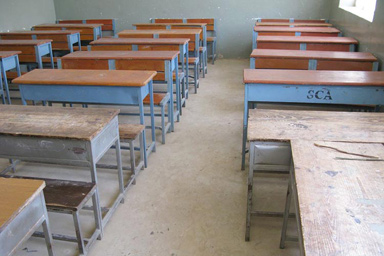
Bashir is standing in a dusty classroom on the ground floor of his modern school, roughly half an hour from Kunduz by car. As recently as just one month ago, he says, some 400 girls were still coming to the school in three daily shifts to learn reading, writing and arithmetic. Figures and formula are still scrawled across the blackboard.
But now, the girls’ classrooms have been left to deteriorate. The desks and chairs are still laid out in neat rows, but a film of dust has collected, and Bashir stands helplessly in the middle of the room. “Parents in Aqtash are afraid to send their girls to school anymore, after the death threats,” he explains. The school director speaks quietly and carefully. He too is afraid, and several of his teachers double as informants for the Taliban. The bearded fighters, he says, would certainly not like it if they knew a reporter was at the school in Aqtash. “You should leave quickly if you want to get out of Aqtash alive,” he whispers.
“Apprehended and killed”
Bashir’s warning is hardly an exaggeration. Not 30 minutes after our arrival in Aqtash, located 15 kilometers northeast of Kunduz just off the main north-south arterial, a group of a dozen Taliban fighters, armed with AK-47s, gathers in front of the blue arch at the entrance to the school. “What do you want here?” one of the fighters calls. “This is our region, the Islamic Emirate of North Afghanistan.”
The trip to the Aqtash school is a trip into the heart of the empire of the Taliban, which controls large areas around Kunduz. Minutes pass before the fighters clear out of the way, allowing us to leave.
The trip out of Aqtash is hardly any less dangerous and provides a look at the situation not 15 kilometers from the German military camp in Kunduz. There are Taliban checkpoints all over the roads, and they are well armed. The Taliban commander in the region is a man named Khalid Salim. He is young and has a reputation for brutality. Salim is on the most wanted list for the region surrounding Kunduz. “Those who work for the government or for the Western soldiers,” says one of his men at a checkpoint, “are immediately apprehended and killed.”
The fate of the school in Aqtash, which received a new roof just one year ago, paid for out of German development funds, is hardly unique. At least 10 girls’ sections of schools located near Kunduz have been closed down in the last three weeks after receiving threats from the Taliban. Parents simply stopped sending their children to school because of the danger. And the closures haven’t just been in the region of Char Dara southwest of Kunduz, a well-known Taliban hot spot. Schools in three other districts have likewise ceased operation.
No German soldiers
It didn’t take long for news of the school closures to reach the highest echelons of government in both Kabul and Berlin. Stories about schools buckling to the Taliban are exactly what they hoped to avoid. On the one hand, it shows that the Taliban is increasingly gaining the upper hand right outside the front gates of the German military camp in Kunduz. Neither the German army, the Bundeswehr, nor the local police force are effective against the Islamist extremists. At the most, they can temporarily dislodge the Taliban, but they then move on to terrorize other areas where there are no German soldiers.
Most of all, though, the closures threaten one of the few successes that the Germans have had in Afghanistan. It is an achievement that has been repeatedly trumpeted by those in favor of continued engagement; hardly a German politician has refrained from mentioning how encouraging it is to visit a girls’ school in Afghanistan. Now, though, the schools — just like in the south where recent acid attacks against schoolgirls have hit the headlines — have become a potent propaganda tool for the Taliban. Western troops, so goes the message, can’t do anything to stop the Islamist fighters.
The tactics used by the Taliban are shockingly simple. Dozens of so-called night letters, which are affixed to the doors of schools in the dead of night, are piled on Muqim Halimi’s huge desk. Halimi is the commissioner of education for the Kunduz province and a crowd of men are waiting outside his office, most of them hoping to be able to bribe their way into good grades for their children. But when Halimi hears that a German reporter wants to talk about the closure of the girls’ schools, he clears the room so he can talk undisturbed.
After confirming the closures, he reads aloud from the Taliban night letters, as simply formulated as they are explicit. “As of today,” he reads from a message from Aqtash, “girls are no longer allowed to attend school.” The letter is marked with a logo of the Islamic Emirate of Afghanistan — in English, yet another indication of just how well organized the Taliban are in the German area of operation.
“If we now kill schoolgirls …”
Another threat letter depicts a schoolgirl at the gallows. “We have warned you,” reads the message. “If we now kill schoolgirls, you shouldn’t be surprised.”
Halimi is open in his description of the precarious situation the schools find themselves in. “There is no police there and even the army is afraid to go there,” he says. “What should I do, as a civilian, against the Taliban?”
Alarmed about the reports, Afghan Interior Minister Hanif Atmar has rebuked the Kunduz police chief over the phone. The school closures are a “disgrace for Afghanistan,” he says, demanding that something be done. But police chief Abdul Racak also doesn’t know what to do. Last week he tried to send a police patrol to Aqtash, but they came under fire almost as soon as they turned off the main road. Two police officers were killed in the attack.
The reaction from the German camp in Kunduz is also a mixture of dismay and helplessness. The security situation is so poor at the moment that neither the military nor their civilian assistants can visit Aqtash themselves. Realistically, though, there isn’t much they can do to combat the threats of the Taliban. There are some 650 schools in the region surrounding Kunduz and the German theater of operation is almost the size of the U.S. state of Massachusetts. With a German contingent of just 667 soldiers, security simply cannot be guaranteed.
Reports about the closures of the girls’ schools aren’t the only indications that the Kunduz region is at risk. The German military has noted that the Taliban threats began at the exact same time as attacks against German soldiers began to increase in both number and sophistication. Since the end of April, 19 patrols have come under attack, with one soldier losing his life in an April 29 attack. So far in May there have been four well-organized assaults with soldiers wary that the next one could come at any time. Nobody believes that the correlation between the school threats and the attacks is a coincidence.
The reaction to the threats has become almost routine in recent months. The Afghans, so goes the formula, have to use their army to establish security in threatened areas like Aqtash. The Germans have held talks with their Afghan partners in the hopes that they will launch an offensive in Aqtash. German troops will support the operation, but Afghan troops should be the ones at the front.
But it would surprise no one were further girls’ schools to shut their doors by the time such an operation is launched.
Still, the news isn’t all bad. At the girls’ school in Qosh Tappeh, likewise near Kunduz, the school director, a veteran of the mujahedeen, took things into his own hands. When the Taliban showed up to his school for the second time to present their threats, he found a uniquely Afghan solution to the problem. He told his visitors that, when it comes to fighting to the death, he is much more experienced than they. Should they like to find out for sure, he offered, he would be happy to accommodate them.
His threat seemed to have worked. The girls in Qosh Tappeh continue to attend school.
This article has been provided by Der Spiegel through a special arrangement with Salon. For more from Europe’s most-read newsmagazine, visit Spiegel Online or subscribe to the daily newsletter.
The news that Afghan President Hamid Karzai was considering resignation caused considerable agitation in Western capitals late last week. It was a sudden shift. The Afghan president, once installed by the United States and lauded as a torchbearer, is now identified as the scapegoat for the West’s lack of success in Afghanistan. Nevertheless, no one in the West has any idea how things could proceed without him.
The reports of his departure were more than just another product of the Kabul rumor mill. In their classified reports, intelligence agencies noted that something was cooking in Kabul, and yet they were unable to predict exactly what was about to happen there.
The uncertainty was finally laid to rest on Saturday afternoon, when Karzai issued a decree announcing his intention to hold the presidential elections in the spring, by April 21 at the latest. Always the statesman, the president, who lacks even the power necessary to protect Kabul from the Taliban, explained that he is bound to respect the Afghan constitution. Under Article 61, the election must take place at least one month prior to the end of a sitting president’s term. Karzai’s term ends on May 21.
In his decree, Karzai emphasizes that he wants to remain president. Instead of knuckling under to the West, he is provoking the NATO protective force and the United Nations — an approach that has always scored points among Afghans. “Even if I fail,” so goes an old motto of this proud Pashtun, “I will do so with my head held high.”
The United States distanced itself from Karzai’s decision to move up the elections. US State Department spokesman Robert Wood, speaking in Washington on Saturday, said that although the decree is based on the right principles, the US government still considers it advisable to stick to the Afghan Election Commission’s original plan to hold the election in August.
Karzai is driven by various motives. He has been under great pressure in Afghanistan, where he is criticized for having given in to the West. The election commission, paid for and controlled by the U.N., had ruled that the election should not be held until August. The tense security situation and the need to provide Afghanistan with more time to recover from what has been a harsh winter, the commission argued, would preclude an earlier election — and breaching the constitution, though unfortunate, would be necessary.
Experts Rule Out Earlier Election
The decision sparked massive resistance in the country, and Karzai was criticized by his opponents and supporters alike. They also made it clear that they would no longer recognize the president after the end of his regular term in office. Weeks ago, the Taliban warned all Afghans that anyone taking part in the vote, whether as a voter or a candidate, would be a legitimate target of attack. According to Western analysts, this threat makes elections virtually unthinkable, especially in the south.
These concerns remain valid today. The 17,000 U.S. troops and several thousand European ISAF soldiers meant to provide security for the vote will not be available until the summer. Besides, the preparations — voter registration and the compilation of candidate lists — are not yet complete. The U.N. has not even come up with the $200 million it needs to organize the election. It is still collecting donations.
Not surprisingly, reactions to Karzai’s decree were clear. “There will be no election in the spring,” said a U.N. insider in Kabul only hours after the announcement of the presidential decree, “even if that’s what Karzai suddenly wants.”
“The Buck Is Being Passed to the Evil West”
Perhaps Karzai is even hoping for the West’s predictable rejection of his plan. And perhaps Karzai reasons that if the West does not manage to organize a spring election, he will be able to claim that at least he tried to obey the constitution. “The buck is being passed to the evil West,” says an EU diplomat, “which leaves Karzai looking good.” If this happens, an interim regime — led by Karzai as the “father of the nation” — could be installed until a later election date. A key advantage of this option is that Karzai could still be ousted in the election.
The election commission, playing for time, has not commented on the decree yet. Commission officials say that they cannot make a decision until they have received the official letter from the presidential palace. ISAF’s official response has also been scant. Internally, however, Karzai’s announcement has been met with concern.
Karzai confronted the West’s concerns in his decree. In its four articles, he appealed to the Afghan security forces — namely, the military, the police and the NDS intelligence agency — which are still in the process of being assembled, to do everything possible to ensure a safe election. He also called upon the “enemies of Afghanistan” to take part in the elections. However, many in the West doubt whether local authorities will be capable of providing security.
Karzai’s decision is a signal to critics at home and abroad. Under pressure at home for being Washington’s puppet, the president is looking for ways to distinguish himself. After fatal mistakes were made during NATO bombing attacks on supposed Taliban camps, Karzai was quick to level sharp criticism at the West. It was so sharp, in fact, that last fall then-U.S. Secretary of State Condoleezza Rice issued an unmistakable warning: Unless Karzai’s criticism stopped, the United States would end its cooperative relationship with him.
“There Are Plenty of Qualified Afghans”
“I will not be silent, and I will not stop promoting the interests of my people and their children,” Karzai allegedly fired back — at least according to the version his palace broadcast. But the criticism did not stop when a new administration came into power in Washington. On the contrary, President Barack Obama has, in fact, identified Afghanistan as a priority more clearly than his predecessor did, no matter who is in office in Kabul.
U.S. statements in recent weeks sounded practically like Karzai’s notice of termination. For example, when U.S. Special Envoy Richard Holbrooke was asked whether the Obama administration even supports Karzai anymore, he replied: “There are plenty of qualified, impressive Afghans in the country.” Obama had been in office for several weeks before he called his new counterpart in Afghan. Bush, on the other hand, had conferred with Karzai every week.
The opposition is already taking shape in Afghanistan. Former Interior Minister Ali Ahmed Jalali is one of Karzai’s possible challengers in an election. Karzai had removed the 68-year-old politician from his position after Jalali took legal action against the Karzai family for its alleged involvement in the drug trade. Jalali, who was often in the United States in recent months, has strong connections to the conservative camp and is claiming the role of the clean candidate for himself.
There are rumors that another man is the current favorite in the United States. Ashraf Ghani, like Jalali, holds a U.S. passport. He was an adviser at the World Bank and later served in Karzai’s cabinet as finance minister. Even though Ghani himself is suspected of involvement in nepotism, he could become Washington’s new man. Minor flaws haven’t deterred the Americans in the past. Other possible candidates are the governor of Nangahar Province and Interior Minister Mohammed Atmar.
Secret Pacts With Taliban Leaders?
But all of these candidates will not stand much of a chance if Karzai succeeds in his push for early elections. With Karzai’s envisioned election day less than two months away, none of them would have enough time to gain sufficient name recognition in the country, not even with U.S. support. This, too, is likely to have prompted Karzai to issue his decree. Whether or not the elections actually take place in accordance with constitutional rules, Karzai now enjoys an advantage.
Karzai’s sudden fondness for the constitution seems implausible, especially after the many times the president has allowed the constitution to be breached when it suited him. One of the best examples regards Foreign Minister Rangin Dadfar Spanta. Even though the politician, who lived in Germany for many years, was voted out of office by the parliament several times, Karzai kept him in his position. In Spanta’s case, the constitution was merely an impediment.
Only a fool would bet on the outcome of this race, but it is already clear that Karzai will not go without a fight. He is believed to have concluded various pacts throughout the winter with high-ranking Taliban officials and tribal leaders in the south to secure him a majority of votes. No matter how big a role U.S. support and U.N. money play, a president still has to be elected, even in Afghanistan.
Continue Reading
Close
So far, little has remained behind closed doors at the NATO summit in Bucharest, Romania. Almost every cough from every negotiating session has found its way into the press. But there is one document that has remained largely in the shadows. NATO diplomats have been working on a far-reaching strategy paper for the ongoing mission in Afghanistan.
The secrecy, some say, is necessary, as the dossier contains details that could compromise the safety of NATO troops in Afghanistan. Others have been a bit more direct, saying that the paper is simply too controversial to be made public.
According to diplomats, there are indeed some interesting details to be found. The paper illustrates a new train of thought developing within NATO: For the first time, a step-by-step outline has been sketched — with substantial help from Germany — for when the 47,000 NATO troops currently in Afghanistan might be pulled out. According to diplomats, concrete benchmarks are laid out — though any withdrawal, they make clear, would not be immediate.
It is no accident that Germany has played a big part in the drafting of the paper. It has long been clear in Berlin that Germany’s involvement in the mission has a limited shelf life given widespread opposition among the German populace and growing doubts in Parliament. Were there something of a “master plan” for the operation, politicians in the chancellery and Defense Ministry would be able to offer the prospect of German troops returning from Afghanistan. Benchmarks for what must be achieved before that happens could also be clearly defined.
German Defense Minister Franz-Josef Jung began thinking aloud about an Afghanistan master plan last autumn during a NATO meeting in the Netherlands. The current paper being circulated in Bucharest is largely based on his deliberations on the possibility of an exit strategy. In an early draft, the concepts of “networked security” and reconstruction played prominent roles. The “fight against insurgents” was only mentioned in passing. The current draft of the communiqué maintains a similar focus — though a demand for “burden sharing” among NATO allies has not been left out.
The authors of the secret paper seem to have been quite realistic when formulating their list of NATO benchmarks. They sketched out very concretely just how strong the Afghan security forces had to be before they could start taking over security responsibilities from NATO. The number of soldiers needed in the Afghan army was set at 80,000. The minimum level of competence the soldiers must achieve was also spelled out, as was a list of the army’s logistical capabilities. Given those criteria, say experts, any pullout couldn’t begin before 2015.
Indeed, diplomats say that the new plan avoids mentioning a specific date at all. There were fears that setting such a target could weaken NATO’s resolve and stoke false expectations. Furthermore, it has repeatedly become apparent just how difficult it is to meet specific goals in Afghanistan. Germany, for example, admitted just recently that its training program for police in Afghanistan has not proceeded according to plan.
Still, the new paper signals a clear and completely new direction in Afghanistan for both NATO and Germany. It calls for soldiers to gradually focus their attention more on training Afghan police forces and to hand over responsibility for actual conflict situations “as soon as external circumstances and Afghan capabilities allow.” It is precisely for this reason that several NATO countries want to expand their training programs. Defense Minister Jung has even mentioned tripling Germany’s training efforts.
But the paper also alludes to some problem areas that NATO has been studiously ignoring. Diplomats say that the paper would provide very clear benchmarks for Afghan officials in the areas of combating illicit drugs and creating an independent, accountable judiciary, for example.
Several diplomats believe that such benchmarks make the outlook for a swift withdrawal even bleaker. Indeed, Jung has completely avoided using the taboo phrase “exit strategy” in reference to the paper, but he has nevertheless been quick to praise the draft plan. He has referred to it as an “objective we can all set our sights on.”
“According to everything I’ve seen and to everything that other countries have added,” Jung said of the paper, “I am very hopeful that it can be achieved in the foreseeable future.” Specific timelines, however, remain taboo.
What the new secret plan really means for NATO in Afghanistan will become clear only in the months to come. In June, a number of NATO member states will gather in Paris for an Afghanistan summit. Only then will we know just how prepared NATO is to increase reconstruction aid.
Still, despite the paper, it is clear that NATO will not be leaving Afghanistan anytime soon. The mission, the alliance has repeatedly made clear, remains a “long-term mission.”
This article has been provided by Der Spiegel through a special arrangement with Salon. For more from Europe’s most-read newsmagazine, visit Spiegel Online or subscribe to the daily newsletter.
Continue Reading
Close
Shahidul Mullah really doesn’t have any time. Along with his friends from the island Char Bangla, he’s perched on the bamboo frame of a roof that will eventually cover a new barn he is building for his cows and chickens. But time is a luxury Shahidul doesn’t have. As he knows all too well, monsoon season is on its way — and when it arrives, virtually the entire island will be flooded. The barn has to be ready by then, especially the thatched roof.
During the flood season, Shahidul and his family will hold out for weeks on the meter-high clay plateau on which his hut and new barn stand. Once the waters recede, they will then plant chili peppers and turnips in the fertile mud left behind. It’s been like this as long as Shahidul Mullah has lived here. So he has to hurry.
The words “climate change” are ones that Shahidul — who has no electricity, no television, and can’t read — has never heard before. Yet while the debate on global warming and its likely consequences rages across the globe, the 32-year-old farmer lives on the absolute front line of climate change. His “char,” Bengali for “island,” stretches out deep into the Bay of Bengal like a finger. Flowing past it is one of the 13 rivers that make Bangladesh into a giant delta, sandwiched between the glaciers of the Himalayas and the bay. Just 20 meters from his house, a glittering mass of water moves peacefully in the direction of the nearby ocean. Any rise in global ocean levels will hit Shahidul and his family first.
Indeed, southern Bangladesh, where Shahidul lives, is one of the places on Earth most vulnerable to creeping sea levels. “Even if people stopped emitting carbon dioxide tomorrow, large regions of the South would soon be under water,” says climate expert Atiq Rahman. Approximately 10 million people live in parts of Bangladesh lying less than a meter above current sea levels. The rivers add to the problem, providing rising sea waters easy access to the country’s interior. If average sea levels rise by only a few centimeters, Shahidul Mullah’s island will cease to exist — and a rise of this magnitude is already regarded as a certainty.
Even without television and newspapers, Shahidul can sense that something just isn’t right about the weather. “It gets warmer every year, there are more storms and the monsoon doesn’t come on time,” he says. The water level in front of his house also rises a little every year. “When I moved here, we still had three fields in front of the house. Now there are only two,” Shahidul goes on. “I’m afraid the water will take another piece away from me this year.” As a precautionary measure, he had the platform for his little barn built half a meter higher. “You never know what will happen.”
Few people in southern Bangladesh know that there is such a thing as climate change. Even the local correspondent of the Daily Prothomalo, the region’s largest newspaper with a circulation of around 300,000, describes reports on global warming as “rumors.” Libtom, a well-groomed man in his mid-30s, says he heard something recently about a report on his transistor radio. What he’s referring to is the most recent climate change assessment by the United Nations Intergovernmental Panel on Climate Change.
“Right now we’re trying to find out more about it,” says Libtom. Erratic weather is completely normal in the region, he says. People know how to deal with it. The government sees things similarly, having only just established a working group to look into the IPCC study.
The front line of climate change is long. Twelve hours on an overcrowded ferry takes you from the capital city of Dhaka to Patuakhali. From there, a four-wheel-drive jeep toils for hours to cover the few kilometers to Galachipa. Here, the roads end for good. Having arrived in the massive river delta, a tattered landscape of elongated islands, only a boat can take you closer to the bay. The helmsman of our speedboat rushes through the sometimes narrow canals for two hours. Occasionally, a kilometer-wide river opens up, its water brown like milky coffee. There are no maps of this area; each boat has its own names for the rivers.
We have to stop repeatedly to let hundreds of manatees cross from one bank to the other. Large flocks of birds fly overhead and fishing boats bob up and down wherever one looks — little nutshells made of wood. Mostly, the lanky men wade through the tide with nets on the search for fish; sometimes they mount their nets on wooden posts. Even in this natural paradise, there is no lack of humans. About 150 million people are crammed into this overcrowded country, making for a density of 1,000 people for every square kilometer. The country is only 40 percent the size of Germany.
Shahidul Mullah came to Char Bangla 15 years ago. “I had no land; we found room to live here,” he says simply. The unforgiving sun beats down upon him and the other villagers. It is a simple life the people lead here and they have adapted to the extreme weather. “We learned from older generations that it rains so hard in early May that the islands are completely underwater until June,” says Shahidul Mullah. Consequently, he built his hut on a plateau and sows rice in the rainy season. When the water recedes, he switches to other crops.
It’s a system that defines the entire area. And even if these simple farmers have never heard of greenhouse gases or the ozone layer, they have their own philosophy of life. “The water has always been our enemy but also a source of life,” says Shahidul. Now, however, the bodies of water have changed. “The water just takes land away from me; it hardly gives me anything in exchange.” Who is responsible he cannot say. In his view, only Allah is capable of such change.
Subject to nature’s whims, the farmers have just been able to feed their families on the hard-earned returns of their work. It is enough for a daily bowl of dal — a yellowish porridge of lentils — onions and a little rice. A piece of meat or fish is added once a week. In the evenings, the exhausted farmer gets one or two packages of paan, a mixture of nutmeg and lime rolled up in a green leaf. This local drug is relaxing and has turned Shahidul’s teeth blood red. Besides, he says, you forget your problems; as if on cue, his friends grin and show their own sets of red teeth.
Thanks to climate change, however, Shahidul’s life is being derailed. Serious cyclones are becoming more frequent, says the farmer; this year, there was a severe cyclone even before the monsoon season began. Weather experts have in fact registered an increase in such storms in recent years — from once every 20 years to once every five years. Shahidul is not familiar with this research; his only option is to pray every evening that no storm will roll in the following morning.
At the moment, however, Shahidul has other worries. Twelve days ago, his wife, Alea Becum, left the meager abode with their three children. She wanted to see a doctor, but since the ferries rarely come by the island, she still hasn’t returned nor has he heard from them. The island has no electricity, and Shahidul has only heard of the existence of telephones. The father hopes she will come back before the monsoon; if she doesn’t, he will have to spend the wet season without his family. The only thing he can do is wait.
Indeed, Shahidul and the other inhabitants of southern Bangladesh have no choice but to wait for the coming climate crisis as well. Shahidul Mullah would like for his children to have the opportunity to live elsewhere someday. But their chances aren’t promising. The island’s little school, built by an aid organization, is only open in the dry season — not enough for a real education, much less for a life in the capital Dhaka.
“We have no future; we can only hope for better times,” says the father as he starts working on the roof again. Only God can help him out of this situation and hold the weather at bay.
Shahidul Mullah intends to pray for exactly that later this evening.
- – - – - – - – - – - – - – - – -
This article has been provided by Der Spiegel through a special arrangement with Salon. For more from Europe’s most-read newsmagazine, visit Spiegel Online or subscribe to the daily newsletter.
Continue Reading
Close