Matthias Gebauer

Freed CIA prisoner renders his version of the truth

Despite orders to remain silent, radical imam Abu Omar tells of being abducted by the CIA, shuttled to Egypt and tortured for a year.

  • more
    • All Share Services

Osama Hussein Nasr comes downstairs to show the way to his house in Alexandria, which is difficult to find amid the chaos of narrow alleys with open sewers. Suddenly he’s standing there, in front of a small cafe — a diminutive man with a long, scruffy beard and a round white cap on his head. After a brief handshake, the man better known as Abu Omar urges us to follow him back upstairs. It’s better to talk there, he says: “They’re everywhere down here on the street, the security people.”

Abu Omar isn’t allowed to receive visits from Western journalists. He says his “friends” — the Egyptian authorities — have “strongly advised” him to observe this prohibition. Abu Omar is nervous. The 46-year-old was released from jail on Feb. 11 and has been free, at least officially, ever since. The authorities have dropped all charges against him. Nevertheless, he is violating his orders by meeting with us. “I have two options,” he says. “Either I can keep quiet, do what I’m told and live a quiet life — or I can tell my story to the world and risk running into a lot of problems.”

He keeps looking over his shoulder throughout the few meters it takes to get to his decrepit apartment building in a side alley. He has to watch his back: The men lurking behind hookahs, the street vendors, the men loitering around — any one of them could be a policeman. “I’m under surveillance around the clock,” Abu Omar says. “To them, I’m a walking risk factor.” But his decision, preceded by lengthy negotiations with his lawyer in Cairo, now stands. Abu Omar wants to talk, “no matter what the consequences for me will be.” As his lawyer puts it: The world must be told “the truth.”

Abu Omar’s story is at the center of one of the most dubious CIA operations to be conducted since the Sept. 11, 2001, terrorist attacks. On Feb. 17, 2003, agents employed by the U.S. foreign intelligence agency kidnapped the radical imam right off the street in the center of Milan, Italy. The imam was certainly no docile pacifist: For years he had preached messages of hate against the United States to fundamentalist Muslims in Milan. He fought in Afghanistan himself and he’s said to have encouraged young recruits of jihad to do the same. To the Italians, Abu Omar was one of the big fish and his arrest was imminent. But for the CIA he was a target and the U.S. terrorist hunters didn’t want to wait for the rule of law to complete its course. They wanted men like Omar to be taken out of circulation as quickly and quietly as possible.

Omar’s kidnappers flew him back to his home country of Egypt, using one of the CIA’s Learjets — planes that have since become notorious for their role in clandestinely shuttling suspected terrorists through Europe on their way to countries that often permitted torture to extract confessions and information. The plan was for the Egyptian intelligence agency’s unscrupulous interrogators to extract as much information out of Omar as possible.

Egypt complied with its ally’s request. If what Abu Omar says is true, what began for him on the other side of the Mediterranean was an experience of martyrdom reminiscent of the darkest days of Latin American dictatorships: Omar’s torturers, whom he describes as “vassals of the United States,” connected electrodes to his genitalia to make him talk. They almost drove him insane by playing loud music. He says he still can’t control his bladder today. As evidence, he reveals small black spots on his skin, burns from the electric shocks.

The investigators didn’t extract any useful information from Abu Omar and the operation became a disaster for the CIA. There is not a single case of the agency’s kidnappings — known as “renditions” in the jargon of its employees — that is better documented than that of Abu Omar. After finding the passports of the agents involved, as well as their enormous restaurant expense claims, and tracing their phones calls, the Milan prosecutor ultimately moved to file charges against the kidnappers. The main trial proceedings are set to start in June. And even if the 26 CIA agents charged in the case don’t appear in the dock, the trial is still expected to be a highly uncomfortable affair for many high-profile parties. That includes the Italian government, which is seeking to put the brakes on the trial using the country’s highest court.

Abu Omar breathes heavily at the top of the four flights of stairs to his three-room apartment. As soon as he’s inside, he immediately bolts the door and pulls the curtains shut. Groaning, he drops onto one of the simple, gold-dyed armchairs in the tiny living room, illuminated by the cold light from a neon tube on the ceiling. “I feel like an old man,” the 46-year-old says. “Every movement hurts my back, and my joints are still sore from being constantly restrained in prison.” His release from jail may have been a “gift from God,” but his life has been left in ruins and it is unlikely he will ever be able to put it back together, he says.

Indeed, there’s not much left of the man Italian intelligence dossiers describe as a fundamentalist Muslim agitator and a fiery advocate of jihad. Abu Omar sits in the cramped apartment with his veiled wife, Nabila, and his son, Mohammed. His brother pays the rent. Egypt has banned Abu Omar from preaching in the country, but it’s the only profession he knows. “My only diversion is the walk to a little mosque. Apart from that, I just sit here all day,” he says.

Images from Italy are flashing on the small TV set — another report on the trial against the CIA’s terrorist hunters. Abu Omar begins telling his story. He vividly remembers the late morning of Feb. 17, 2003. It seemed like it would be a day just like any other. He was on the way to his mosque, located just a few minutes from his apartment, when a man in a red car pulled alongside him. The man claimed to be with the police and asked for his papers. “I knew right away that something was wrong, but it all happened very, very quickly,” Abu Omar says. The operation had begun.

A moment after being asked to present his papers, Abu Omar felt the hands of two brawny men on his body. “They grabbed me from behind and dragged me into a white delivery van, then beat me,” he recalls. “I thought they were going to kill me.” He says he only got a quick glimpse of the “hulks,” as he calls them. He says they quickly pulled a hat over his head and tied his hands with plastic cuffs. Abu Omar lay gasping in the van’s cargo bay as it sped off, tires squeaking, in the direction of the U.S. air base at Aviano, about a two-hour drive from Milan.

When Abu Omar speaks, his voice fails. “I was completely at their mercy,” he stutters. He only saw his kidnappers once at the airport in Aviano. “They stood me on my feet, cut my clothes off and put a diaper on me,” he says. “I saw eight men in beige military uniforms and face masks.” Within the space of a second, a camera flashed and then his head was wrapped in duct tape. He wouldn’t be able to identify any of the men he saw. “They knew exactly what they were doing,” he insists.

He had no inkling of where the men were taking him. He was dropped roughly onto the floor of an airplane that took off soon after. His hearing was impaired by a headset placed over his ears, but he could still sense in his stomach that he was in a plane. The kidnappers treated him like an animal, he says. “Their only concern was that I did not die,” he continues. Earlier, in the white minivan, the men suddenly broke into a panic, afraid Abu Omar might die. “They shouted wildly, one even inspected my pupils,” he says excitedly. Later, in the airplane, they kicked him when he spat out the water they funneled into his mouth.

When the airplane doors opened about eight hours later, Abu Omar felt the oppressive heat and heard a muezzin announce the morning prayer somewhere in the distance. His feet restraints were loosened and he was led down the gangway, still blindfolded. “Someone called out to me in Arabic to come down,” he remembers. “That was when I knew I must be back in Egypt.” Still blindfolded, he was taken by car to the headquarters of the Egyptian intelligence agency in the center of Cairo.

Even today, Abu Omar still doesn’t understand what the agents actually wanted from him. First, they asked him whether he wanted to help spy on fundamentalist Muslims in Milan. He refused repeatedly and was placed in solitary confinement. Then, he was suspended from the wall with his hands restrained for several days. “I was interrogated, blindfolded, again and again. They kept asking who I knew and whether I knew anything about plans for terrorist operations,” he says. But according to his own account, he didn’t have any information to give, nor did he tell them anything.

Then came the electric shocks. Abu Omar is embarrassed to talk about them. He doesn’t like having to recollect that he “begged for mercy because of the pain” when electrodes were attached to his genitals and other body parts. “I would have told them anything, but I didn’t know what they wanted to hear,” he says. Still the interrogators continued to torture him every few days until he lost consciousness. Once, he says, someone whispered to him that Egypt had nothing against him and that he was being held purely because of the United States. It would be better for him to cooperate, the person said, otherwise the torture would continue.

But Abu Omar was, in fact, a problem for Egypt. The authorities released him one year after the kidnapping — on the condition that he spoke neither about the kidnapping nor about his time in prison. But the imam immediately made phone calls to Italy, speaking to his wife and friends. The police, who had long wanted to find out more about Abu Omar’s disappearance, had wiretapped his phone lines. Ultimately his brief release from jail turned out to be counterproductive for his captors, since the phone calls provided Italian legal authorities with proof that Abu Omar had in fact been kidnapped.

It didn’t take more than a few days before Egyptian police had hauled the imam back to jail. And though it may have been a normal jail this time, they still put him in solitary confinement. “The first thing they did was punish me because I had talked,” Abu Omar says. Once again, he was tortured with electric shocks and loud music was played, preventing him from sleeping for days. But one thing changed: He was no longer interrogated. He says he was suddenly presented with offers such as being given $2 million and a U.S. passport. Still, it’s impossible to verify whether the claim is true — a fact he is aware of himself.

The reasons for Abu Omar’s release in February remain a mystery, even to his attorney. Abu Omar’s lawyer is devoting much of his time to pushing forward legal charges, despite the danger of Abu Omar being incarcerated again. A lawsuit against the CIA is certain. But the lawyer also found plenty of incriminating information against Italy in the case files. Italy’s intelligence agency seems to have known about the CIA’s plans, at least on the operative level, and some of its employees appear to have been involved in the kidnapping; his lawyer is requesting no less than $20 million from Rome and Washington.

Abu Omar has found an additional guilty party. He may have been blindfolded through most of his ordeal, but Abu Omar says reading the news each day online has shed light on a number of facts in the case. While surfing the Internet, he became aware of the U.S. military base in Ramstein, Germany, where the plane that took him to Cairo made a brief stopover. “Germany certainly shares responsibility for what happened to me. After all, the German government allowed the CIA jet to land in Ramstein and then fly on,” he says in an unwavering tone. “All those who did nothing to prevent the CIA’s activities abetted them.”

Abu Omar’s lawyer is still in the process of making concrete plans about which steps to take next. For now, he wants to fly to Milan and inspect more of the trial records. Back home in Alexandria, Abu Omar is well aware that any statements he makes about his kidnapping could quickly land him back in jail. Egyptian authorities do not want further light being shed on the case; nor does the Arab country, with its dependence on the United States, want to see any legal action against the CIA. “From their point of view, it would probably be best if I just disappeared somewhere,” he says.

Of course, the imam knows that meeting with Western journalists and his critical statements on the Egyptian government could have serious consequences.

“Look here, next to the door,” he says as his visitors are about to leave. “There’s a little bag with a few clothes.” His wife, Nabila, packed the duffel bag for the next trip to prison, he says. “Let me know before you publish the story,” he calls after us as we walk down the staircase. “That way I can prepare for the visit from the police.”

- – - – - – - – - – - -

This article has been provided by Der Spiegel through a special arrangement with Salon. For more from Europe’s most-read newsmagazine, please visit Spiegel Online or subscribe to the daily newsletter.

Is Israel facing a quagmire?

As many as 14 Israeli troops were killed by Hezbollah forces Wednesday, raising the specter of a grinding guerrilla war Israelis don't want.

  • more
    • All Share Services

On the map the war looks so straightforward. An Israeli commander has marked Hezbollah strongholds in south Lebanon red for the purposes of our briefing — lately practically all of the towns north of the Israeli border are colored red. Marked with blue crosses are the strategically important positions, mostly crossroads, now controlled by Israel. “Now we have to just go in and deal with the Hezbollah boys,” the commander, who asked not to be identified, said. “There isn’t much more to say.”

Only a few hundred meters from Bokim Battalion’s base — a unit dispatched to Avivim in northern Israel for the battle against Hezbollah — lies Lebanon. For the past few days the Israeli army has been launching a series of compact commando missions, at the most comprising a few tanks and a couple of dozen men, across the border. The idea is to weaken Hezbollah, putting a stop to the nearly 100 small missiles fired at Israel every day and leading ultimately to victory in the war against the Islamist militia.

The mission, christened “Just Reward,” now appears much more difficult than was first thought — above all in terms of casualties. Since the small targeted ground operations began Israeli soldiers have been dying on a daily basis in heavy firefights. Wednesday was especially bloody. In an attempt to take the Hezbollah stronghold of Bint Jbail, as many as 14 Israelis lost their lives.

Military analysts and politicians talked confidently at the beginning of the mission of targeted, surgical assaults against Hezbollah and an estimated conflict duration of about a week. Now Israel is increasingly preparing for a long war. Even the commander in Avivim just shrugs his shoulders when he is asked when the war will end. “We are fighting against an invisible enemy … against small hidden positions all over southern Lebanon, against weapons concealed in bunkers,” he says. “That can take a while.”

Still the newspapers have refrained from criticism, describing merely the dilemma the army faces. “Two weeks after Israel set out to defeat Hezbollah, its military achievements are pretty limited,” wrote columnist Yoel Marcus in the newspaper Haaretz. However, should more deaths, injuries and minor victories for Hezbollah occur in the coming days, the mood could change. Already Israelis are starting to hear and read comparisons with Iraq or Afghanistan.

The long road toward Avivim is an impressive display of Israel’s military superiority. The army’s heavy tanks line the roadsides, with soldiers sitting on top polishing their weapons. Artillery fires night and day. And Apache attack helicopters fly almost continuous sorties over the border. You can hear the explosions from their deadly cargo even from Avivim.

But all this technology has its limits. Despite days of bombardment from the air, Hezbollah appears to have been only slightly weakened, and continues launching around 80 missiles at Israel every day. For days the military has been indicating that only a ground offensive can achieve its objective. “We have to go into the villages,” says the commander. “But it is obvious that we will be attacked there.” Even more obvious is the fact that Hezbollah’s fighters will have an advantage because of their local knowledge.

That it would not remain simply an aerial war must have been apparent to those responsible in Ehud Olmert’s government. During the past few days Israeli newspapers have reported that two years ago an attack against Hezbollah was played out on the military planning table. The result: Simply bombing the Hezbollah militia from a height of 10,000 meters would be ineffective against its small bunkers, plentiful weapons, and improvised yet functioning communications system.

Ultimately the Israelis are experiencing conditions similar to those the U.S. has encountered in Iraq and Afghanistan — the classical arena of asymmetric warfare and a prime example of an army facing a difficult-to-identify enemy. They are fighting against troops without uniforms, with no bases and with incalculable support from the local populace. “A father, who will be feeding his child one moment, can suddenly become a fighter, and then switch back again,” said an Israeli general recently.

In the fight for Bint Jbail a further problem in the offensive against the militants became apparent. The Israeli military is unable to reach many corners of the town with its well-armored tanks. “We had to advance house by house, street by street,” said a military spokesman on Tuesday. But it is exactly this sort of fighting that Hezbollah guerrillas specialize in. Their fighters know where the good hiding spots and firing positions are. Above all, they know the escape routes. Israeli air superiority is of little help.

Listening to the exhausted soldiers recuperating in Avivim, the picture of classic guerrilla warfare emerges — exactly the kind of fight for which Hezbollah has been preparing for years. A young tank driver, just 21 years of age, described on Monday a typical ambush. First, the tank column came under fire from the roof of a building, likely from a machine gun. When they approached the target, they were attacked from behind with an anti-tank grenade. One of the tanks was heavily damaged and a number of soldiers were injured. Two soldiers lost their lives.

Israeli soldiers, well schooled as they are in both fighting and strategy, like to describe the Hezbollah fighters as cowardly — but as dangerous just the same. “They know that they wouldn’t have a chance against us in face-to-face fight,” says one soldier. “That’s why they hide and try to lure us into ambushes.” The young Israeli was operating in Lebanon for several days, and every day, he says, he and his men came under fire. “The men who fight for Hezbollah have nothing to lose,” he says. “The only thing they want is to kill as many of us as possible.”

For Hezbollah, pictures like those from Wednesday are the best propaganda possible. Dead Israeli soldiers and the wounded being carried back over the border on stretchers by their comrades — exactly the sort of images the militants want the world to see. Their message: “Our areas cannot be taken.” Over and over in recent days they have said how much they welcome the advances by the Israeli military. According to a spokesman for Hezbollah leader Sheik Hassan Nasrallah, they want to kill as many as 40 Israelis a day.

Continue Reading Close

Hunkered down in Israel, again

Faced with Hezbollah's steady rocket attacks, Israelis remaining near the vulnerable northern border return to bunker life.

  • more
    • All Share Services

Never mind the Katyusha rockets overhead, down here it’s just plain hot. The humid air reeks with the smell of too many people, crammed into the 150-square-foot cellar right on the beachfront of the northern Israeli resort town of Nahariya. Mattresses are stacked up against the white walls during the day, and Hamwa Shoshan can’t stand the bunker anymore. Though she’s afraid of the Hezbollah attacks, she’d rather take her chances and sit with her friend Rachel at the entrance.

But there’s not much to see in front of official bunker No. 516 either. Nahariya’s normally packed beach promenade is empty these days as the conflict in the Middle East has turned the community of 56,000 into a ghost town. Only 9 kilometers from the Lebanese border, those residents who could leave Nahariya did so shortly after the first Katyushas hit here early in the morning a week ago.

Retired teacher Hamwa and Rachel had to stay. Hamwa’s husband works at a plastics factory in Haifa; otherwise they would have left, she says. The company saw no reason to halt production over a few randomly aimed rockets. Rachel stayed behind because her 92-year-old mother, Elisabeth, is bedridden. “Besides, she’s already survived many wars,” Rachel says, laughing. “She feels like she’s immune.” Bombs in Nahariya somehow are just part of the local routine.

An odd mood is prevalent among those staying behind in the north. They’re familiar with the dangers that living close to the border entails, since there have been plenty of attacks in the past — and those doesn’t even include the war in 1982. Most Israelis are so used to violence that they don’t outwardly show fear anymore. But they clearly hate living under threat enough to use the most brutal rhetoric when demanding the utter destruction of Hezbollah. Prime Minister Ehud Olmert needs to carry things through “to the end,” says Hamwa.

But in the meantime, a sort of slapstick humor dominates conversations. Hamwa and Rachel have no problem discussing in detail why the bunker doesn’t have air conditioning and television installed. And they know the latest crisis could continue for a long time. “Days, weeks or even months,” estimates Rachel. “It depends on when we’ve finally destroyed Hezbollah.”

Still, Rachel admits that her nerves are starting to wear thin. At night, she has trouble sleeping. Between midnight and dawn she leaves the bunker to barricade herself and her dog in the bathroom located in her basement. She’s not deterred by the fact that a rocket slammed into an apartment building only two blocks away. “It’s not for me,” Rachel says, referring to the bunker. With her small shop shuttered, her days are mostly filled with boredom. Watching TV doesn’t offer any escape either, since broadcasting is dominated by war coverage.

Suddenly there is a dull thud. Rachel and Hamwa jump up quickly and head toward the stairs. But then they turn back again. “That one was far away,” says Rachel, expertly, “at least 3 kilometers.” She dials the number of her daughter. She’s fled with the children to Tel Aviv. “It shouldn’t worry anyone,” Rachel says. She shrieks down the phone as her small niece picks up. Everything’s fine, it’s just a bit hot.

Everyone in Nahariya is supposed to spend the whole day in the bunker. More than 70 rockets have already struck the city. On a map hanging in a military bunker there is very little space left between the red pins marking the explosions. The soldiers, who were hurriedly ordered north after the initial escalation, can’t really do anything. “We mount patrols, make announcements, and look after security,” says the sergeant. But they can’t forewarn people — they can only rush to where the rockets strike.

The sergeant was quick to the scene of the incident when, at 7:15 p.m. on Tuesday, a rocket landed right in the center of Nahariya. Andrei Zelinksi, 37, had just sent his two daughters to the bunker. He himself wanted to run home quickly and fetch new clothes. The missile, fired completely untargeted from behind the mountains near Nahariya, struck him directly. He died immediately, making him the second person in Nahariya to be killed by a rocket attack. Seventy more have been injured.

The media swings into action when these events occur. Barely a few hours had gone by before the first photos of the father appeared on Israeli TV screens. Members of his family were interviewed. Israel is being attacked; everyone needs to know. In Haifa, the government press office organizes tours for journalists, specifically to include a couple of bombing sites and a lunch. Those journalists who can’t make the journey to the north can contact eyewitnesses directly by phone. There are lists of names posted daily on the Internet.

Hospitals are also well prepared for the onslaught of journalists. The hospital’s English-speaking spokeswoman, Judy, has a whole list of patients who can provide information in various languages. Just as happily, she leads a tour of the clinic’s underground facilities, which were constructed in 2003. “We have known for a long time that we could be attacked by Hezbollah,” she says. “When it happened, at first it was a bit hectic, but we had everything under control.”

It is the Israeli routine of war. On Wednesday, 20 young people arrive from Jerusalem. “The children in the bunkers are going crazy, but we’ll look after them,” says one of the youths. In the office of Galia Mor, the city’s cultural commissioner, there are lists of the activities that are available underground. Yoga, meditation, puppet shows, a magician and a painting course are all on offer to help time pass more quickly for people stuck in the bunkers.

But the entertainment program hasn’t yet reached bunker 516 on the beach promenade. Around midnight, a police car suddenly pulls up. One of the smiling uniformed officers asks the women to go back down into the bunker. There’s been a warning of further attacks tonight. Rachel and Hamwa obey the instructions, though reluctantly. “When they’re gone, I’m going home,” Hamwa says, offering a wink. “My bed is much better than the mattresses.”

- – - – - – - – - – - -

This article has been provided by Der Spiegel through a special arrangement with Salon. For more from Europe’s most-read newsmagazine, please visit Spiegel Online at http://www.spiegel.de/international or subscribe to the daily newsletter.

Continue Reading Close

The Pakistan powder keg

Ahmed Rashid, an expert on militant Islam, says unless the West turns up the heat on Musharraf, al-Qaida will continue to flourish there.

  • more
    • All Share Services

The investigation into the July 7 terrorist bombings in London quickly revealed connections to Pakistan. But what role if any did the country run by Gen. Pervez Musharraf play in the attacks? Pakistani journalist and scholar Ahmed Rashid tells us.

After the London bombings, police quickly revealed that most of the bombers were British citizens of Pakistani origin and that they might have traveled to Pakistan to receive instructions and training prior to the July 7 attacks. Was this a surprise to you?

People in Pakistan were very apprehensive after the bombing, but the connection with Pakistan did not come as a surprise. It was clear there was a great danger that the Pakistani community in London would carry out such an attack. It is well known that the Muslim community there is very radical — at least some of them. People also knew many of them had connections in Pakistan.

There have been a number of arrests in Pakistan in recent days. Were the roots of the London attacks in Britain, or were they in Pakistan?

The roots of the attack were in England. There has been an enormous radicalization of British Muslims in the last few years and especially since the Sept. 11, 2001, attacks in the United States. There are radical preachers; there are radical mosques. There are lots of schools there that have been teaching students the Koran on Friday afternoons and at the same time radicalizing them. There is no dearth of ideological training in England.

So how great a role does Pakistan play in international terrorism?

Pakistan remains the global center for terrorism and for the remnants of al-Qaida, which is still very strong here. The fact is, after Sept. 11, despite the many crackdowns made by the military regime of Gen. Musharraf, we haven’t effectively shut down the Pakistani militant groups. The reason for that is that these groups are very closely tied into the military’s foreign policy, especially with respect to Kashmir and Afghanistan. The militant groups here have not been crushed, and if the madrassas they control — they all control a certain number of such religious schools — are not shut down, we’re not going to see an end to militancy here.

So in other words, despite Musharraf’s claims to be combating terrorism — claims that he repeated in his speech to Pakistan on Thursday evening — he is not doing enough. Is that what you are saying?

When crackdowns do occur, they aren’t effective. Three hundred, or even 2,000, people are picked up; they’re held for 90 days, and then they are freed as soon as the attention and pressure from the West has stopped. There has never been an organized campaign to combat it. It has never taken place.

In his speech, Musharraf spoke quite a bit about the July 7 bombings in London. What was the main message he was trying to communicate to his nation?

His main message was a very positive one. He said we must combat extremism and launch a jihad against radicalism. He asked that people mobilize and not vote for extremists and so on. But there has been no shortage of such speeches. The main question is whether they will be followed by any meaningful action.

Musharraf also emphasized that the London bombers were born and raised in England, as though he were trying to take the blame off of Pakistan. Do you think that’s what he was trying to say?

The message was that you don’t need to come to Pakistan to become a fanatic. You can become a fanatic in Yorkshire, in Leeds or anywhere in England because there’s enough extremism there too. That’s what he was alluding to.

You mentioned before that there is a lot of work to do in Pakistan when it comes to cracking down on extremism. But what can the West do to keep up pressure on the country and on Musharraf to energetically combat fanaticism and terrorism?

The biggest mistake the West has made with Pakistan since 9/11 has been the pursuit of private diplomacy. It hasn’t been made public. The West should spell out exactly what is expected of Pakistan and the regime. U.S. President George W. Bush, British Prime Minister Tony Blair, German Chancellor Gerhard Schroeder, they keep praising Pakistan and saying it is doing a great job hunting down al-Qaida and the Taliban, but behind the scenes they are whistling a completely different tune. The West needs to have one policy, which should be in the public domain. Then the Pakistani public would insist that Musharraf fulfill these demands.

But Musharraf is already under great pressure as he tries to walk the fine line between being allied with the West in the war on terror and at the same time having powerful factions in his society that are radicalized and extreme.

But that has been the argument for the last four years. The fact is, Musharraf is still here; he is still very much in power and absolutely nothing has been done about extremism. It is clear that Musharraf has a very political agenda. He wants to be reelected in 2007 and he wants to remain in office until 2012. And for that, he needs votes. At the same time, though, he has been trying to be a good partner with the West. But his political agenda takes precedence over any commitments to combating extremism and terrorism. An army general cannot have a political agenda while he is trying to crack down on terror.

One of the reasons the West is not putting too much pressure on Musharraf is that it is afraid of what would happen if he were no longer there. He has been targeted by assassination attempts twice in his own country. What would happen if his government were toppled or if he were killed?

I have no doubt that the army would take over again. People are afraid because the country has nuclear weapons and they think the country would fall apart. I don’t believe any of that would happen. There would be continuity.

Since the July 7 bombings, there has been lots of focus on the madrassas as breeding grounds for terrorism and radicalism. What role do these religious schools play in Pakistan?

The London bombers came to Pakistan, but I don’t think they came to attend a madrassa. I think they came here to make contacts with militant groups and possibly to get training. The majority of madrassas in Pakistan — I would say around 80 percent — play a traditional role. That means they teach the Koran and then produce mullahs or religious leaders — just like religious schools in any religion. But in Pakistan, a number of madrassas have been taken over by militant groups, and it has become a sort of badge of honor for the extremists. These madrassas have become recruiting platforms for these extremist groups. But it is difficult to close them down because they are run by the militant groups Musharraf needs for other aspects of his foreign policy.

It is suspected that Osama bin Laden is on the run or hiding somewhere in Pakistan. What role does he currently play in international terrorism?

He is on the run. His main priority at the moment is to stay alive. At the most, he may be able to provide some strategic directives through his support group. But he’s not in a position to run day-to-day operations.

Some say that he is in Pakistan and that the Pakistani secret services know where he is and could catch him, but they are not willing to.

He is certainly in Pakistan because Pakistan has traditionally had the best infrastructure for al-Qaida. I don’t think the Pakistani military knows where he is, but they aren’t looking very hard, either, because they fear the military support they get from the United States would disappear as soon as bin Laden is caught.

Indian Prime Minister Manmohan Singh was recently in Washington, and Bush promised closer cooperation with India — even support for India’s civil nuclear program. What does that mean for Pakistan?

The biggest fear of the Pakistani military is the new American relationship with India. The fact that the Americans are even willing to work with India’s nuclear program now — something they would never do with Pakistan — makes the military very nervous. They want to keep the Americans on-board, but the Pakistanis know that the long-term interests of the United States lie with India. The goal of the Pakistani military is to keep the Americans on its side for as long as possible.

Where do you see Pakistan in 10 years?

The country has a lot of potential and there is a democratic force here. But the main powers in the country at the moment are without a doubt the military and the fundamentalists.

- – - – - – - – - – - – - – - – —

This article has been provided by Der Spiegel through a special arrangement with Salon. For more from Europe’s most-read newsmagazine, please visit Spiegel Online at http://www.spiegel.de/international or subscribe to the daily newsletter.

Continue Reading Close

Temple of death

The temple of Lom Kaen in the devastated tourist hub of Phuket, Thailand, is for many the last stop in the search for missing loved ones.

  • more
    • All Share Services

Temple of death

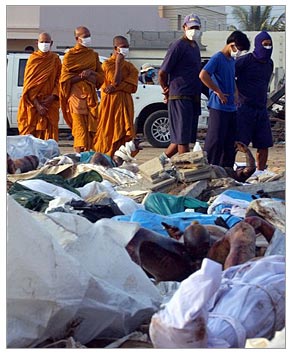
No one knows what to do with all the bodies. In death, they’re all the same — natives, foreign workers, Western tourists. They’re lined up next to each other around the golden temple of Lom Kaen in the small community of Khao Lak. No one knows how many bodies there are. Several hundred, certainly. Out of necessity and the need to keep them from getting too much exposure to sun, relief workers have wrapped the corpses in makeshift shrouds and tied them with cords. But not even the provisional packing can dampen the biting and pervasive smell of death. Every few minutes, a new pickup truck arrives with red blinking lights to deliver another load of bodies.

On Wednesday, the first fires were started. “There are just too many bodies,” a policeman said. He jabbed at the fire with a branch, hoping to speed the impromptu cremation along. The official death count for the region is close to 2,000. In preparation for the corpses that arrive at frequent intervals, people have collected wood and as much gasoline as they can round up. The temple is surrounded with the stuff. Before each corpse is burned, a photo is taken in hopes that it can later be identified. But many of the bodies are so disfigured that it’s nearly impossible to recognize anyone as he or she was in life.

Victims’ families sit next to the funeral pyres, watching and mourning. Many here have lost more than one family member. Still, these impromptu funerals are marked more by shock than pathos. A few people have brought along straw mats to squat on. Others have placed a single memorial candle in front of them and sit in silence. All are wearing masks — once white, now yellowed — over their mouths to keep the smell away. Intermittently, people spit on the ground. It’s as if they want to keep from swallowing death.

Along the Phuket island coast — once a pearl of tourism — everything has been razed. Sprawled across the beach promenade are the scattered remains of what was once a booming resort area. Now everything is twisted into itself and coated in thick layers of mud. Cars, palm trees ripped from their roots, and pieces of beach huts litter the streets. The region is “finished,” said one of the main tourist guides.

Amid the Thai families surrounding the temple, a retired Swiss man sits on a plastic chair next to his son. Both are wearing masks. “This may sound strange,” said the father, white-haired Josef Vavrina. “But I was happy when I finally found my wife here.” He then grew quiet, staring into the fire.

Last Sunday should have been a perfect day for the retired couple. “My wife, Maria, was celebrating her 63rd birthday and the sun was shining,” Vavrina said. That morning, the two had felt the underwater quake as a little vibration. “On my nightstand, there was a glass of water and I saw how the water moved,” he said. But they hadn’t paid much attention to it. Maria even told him not to worry, that it was likely just a little tremor. When he saw the water moving quickly from the coast to form a deadly wave, he ran back to his bungalow, hoping to grab his camera and photograph the phenomenon. Many other tourists had the same idea. By the time he got back to the beach, the wave was getting ready to crash. It was at least 20 meters high. “I screamed as loud as I could,” Vavrina said. But his wife didn’t hear him. Within seconds, she disappeared in the sea of water.

He spent three days searching for her. He visited every clinic on Phuket. He walked into every room. All were packed with victims. His son, also named Josef, arrived Tuesday night to help search. On Wednesday morning, they arrived at the temple.

Wearing plastic gloves, they began ripping open the makeshift shrouds of the dead. Josef, the son, who is a doctor, had seen many corpses during his studies. But none like these, he said. At first, they tried scanning the deformed bodies for something recognizable like a wedding band or earrings. But soon they realized that thieves had scoured the coasts and ripped all the valuables from the dead before they arrived at the temple. Finally, the men came upon a body they thought was hers. The son studied the corpse, confirming her identity by a few unmistakable marks.

Father and son then returned to the ruins of the couple’s room at the luxury resort, hoping to find traces of Maria’s last days. Once, the room offered a picturesque view of the stunning Khao Lak coastline. Now it was mere debris. They found little solace. “At least now we know that when she died, my mother was wearing her orange bikini, not her blue one,” the younger Vavrina said.

No one is quite sure what will become of the bodies surrounding the temple or how they will be identified before being burned. Relief workers are resisting burning anyone who looks like a tourist or a foreigner before they have been identified and a death certificate has been issued. So far, there has been no sign of any foreign officials at the temple. Consulates have sent dozens of representatives to the island but they, too, are overwhelmed by the number of bodies. Even if detectives do manage to get DNA samples from bodies before they are burned, it will be days before any of the results come back — days before any of these terrified families get any news.

Outside the temple, the Vavrinas carried their corpse to the fire. “My mother spent three days lying dead in the heat,” said Josef the son. “Now, finally, she will find peace.” His father sat motionless. As the fire continued to burn, he got up and walked along the street, not caring in which direction he was headed.

- – - – - – - – - – - -

This article has been provided by Der Spiegel through a special arrangement with Salon. ) For more from Europe’s most-read newsmagazine, please visit Spiegel Online at http://www.spiegel.de/international or subscribe to our daily newsletter.

Continue Reading Close

Page 2 of 2 in Matthias Gebauer