Maud Newton

When actors read poetry

A new app puts Dominic West, Ralph Fiennes and W.H. Auden in your pocket

This originally appeared on The Chimerist, a site devoted to the intersection of art, stories, and technology.

Words That Burn, a poetry app, includes audio and video from the late writer Josephine Hart’s Poetry Hour at the British Library. Beginning in 2004, Hart devoted an evening each month to a poet or two, “introducing and setting their poems in the context of their life,” and staging readings of the work from actors like Dominic West, Harold Pinter and Elizabeth McGovern.

The idea, Hart said, was that understanding “‘the life and philosophy of the poet illuminates the poetry,” which “readings by some of our finest actors then ignite.” In a video introduction, Hart contends that poetry is “the highest form of language, without a doubt.”

Words That Burn features 15 poets, and many more pairings: Dominic West reads Percy Shelley and Robert Lowell; Juliet Stevenson reads Emily Dickinson; Ralph Fiennes reads W.H. Auden. Harriet Walter reads Sylvia Plath; Charles Dance reads Elizabeth Bishop; Elizabeth McGovern reads Lowell and Marianne Moore; and so on. And the app is free, created by the Josephine Hart Poetry Foundation in her memory.

Alongside each recording, the text of the poem appears. Occasionally, while reciting, an actor will add or modify a word, changing the meaning of the text slightly, causing the listener to reflect on the difference between the original and what has been spoken. Some read quickly and brusquely, others languorously.

Dominic West inserts an extra “I” in Lowell’s “Man and Wife.” Harold Pinter is all force delivering Philip Larkin’s “Vers de Sociéte.”

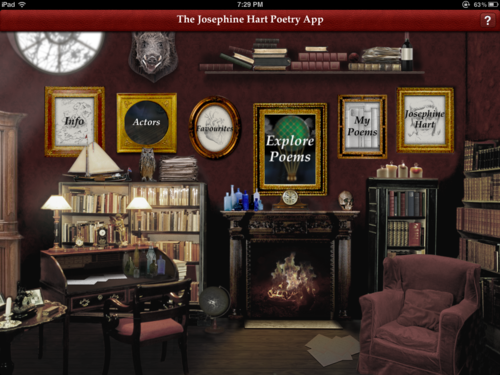
Outside the simple poetry layouts, the graphics are both wonderful and ridiculous. The main navigation screen, presented as a library, features a crackling fire, mounted animal head, and ornate gold portrait frames filled with an overlarge italicized font.

The aesthetic of this room powerfully calls to mind a strange sugar plantation whodunit game that I played in the early ’90s. Other aspects of the design are more evocative of New Yorker caricatures or Monty Python.

Getting around can be tricky. Move a balloon to the center of the screen and click just once on it to select a poem. Make sure not to confuse the app into thinking you want to read the poet’s or actor’s bio yet again. I would provide more guidance here, but I don’t want to mislead you. I still get lost, myself.

Juliet Stevenson’s rendition of “I Heard a Fly Buzz — When I Died—” is particularly lovely — slow and melodious, with pauses where I didn’t expect them, underscoring the gravity of Dickinson’s verse in a whole new way.

Hart herself, as the critic Emma Garman has said, “believed in three major destructive powers: erotic obsession, grief and envy. In her six novels, she anatomized each with an unflinching boldness that was, and remains, unparalleled.” The poetry showcased here tends to reflect those and other dark preoccupations.

A cartoonist gets personal

Alison Bechdel talks about the fraught mother-daughter relationship that shaped her latest work

This article appears courtesy of The Barnes & Noble Review.

Over three decades, Alison Bechdel’s comics have grown increasingly intimate. Her alt-weekly strip, “Dykes to Watch Out For,” was as emotionally true as it was funny and shrewd, but as with other great political cartoons of the era, like “Bloom County” and “Doonesbury,” the travails of its cast — a gay-community ensemble whose lives Bechdel chronicled from the Reagan era through the first anxious decade of a new century — only hinted at the life of the artist herself.

Barnes & Noble ReviewHer own personality burst out more explicitly in 2006 with the appearance of “Fun Home,” a masterful graphic memoir about her relationship with her clever, exacting and very closeted father, who taught school and ran a funeral home simultaneously, and whose death under mysterious circumstances raised the possibility of suicide. Critics justly heaped acclaim on “Fun Home,” praising its intricate narrative architecture and honest, despairing voice. In reconstructing her path from girlhood to womanhood, from nervous young diarist to nervous young artist, Bechdel overturned many of her family’s myths, and a host of broader cultural ones.

Her new book, “Are You My Mother?,” is even more personal, restless and reflective, a wry, self-interrogating look at her relationship with her mother, and the ways that relationship has fed — and obstructed — Bechdel’s own work. Like Roland Barthes’ “Mourning Diary,” it’s a gorgeous meditation on the lack of a mother’s love, one that keeps shuddering over a catastrophe that has already occurred; but whereas Barthes’ notes came into being in the months following his mother’s funeral, Bechdel wrote and is publishing her book while her mother is still alive. “The secret subversive goal of my work,” she has said, “is to show that women, not just lesbians, are regular human beings.” I spoke with the author by phone earlier this month about that project, and about her book and the fraught relationship it documents. The following is an edited transcript of our conversation.

The Barnes & Noble Review: You wrote ”Fun Home” looking back on your relationship with your dad, but you were constantly talking to your mom while you wrote this book. And she was a somewhat grudging subject. Was this one harder?

Alison Bechdel: Yes, as I learned during the research for ”Are You My Mother?,” and also instinctively from my experience being a human, mothers are just more difficult than fathers. It’s a much more fraught and complex relationship for everyone whether you’re male or female because this is someone who you’re physically a part of. And so it became very confounding for me, trying to sort that out. The psychoanalyst who I write a lot about in the book, Winnicott, wrote that the mother must be dismantled whereas the father can be murdered. And I feel like somehow I murdered my dad, and that was really a walk in the park. That was so much easier than dismantling my mother.

BNR: You were talking to her all the time, transcribing your conversations with her, and you had all these letters and diaries, and really precise memories, and then all of your reading, of Winnicott and Virginia Woolf and ”The Drama of the Gifted Child.” It must have been a lot to wrangle.

AB: It was, especially the Winnicott stuff. I kind of had to give myself a tutorial on psychoanalysis, which really took me a couple of years — you know, learning that language and getting a handle on it, just a slim grasp of the body of Winnicott’s ideas. That was a big project, but a kind of enjoyable procrastination too, because I couldn’t quite face what I was going to have to do.

BNR: But Winnicott ends up being, in a way, a character in the book.

AB: That was a real breakthrough for me, the moment that happened. When I began, I guess I realized it could be possible to introduce Winnicott as a character but I felt very firmly that I wasn’t going to do that, that somehow it was not in the scope of what I was doing. But then he somehow sort of insisted. That was soon after I ruled out the first name of the book and started over. Virginia Woolf and Donald Winnicott appeared in my mind crossing paths one day in London and that started me out in a new direction.

BNR: I love the way their experiences live alongside and reflect yours — your relationship with your mom, your romantic relationships, your psychoanalysis.

AB: I don’t know how this book is going to go over. I don’t know how many people are interested in psychoanalysis. I feel like most people are impatient with it.

BNR: Did you happen to see Maria Bustillos’ piece for “The Awl” about going to David Foster Wallace’s archives at the Ransom Center and looking through his self-help books?

AB: Oh God, no. I’m looking it up now. The first page I Googled has an image of ”The Drama of the Gifted Child” on it.

BNR: He wrote notes in it about his relationship with his mom, and that piece cycled around and around the Internet. ”The Drama of the Gifted Child” has a huge readership among people who are interested in literature and ideas.

AB: The interesting thing about that book is, it’s really intended for other analysts. It’s not meant for a lay audience, really. I mean it wasn’t directed toward that audience, though that’s the audience it found. But I just want to say, I’m relieved I didn’t see that. I feel like it would’ve distracted me from what I was doing.

BNR: One thing you highlight beautifully in ”Are You My Mother?” is that writers have the same problem analysts do: They compulsively analyze people. Would you say that your mom shares that tendency?

AB: Yeah, I would say she has a really keen kind of psychological insight into other people and their motivations.

BNR: Is it hard to talk about this, knowing that she might read the interviews?

AB: You know, I can’t even think about that. Whenever I do interviews I just have to assume that she’s not going to see them. She really is not interested to that extent, and I’m pretty sure she doesn’t seek stuff out online. So I think I’m just going to tell myself that she’s not going to see this interview.

BNR: OK, then, gloves off! One thing that makes her such a fascinating character is that you can’t tell — I can’t tell — whether she’s being intentionally undermining or just applying the same critical lens to your work that she uses to judge the rest of the world.

AB: I think it’s the latter, but I always have to deal with the former. You know, when she makes these comments about other writers or other cartoonists and seems to be comparing me to them, my first feeling is always that I’m coming up short and she’s criticizing me, trying to humiliate me. But I don’t think she’s really trying to do that.

BNR: That tension absolutely comes across. You transmit it so well, I found myself squirming. But I came to like her more and more as the book went along. Especially when you ask her to tell you the first thing she can think of that she learned from her mother, and she says she learned that boys are more important than girls.

AB: That was a really pivotal moment. My first therapist told me to do that, thinking it would yield some useful information, and it did. That was like the key to my childhood. I also want to say, I genuinely like my mother in a way that I don’t think a lot of my friends do. They love their mothers, they’re close to their mothers, but I don’t know if they genuinely enjoy their mothers’ company in the way that I do. Sometimes she drives me crazy, but she can also seem completely delightful. I can have serious conversations about writing with my mother, which I think is kind of amazing. I’m also still scared of her, so that was the biggest thing I had to grapple with in the book and don’t know if I succeeded. I don’t know if I really took her on in a way that if I were completely honest I would have. Because I’m still afraid of her.

BNR: She is formidable. But then at times she would play with you and make stories with you.

AB: One of my earliest, most powerful memories of my mother is playing this game where I would be a crippled child like the kids I would see at the orthopedic wing of the hospital when I would go to get my fallen arches checked up on. I was just fascinated with these children, with their external signs of disability, their crutches and braces and big shoes. There was something about that that I needed to reenact, and my mother entered into that imaginary space so willingly with me and in such an encouraging way. Even though I knew there was something weird about having this fantasy about disabled children, she didn’t censor it. She encouraged me to go with it, and I feel like she probably did that with me in lots of imaginary games as a kid but for some reason this is the one that I remember the most vividly. And I speculate in the book that it’s because it was a fantasy that she shared to a certain extent as well.

BNR: And when your OCD was making it really difficult to keep the diary, your mom would write down your entries. I remember that from ”Fun Home,” too, and both times it gave me chills. The devotion implicit in it.

AB: Oh my God, that was another pivotal moment. She would sit there and write down everything I said. It was amazing. It also becomes weirdly this template for my relationship later with therapists, other women who would sit there and take down notes on what I was saying.

BNR: Yes! What’s it like to go back and look at those journals now? Those diaries where she wrote the entries for you?

AB: It’s really powerful. I’m at the University of Chicago right now, teaching a class. I moved out here for a couple months, and part of what I’m doing is putting up an exhibit of my work in a space on campus. One of the things that I wanted to show was the way I used all these different archival references in my work.

And so I took a section from ”Fun Home,” a section where my mother starts writing in my diary near the end of Chapter 5. There’s this accident and these people are killed, one of them’s a young boy, and they’re all at our family funeral home, all the bodies. On the wall, along with the printed pages from the book, I show the topographical map of my hometown, the big coloring book page from the ”Wind in the Willows” coloring book when I was a kid. And also I scanned my childhood diary, first the spread of the week before this terrible accident when my OCD was reaching a crescendo and there’s just this childish handwriting with these big squiggles and blocks all over it, and the following week — the next thread — is my mother’s tidy handwriting. It’s still my language but her writing. I think it’s such a visual and striking image of this moment of transmission or connection with her. It’s still, you know, really arm’s length. It’s this intellectual exercise. That’s as much as I got, and that’s what I will take.

BNR: She was giving the gift she knew how to give you. It’s a striking counterpoint to her early days as a mother when she’s trying to breastfeed you and can’t, and the doctor tells her she’s not a good cow, which is (laughing) just awful.

AB (laughing): I know, he really said that.

BNR: But then the journals, the storytelling, was just something she could so naturally share with you.

AB: But what she did is a double-edged sword. Yes, she was teaching me to write, but this cathexis, for lack of a better word, around the diary entries, I feel like that’s what made me want to write memoir. That’s what makes nonfiction so vital for me. That she taught me to write about my particular life, but she doesn’t like that I do that. She really wishes that I were a fiction writer.

BNR: Right, which is…

AB: Like you.

BNR: Well, I’ve written plenty of nonfiction stuff about my mother. A lot of it seems, now that I’m older, not very generous. I was filled with rage toward her when I was younger, and now I feel much more love and empathy. Your work is vastly more mature and more nuanced.

AB: I wonder how much the empathy you’re feeling now is a result of the fact that you wrote about her, you know? Would you be able to feel that if you hadn’t done that writing?

BNR: That’s a good question. Do you think writing ”Fun Home ”and ”Are You My Mother? ”helped you move beyond and change some of your own feelings?

AB: I totally do. That’s why I do it, and it feels so fraught to talk about this because writing is not supposed to be therapeutic. A sort of analogy has occurred to me. People ask me, was writing “Fun Home” therapeutic? And I feel like, yes it was, but that’s kind of like asking somebody if swimming the English Channel was a good workout for them. That’s not why they did it — “of course “it was a good workout. Both of these books have entailed transformative processes. You can’t engineer or will yourself to undergo a transformation, but that’s what both of these books have involved. I kind of set out on a journey, and I know that that’s what I have to do, and it’s sort of a high-wire act in that respect. Especially with this book about my mother, when I had a book deal for it, I couldn’t really promise that I was going to figure this out in three years or whatever my initial contract was for. And in fact I didn’t; it took me a lot longer.

BNR: How long did it take?

AB: Six years, almost as long as ”Fun Home.” “Fun Home” was a seven-year project, but I was also writing my comic strip for that time, and with ”Are You My Mother?,” for two years of that I was writing the comic strip, and then for the next four years all I was doing was writing this book. It’s kind of crazy.

BNR: But the work shows. And your process is so painstaking. You’ll take photographs of yourself in various positions and then translate them into drawings.

AB: Yeah. That’s really crazy, I do that for every figure in the book.

BNR: One of your therapists advanced this theory, and it dovetails with some of Winnicott’s ideas and ”The Drama of the Gifted Child,” that in encouraging your diary to the extent she did, your mother was teaching you to be the repository of all of the emotions that your family couldn’t process. And so in addition to predisposing you to the memoir form by helping you write your diary, your mom was also — if that’s true — making it fraught for you.

AB: Yes. Very much. Interestingly, my father too, I feel, was complicit in the diary thing, because he’s the one who physically started me off writing in a diary. My very first entry, he wrote the first sentence or began the first sentence, “Dad is reading ‘The Trumpet of the Swan.’” Both of my parents sort of ceremonially made me the, I don’t know, repository for all of this emotional anguish.

BNR: They really liked the idea of their daughter taking on that role. I guess it’s typical to give a girl a diary — to hope that she’ll write secrets in it and use the little key that comes with it.

AB: You know, that’s so interesting. I didn’t address at all the archetypically feminine role that the diaries have, but that’s so much a part of the story too. Why is that? We don’t give boys diaries.

BNR: I laughed out loud when your mom says, after reading an early draft of the book, “You must have a pretty good memory.”

AB: Yeah, I don’t quite know how to take that.

BNR: But then she also seems pleased. She says that it coheres and there are clear themes, and it’s a meta book, which goes back to what you were saying about being able to talk with your mother about stories and about literature at a really high level.

AB: I feel like she’s at a higher level than I am. She thought of it as a meta book; I hadn’t even been thinking of it in that way. So you know, she’s actually much more well-read than I am, much more up on what’s happening in literature at this moment.

BNR: Well, as someone who spends a lot of time reading opinions about books online, I’m not really sure for a writer that that’s a good thing.

AB: In my mother’s case I wonder too if she’s so — she’s following the state of criticism so closely that she can’t write because she feels so scrutinized.

BNR: To have the level of critical acumen that she has and to have the very precise ideas that she seems to have about what stories should be and the best way to tell them — for many people, that’s death to more creative kinds of writing.

AB: As I worked on this project about her, my image of who she could have been or what she could have been kept morphing. At first I thought, oh, my mother was a frustrated poet. Then I saw more of her frustrated actress part, and in the end I feel like it’s really her frustrated critic part that is maybe the most… maybe that’s who she really would have been. Like when she says she wishes she could’ve been Helen Vendler.

BNR: And how your dad had her read books for him and help him write his papers.

AB: She should’ve been an academic, I think. She did teach high school English, but I think she could’ve gotten a PhD and been a really kick-ass poetry professor.

BNR: You write early in ”Are You My Mother?”: ”My foremost difficulty is the extent to which I have internalized my mother’s critical faculties.” Apart from all your second-guessing of your writing itself, I’ve noticed that you’re really hard on yourself for using a font based on your handwriting to letter your frames.

AB: I do feel guilty about it, like it’s somehow cheating to use a digital font, and to not actually hand-letter my work. But at the same time, I have these lengthy passages of quotations from Winnicott or from Virginia Woolf that I have obsessively hand-lettered.

BNR: So interesting: the parts that aren’t your language.

AB: Yeah. In fact those things are treated as drawings in the book, even though they’re text. I frame them as a drawing and often overlay them with my digital narration. It’s almost like I’m giving those words more attention than my own words, but not really.

BNR: I’m so interested in — and ignorant of — the mechanics of putting together graphic novels. Were all of the quotes from other writers treated as drawings, or the longer ones?

AB: Pretty much all of them. I mean, there are very short things that are just half a sentence that I might have quoted in my own narration, but most of them are actually copied from the original text where I read them. Part of it was trying to replicate my own experience as a reader. Well, not replicate but transmit. To get people to read kind of through my eyes. In my early drafts the quotations went on a lot longer. My editor really pushed me to cut them down.

BNR: How was that, working with an editor and showing her the book in stages?

AB: I had an amazing connection with my editor about this book. She’s the same editor I had for ”Fun Home,” which seems like a great gift in this era, to have that kind of continuity with a publisher. Let’s go back to the question of how I actually do the book. I do write first, but my writing is very drawing-based. I actually write in a drawing application, in Adobe Illustrator. So I’m not just writing in a word processing program, I’m creating these panels on the page and I create little text boxes for the narration or dialogue and I’m able to move that stuff all around. I’m thinking about the page as a two-dimensional field as I write, which feels to me like a kind of drawing even though I’m not drawing with a pencil or not drawing much. I will do occasional sketches. So that takes a really, really long time and that’s how I get the whole story mapped out. If you saw the pages at that point, it would be just blank boxes with the text and the dialogue, with the narration and the dialogue and maybe a few images dragged in here and there.

BNR: Is that what your mom had seen when she said that she couldn’t imagine how you were going to draw it all?

AB: Yeah. It was hard for her to read that, and it’s hard for anyone to. It doesn’t make sense unless you’re really comics literate, and my editor is somehow able to see how that stuff is working without the pictures, and then proceed to edit me the way she would edit any book. I’ve never really talked with other cartoonists about how they work with their editors. It’s hard for me to imagine Chris Ware or Joe Sacco being edited at all. I feel like drawing is more primary in their work somehow. Maybe not. I don’t know if they work with editors, but I just somehow imagine that they don’t, but who knows.

BNR: Your work feels more literary to me than a lot of graphic novelists’.

AB: Well, you know… I’m sorry to use this word in this way, but I think I probably do privilege the writing more than the drawing. I mean the drawing I do work very hard at, but it’s a little more in service of the writing than vice versa, and I think that mix varies a lot for different cartoonists.

BNR: Your visuals are wonderful, but I always feel very connected to the internality of your characters.

AB: You know what, Maud? I feel like cartooning for me has been like a way to be a crypto-writer. I couldn’t ever say I wanted to be a writer because my mother was a writer, and even now I’ve had to find this alternative way of expressing myself as a writer. I don’t want to diminish the drawing. I think it’s integral to what I do. But I’m kind of a secret writer.

BNR: Not so secret really, I hate to tell you. I was reading another interview in which you said that each of your parents had carved out and claimed huge portions of the artistic sphere. Your dad was so visual arts driven, and your mom was a writer and an actor, so you felt like cartooning was this little sliver of creative self-expression that neither of them had claimed.

AB: Yeah.

BNR: When I read about your font, I had the image of you sitting there trying to decide which –

AB: Actually, I basically did that. This guy had me write five or six versions of each letter, and then he kind of averaged them out.

BNR: Does it help with the niggly copyediting problems — “its/it’s” and whatnot — that pedants like me notice in a lot of graphic novels?

AB: Yeah, it enables me to make corrections of typos or to make last-minute editing changes in a way that would be just way too onerous to do by hand. You’d have to go in and manually erase and re-draw the “it’s” and take the apostrophe out and move the space. It would take you forever; it’s insane. So I feel like I’m able to write more carefully because I’m using a digital font. A lot of cartoonists, their stuff is filled with typos. It’s part of the charm, but I feel like my kind of writing I can’t do that. I can’t live with that.

BNR: Your work is so precise and well-considered that I would imagine you’re constantly revising. Do you ever find yourself having to choose a word that will fit in the spot?

AB: Oh yeah, very much. I’m very wordy for a cartoonist. I’m always struggling against that, because the more space your words take up the less room you have for pictures. So it’s always this precarious balancing act. I will often use a word that’s shorter than the word I really want just so I can fit it into three lines instead of going to four. I can’t give you an example right now, but I do that constantly. Editing decisions based on that really minute kind of space.

BNR: So as you’re creating the panels, as you’re drawing, do you ever find yourself shortening things so that you’ll have more room to include some other object in the panel?

AB: Well, just as a general principle, I try to keep the words at an absolute minimum. What’s interesting, as I continue with the drawing process, is that I often find spots where the words become kind of vestigial because I’m conveying something in the picture that makes them redundant. I can delete the words and get these powerful moments in the story that way. There was that one section, when I’m talking about my parents and their courtship and how my mother would like go to my father’s grad school classes with him occasionally. I had a line there saying explicitly “I think my mother should have gone to grad school” or something like that. And it became very clear as I was illustrating this that that my opinion was much more powerful as an implied thing, and so I took that line out and then it came to life. Sometimes the words overdetermine it and kill the energy of the writing. I guess that’s true of any type of writing, you hope to get to the phase when you can just delete stuff and get rid of all that baggage. But in my case, a lot of the time, it’s things I’ve already done in the drawing that enable me to get rid of words.

BNR: Your mom wished you’d written ”Fun Home” as fiction, but in the end she capitulated. She read the draft and said some perceptive things about it –

AB: I feel like she hasn’t really capitulated. She has this really amazingly schizoid response to what I’m doing. On the one hand, she’s very excited about the book actually coming out. She’s sort of anxious that it do well as a book, but just like with ”Fun Home” she doesn’t want to talk about the content of the book. And she’s really — beyond those few things that you just said, like that she observed that it coheres and it’s a meta book, she really hasn’t said much to me about the substance of the book. Has said nothing to me.

BNR: Were you conscious when writing of trying to communicate something to her about your relationship, or did you try to put her reaction out of your mind?

AB: I feel like this book is at its core just a simple and quite pathetic effort to get my mother to hear me tell her that I love her. I could not possibly do that in person, I mean I’ve tried that. I’ve done that. It goes OK, but it’s never what I want. And even having done this, I don’t… you know, I’m still waiting for some kind of response from her that I’m sure I will never get. She really feels like the book is — she sees the hostility; she doesn’t see the love. And that is distressing to me.

BNR: It’s so clearly drenched in love and in longing for that kind of response from her. But part of the tragedy of the book is that she doesn’t feel like — well, like the kind of character who’s going to be able to give that sort of response.

AB: Something that really captures her sort of split response to the book is that I got a pre-pub review that talked about my “substantive yet essentially distant” relationship with my mother, and I showed her that review and she was really psyched about it. She thought it was good. It was a starred review, and she was happy about that. She did not seem the least bit fazed to hear our relationship described as “substantive yet essentially distant.” I think she would agree that’s accurate.

BNR: Have you ever heard your mother describe your relationship?

AB: No. No, I haven’t. I have no idea what she would say. I know that she talks about me to other people, like in this kind of bragging way. I know that she’s proud of me and takes some vicarious pleasure in my successes, but she doesn’t say that to me. I only gather that she says that to other people.

BNR: So other people will tell you, “Your mom is so proud of you. She told me that your new book got a starred review in Kirkus?

AB: No, actually, I feel like I overhear her at her house. If I’m visiting, I can hear her saying to her best friend on the phone or to someone else on the phone. That’s how I know she does that. It’s like she doesn’t care if I’m overhearing her or not, I’m not really part of the – she’s not factoring me in, I don’t think.

Continue Reading Close

Joan Didion’s most beautiful book yet

Her new memoir is harsh, self-questioning exploration of her life before and after her daughter's death

This article appears courtesy of The Barnes & Noble Review.

In 2003′s “Where I Was From,” Joan Didion tells of a long wagon journey on which her great-great-grandmother buried a child, gave birth to another, contracted mountain fever twice, and sewed a quilt, “a blinding and pointless compaction of stitches,” that she must have finished en route, “somewhere in the wilderness of her own grief and illness, and just kept on stitching.” Throughout the book, Didion ruminates on her female forebears, women “pragmatic and in their deepest instincts clinically radical, given to breaking clean with everyone and everything they knew,” even their own dead babies.

Barnes & Noble ReviewIt was Didion’s adopted daughter, Quintana, at age 5 or 6, who first made all this heredity start to seem remote. And if the author harbored any lingering doubt about whether she shared her ancestors’ breaking-clean tendencies, the shattering effect of Quintana’s death in 2005, at age 39, must have swept it away. In her new memoir, “Blue Nights,” about life before and after the loss of her daughter, Didion writes, “When we talk about mortality, we are talking about our children.”

This book may be Didion’s harshest, most self-questioning book yet; it’s definitely her most beautiful. Like the stitches on her grandmother’s quilt, it covers the same material again and again, swooping down on its author’s grief with dogged, needle-like precision, from countless angles that don’t lead her anywhere soothing. “What if I fail to love this baby?” Didion worried as she carried the newborn Quintana home from the hospital. By the time of “Blue Nights,” the questions have changed. What if I didn’t love her right, the author interrogates herself. What if I didn’t love her enough? How could Didion “have missed what was so clearly there to be seen” — “the startling depths and shallows of her expressions, the quicksilver changes of mood,” the list of “Mom’s sayings” that Quintana posted on the garage wall: “Brush your teeth, brush your hair, shush I’m working“? “Was I the problem?” she wonders. “Was I always the problem?”

Didion dwelt in “Where I Was From” on her female forebears’ tendencies “toward slight and major derangements” and “apparently eccentric pronouncements,” traits she’d once seen as biologically endemic. “Blue Nights,” by contrast, fixates on nurture, on the terrible possibility that a mother’s neuroses might be contagious. At the age of 5, Quintana called a state psychiatric facility to “find out what she needed to do if she was going crazy.” Around the same time, she called Twentieth Century Fox “to find out what she needed to do to be a star.” She dreamed of a “Broken Man” who threatened to lock her in the garage, and she wrote a novel “just to show you” that told “why and how Quintana [not just the name of its author but also its protagonist] died and her friends became complete burnouts at the age of eighteen.” Once she was born, Didion admits, “I was never not afraid.” And she all but blames herself for Quintana’s nightmares. “[M]y fear of The Broken Man [was] as unquestioning as her own,” she says.

Throughout these struggles, Quintana’s psychiatric diagnosis remained frustratingly protean. Manic depression became OCD; OCD became something else, something Didion can’t remember now, but something that ultimately gave way to a succession of other conditions before “the least programmatic of her doctors settled on one that actually seemed to apply”: borderline personality disorder, a diagnosis that didn’t lead to a cure, only “a confirmed, and therefore an enforced, debility.” Depressed and anxious, Quintana drank too much. She wished for death as she lay on her sitting room floor: “Let me just be in the ground, she had kept sobbing. Let me just be in the ground and go to sleep.” She implored Didion not to read Auden’s “Funeral Blues” at her father’s funeral. “Like when someone dies,” she once told her mother, “don’t dwell on it.”

Even as she torments herself with memories of Quintana’s troubles, Didion recognizes that child-rearing standards change. While parents measure their success now by “the extent to which we manage to keep our children monitored, tethered, tied to us,” her own World War Two-era childhood emphasized independence over schooling and friends. She roamed the grounds of a psychiatric hospital, eavesdropped on the patients, and put them into stories. “There was a war in progress,” she recalls. “That war did not revolve around or in any way hinge upon the wishes of children. In return for tolerating these … truths, children were allowed to invent their own lives. The notion that they could be left to their own devices — were in fact best left so — went unquestioned.”

In the title essay of her 1979 book “The White Album,” Didion recalls a psychiatric evaluation of her own, conducted in 1968 (two years after she and her late husband, John Gregory Dunne, brought Quintana home from the hospital), that said her Rorschach responses “emphasize[d] her fundamentally pessimistic, fatalistic, and depressive view of the world around her. It is as though she feels deeply that all human effort is foredoomed to failure, a conviction which seems to push her further into a dependent, passive withdrawal.” Rather than admitting to or denying these claims, or trying to trace the source of her (mild) breakdown, Didion jokes that “an attack of vertigo and nausea does not now seem to me an inappropriate response to the summer of 1968.”

In “Blue Nights” Didion brings a compelling and paradoxical blend of skepticism, acceptance, and astringent detachment to bear on these trends in psychology — and how they both reflect and shape our own self-images. As in most of her personal writing, she’s highly attuned to these kinds of recursive absurdities, and I would guess she’s also more than a little bit amused by them. But, like the very funny Flannery O’Connor, she depicts the ridiculous with a poker-face. And, as in O’Connor, the comic element of human existence is always the obverse of something much darker.

Didion acknowledges in interviews that it was a fluke — a flu — that killed Quintana, not mental illness, not alcoholism, not anything she herself did. But as she sees her own health fail, as she tries to “maintain faith (another word for momentum),” follow the doctor’s instructions, and “collect encouraging news,” as she spends whole days in frigid waiting rooms pondering “this one question, this question with no possible answer: who do I want notified in case of emergency?,” she sustains herself by “memoriz[ing] her child’s face.” Didion’s implicit subject has always been the storyteller’s conundrum: that in standing far apart enough from life to digest it and to evoke it, the writer forgets how to live in real life. For Didion, to remember Quintana is to tell stories in which she’s not a good enough mother to Quintana, but to stop telling these stories is to run the risk that Quintana “will fade from my touch. Vanish. Pass into nothingness.” We tell ourselves stories in order to live, she once wrote. If Quintana were to disappear, Didion implies, she herself would stop existing.

Continue Reading Close

Is Adam Levin the new David Foster Wallace?

"The Instructions" is a brilliant new novel about a young Jewish boy that recalls Philip Roth and "Infinite Jest"

Adam Levin’s dark, funny, and deeply provocative first novel, “The Instructions,” comprises the scriptures of one Gurion ben-Judah Maccabee, an impossibly articulate ten-year old who might or might not be the messiah. When I say “impossibly,” I do mean impossibly, but Gurion is no cutesy child hero. He shares with Oskar Schell — the young, tambourine-playing pacifist vegan of Jonathan Safran Foer’s “Extremely Loud and Incredibly Close” — a fixation on the horrors of the past, and like Schell’s his story is propelled by a series of unlikely, seemingly symbolic coincidences. Here, though, there is no redemption, only confusion and violence — an indictment of tribe mentality, and of the concept of being “chosen.”


Barnes & Noble Review

Gurion’s scholarly erudition is so staggering, so monumentally over-the-top, that the accusation of its implausibility is embedded in the book itself. A footnote excerpts a letter from Philip Roth (his fictional counterpart, anyway), who misreads fan mail from Gurion as an adult’s “terrifically cruel and on point” mimicry of “recent so-called Jewish wunderkind authors.” Roth urges him to stop “writing from the unconvincing POV of a boy-genius whose name suggests a messianic fate” and instead to adopt the more realistic perspective of a man remembering his childhood “as a time when he, like so many of us, suspected that he was the messiah.”

Even at five years old, we are told, the boy asked scriptural questions so complex that his mentor, a rabbinical scholar, was moved to transcribe their conversations. No doubt the allegorical touchstone is different for Jewish readers, but for this fundamentalist-raised gentile the obvious echo is of Jesus’ three-day debate, at age twelve, that left Jerusalem’s temple elders astonished. (Luke 2:46-47) At times, like the fictional Roth, I struggled with Gurion’s voice — with the high diction, and the essaylets and other postmodern flourishes — but Levin has an uncanny facility for blending sympathy and satire, for making us care about his charming but dubious hero and for infusing life into this alternate, slightly fantastical reality that’s very much like our own. “The Instructions” recalls both the real Philip Roth’s “The Plot Against America,” in which aviation hero and Nazi sympathizer Charles Lindberg defeats FDR on an isolationist platform and winds up in the White House, and Kurt Vonnegut’s “Slapstick,” in which members of the Church of Jesus Christ, Kidnapped are required to “spend every waking hour” trying to find their savior, who was “kidnapped by the Forces of Evil” at the second coming. And, like Roth’s and Vonnegut’s, Levin’s flights of fancy are placed in service of a deadly serious project. Not only is he, as he recently told The Chicago Tribune, having “a conversation with Jewish literature,” he’s illustrating, in a wholly original way, exactly what sort of catastrophe results when fervent religious conviction meets brute force.

Gurion may be a scholar, but he’s also a thug, at least according to his record. He’s been kicked out of three schools, for starters. The first, the ultra-orthodox Schechter, booted him for throwing a stapler at a rabbi who said “the all-time snakiest thing anyone had ever said to me”: that Gurion could not be the messiah, because “‘The messiah will be a Jew.’” “I was half lost-tribe,” Gurion explains. “You couldn’t see it in my skin unless you were trying, but my mother’s parents were from Ethiopia and a few Ashkenazis still thought that meant I wasn’t an Israelite.” Northside Hebrew Day expelled him for distributing a pamphlet to teach fellow students how to make a pennygun — a sort of sling shot — from a balloon, a penny, and the sawed-off top of a soda bottle. The instructions, inspired by an attack Gurion witnessed on a synagogue, required recipients to pass them along, in secret, to other Israelites (Gurion rejects the word “Jews”), so that they would never again “cower amidst the masses of the Roman and Canaanite children.” Next Gurion was assigned to the lock-down program at Martin Luther King Middle School, where he lasted four days before he was accused, wrongly, of beating a boy with a cinder block.

Now enrolled at Aptakisic Junior High, Gurion has been placed under all-day surveillance with the school’s other most dangerous kids, in “The Cage.” Cut off from his fellow Israelite scholars, Gurion is drawn to kids who are, as he puts it, damaged. Meeting Eliyahu of Brooklyn, a Hasidic new arrival at AptakisicI – who is both damaged and an Israelite — causes Gurion to reflect that “Everyone I liked who wasn’t damaged was a scholar. Rather, everyone I liked who wasn’t a scholar was damaged. Or maybe the first way. The stress kept shifting.” His scriptures are primarily for “all the Israelites,” but also for “anyone who’s on the side of damage.” In his heart of hearts, Gurion knows he can’t lead both the chosen and the damaged, but as a member of both groups he refuses to choose.

The pressure that refusal comes under is made more explicit by the fact that those who shape Gurion’s messianic project most are not in fact Israelites. He learns how to write scripture from the novelist, motel owner, and ex-lawyer Flowers, who forbids Gurion “to portray him as a wise old black man who gave life-lessons to an Israelite boy.”‘I think you best not harp on about being the messiah,’” Flowers tells him. “‘[L]eak it in slowly while you’re hooking everyone, and then Blast!’”

When Gurion falls in love with a troubled but talented red-haired girl, he’s convinced she’s Jewish even after his mother pronounces her name — Eliza June Watermark — “the single most goyishe” she’s ever heard. “Hashem would never fall me in love with someone who wasn’t an Israelite,” he explains. When June reveals the next day that she’s a Unitarian, Gurion is distraught and rageful, but decides, partly on the strength of their matching birthmarks that are “an abbreviation of Adonai’s best written name,” to convert her; since Adonai neither yells “No” nor paralyzes him during the impromptu ceremony, Gurion pronounces June an Israelite.

And then there’s Gurion’s best friend, Benji. Although he isn’t an Israelite either, Gurion includes him in the dissemination of the contraband pennygun-making documents. But Benji is instructed to destroy the pamphlet rather than join in its viral spread. “‘Mine says if I don’t burn it we’re enemies,’” Benji says, when he encounters the original. “‘Theirs say, strangers, please spread this to other strangers.’” “You want me to apologize?” Gurion says. “Cause you’re not an Israelite? Because I am?”

Gurion’s dilemma — the impossibility of protecting the downtrodden while leading God’s chosen people — is tied up in the words of the Israelite prophets, in specifically Jewish tropes of identity. And it is the specificity of his tangled doctrinal illogic that makes him so sympathetic and compelling. But in our fanaticism-addled world, the implications of his story’s tragic arc resonate much further. To carve out any group for salvation is to condemn everyone outside it to damnation of one kind or another.

Inevitably, given this debut novel’s range, energy, and sprawl, pre-publication quotes compare Adam Levin to David Foster Wallace. And in its footnotes and asides, its thoroughgoing but wholly approachable intellectualism, and its relentless self-awareness, “The Instructions” really does recall “Infinite Jest.” Other forebears — Roth, Salinger, Cervantes, and “The Book of Jonah” (“the most deadpan comedy ever written”) — are explicitly evoked by Gurion himself.

But the ability to engender true sympathy in a reader for the schemes of a narcissist is a very particular and rare sort of talent. There is, of course, Humbert Humbert, whose criminal seduction of Lolita Nabokov somehow enlists his reader in rooting for. And the antihero of Iris Murdoch’s “The Sea, the Sea” fascinates as much as he repels when he takes his first love hostage. As I mull over “The Instructions,” though, my mind keeps returning – again I reveal my goyishe frame of reference — to John Milton’s Satan, the most compelling figure of “Paradise Lost.” And I think of the words of an aging country squire (quoted by Philip Pullman in an introduction to the poem), who wrote, transfixed by the fallen archangel’s saga, “I know not what the outcome may be, but this Lucifer is a damned fine fellow, and I hope he may win!”

Continue Reading Close

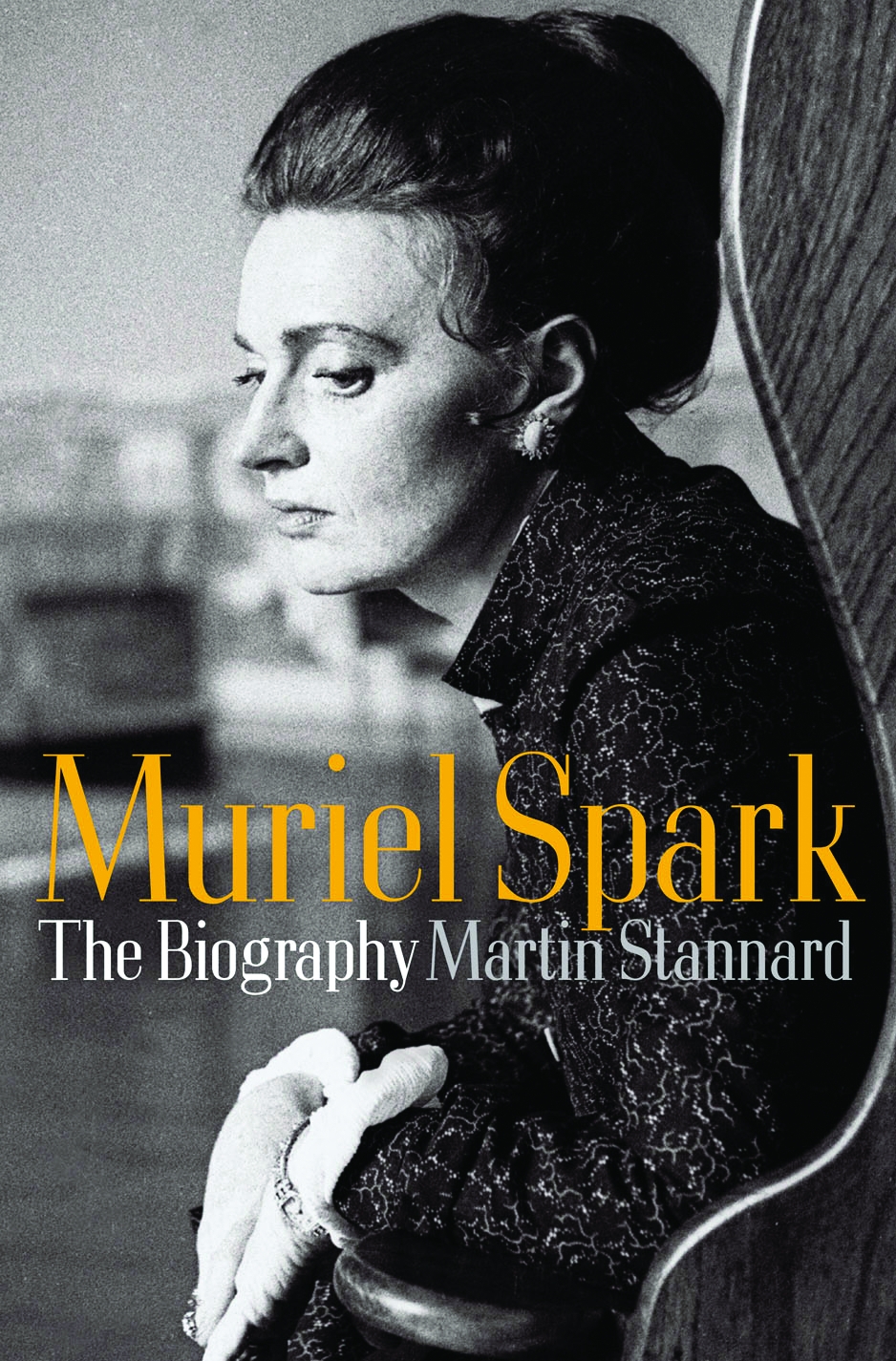
“Muriel Spark: The Biography”: A fearless novelist, betrayed

A new biography of the writer reveals a life of personal struggle -- and a lover with an unscrupulous agenda

Muriel Spark: The Biography

At age forty-three, the witty, exacting, and wholly original Muriel Spark became known to American readers when The New Yorker devoted an entire issue to her sixth and most celebrated novel,“The Prime of Miss Jean Brodie”. Brodie, a magnetic and domineering schoolteacher, selects a group of girls to mold into the “crème de la crème” — young women made in her image who will recognize their prime when it arrives and know how to exploit it. Propping up their history textbooks for appearances as she recounts a pre-war love affair, trailing after her through strange neighborhoods on the way to plays and picnics, Miss Brodie’s chosen pupils idolize her — until the danger of her manipulations becomes clear.

Spark herself attended an Edinburgh girls’ school much like the one she depicts so vividly and in such biting detail — students in stiff blazers, boys hovering on the periphery with their bicycles after the final bell, and the portrait of the widow who endowed the school “hung in the great hall, and was honoured every Founder’s Day by a bunch of hard-wearing flowers such as chrysanthemums or dahlias. These were placed in a vase beneath the portrait, upon a lectern which also held an open Bible with the text underlined in red ink, ‘O where shall I find a virtuous woman, for her price is above rubies.’” Yet the uniquely charming and monstrous Miss Brodie, for all her verisimilitude, could only have sprung from Muriel Spark’s complex mind.

Barnes & Noble ReviewMartin Stannard’s sprawling, respectful, frequently overwritten new life, “Muriel Spark: The Biography,” underscores just how much the existence of Spark’s novels — some of the finest and funniest of the last century — owes to happenstance. It’s astonishing (and, at least to this aspiring writer, sobering) to realize just how easily she could have failed to bring them into being.

After a painful divorce in her late twenties, Spark left the son of her disastrous marriage in her parents’ care, toiled during the day in often thankless office jobs, and wrote poetry and criticism at night, slowly earning respect as a literary scholar. She first tried her hand at fiction at the age of thirty-three, almost by accident. The Observer announced a £250 holiday story contest, and Spark, who hoped to avoid another secretarial gig but had fallen behind on her bills and a book-length study of John Masefield, dashed off an entry and mailed it in. Until then, she claimed, she had no intention of writing narrative prose. She might well have continued to dedicate herself to verse and to tomes on other people’s writing had the newspaper’s literary editor not called that Christmas Eve morning to let her know she’d won the prize.

Even for a few years afterward, Spark’s literary path remained uncertain. She published reviews, wrote poems and stories, worked on a book about the Brontës, and tried to sort out her life. Finding solace in Catholicism, she slowly extricated herself from a poisonous relationship with her live-in lover, the needy, far less talented writer Derek Stanford.

After her Observer winnings dwindled, she took Dexedrine diet pills not only to stay slim but to keep her food costs down. The hallucinatory, paranoiac effects of amphetamine poisoning were unknown at the time, and Spark had always been given to intense literary passions, so friends saw nothing amiss in her fixation on T. S. Eliot’s Christian play “The Confidential Clerk” until she began to speak of threatening codes that she believed were embedded in the text and directed at her. “Obsessively she began to seek them out, covering sheet after sheet of paper with anagrams and cryptographic experiments.” As her delusions intensified, she became convinced that Eliot had taken a job with some of her acquaintances as a window-washer in order to rifle through their papers.

“We loved her so much during that period,” a friend said. “It was really like watching someone using spiritual crossword puzzles…. The text [of the play] kept her mind together somehow.” While she recovered, Spark focused on fiction.

Her first novel, “The Comforters,” which the novelist Katharine Weber and others have argued she wrote “to save herself from madness,” explicitly deals with hallucinations. The protagonist, Caroline, a literary critic, is plagued by voices — as though, she tells her priest, “‘a writer on another plane of existence was writing a story about us.’”

Stannard sensitively but persuasively examines the way Spark’s breakdown found its way into her work — and may even have enabled it — but also reveals how desperately she wanted to prevent anyone from making the connection. Not only is “The Comforters’” Caroline, like the author, “[t]orn between the spiritual and the material worlds,” but a later novel, “The Bachelors,” plays back conversations … as a psychodrama of jabbering demons.” Like her friend Evelyn Waugh, who was also suffering from amphetamine overdose, Spark coped with her illness by transforming it into art.

Spark published “The Comforters” in 1957, at thirty-nine, to acclaim and confusion (it employed a postmodern structure that was still unfamiliar). Her next book came six months later. “Usually,” Stannard observes, “she had one … finished while another was in proof and a third being launched.” Writing novels was so easy, she said in 1960, “I was in some doubt about its value.”

Having found her literary footing, Spark was increasingly certain of her talents. She forbade her editors to alter so much as a punctuation mark without permission. She didn’t, or at least claimed not to, revise. “If I write it, it’s grammatical,” she told a friend and fellow novelist who dared to question one of her sentences. When one of her essays was “updated” without her consent, she demanded the culprit make reparations by contributing to her church’s organ fund. He balked; she threatened to sue. In the end, he paid. The one critic she relied on was her Persian cat, Bluebell, “a gifted clairvoyante,” who “would sit on my notebooks if what I had written therein was all right.”

Spark’s staggering confidence in her work was largely warranted. “If she thinks it’s good,” one of her publishers said, “it is good.” Her characters, she informed Iris Murdoch, “do exactly what I tell them to do.” Novel-writing was “the easiest thing I had ever done.” Love affairs, by contrast, were fraught — and dangerous.

In her fiction, Spark developed stunning authorial control, reminiscent of fellow Catholic Flannery O’Connor’s in its precision, insight, and detachment, but less austere and far more inclined to hilarity and wit. Her characters’ disagreements are often played for laughs, even as they somehow remain human, believable, and completely engrossing. In “Memento Mori,” the most dog-eared among my copies, of her books, Godfrey Colson cross-examines his Catholic wife and housekeeper about cremation:

“It isn’t a matter of how you feel, it’s a question of what your Church says you’ve not got to do. Your Church says you must not be cremated, that’s the point.”

“Well, as I say, Mr. Colston, I don’t really fancy the idea –”

“‘Fancy the idea‘ … It is not a question of what you fancy. You have no choice in the matter, do you see?”

“Well, I always like to see a proper burial, I always like –”

“It’s a point of discipline in your Church,” he said, “that you mustn’t be cremated. You women don’t know your own system.”

“I see, Mr. Colston. I’ve got something on the stove.”

Spark wrote fearlessly but lived, especially once she became famous, defensively. Success made her wary. When considering attachments, she was exceedingly conscious of “the fragility of reputation, the carelessness with which this precious commodity was handled by third parties, the exposure to competitive defamation and gossip-mongering.”

Stanford, perhaps her greatest love, betrayed her most egregiously. He sold the letters she’d sent him, stole and did a small trade in her private papers, wrote a patronizing “biographical and critical study” of Spark and her work, and, until he died, published withering reviews of her books. Most unforgiveable of all, though, he told her family of her secret breakdown. And publicly, he insinuated that her work was infected by madness.

Spark raged. An artist, she believed, “was in one sense ‘possessed’ by her vision but must never be possessed by anyone or anything obstructing this vision. Above all, she must not be possessed by insanity. Great art always walked close to that borderline but the great artist always knew her way back.” Her attempts to keep the Dexedrine debacle a secret failed, and not just because of Stanford; as her literary fame grew, other friends, and even her son, proved loose-lipped and judgmental. When they did, she added them to her “menagerie of bêtes noires, the unforgiveables.” And she hit back hard.

When her novella “The Driver’s Seat” appeared, Stanford implied in The Scotsman that Spark’s fiction was fixated on “batty” women and traded in “giggles and sniggers.” Her revenge in “A Far Cry from Kensington” rivals Somerset Maugham’s brilliantly scathing attack on Walpole in “Cakes and Ale.” Bartlett, Spark’s pisseur de copie, has Stanford’s “speech mannerisms and literary style, the yellow tie and check shirt.” His prose “reveals him not only as pompous but also a traitor.”

In 1993, Spark’s former longtime editor Alan Maclean echoed Stanford, telling the New Yorker that she was “really quite batty” in the diet pill years. “[S]he thought I was one of ‘them’ — ‘them’ being the people who were planting the clues. For a long time afterwards, when she was under pressure she would react very badly.” Asked for comment, Spark called him an “indescribably filthy liar” who “must be on the bottle again.”

For many years, she avoided interviews lest they depict her in an unflattering light. Her life was the raw material of her art; she refused to squander it just to fill out lazy journalists’ puff pieces. Yet she was always cognizant of the public eye, and in some sense enjoyed playing to it. She kept herself thin, dressed as fashionably and expensively as her finances would allow, and reveled in being admired, especially by men.

When in complete control of how she was presented, Spark could be surprisingly revealing. In 1996, she kept an online diary for Slate about her failing health and the way she spent her days. Her warm, confiding tone prefigured blogging; unlike many of today’s online diarists, though, she doled out the confessions sparingly.

Even as a girl, she deplored idle curiosity and enjoyed thwarting it. She wrote letters to herself from imaginary admirers and tucked them between the sofa cushions for her nosy mother to find. “Dear Colin,” one of her fake responses began, “You were wonderful last night.” This trickery is pure Spark: theatrical, clever, subversive — effortlessly outwitting those who would intrude on her private world.

Her best novels — “Jean Brodie,” “The Girls of Slender Means,”“Memento Mori,”“The Bachelors,”“The Finishing School” — evince this same amusement at people’s foibles, at our half-truths and half-baked schemes, our prying and evasions and delusions and prejudices. All of her characters are viewed through her shrewd, unsentimental lens, a perspective that prefigured those Iris Murdoch and Hilary Mantel later adopted. Her work is sui generis, her influence unquantifiable. The people in her books live and speak believably, passionately, ridiculously — like lovers overheard arguing in an adjacent apartment.


Visit Barnes & Noble Review for more reviews, interviews, and other features.

Continue Reading Close
www.salon.com/writer/maud_newton/index.html