Morris Davis

Khalid Sheikh Mohammed gets his way

Obama officials insisted the terror mastermind receive a military tribunal this week, but their arguments are bunk

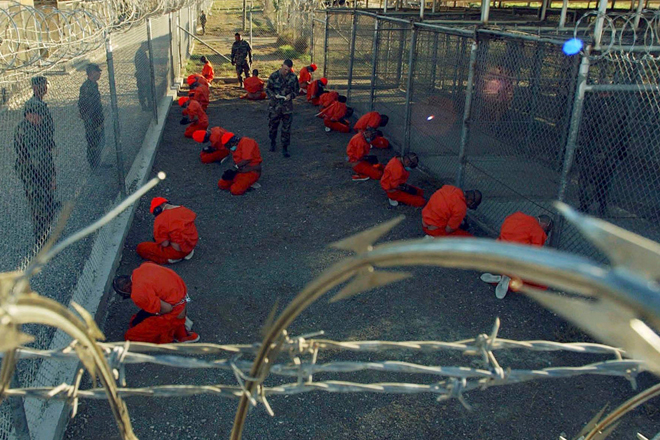
Detainees at Guantanamo Bay (Credit: Reuters)

A military guard will be on each arm of Khalid Sheikh Mohammed as he is led into a courtroom on Saturday to be arraigned for a second time before a military commission at Guantanamo Bay. He went through the same process in the same courtroom on nearly the same charges almost four years ago in the closing months of the Bush administration. The fact that President Obama chooses now, six months before voters choose between him and Mitt Romney, to restart what some have dubbed “the trial of the century,” using a second-rate system of justice he had ordered stopped at a facility he had ordered closed, makes an unflattering statement about the timidity of his leadership and the malleability of his principles.

Apologists for the tarnished military commissions, like Attorney General Eric Holder and the sixth and current chief prosecutor Brigadier General Mark Martins, acknowledge that our regular federal courts are best suited for terrorism trials. Holder told an audience at Northwestern University in March:

Simply put, since 9/11, hundreds of individuals have been convicted of terrorism or terrorism-related offenses in Article III courts and are now serving long sentences in federal prison.  Not one has ever escaped custody.  No judicial district has suffered any kind of retaliatory attack. These are facts, not opinions.  There are not two sides to this story. Those who claim that our federal courts are incapable of handling terrorism cases are not registering a dissenting opinion – they are simply wrong.

After singing the praises of the federal courts – which really have been swift, severe and successful in comparison to the six and-a-half dubious trials completed over the past decade at Guantanamo – Martins and Holder pivot to polishing the image of the tarnished military commissions they argue are well-suited for a small category of cases. Martins told an audience at Harvard in April:

It is perfectly reasonable to ask why – with concurrent jurisdiction over offenses that can be characterized as both federal civilian crimes and violations of the law of war and with comparable procedural protections – we should invest great energy and resources in military trials. The answer is that there is a narrow but important category of cases in which the pragmatic and principled choice among the lawful tools available to protect our people and serve the interests of justice is a reformed military commission.

Beltway bureaucrats are prone to using buzzwords to shade the truth. For example, rather than saying “yes, it makes us look bad when we lock people away in prison for a decade without a trial,” some might soften it up by using more subtle Beltway language: “The optics are not optimal.”  The word “pragmatic” has become a favorite of the spinmeisters. In truth, being pragmatic has become a synonym for being a wuss. When a bureaucrat capitulates instead of confronting barriers standing in the way of doing the right thing, and then cites the barriers as an excuse for choosing the easier path, he is lauded for making the “pragmatic choice.” Others might say he simply wussed out. President Obama has been “pragmatic” far too often on national security choices in his first three years in office.

There is nothing pragmatic or principled about undermining America’s reputation as a champion of the rule of law and a supposed model for the world to follow. The apologists for Obama’s decision to embrace military commissions call attention to similarities between the commission rules and the rules in federal courts, and they claim those rules are essentially the same. They argue that the two systems are virtually identical and that trial observers will find trials in the two forums nearly indistinguishable. In some things, however, close is just not good enough. An O’Doul’s looks like a beer and has a beer-like flavor, but a real beer drinker would never argue that an O’Doul’s is virtually indistinguishable from a Sam Adams. Just as a near-beer is not practically the same as a real beer, neither is near-justice the equivalent of real justice. The apologists may think they are fooling the rest of the world when they say at long last military commissions do real justice, but they are wrong.

Holder and Martins justify the need for a second-rate military commission system by talking up the alleged realities of the battlefield that they say make it impracticable for troops to worry about doing rights advisements and establishing a chain of custody for evidence while in the midst of a war. Their general principle is entirely valid … but also totally irrelevant in the cases they intend to prosecute before military commissions. Few of the 779 men ever held at Guantanamo were captured by members of the U.S. armed forces and even fewer still were apprehended on the battlefield as that term is commonly understood by ordinary human beings. Khalid Sheikh Mohammed, for instance, was rousted from a sound sleep and arrested in Rawalpindi, Pakistan, by the Pakistani Inter-Services Intelligence Directorate based on information developed by our civilian Central Intelligence Agency. Abd al Rahim al Nashiri, the alleged USS Cole bomber, was apprehended in Dubai, a bustling global business center in the United Arab Emirates that no one considers a battlefield. Hambali was arrested near Bangkok, Thailand, by Thai authorities and later turned over to the CIA. The truth is that not a single one of the 14 so-called high-value detainees was captured by members of the U.S. armed forces on a battlefield; in fact, none were even apprehended in Afghanistan. The perception of some inexperienced 19-year-old Army private trying to read Miranda rights to a captured al Qaeda fighter while hunkered down in a foxhole with bombs exploding nearby and bullets whizzing past overhead is a canard.

Military commission apologists should have the integrity to stand up and tell the public the truth about the small category of cases they believe are best-suited for the second-rate procedures of the tarnished military commissions. The truth is the reason the apologists want a second-rate military commission option is because of what we did to the detainees, not because of what the detainees did to us. This is not about the exigencies of the battlefield and the problems our soldiers face trying to fight a war; this is about torture, coercion, rendition and a decade or more in confinement without an opportunity to confront the evidence – abuses that would have us up in arms if done to an American citizen by some other country – that make the tarnished military commissions uniquely suited to try and accommodate the small category of cases where we crossed over to the dark side. A military commission may be a justice-themed theatrical production – complete with a script, actors, a sound stage and costumes that create a passable courtroom-like atmosphere – but beneath that facade is a ‘heads we win, tails you lose’ charade where, as the government admits, even if a KSM or a Nashiri is found not guilty he returns to a cell to continue serving what is likely a life sentence. That should not inspire anyone to wave the flag and shout USA! USA! in celebration of our vaunted exceptionalism.

Lloyd Cutler was the youngest member of the prosecution team in the trial of eight Nazi saboteurs captured, convicted by a military commission and executed in a span of six weeks in the summer of 1942. He wrote an op-ed in the Wall Street Journal on December 31, 2001, nearly 60 years after his military commission experience ended and 10 days before the first detainees arrived at Guantanamo Bay. Mr. Cutler said that how we prosecute alleged al Qaeda terrorists will say as much about us as it does about al Qaeda. He warned that success will be judged by our ability to show the world that justice is in fact being done.

Had we heeded Mr. Cutler’s advice back in 2001 we would not be where we are now in 2012, fumbling along more than a decade later still trying to mold a second-rate process to fit around sets of bad facts we created when we turned our backs on the law and our values.  In normal practice, cases are developed to conform to the court. Here, because of how we mistreated some of the detainees, we are trying to develop a court to conform to the cases. We are setting an example for the world, but not a good one.

Guantanamo’s deepening failure

The secretive military system for prosecuting accused terrorists is a travesty, says the man who once ran it

Morris Davis (Credit: AP/Reuters/Yuri Gripas)

The U.S. Defense Department specializes in euphemism. “Limited kinetic action” is a polite way of saying “war,” and “collateral damage” does not sound as blunt as “dead children.”  When I was chief prosecutor for the military commissions at Guantanamo Bay during the Bush administration, I was told not to say publicly that a detainee had “attempted suicide.”  The government-approved term for the act was “self-injurious behavior.”  I could not say “torture,” or as some called it, the “T-word.” Instead, I had to say “enhanced interrogation techniques.”

The euphemism tradition remains alive and well in the Obama administration.  The slogan “fairness, transparency, justice” is featured prominently throughout the military commissions’ new half-million-dollar website.  The slogan even shows up when case document links lead to a notice saying the “document you are trying to access is currently undergoing a security review” and might be posted later if the government decides it is “publicly releasable.”

Say you are interested in the case against Abd Rashim Nashiri, the alleged mastermind of the USS Cole bombing in Yemen in October 2000 that killed 17 U.S. sailors.   You are not allowed to see the judge’s docketing order setting April 11-13 for the next session to consider motions.

You are not allowed to see a key motion seeking authorization for Nashiri’s lawyers to depose former Yemeni President Ali Abdullah Saleh while he is in the United States.  The Obama administration is permitting Saleh to visit New York City for medical care; many believe he should be at the International Criminal Court facing charges for turning his forces on Yemeni protesters resulting in 270 civilian deaths.

Before being elected to the presidency, Barack Obama condemned what he said were “flawed” Bush-era military commissions.  He voted against the Military Commissions Act of 2006 when he was a member of the Senate and he argued that detainees accused of criminal conduct should be tried in federal courts or courts-martial, either of which he said would “demonstrate our commitment to the rule of law.”  Six years later it appears all it takes to transform fatally flawed into fundamentally fine for Barack Obama is to tack a new word onto an old title to give it a euphemistic revival: now we have “reformed military commissions.”

Brig. Gen. Mark Martins, the sixth and current chief prosecutor for the military commissions, gave a talk to the New York City Bar Association last month.  In it, he used the phrase “reformed military commissions” more than three dozen times.  Apparently tacking the word “reformed” onto “military commissions” and using it over and over is supposed to erase a decade-long record of failure that has, as then-Sen. Obama said, tarnished “our credibility as a nation committed to the rule of law.”

The failure of the military commission system is well documented.  President Bush first authorized military commissions in an order he issued on Nov. 13, 2001.  Six military commission trials were completed in the decade that followed.  Two of the six “worst of the worst” war criminals – David Hicks and Salim Hamdan – have served their short military commission sentences and are free men back in their home countries.

Over the same period, hundreds of terrorism-related cases were tried with success and without incident in federal courts resulting in typical sentences that exceeded those in military commissions by a wide margin.  The Bush administration’s initial notion that military commissions would be more swift, more secret and more severe than federal courts has proven  clearly wrong.  Nonetheless, the Obama administration intends to press ahead with “reformed military commissions,” U.S. credibility be damned.

I was one of the most public advocates of the original military commission structure that the U.S. Supreme Court ruled was illegal in June 2006.  Congress revived and reformed the military commissions in September 2006 with the Military Commissions Act (that Sen. Obama voted against).  These “reformed” military commissions were implemented through a series of documents that set out new rules and procedures to improve the process that the Supreme Court had struck down.  Once again, I publicly praised their virtues to an increasingly skeptical world audience.  Before I resigned as chief prosecutor in October 2007, I personally authorized charges against David Hicks, Salim Hamdan and Omar Khadr under the 2006 “reformed” military commission system.

President Obama ordered a halt to military commissions as soon as he took office in January 2009, but he backtracked a few months later in the face of conservative fear-mongering.  Nine months after President Obama took office, the Democrat-controlled Congress passed the Military Commissions Act of 2009 to replace and reform the process it had created in 2006 to replace the process President Bush created in 2001.  The slight change in 2009 is supposed to let President Obama save face.  The military commissions authorized in 2001, 2006 and 2009 have so far generated 51 implementing documents totaling 2,352 pages setting out rules and procedures.  Each series of reforms purports to be better than the last, which had purported to be better than ones before.  Each has failed.

 I honestly believed we were committed to full, fair and open trials when I became chief prosecutor in 2005, but I lost confidence in that commitment over time as political appointees tried to manipulate the process and make it more like a theatrical production than a judicial proceeding.  After more than a decade of futility and failure, the question is no longer whether the U.S. could proceed with “reformed again and again and again military commissions,” but whether it should.

In his recent talk, Brig. Gen. Martins said, “while federal courts will and should objectively be the appropriate forum in most instances, reformed military commissions will sometimes be the better choice.”  His rather vague statement raises some issues that should be considered before lumbering along even further down the sullied military commission path.

Which cases are candidates for military commissions?  Brig. Gen. Martins said federal courts are the appropriate forum in most instances and that military commission cases may be “numerically few.”  The administration has identified fewer than three dozen detainees they intend to prosecute for alleged criminal conduct.  How will those cases be divided between federal courts and military commissions?  Sen. Dianne Feinstein hinted at the answer during a Senate Judiciary Committee hearing in 2010 when she told Attorney General Eric Holder that in choosing between the two forums, “make the decisions based on the legal facts and where we best get a conviction.”  If you peel back the rhetoric and examine the ground truth, military commissions likely end up the “better choice” when there is a chance the U.S. government might not be assured of a conviction elsewhere.  In other words, the U.S. will afford an accused all the justice possible while ensuring the cards are stacked decidedly in the government’s favor.

Military commission proponents rationalize the need for this peculiar forum citing the exigencies of war and the unique circumstances presented on the battlefield.  That argument would be more persuasive had most of the Guantanamo detainees been captured under circumstances bearing some resemblance to battle.  They were not.  For example, Khalid Sheikh Mohammed was rousted from a bed in a house in Rawalpindi, Pakistan, by Pakistani authorities, and Abd al-Rahim al-Nashiri was captured in the United Arab Emirates without any U.S. military involvement.  In the end, it is not so much what the detainees did that make military commissions the better choice, it is what the U.S. did that may not stand up to traditional principles of justice.

The U.S. has invested a great deal of effort in trying to revive a military commission process it last used in World War II and make it fit the unique circumstances of a handful of post-9/11 terrorism cases.  There have been 779 men detained at Guantanamo over the past decade.  Only 171 remain, and a majority of them have been cleared for transfer (about 89 men) or designated for indefinite detention without trial (about 46 men).  Four more have already been convicted and sentenced, leaving 32 potential cases for prosecution.  The last of the 32 was captured in 2006, so the facts of any case have not changed in more than five years.

Rather than developing these few cases to conform to the rules of regular federal court, the U.S. has tried to develop an irregular military court to accommodate the cases.  The end result – at least until the next reform attempt – is a process where an accused can spend a decade or more waiting for his day in court; nearly all of the information is classified and the accused only gets to see what the prosecution decides is appropriate; the government demands that it gets to see the information shared between the accused and his attorney; and even if the accused wins, he is likely to still spend the rest of his life in prison.

This is the kind of “heads we win, tails you lose” process the U.S. condemns when it is used in other countries.  If President Obama thinks this is going to restore America’s reputation as a nation committed to the rule of law he is mistaken.  Pinning the word “reformed” to the title does not make a silk purse out of this sow’s ear of justice.

Continue Reading Close
www.salon.com/writer/morris_davis/index.html