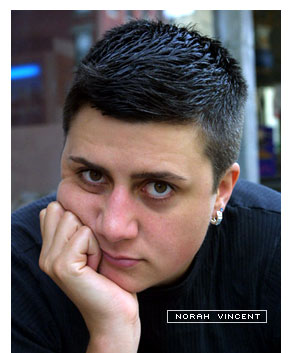
Norah Vincent

Yes, they are cowards

Every couch potato in America would off himself instantly and painlessly if he thought he'd wake up in a Budweiser commercial on the other side.

  • more
    • All Share Services

Much to the delight, I’m sure, of semioticians everywhere, the American media’s response to the Sept. 11 disaster is devolving, more or less, into a war of words. Stanley Fish’s recent New York Times op-ed, “Condemnation Without Absolutes,” is perhaps the best single example of this. Any sensible person who has read it readily admits that it is time — actually, well beyond time — that we, the doltish absolutists of the lollipop guild, clarified our terms. And, while we’re at it, a couple of darling dean Fish’s terms as well.

1) Cowardly

Here is Fish: “Bill Maher, Dinesh D’Souza and Susan Sontag have gotten into trouble by pointing out that ‘cowardly’ is not the word to describe men who sacrifice themselves for a cause they believe in.”

Indeed, it’s true that during the last five weeks much has been made of one of President Bush’s early remarks about the catastrophe. “Today,” he said in his first address to the nation on the subject, “America was attacked by a faceless coward.”

Now Fish, like so many of his fashionably iconoclastic cohorts in academe and elsewhere, along with Maher, D’Souza and Sontag, insists that “coward” is the wrong word here.

He’s mistaken.

First of all, his backhanded definition of what cowardice is NOT (which is really just a wormy way of saying that the terrorists were brave) is flimsy. A person who kills himself for a cause, while he may not be a coward, is certainly not brave or in any way laudable either. He’s a nut. No sane person, or truly self-sacrificing person, just outright kills himself for a cause. He may fight for it. He may even fight for it like the soldiers who stormed the beaches in Normandy, with the knowledge that he is likely to die. But living, not dying, is the goal, and this wish to live, as opposed to the wish to die, is what makes putting himself in harm’s way so hard and so frightening. He doesn’t want to do it, and therein lies the sacrifice. People who want to die, or who believe they’ll be met by a pack of willing virgins in paradise if they die in service of their ideal, have resigned themselves and their will to live either to despair or fanaticism, both of which have the effect of numbing the lamb into an automaton. Death isn’t frightening when you’re too hypnotized or narcotized to know what’s happening, or care.

What’s more, no truly brave person ever submits himself to death for a reward. Where’s the sacrifice in that? Every couch potato in America would off himself instantly and painlessly — which is in itself no small enticement to commit suicide — if he thought he’d wake up in a Budweiser commercial on the other side. No suffering, and a chance to finally get your rocks off for eternity with no mullah lurking in the closet? Hell, I’d do it, too. Mass murder/suicide under these mercenary circumstances is cowardice, as well as lack of sincere conviction, defined.

But most importantly, and this is a point Sontag and Fish and others have willfully overlooked, these hijackers were cowards not so much because of what they did, but because of how they did it — that is, anonymously. As Bush so appositely put it, they were cowards because they were “faceless.” A coward is someone who won’t stand up to a fight, and that is exactly what al-Qaida won’t do. It’s the warfare equivalent of a hit and run. Blow up thousands of unsuspecting noncombatants, who are utterly unable to defend themselves, and then take off for la-la land, or deny all responsibility, and then hide in a cave, letting your fellow faithful die on your behalf, because you’re too much of a coward to make an appearance.

If Osama bin Laden’s cause is so just, and he’s so brave, then why doesn’t he stand up and claim the carnage? Why doesn’t he lead his armies into a bona fide battle, instead of ranting by videotape, refusing, exactly like Hitler, to emerge from his bunker, and insuring thereby that innocent Afghans will die? It doesn’t seem to have occurred to anyone that if Osama bin Laden were truly a martyr dying for a cause, he’d have come out of hiding to save his people. Had he done so, no bombs would have fallen on them. But instead, he prefers to officiate from afar a war of attrition that inflicts death randomly, and to no ultimate avail.

And the fact that there is no avail, no actual cause except petty revenge and gross nihilism behind al-Qaida’s murders brings us to our next embattled term.

2) Terrorism

Again, here is Fish: “When Reuters decided to be careful about using the word ‘terrorism’ because, according to its news director, one man’s terrorist is another man’s freedom fighter, Martin Kaplan, associate dean of the Annenberg School for Communication at the University of Southern California, castigated what he saw as one more instance of cultural relativism. But Reuters is simply recognizing how unhelpful the word is, because it prevents us from making distinctions that would allow us to get a better picture of where we are and what we might do. If you think of yourself as the target of terrorism with a capital T, your opponent is everywhere and nowhere.”

For starters, in no moral universe, except a relativistic one, do terrorists equal freedom fighters. Any freedom fighter worthy of the name does not kill innocent civilians. He targets the armies and military installations of the hostile occupying power, as a means of driving that power out. As such, he does so systematically, not randomly. His aim is not to terrify, or revenge himself upon his enemy, but to vanquish and expel him. The killing is a means to an end, and fairly undertaken in accordance with the rules of engagement in war, even guerrilla war.

A terrorist, by contrast, always targets civilians — innocent bystanders to the conflict at hand. And he always does so at random. That’s why he’s called a terrorist. Duh. Terrorists are terrifying precisely because we do not know when or where they will strike next. They are indeed “everywhere and nowhere,” and each of us, though a noncombatant, is made to feel that he is on the front lines of a war, a war he never declared and can do nothing to abridge. That combination of helplessness and vulnerability is the quintessence of terrorism.

Al-Qaida is its embodiment, and worse. It represents a new breed of terrorism even more senseless and terrifying than the old, and one eminently worthy of a capital T. These men have no cause but carnage. They are fighting solely for their pound of Western flesh. Nothing more. Why else would they bomb civilians randomly, refuse to take responsibility for the deed and make no demands? Even Arafat has rejected al-Qaida’s clumsy, disingenuous attempts to co-opt the Palestinian cause after the fact. And now bin Laden is raving about Kashmir as well? Talk about a desperate grab bag of conceits. This isn’t principled conflict. This is pure sadistic opportunism, bloodlust posing as crusade, a false paradigm of East vs. West engineered for one purpose only, to plunge the whole world into chaos.

To call such people anything but terrorists, or something more pejorative — yes, even evil — if we can think of it, is to play into their unappeasable hands, to disseminate their propaganda. To say, as Fish does, that they are “an enemy who comes at us with a full roster of grievances, goals and strategies,” is to give them much more, not less (as he claims), credit than they deserve. Their belated grievances are a sham, and their strategy, mass murder, their goal. That’s all. No equivocation need apply to or cloud this fact.

But nebulizing what’s clear is the favored sport of Fish and friends. From his throne of great wisdom and remove, Fish supposes that, in the throes of our cultural brainwashing, we condemn our enemy solely because he is the enemy, and not because he is wrong. We lack empathy. Understanding. And most of all — here is the arrogant subtext — intelligence. We use the words coward and terrorist because they are insulting, effective at demonizing an adversary against whom we are required to whip up public belligerence. If we were more enlightened, we’d see that such terms are inappropriate and, in fact, unhelpful to our greater understanding of the crisis we face.

Of course, precisely the opposite is true. Using terminology that applies, and can be reasonably argued to apply, is exactly what clarifies the situation and allows us to see it clearly and act accordingly. By contrast, this kind of intellectual gamesmanship and epistemic masturbation in which Fish and his ilk are so fond of indulging is utterly unhelpful.

Oh sure, to the uninitiated it sounds urbane on paper. Why it’s the very porridge every sophist serves and every sophomore groupie eats for breakfast. But it is by no means “another name for serious thought.” Rather it is just more proof of how irrelevant, self-aggrandizing, and willfully obfuscating our vogueish cognoscenti continue to be.

In trying to interpret the current crisis through a postmodern, morally relativistic lens, the usual suspects on the intellectual left threaten to seriously harm our focus and our spirit in a wildly confusing time. This is not to say that subtle, critical thinking is out of place in the current climate. On the contrary, it is desperately needed. But clarity, a reasonable attempt to face facts, and a concerted effort to use language responsibly are the intellectual’s solemn mandate in trying times such as these, when life and death are at stake. It’s not the time for word games.

When doubt is a moral responsibility

How to respond to bin Laden? Remember that peace won't necessarily save lives -- and war won't either. And don't listen to anyone who says the choices are obvious.

  • more
    • All Share Services

I wonder. Were he alive today, would Karl Marx enjoy the bitter irony that recent events have made of his famous epigram, religion is the opiate of the masses? Terra non grata Afghanistan, is, after all, the world’s premier producer and exporter of opium, and its resident terrorists are ruled by religious delusion.

How quaint. Thesis meets antithesis, producing the terrible synthesis: numb zealotry. Who’d have thunk it? The man who made a religion out of politics, and whose ideas made a right mess of the 20th century, was a prophet after all, though perhaps not quite in the way he intended.

Alas, such is the strange alchemy of dialectical materialism: The past cannot predict the future, and never repeats it. How could it, when into the roiling crucible of history, there always drops an unknown quantity? The present is always a mysterious hybrid. Unique and surprising each time. Not what we expected at all.

Which, I suppose, is why these times are so confusing to us. Somehow the trusted guidelines don’t apply. We don’t quite know what’s demanded of us, because we’ve never faced these particular circumstances before. What’s the moral thing to do, we ask ourselves, when we are left with no choice but the lesser of two evils? And despite what the anarcho-pacifists and the schadenfreude intelligentsia (e.g., Susan Sontag and Noam Chomsky) will tell you, we are indeed faced with a choice between the lesser of two evils. That, or an acquiescence to utter chaos and destruction — in short, hell. But knowing all this doesn’t make the choice any easier, or at least it shouldn’t to anyone who still knows how to recognize a moral dilemma.

The pacifists don’t see the moral dilemma, because they refuse to take responsibility for the consequences of noninvolvement in this conflict. To do so would be to submit to the doubt and confusion at the heart of the present global struggle. So, instead, to them it’s black and white. Violence, they maintain, breeds only violence. But this is manifestly untrue. Violence can bring peace. The converse is also true. Peace can breed violence.

Take the most obvious historical example. We fought the Nazis. We defeated them, and thereby crushed the fascist threat. By killing them, we prevented the deaths and miseries not only of ourselves, but more important, of millions of others around the globe who would have perished and/or suffered egregiously in a Nazi-dominated world. Thus, our violence made for peace. It saved lives.

By contrast, if we had not acted, if we had not fought, we would have had the blood of all the Nazis’ next victims on our hands. Our passivity would have abetted the German war machine, and quite possibly enslaved much of the human race. Surely, not to act would have been a sin of omission. To stand by in the name of pacifism and watch others die, while refusing on principle to intervene, is murder by proxy. It is a peace that kills many more than it saves.

Thus peace is not always the moral option — or, at least, not by any means the obvious one.

In another camp, avoiding the quandary in their own inimitable way, are the ever contrarian leftist intellectuals gleefully clucking like the proverbial chickens coming home to roost. At last America has gotten her long deserved comeuppance. The bombs she has been lobbing so cravenly from afar on foreign soil have finally hit home.

This is a predictable stance, and one that is as flawed in its obtuse absolutism as the current pacifist rhetoric. It is infused through and through with the kind of moral relativism so characteristic of our nihilist postmodernist clerics. At its heart lies their “sophisticated” Nietzschean conviction that good and evil are for lamebrained sissies who have swallowed and been swallowed by the lies of an opportunistic Judeo-Christian morality. They, however, are beyond such sophomoric categories now, and so, to them, nothing is either bad or good but thinking makes it so.

Add to that the leftist intelligentsia’s distressingly reductivist tendency to side automatically with the brown people in any conflict, and you have a pleasing paradox wherein no one and everyone is right and wrong, and therefore neither. This is not, mind you, a moral dilemma, but a paradox — always the intellectual’s favorite dessert, because it admits of no solution, and simply hangs there, the narcissist’s whirligig, titillating the bored, solipsistic superior-IQ elites. And so the practical question of what we should do to forestall the deaths of more innocent victims gets replaced by the self-satisfied intellectual’s static version of “Who’s on first?”

But there is something else loathsome at the root of the leftist intelligentsia’s decidedly anti-American stance, and it brings us to the choicest of all Marxist ironies. Though it has always pretended to be down with the proletariat, the leftist intelligentsia in this country has always been covertly elitist in the extreme. Hence its reflexive dislike of flag-waving patriotism. (Vide Katha Pollit and Barbara Kingsolver’s recent diatribes against displaying the red, white and blue.)

You see, patriotism is for rednecks and burly white cops who shoot unarmed black people, and still use the word “nigger” on a regular basis. Patriotism is for sexist construction workers who spend their lunch hours harassing female passersby, and who ritually beat their wives on Superbowl Sundays, and who wank over the Sports Illustrated Swimsuit Issue, and tack up the Second Amendment right beneath the gun racks in the cabs of their Chevy pickups. These are the very uneducated people who’ve never heard of Nietzsche, who fought or have relatives who fought in the war in Vietnam, and who still believe in the infallibility of God and — -as the flag-burning teacher in Southern California called it — the United Snakes of America.

Never mind that these cops and firemen and construction workers are the same people who risked their lives and died trying to save trapped and injured strangers at the World Trade Center. They’re also the ones waving the flag most proudly from their squad cars and dump trucks and Humvees.

Meanwhile, the rest of us are struggling, however maladroitly, with the tenuous middle ground, knowing that pacifism is a dangerous luxury, and livid anti-Americanism an impotent pose. We’re stuck grappling with what might well prove to be our generation’s Spanish Civil War.

The only sane choice seems to be the one the Bush administration has apparently made, to side in some way with the Afghan rebels, our modern equivalent of the anarcho-communist militias of 1930s Spain, and the aforementioned lesser of two evils. Like the Spanish communists, the Northern Alliance is a less than savory pack of poorly armed guerrillas with whom we must cooperate in the interests of stopping a nonnegotiable fascistic evil from spreading.

Yet this cannot be undertaken with righteous abandon. By siding with the anti-Taliban forces, whose humanitarian track record is nothing to shout about, we may very well be making the same mistake we made in the 1980s when we supported the then incipient Taliban against the Soviets. We will be cavorting with criminals in order to reach our short-term goals and we should, by no means, be proud of this. The regime we prop up in place of the Taliban may be little better. But what’s the reasonable alternative?

Finally, there is the question of method, which the bellicose on the right and the left aren’t much grappling with. Certainly putting a bullet through the heads of all locatable terrorists is the most expedient thing, but is it the most humane thing? Or the most diplomatically effective thing? After all, it’s possible that we could capture and imprison some of al-Quida’s rank and file, and just as effectively remove the threat of further terrorist attacks. True, the Taliban’s refusal to hand over bin Laden et al has made invasion unavoidable, but will this make the eventual taking of prisoners impossible? And then there is the possibility of war crimes tribunals, which, granted, would probably devolve into a tangled mess full of all the usual loopholes associated with the presumption of innocence. And yet, if we stand for liberty and justice, mustn’t we at least make a stab at due process? Who ever said doing the right thing was easy?

The list of questions is potentially endless, and the right answers aren’t conspicuous. And so, we sit and sit, and mull and mull, trying to reconcile moral imperatives with realpolitik. The process is made that much harder by the preponderance of contradictions floating around us just now. Peace is war, and war peace. Devils are saints, and enemies are friends. Such queer reversals are everywhere these days, defying ethics and reason both, making a dreadful and unavoidable conundrum of each undistracted hour. But we must keep on with our thinking and questioning, because now, more than ever, it matters if we care enough to doubt.

Continue Reading Close

Apocalypse now

We faced death, and saw the world through the eyes of the brainsick bag ladies we used to ignore. Will we remember their insights?

  • more
    • All Share Services

Lewis Carroll once wrote that even a stopped clock is right twice a day. I think of this often now as I walk the streets of a changed Manhattan, and find myself listening for the first time to all the usual raving Armageddonites who, under normal circumstances, every New Yorker is preprogrammed to ignore.

But, of course, these are by no means normal circumstances, and for once, unbelievably, those same fixture lunatics and unheeded cranks who have been foretelling the end of the world for so long may just have turned out to be right after all. Or so it seems, when you consider that the unthinkable has in fact happened: The world, or at least capitalism’s symbolic equivalent, the World Trade Center, has fallen down around us. Add to that the haunting (and until now absurdly superstitious) fact that 2001, not 2000, is the actual Millennium, and suddenly, those brainsick bag ladies you see around Grand Central start to sound a lot like Cassandras — bona fide prophetesses doomed never to be believed until it’s too late.

And now in a sense it is almost too late. Death and disaster have ambushed us, as they are often wont to do, though surely not as alarmingly and ineluctably as they did the people who worked in the twin towers. Those victims had no recourse, no time for appeal. And for those who didn’t die instantly, they had virtually no time to think or even pray. For them it was indeed too late. The mortal decisions and revisions that we spend our lives dreading, yet ignoring, were upon them instantly, literally out of the bright blue morning sky. One moment they were in the mundane workaday, and the next they were face to face with the final egress. And in all our reactions to this holocaust, all our news coverage and all our table talk, we’ve spent nary a word discussing the apolitical reminder at the heart of this apocalyptic event — that being, of course, our readiness to die.

Yet privately it seems clear that we are all aware of our impermanence and our mortal souls in a way most of us weren’t just days ago. Whatever our religious persuasions or lack thereof, it’s hard to escape the looming sense that the fundamental lesson of all this destruction is metaphysical, not military, or fiscal, or nationalist, or even emotional. It is those things too, naturally, but not primarily. If attendance at churches, synagogues and mosques in recent days is any indication of the public mood, in a flash, we got religion. We threw up our hands. For once we looked beyond ourselves for explanations.

We’re not turning to Alan Greenspan anymore for solace, the way we did in the past few months as recession tightened its grip on the American economy. Even now that the stock market has reopened and plunged more than 600 points on its first day, and we know that our chairman of the Fed, our God of mammon, will have a great deal to do with getting capitalism back on its feet, we also know that his powers ring hollow in the face of life and death, that his sphere of influence is mere window dressing for the real affair.

There has been much talk of Satan and of evil in recent days as well, and this is largely unprecedented, at least among news anchors and other secular commentators who are much too fond of metaphors. Strangely, the world and its consciousness has turned upside down. The thoughts and awarenesses that were once the exclusive purview of the depressed and otherwise insane are now the collective norm. The importance of this should not be overlooked amid the rubble and the ubiquitous, mad patriotism.

When I remember the way New York responded to the attacks on Sept. 11 (I live a mile and a half from ground zero), I am reminded of Albert Camus’ novel “The Plague,” not only because it too is about catastrophe and the various ways in which people respond to it, both good and bad, opportunistic and heroic, but because it depicts this exact inverted reality I’m talking about.

As happened in New York last week, the city that is struck by plague in Camus’ novel is quarantined. Shut off from its surroundings by manned barricades. No one comes and no one goes. Thus, the city becomes a capsule in which normal life, and seemingly time, have been suspended. Rather than poking through the fabric of reality now and then, the way it does in everyday life, death pervades this place. All superficialities have been dispensed with of necessity, and everyone is consumed by the eternal considerations that only the most assiduous philosophers and monks make their daily fare.

Naturally, most normal people are not made particularly happy by the omnipresence of death and all the spiritual concerns it entails. And so it goes in Camus’ city. The citizens want things to return to normal. They don’t like being trapped with the deep and frightening questions, and they are simply praying for an end to the epidemic. One character, however, a man who had been severely depressed before the plague struck and had tried to commit suicide, has quite the opposite response to the disaster. Suddenly, he feels more alive than ever. Suddenly reality has come to reflect his point of view, a point of view that, until the plague struck, had made his life unlivable. Hence his previous attempt to end it.

This is, obviously, the very essence of existential despair, the constant awareness of mortality, the impossibly cumbersome insight into the lack of meaning so inherent in quotidian pursuits. As it happens, this is also a rather good description of clinical depression, the scourge of our age it would seem, and the reason why so many Americans are enriching the pharmaceutical industry by popping its happy pills. Not to pop them leaves one engulfed in contempt for the absurd denial of death at the core of what passes for everyday life. Life is untenable under these conditions. Very quickly it becomes impossible to convince yourself to do anything even as basic as getting out of bed, because your brain is always saying “Why? What’s the point?” And in the face of that colossal question, very little in the way of humdrum, ho hum living can stand up to scrutiny.

In New York City last week, 8 million people had a glimpse of this unusual despair. Reality changed our vantage point, and for two days an entire city was depressed, stunned into existential despair, wandering aimlessly through the ruins of its candyland.

The pall has lifted now, of course, and we are beginning to resume “normal” life. But the question is: Will we remember the insights of those few days? Will those insights teach us to live our lives more consciously, indeed more existentially, with more readiness to die? Or will we bury ourselves once again in the safe and willful ignorance of petty concerns? Most of all, will we pass those familiar crazies on the street and feel a certain unmistakable kinship with them now that, for a moment, we have partaken of their vision? Sadly, but perhaps necessarily, I think we all know the answer. We will choose willfully to forget. And why? Well, of course, because our survival depends on it.

Continue Reading Close

Swimming with sharks

"Compassionate conservatism" means creating a social contract where people take responsibility for swimming with sharks -- or sleeping with them.

  • more
    • All Share Services

Swimming with sharks

The recent shark infestation off the coast of Florida (and the insurgent response to it by some surfers) is a perfect metaphor for one of America’s biggest social problems, and for the way in which liberals and conservatives have attempted to solve or worsen it, as the case may be.

By now, every prospective surfer in the country knows that at least seven other surfers have been bitten by sharks in the past few weeks, all in the same stretch of water off Smyrna Beach, where a surfing competition recently took place. (I should make it clear here that I’m not talking about the two other swimmers, one in North Carolina and one in Virginia, who have been killed by sharks in recent days. Neither of them went into the water knowing the dangers.) Some Smyrna surfers, however, having been made aware of the considerable risks, have insisted on braving the waves anyway, which is, of course, their prerogative. But, as always, there’s a hitch. That prerogative of doing what you like with your body comes with a price. Paradoxically, freedoms don’t come free. They come with responsibilities attached.

In this particular case, this means that if a surfer wades into the surf, knowing all too well that 1) those waters are infested with sharks; 2) an alarming number of other surfers have been bitten by those sharks; and 3) the authorities have closed the beaches for this very reason, he must take sole responsibility for what happens to him.

Now, to most litigious idiots, this means that if they get bitten they’ll agree not to sue the state for damages. It would never occur to them, or to us, apparently, that taking responsibility for one’s injuries in this case means a great deal more than not crying foul. Or, at least, it should. It should mean that the person who knowingly swims in shark-infested waters thereby automatically renounces his right to expect the lifeguards on duty to risk their lives trying to save him once the inevitable bite has been taken out of his demonstrably dumb ass. It should also mean that the surfer, not the taxpayer, must absorb the entire cost of whatever help and/or medical treatment he receives during and after his ill-advised swim.

But most Americans, childish and self-entitled as they are, don’t like this idea. “What?” they whine. “I can’t do anything I want and still expect someone else to pick up the tab or otherwise pay the consequences? That’s not freedom.” No, they argue, this must be some politician’s plot. That, or the scourge of compassionate conservatism, President Bush’s ballyhooed philosophy for revamping public policy.

Which indeed it is. To wit: Everyone has to play by the rules. It’s a simple principle, and one that we should, by all rights, expect of every citizen, rich and poor alike. Think of it. If everyone understood that the social contract is a transaction, not an automatic entitlement proposition; a two-way street, not a free lunch; imagine how things would change for the better. Imagine how much money would cease to be wasted on the inevitable results of bad behavior willingly undertaken. Imagine that same saved money supporting programs that help the truly helpless, rather than abetting the sophomoric decision making of the perpetual 2-year-olds with whom our culture is rife.

Doesn’t it strike you, for example, that this death beach scenario, and the way that these would-be water babies have responded to it, sounds an awful lot like the sexual habits of a certain segment of the gay male population? In a recent New York Times article on the 20th year of AIDS, Erica Goode reported the sad finding that, these days, your average Priapus is likely to have lapsed again into having unsafe sex. It seems a new complacency has arisen in the wake of the stunning success of the latest HIV drug cocktails, which have managed, for now at least, to stem the death toll of AIDS.

Think of it. Each young surfer, determined to ride the waves of sexual bliss though he knows the waters to be infested with ravenous, disease-bearing, unscrupulous sharks who’d just as soon maim him as look at him, jumps in feet first. The authorities have warned him against it, but he insists on going in without (sorry for the ham-handed analogy) his wetsuit. Yet, he does so fully expecting that if he meets with a bad end, the Coast Guard will dutifully dispatch its fearless Argonauts to try to save him.

In the real world this translates into spending astronomical sums of money and inordinate amounts of time on finding a cure for a disease that is already curable. Anyone who doesn’t already have it knows how to avoid getting it. Don’t go swimming with sharks. And those who already have it know how not to spread it. Don’t be a shark. Those who have it already also know how to manage it. Would that we could say the same for cancer, Alzheimer’s, Lou Gehrig’s disease and a long list of other fatal diseases. Imagine if we could have said it a mere 20 years after these diseases were discovered.

The current abortion fiasco is a similar case in point. Women want sexual freedom at all costs. They demand it. They deserve it unequivocally, no questions asked. And why? Because they fully expect, and, in the current judicial climate, are not mistaken in this expectation, that the Uterus Guard will swoop in with a scalpel and do for them what they refuse to do for themselves: prevent a pregnancy. And, as anyone familiar with the statistics knows, failure to prevent, or in many cases even to take precautions against pregnancy, accounts for the vast majority of abortions in this country. (Rape accounts for only a tiny percentage.) So, the ladies go swimming with sharks and do so simply because they want to, not caring a whit, of course, for the blastocyst/alleged nonperson who dies in the process of rescuing insouciant them.

Or perhaps, attempting to avert what W.H. Auden called “the necessary murder,” they decide to have the kid and raise him without preparation and without a father, thereby giving rise to all the usual problems like chronic delinquency and maladjustment. This, too, fits our analogy. The reproductive risks an individual takes out of sheer arrogance and brass end up costing the taxpayer, who, like it or not, must come to the rescue.

Even liberals concede this, though in their own way, of course. Two professors, for example, one from Stanford and one from the University of Chicago, recently announced the results of a study that appeared to show a causal link between the legalization of abortion in 1973 and subsequent reductions in crime. Aborted kids are unwanted kids, they reasoned, and rightly so. Unwanted kids often have a harder time of it, and are often raised in less than ideal conditions. They grow up scarred and often criminally inclined as a result. Thus, it makes sense that more abortions would produce less crime.

Now, using that same logic, imagine the result if women who can neither emotionally nor financially afford to raise children out of wedlock (two of the main reasons women seek abortions) stopped having unprotected or insufficiently protected sex whenever the fancy struck them. We’d end up with less crime, and not at the expense of more than a million fetal lives per year.

But, you see, compassionate liberalism is on the side of the silly surfers. Give the people what they want. Everything they want. And then pick up the tab and clean up the mess when they crash. Anything else would be mean-spirited and less than civilized.

Meanwhile, conservatives who see the inevitable link between bad impulse control and bad results, between the inability of many people to see themselves as a part of a society, and the resultant malfunctioning of that society, are seen as cruel and unusual for expecting of all Americans what all sane parents expect of their children: responsibility and fair play.

The mantra of compassionate conservatism should neatly reverse the classic ’70s feminist rallying cry “The personal is political,” and thereby yield the more sensible pronouncement “The political is personal.” If we as a culture could embrace such a philosophy and learn to change our own behavior, rather than expecting government to do it for us, we might change entirely the face of American life. I am suggesting a change from the bottom up instead of from the top down, from the living room out, not from the courtroom in. I am asserting only that altering individual mind-sets will alter individual behaviors, and that in turn will change the society at large.

Continue Reading Close

Enabling disabled scholarship

A budding intellectual movement asks scholars to redefine normal. But who are these postmodern theories really helping?

  • more
    • All Share Services

“Byron had a club foot, and Homer was blind.” Northern Michigan University professor of English David Mitchell was lecturing me on the latest academic sub-discipline: disability studies. As president of the Society for Disability Studies, he is one of the world’s reigning authorities on the social construction of disability and the prevalence of disabled writers in the literary canon. “Toulouse Lautrec was short statured,” he went on, “a dwarfish figure. There’s also Henry James, Stephen Crane, Hemingway. You can keep going down the line.” And he did, but I was stuck on Hemingway. What was his disability, I wondered? Later, when asked to clarify, he paused. “Did I say he had one? I think I was talking about one of Hemingway’s characters from ‘The Sun Also Rises.’ Jake Barnes. He’s impotent and he has a war wound.”

In May the SDS held its 12th annual conference in Washington. The vast majority of the 250 members are themselves disabled. I attended, hoping to witness this new brand of literary theory at work. Partly due to the flurry of judicial and legislative activity pursuant to the Americans With Disabilities Act of 1990, disability studies, once an arcane field of literary theory, has begun to attract attention from both the media and the academy. Last year the Chronicle of Higher Education ran a congratulatory piece on the rise of the new field. Meanwhile, several well-respected university presses have begun cranking out the obligatory readers and monographs on the subject. Some schools have even launched DS graduate programs: Syracuse University offers a master’s and the University of Illinois at Chicago has its own Ph.D. program.

Following the tradition of leftist identity politics, in which marginal or minority groups embody a surrogate proletariat and a potential instrument of cultural revolution, SDS envisions disabled people as an inherently subversive class. So, as Brown University professor of German Carol Poore asserted in her SDS conference lecture, “No Friend of the Third Reich,” disability is actually preferable to ability in that able-bodiedness “is the precondition for being a tool of the ruling class.” Disability is, therefore, seditious; and disabled bodies, as Poore put it, are “non-conforming bodies.”

Poore drove her point home in her analysis of Arnold Zweig’s novel “The Acts of Wandsbeck.” In the book, Tom, a crippled man and a committed anti-fascist, helps to bring down a local shopkeeper who is determined to enforce Nazi race laws, which, as we know, subjected disabled people to the same brutal discrimination and genocide as Jews, homosexuals, communists and Gypsies. According to Poore, Tom’s disability hard-wires him for political resistance, and thereby separates him organically from the run-of-the-mill German who is equally hard-wired to be fascistic, or to be what Daniel Goldhagen called one of “Hitler’s willing executioners.” So, like Goldhagen, Poore argued that “the defect is not Tom’s, but the larger society’s.”

No one disputes that this was true in Nazi Germany, but Poore’s conclusions didn’t seem focused entirely on Germany circa 1945. In the context of a conference where many of the participants appeared to endorse the notion that we are living in what disability studies guru Lennard Davis calls “the United States of Ability,” there also lurked the idea that Amerika is also filled with body-fascists, who, if given the chance, would happily exterminate their disabled population. Like the most radical race philosophies in America, according to which it is commonly understood that being white ipso facto makes you racist, the SDS philosophy seemed to endorse the idea that disabled people are martyred revolutionaries, and “normals” are really just Nazis in disguise.

In another panel discussion, “Why the Media Have No Understanding of Disability,” David Pfeiffer of the University of Hawaii echoed Poore’s Nazi analysis, applying it to contemporary America. Implying that society itself is hell-bent on subjecting disabled people to a final solution, Pfeiffer pointed out that all of Dr. Jack Kevorkian’s “patients” have been severely disabled. This fact tars the ethics of assisted suicide. “It’s not suicide,” he asserted in conclusion. “It’s genocide.”

Throughout history disabled people have been subjected to isolation, ridicule, torture and endless fantasies about their moral monstrousness. Thus, disabled peoples’ fears about fascist societies and eager doctors of death are profoundly understandable. But disability studies has gone a step further and questioned the very notion that society might want to avoid producing disabled individuals. “Many eras have tried to figure out how to get rid of their disabled people,” David Mitchell explains, “not only in terms of eugenics and genocide, although that certainly happened, but also cultures fantasize about literally eliminating disability. Think of the Easter Seals slogan, ‘Prevent birth defects.’ That kind of thing. As if somehow if we were more attentive, we could get rid of disability.”

Can Mitchell really mean that the medicines and technologies that help prevent and predict deformities are part of some insidious plot to exterminate disabled people? Is a woman who chooses to take a folic acid supplement during her pregnancy — a vitamin known to reduce the incidence of birth defects — embracing a polite modern manifestation of eugenics?

While scholars of disabled studies are appropriating the disabled body as the consummate anti-fascist signifier, they also warn against the “ableist” trap of making disabled people into overloaded symbols. In his lecture on Charles Dickens’ “Barnaby Rudge,” Patrick McDonagh of Concordia University argued that the intellectually disabled Barnaby Rudge, who leads his fellow citizens to riot against the British government, is used both to symbolize “the mob’s moral idiocy” and to reinforce the value of paternal authority. Among SDSers the unspoken rule seems to be that it’s kosher to assign symbolic import to disabled folk so long as it’s done in the service of Marxist ideology.

At the core of disability studies is a question that has of late occupied many an academic discipline. What is normal? Since Michel Foucault theorized that societies — not natural laws — invent the “normal,” normalcy has been the focus of fierce debates in women’s studies, queer theory and ethnic studies, as well as in more traditional fields like history, political science, literature, sociology and anthropology. Yet in an academic petri dish teeming with peculiar intellectual hybrids, disability studies must be one of the most bizarre creatures the ivory tower has ever spawned.

The ostensible goal of SDS has been to spread acceptance of the disabled into “ableist” culture. But like their queer studies/gay rights counterparts — who shifted focus from acceptance of gay culture to a more chauvinistic gay pride — disability mavens are advocating a surreal ideology one might call “disability pride.” Not only do SDSers want to declare that disability is normal, they insist that disability should not be associated with disease, and therefore doesn’t need curing.

Having taken disability pride to its logical extreme, many SDSers view Western medicine much the same way most homosexuals view reparative psychotherapy. Just as homosexuality was removed from the Diagnostic & Statistical Manual, and is no longer widely accepted as a disorder, the hope seems to be that society will come to understand disability as a kind of alternative lifestyle, or body-style. SDSers refer disparagingly to such remedial approaches as the “medical model,” in contrast to the “empowerment model,” which locates disabled people on a “continuum of normalcy.” In this vein, one conference attendee announced proudly that she had “given up on being fixed,” adding with a smile, “It feels good.”

But this is not group therapy. It’s a budding intellectual movement — struggling to redefine a portion of our society that has been grossly misrepresented and misunderstood. Does the empowerment model enlighten us about disability’s real role in the lives of individuals and society? Or does it simply obfuscate an unpleasant truth with feel-good oxymorons?

In their interrogation of conventional sexual, racial and social categories, postmodern theories have successfully revealed the limitations of much conventional wisdom. Even so, it’s hard to deny that something called normalcy exists. The human body is a machine, after all — one that has evolved functional parts: lungs for breathing, legs for walking, eyes for seeing, ears for hearing, a tongue for speaking and most crucially for all the academics concerned, a brain for thinking. This is science, not culture. How then can we make the case that blind eyes, or deaf ears, or mute tongues are serving the purpose for which they evolved? They are, in purely ergonomic terms, broken, dysfunctional and — contrary to what SDSers might maintain — in need of repair, if repair is feasible. When one is dealing with severe physical disabilities, it’s difficult to accept that anti-medical definitions of disabilities do anyone any good. As SDSers themselves admit, such disabilities quite often entail a great deal of discomfort and pain, not to mention infuriating inconvenience.

“It takes much longer for a disabled person to relax and be comfortable than a non-disabled person,” SDS board member Phyllis Rubenfeld a professor of social work and special education at Hunter College, told me. “There are people at this conference who are exhausting themselves out of their minds, who are ruining their bodies because they don’t want to use a chair or a scooter, because then they would feel more disabled.”

But some SDSers maintain that, even if they were presented with a cure for their disabilities, they wouldn’t take it. Such rejections of medical and therapeutic interventions are most well known in the deaf community — a group that has created a rich culture based on sign language. But while sign language can work as a viable substitute for spoken language, it’s more difficult to understand how quadriplegic culture might evolve a movement form that would render the ability to walk truly undesirable. This is perhaps the biggest self-delusion at the heart of SDS — one that you can’t entirely begrudge disabled people from indulging. We all lie to ourselves about unpleasant realities, if only just to get through the day.

When asked about this casting-off of cures, Phyllis Rubenfeld said: “You don’t really think they believe that, do you? They think it’s cool to say that. To some degree you do have to come to terms with your disability, because if you didn’t you’d be on so many antidepressants and anti-anxiety drugs that it wouldn’t be funny. We all engage in denial.”

Much like its cousins — queer studies, women’s studies and African-American studies — disability studies already has a rigid methodology in place, from which few if any of its practitioners stray. In an essay in the Disability Studies Quarterly, Lennard Davis outlined this methodology of “emerging disciplines” into three basic tasks. The first is to expose negative stereotypes of disabled people throughout history and culture. McDonagh is a typical practitioner of this method. Oft-repeated examples of such negative stereotypes include Shakespeare’s Richard III and Melville’s Captain Ahab.

The second task in SDS is to unearth more positive examples of the disabled. This aims to show us that Western culture is, in fact, chock-full of disabled geniuses. Alexander Pope is one canonical literato that SDSers are fond of calling their own. As David Mitchell says:

Pope was a hunchback with severe scoliosis. Yet, he’s famous for creating this perfectly symmetrical poetic style. His poems, for instance, use poetic couplets. It’s interesting to see how Pope’s experience of his own body influenced his belief in this kind of poetry that was a counterbalance to his own physical life. Pope has had many biographers, including Maynard Mack, who have completely discounted the role of his disability in his work.

Regurgitating a bit of dubious scholarship, Mitchell has also managed to add the Bard himself to the list of luminaries. “New research on the Earl of Oxford, who was actually Shakespeare,” says Mitchell, “shows that he had a severe disability. He walked with a cane.” (This, incidentally, undermines the idea that Shakespeare’s Richard III was the brainchild of an evil normal).

The third and final task in SDS is to create a theory or philosophy of disability that will entirely recast the way our culture has conceptualized disability. This encompasses the so-called “empowerment model” and the drive toward “reforming normalcy.”

But, as Phyllis Rubenfeld pointed out, all of this SDS theory isn’t really helping anyone except the academic careerists who espouse it: “What bothers me about the theoretical stuff is that that’s just being a snob. People would rather teach than work and get their hands dirty in the ditches.”

The ditches, of course, are the depressing economic realities that many disabled people face — most of which disability studies scholars largely ignore. According to Rubenfeld, a distressing number of relatively able-bodied disabled people have been collecting Social Security Disability Insurance since they were 18. Many of them live in government-subsidized (Section 8) housing. Though for the severely disabled who can’t work, this kind of government aid is a life-saver, it often condemns them to lifelong poverty and desuetude. For those who could work but don’t, SSDI, like welfare, can act as a disincentive to getting a job and finding a place in the real world.

But, aside from being useless to disabled people, SDS theory is also self-contradictory. Take steps one and two above: How can we say that Western culture has demonized, oppressed or ignored the disabled, and then turn around and claim that many of the great works of Western culture were created by illustrious disabled people whose disabilities deeply influenced their work? In this scenario, your Dead White Male hegemony turns out to be Dead, White, Male and Disabled. Now who’s oppressing whom?

In his lecture on “Disability Studies in Theory,” University of Michigan professor of English Tobin Siebers fell into this trap. After quoting Foucault and postmodern gender theoretician Judith Butler to bolster his assertion that all bodies are socially constructed, he made one exception: “Disabled bodies are a speck of reality beyond the constructed world, the badly turned ankle under society’s skirts.” He then argued that disability, not ability, might be a better measurement for what is normal since everyone is, at one time or another, disabled. In the womb, he claimed, we are disabled, as we are in the increasing decrepitude of old age. Life, Siebers maintained, is really just a brief window of ability between the natural states of disability. Thus, he concluded, “the able body [not the disabled body] is the true image of the other.” The redefinition is complete: disability is normal, and ability is abnormal.

Today, such inversions are typical in scholarly circles. Disability studies is just another example of what has gone so disastrously wrong with leftist identity politics in the academy and with its overarching schema, postmodern theory. Its adherents see all available evidence through the warped lens of their foregone conclusions, rather than deriving those conclusions from an unbiased examination of the evidence. This is scholarship in reverse, and it is profoundly anti-intellectual. Because if you know the answer you’re looking for in advance, and if there are no accepted facts in your discipline by which to measure truth and falsehood, then you’ll always be able to massage the available evidence to support your conclusions.

Having fallen prey to the same fatuous thinking that once made scholars of racist, sexist and homophobic philosophies academically acceptable, these contemporary scholars glorify those without power instead of those with it. Nietzsche once called this the tyranny of the weak. Scholars are being trained to see hegemony under every bed and so, of course, they do. But in trying to construct a more humane intellectual legacy, they sometimes do damage to the very people they are professing to protect. Ensconced in their increasingly specialized worlds, such scholars have raised theoretical political empowerment over both real political empowerment and the pursuit of truth.

The scholarly world has become a theory factory where Ph.D.s are not considered professionals, much less intellectuals, until 1) they embark on their research with unerring faith in a rote yet radical theoretical paradigm; 2) they apply that paradigm blindly and methodically to every possible victimized subset of humanity; and 3) they neatly invert received bourgeois prejudices on each of those subsets.

So what is to be done? Perhaps the best that real scholars can do is expose the failings of this academic methodology to the students under its influence — students whose chance at a real education in literature, culture and history is so imperiled.

The only hope may be to realize that trendy secondary sources are vastly overrated, and to return to primary sources, facts and the works of art themselves, not some pre-programmed ideologue’s jerry-built interpretation of them. One of the biggest obstacles facing the disabled is that they can’t get jobs because, as spokespeople like Phyllis Rubenfeld pointed out, they lack basic math and reading skills. Perhaps the money that’s going into disability studies departments should really be going into job training programs. Unfortunately, disability studies graduates won’t have much firsthand experience with the ABCs of their chosen disciplines — they’ll be convinced that the Earl of Oxford “was actually” Shakespeare, and they won’t have learned how to think for themselves. But at least they’ll avoid insidious doctors who wish to treat them, they’ll understand their innate role as revolutionaries and, by God, they’ll know they’re normal.

Continue Reading Close

“To Believe in Women: What Lesbians Have Done for America”

A noted historian offers a substantial contribution in a less than crowded field.

  • more
    • All Share Services

Lillian Faderman’s “To Believe in Women” is a classic example of what PC neologists call “herstory.” It’s lesbian history plucked out of obscurity and plunked down center stage — sort of the dyke’s equivalent of one of those Budweiser commercials where you land on an island populated entirely by Amazons, except this time they’re all wearing blue stockings instead of string bikinis. You get to pretend for a while that at one time practically every formidable woman in America was gay, and if you’re a dyke, it kinda makes you feel normal for about 10 minutes. If you’re not a dyke, of course, the experience won’t mean much to you, and there’s nothing about Faderman’s prose that would otherwise entice you to make the leap onto planet Lesbos.

But then again, Faderman, who has made a career out of writing lesbian herstory, isn’t slaving away in the archival trenches because she wants to give you a good time. She’s out to leave a record of a small but very real part of American life that, until a little over a decade ago, had never found its way into print, except distortedly in sexology manuals written by crackpots like Havelock Ellis and Richard von Krafft-Ebing. In this regard Faderman is an admirably unselfish scholar. Like her previous books (“Surpassing the Love of Men: Romantic Friendship and Love Between Women from the Renaissance to the Present,” “Odd Girls and Twilight Lovers: A History of Lesbian Life in Twentieth-Century America”), “To Believe in Women” is a thorough and laudable piece of work that should stand up well in the eyes of future historians and curious lay people.

Because “lesbian” is not a term anyone would have recognized before World War I, Faderman concerns herself chiefly with what she is careful to call “women of the late nineteenth and early twentieth centuries, whose chief sexual and/or affectional and domestic behaviors would have been called ‘lesbian’ if they had been observed in the years after 1920.” She separates her various influential lesbians into four groups: suffragettes, social welfare pioneers, educators and professionals.

Of the suffragettes, Faderman writes: “From its inception, women’s fight for the vote was largely led by women who loved other women … Feminism was the theory, and lesbianism was the practice.” Here, she meticulously reconstructs Susan B. Anthony’s relationship with fellow suffragette Emily Gross; Women’s Christian Temperance Union president Frances Willard’s romantic cohabitation with Anna Gordon, a fellow activist, and subsequently with Kate Jackson, a locomotive heiress; the numerous passionate relationships of activist Anna Howard Shaw, onetime president of the National American Woman Suffrage Association, with women; and the intimacy of Carrie Chapman Catt, founder of the International Woman Suffrage Alliance, with fellow activist Mollie Hay.

In her section on social welfare pioneers, Faderman documents the lesbian attachments of Jane Addams, founder of the famous settlement house called Hull House. She begins: “Addams was responsible for awakening America’s social conscience. That being so, how could she have been a lesbian?” By examining Addams’ private correspondence, Faderman reveals the decidedly romantic quality of her subject’s domestic partnerships with Ellen Starr (the co-founder of Hull House) and, later, with Mary Rozet Smith (a benefactor of Hull House). She likewise makes the case for lesbianism with early 20th century social reformer Frances Kellor.

In her last two sections, Faderman continues in this vein, identifying as “inverts” (to use Havelock Ellis’ term) a host of less famous venturers, including various female academics, women’s-college presidents, doctors and other professionals. This will bore you quickly if you’re not an enthusiast, but you can pick up a few spicy factoids along the way to keep yourself occupied. The most memorable and amusing tidbit is Faderman’s citation of a hilariously clever term for female homosexuality coined by the Hearst newspapers in the 1940s; the half-closeted lesbians among you can drop it into conversation. The next time you’re at a stuffy cocktail party and somebody asks you if you have a boyfriend or a husband, you can say, “Nah, I’m in the doll racket.”

Continue Reading Close

Page 2 of 3 in Norah Vincent