Novella Carpenter

Why I pick lettuce for the Black Panthers

I worry that Alice Waters' crusade for local, seasonal food isn't reaching the people who really need it.

  • more
    • All Share Services

Why I pick lettuce for the Black Panthers

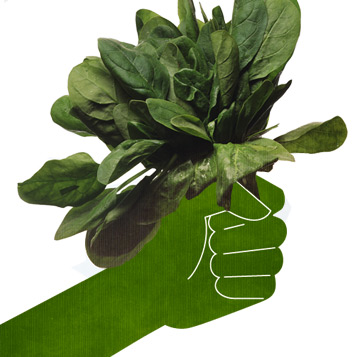
Thursday’s my harvest day for the Black Panthers. I begin in West Oakland, Calif., at an urban garden run by the not-for-profit City Slicker Farms. The beds are chock-full of roaming squash plants, beets and collard greens. I’m here for the lettuce. I might choose the red frilly Outredgeous, or the chartreuse black-seeded Simpson, or the Bronze Arrow; whichever looks the largest and healthiest, I pick five heads. Then I bike back to my own backyard plot 20 blocks away, in a run-down area of Oakland called Ghost Town, where I pick basil, marjoram, mint, wild arugula and edible flowers (nasturtiums and borage) to add to the mix.

I want the Panthers to enjoy a gourmet salad, you see.

In the Bay Area, home of Alice Waters, the high priestess of seasonal food, and slow food’s ground zero, boutique grocery stores evangelize about eating fresh and local. Browse around one of these sedate shops and you’ll find local hand-molded goat cheeses, fresh bundles of escarole and rustic bottles of cold-pressed olive oil from Napa Valley. All organic, all regional and all expensive.

“For any salad greens, you’re looking for the ones that have just been picked,” Waters is quoted as saying in a new biography by Thomas McNamee. “Ones that have an aliveness about them. Ones that don’t have any little discolored ends. I don’t mind the ones that have a little dirt on them because they just came out of the field.”

I think about Waters’ words while I triple-wash my lettuce and herbs, then pack them into plastic bags. She’s right that when you eat a salad fresh from the garden, it tastes vital and truly nourishing. But the kids in my neighborhood eat Cup-a-Soup for breakfast and Cheetos for lunch. Eldridge Cleaver once said, “Black children who go to school hungry each morning have been organized into their poverty.” The chances of my neighbors encountering a salad that has “an aliveness” to it are slim.


When most people think of the Panthers, they think of black men wearing leather jackets and carrying guns, or the famous photo of founder Huey Newton sitting in a wicker throne with a spear in one hand, a shotgun in the other. What have been forgotten are the free medical clinics, the bus service for visiting prisons, the breakfast programs for kids and the thousands of bags of food handed out to needy folks. David Hilliard‘s photographic history of the party, “The Legacy of the Panthers,” quotes a Black Panther newspaper: “It is a beautiful sight to see our children eat in the mornings after remembering the times when our stomachs were not full, and even the teachers in the schools say that there is a great improvement in the academic skills of the children that do get the breakfast.” In the 1970s, a school run by the Panthers called the Oakland Community Learning Center served breakfast, lunch and dinner to all of its students.

I first met the Panthers six months ago on the UC-Berkeley campus, where I attended graduate school. A young guy with cornrows yelled from his booth, “Support the Panther Party!” My mom was active in the civil rights movement, so I went over to have a look. “So I can help?” I cautiously asked the other man at the booth, Melvin Johnson — all the while remembering a scene from the Malcolm X movie where a blond lady’s help is rejected.

“Yes, we aren’t segregationist anymore,” Johnson answered, handing me a copy of the Black Panther Party “Ten-Point Program.”

“Well, I don’t have time or money, but how about vegetables?” I asked.

“Sure,” he answered.

I wrote down my name and number and in a few days Johnson called me back. Turns out Melvin Johnson is a very tenacious fellow. A writer friend of mine said he gave Melvin his number in order to volunteer, and every week for a year, Melvin called. I was glad I hadn’t made my offer of vegetables without having something to back it up.

Willow Rosenthal, the founder of City Slicker Farms, and a dear friend, grows tons of vegetables (literally) on her urban farms. With her organization’s help, once a week I can deliver enough salad for the entire Panther literacy program. When I first told her about the project, she admitted that the Panthers were one of her great inspirations. “Hell,” she said, “we’ll plant a Li’l Bobby Hutton memorial plot of lettuce!”

Before noon on delivery day, as I whiz up Martin Luther King Way on my ten-speed, a bag of salad greens gently rocks on the handlebars. I spot Johnny, the watermelon man, tending to his produce stand. A bit farther on, a man sleeps in an overturned refrigerator box, arms flung out like a baby. Invariably there’s another man or woman with a shopping cart filled with recyclables headed to the transfer station down the street. On a few stretches of MLK, lumbering Magnolia grandifloras grow overhead, their leathery leaves and giant white blossoms so pungent you can smell them even under the stench of Highways 980 and 24.

Acts from people’s lives play out on the streets and sidewalks like Shakespearean drama. Whole families sit near the curb, chairs placed just so, to take in — or be part of — the day’s events. A person on a bike gets to be part of this sidewalk theater. Usually I get a sweet “Hello, good morning”; sometimes I witness a hot dice game, whose rules, once explained to me but never practiced, I’ve now forgotten. The previous night, I listened to a woman demanding money from the father of her son. While she ranted (from the seat of a Hummer) his friends recorded the performance on their cellphones. “You’re acting like some kinda Michael Jackson,” she growled, and the Hummer screeched away. The man and his friends cried out at this dis, slapped street signs and groaned.

After 30 flat blocks, the landscape changes. I’m in Berkeley. There’s a Nuclear-Free Zone sign and then the gleaming giant words “THERE” and “HERE” — a piece of public sculpture that has always rubbed me the wrong way. “There is no there there,” Gertrude Stein famously said of Oakland, her hometown. Seventy years later, does Berkeley, land of Priuses and million-dollar bungalows, really have to remind us?

At Alcatraz, I turn east for half a block, and I’ve arrived. A gold embossed sign above the door reads: “The Commemorator.” A quarterly published by the Commemoration Committee for the Black Panther Party, the newspaper has a circulation of 10,000 and specializes in stories for the black community. It was started in 1990, a year after founding Panther Huey Newton was shot in Oakland in August 1989. The remaining members of the party feared the positive legacy of the Panthers would be lost.

I ring the bell and Johnson lets me in. He’s tall and handsome, but seems bogged down by his formidable tasks, which include coordinating his all-volunteer organization, managing the office and, when I saw him last, holding a picnic for 300. The office smells of sandalwood incense, and on the wall are drawings of Black Panther all-stars. There’s Al “Bunchy” Prentice and Mumia Abu-Jamal and an oil pastel of a Black Panther youth group — all hand-painted directly onto the wall.

Johnson takes me back to the kitchen to do the lettuce handoff. Sometimes I bring shredded beets, which he loves. The lettuce goes into a salad that is served at the youth literacy programs run by the group. These programs, along with the paper, are the last vestige of the Black Panthers’ legacy.

A stocky, muscular man with kind eyes spots me and says, “Hey, is that the salad lady?” He’s the other Melvin. Melvin Dickson was an original Panther, in charge of all things culinary for the Bay Area Panthers from 1972 to 1982. I was curious to hear about the food programs from Dickson, so we sat down for a chat. Before joining the group, he was a cook in the Navy, but he then realized he could help the Panthers more by serving healthy food.

“One thing we imparted was a nutritious diet. That’s why we fed them three meals. And for a while we were not serving red meat — only chicken and fish,” Dickson chuckled. “Tofu. I learned to cook tofu. I cooked with brown rice. It was new and I learned to like it.”

I confess to Dickson that one reason I want to donate the salad is because I see the kids in my neighborhood eating junk food. “Kids are hyper on that junk food,” Dickson said. “You’ve got to challenge them, educate them, get them to try new things.”

To her credit, the Panthers’ neighbor, Alice Waters, has also turned her focus to schoolchildren and food. In 1995 she started the much-lauded Edible Schoolyard Program at the Martin Luther King Middle Jr. Middle School in Berkeley. Children there are encouraged to learn by growing, harvesting and cooking their own food. Folks like Waters and activist chef Ann Cooper are also trying to change the way school kids eat lunch, motivated by the frightening upward trend of juvenile diabetes cases and the possible link to carbohydrate- and fat-packed school lunches. A Paul Cézanne quote on the home page of the Edible Schoolyard Web site declares: “The day is coming when a single carrot, freshly observed, will set off a revolution.”

The Panthers’ Ten-Point Program lists demands regarding employment, an end to police brutality, education and healthcare for “our black and oppressed communities.” The final program point reads: “We want land, bread, housing, education, clothing, justice, peace and people’s community control of modern technology.” It is followed by the first two paragraphs of the Declaration of Independence, the document that embodied the ideas of the American Revolution. It’s more badass than some white lady’s “delicious revolution,” but rooted in the same concept. “We have a saying in the Black Panthers,” says Dickson: “It’s the blacks today, but it’s you tomorrow.”

This is why I bring lettuce to the Panthers every week. I know that one salad on one day isn’t going to save a life or a city. But I worry that Waters’ message about local food isn’t reaching the very people who need it the most, that maybe the person who most needs to try a real salad, picked that morning, isn’t a customer at Chez Panisse or a kid at a Berkeley middle school but a young, poor black kid trying to learn how to read.

Maybe if all of us made a gesture toward sharing the good food of the earth, it would truly start a revolution.

Buzz kill

Preparing my back-porch beehive is my favorite rite of spring, but this year my flock mysteriously went missing. I'll miss more than just the honey.

  • more
    • All Share Services

Buzz kill

Bee! I’m expecting you!
Was saying yesterday
To someone you know
That you were due.

The frogs got home last week,
Are settled, and at work;
Birds, mostly back,
The clover warm and thick.

You’ll get my letter by
The seventeenth; reply
Or better, be with me,
Yours, Fly.

— Emily Dickinson

Spring arrived here in Oakland, Calif., and I didn’t even notice until the police busted a marijuana-filled warehouse across the street. I was in my garden — raised vegetable beds in an abandoned lot in the bad part of town — picking grass and clover for my rabbits, when I heard pounding on the warehouse’s metal roll door. Ten black-and-white squad cars screeched up, some emblazoned with the words “Canine Unit.” I watched awhile — the door came up cautiously, the police inched closer — until, out of the corner of my eye, I was distracted by the most beautiful peach blossoms. Decorating the parking strip between my garden and the just-raided drug warehouse, the blooms were frilly and deep pink, and would have made a good tattoo.

Then I noticed other trees. A weeping Santa Rosa plum, branches like dreadlocks woven with white buds. A three-way grafted apple, each of its girlish pink-and-white blooms promising fruit, a different variety on every branch. Even the eucalyptus across the street, shading the police, was adorned by thousands of filamenty flowers.

All those blooms, but no honeybees.

Like commercial and backyard beekeepers in 22 states around the nation, I recently opened up my beehive for spring inspection, only to discover that my hairy herd had gone missing. For years, the beehive has presided over the deck off my apartment, and the bees bobbed in and out, loaded down with pollen baskets and nectar collected in my garden and in the weedy debris of nearby abandoned lots. But now, nothing.

They left behind no forwarding address nor clues to their whereabouts, and there were no corpses cluttering the hive for my amateur forensic inspection. My flock had simply wandered elsewhere, and likely perished. Bee researchers and and scientists at the Department of Agriculture have christened this unexpected bee holocaust Colony Collapse Disorder and hypothesize that the die-off could be a result of either a fungus, a nicotine-based pesticide, or a virus. (They’re working on it.) But in the meantime, CCD could very well spell commercial disaster: for almond farmers whose trees won’t be pollinated, for consumers who may face a shortage of apples and peaches and cherries because there are no bees to turn flower into fruit. While my livelihood may not depend on it, as the mistress of one hive on one porch in Oakland, the loss still came with an intense pang of grief, like a death in the family.

When a beekeeper dies, the bees must be informed. I learned this tradition a few years ago, while visiting Slovenia’s Apicultural Museum. One of the exhibits was a short film. My mother and I watched as a grandfather trained a lederhosen-wearing boy to be a beekeeper. Shot entirely in golden late afternoon light, it was a bittersweet story, and near the end of the film the grandpa died. A final scene showed the boy hunkered near the hive, his lips moving in a whisper. I knew the boy would have felt the heat of the hive, generated by so many thousands of bees, and that it would have smelled like wax and propolis — a rich ambrosial aroma. The bees whining through the box would have sounded like a wail. How consoling that act would be in the face of death.

- – - – - – - – - – - -

Back then I hadn’t yet experienced the loss of a hive — I was too engrossed in the joyful part. Like installing new packages of bees — one of life’s greatest pleasures. The last one I got, the one that has now died, arrived at the Oakland post office three years ago.

When I pedaled up to retrieve my flock, a few lonely, feral honeybees hovered around the post office. It was April in Northern California, arguably the loveliest month of the year. The postmistress seemed unnerved by their arrival, but admitted she wouldn’t mind some honey, if I got the chance. This was Oakland, not Mayberry — but I nodded and promised anyway. My bike had a basket attached to the front and the humming package fit perfectly inside. As I rode down Telegraph Avenue, I laughed out loud at the bees that trailed us through the traffic and stoplights.

My first colony was a birthday gift, from my beau, Billy, while we were living in Seattle. He loaded me into the car and took me to a small beekeeping shop in the middle of the woods. He promised me a beehive with all the fixings: a smoker, a veil and cap, long, thick gloves, a hive tool, boxes to add as the colony grew, a starter book (“First Lessons in Beekeeping”) and a small wire box filled with 3,000 bees and one queen suspended in her own chamber.

I don’t have children, but that day I experienced a glimmer of what it must feel like to return from the hospital with a newborn. As we pulled our Dodge Dart away from the forest of Christmas trees, I wondered if I could handle such responsibility. What if I dropped the box? What if they grew up and decided to swarm, or to abandon me? But also, to be honest, I was thinking about getting stung. A lot.

Even if you’ve been stung before (when I was 12 I stumbled through a yellow-jacket nest and received more than 25 stings), as a beginning beekeeper you worry about your first sting. We’re choosing to get stung. It feels a bit transgressive. It certainly seemed so to my next-door neighbor.

“You should move to the country,” Trudy said when she saw my buzzing shoe box. She was out on her lawn, trimming the grass with a pair of scissors. Next to her lawn was our raised parking strip garden, a chaotic jumble of tall stalks of fava beans, lettuces and Swiss chard. Most city ordinances allow beekeeping if there is adequate distance from the hive to any neighboring structures. Since we planned to house the hive on our upstairs deck, we were within that legal boundary. And so I marched upstairs to our deck clutching the bee package, hoping I looked like I knew what I was doing.

I put on as much clothing as possible. Triple shirts; a mechanic’s jumpsuit; several pairs of socks, hiked up and tucked into my pants; heavy-duty fabric beekeeping gloves (regretting I hadn’t bought the more expensive leather ones), and finally, my veil. Swaddled as I was, I could barely put down my arms.

The sun was going down, that lovely April day. I set up the hive to face due east so it would get early morning sun. Installing the bees later in the day avoids confusing them, for they like to spend at least a night in their hive before venturing out. I pried the lid off the bee package and, as instructed, tilted the opening toward the fresh hive body, with its orderly rows of frames just waiting to be filled with honey.

The bees fell out like a liquid, spilling into the box without incident. The bearish man who’d sold them to me had demonstrated how to tap the box out — like a ketchup bottle — which I did to get the last of the stragglers. Because of my fear and the sheer volume of my clothing, I had a slick of sweat dripping down my back. But my terror was unfounded: The bees were entirely docile.

Finally, out of the then mostly empty box, I fished out the queen chamber. A few bees, her attendants, clung to the sides. At the bottom was a stopper plug made of candy. The idea is that the workers will eventually chew through the sugary plug and release the queen. But I wanted to see her. So, against proper bee protocol, I popped the candy inward with the end of my hive tool — and out she emerged. Her ass was enormous; she looked like some kind of exotic beetle. I held her on the top of the new hive, and she strutted across. Was it just me, or did she actually have the gallant air of royalty? Then she was gone, down into her chambers where she would lay all the eggs to keep the hive going.

Most of us carry around a pack of defining moments. Beginning that colony on a gentle spring day is one of my fondest. I received one sting: on my wedding finger.

- – - – - – - – - – - -

Six years later, I’ve made room for a honey extractor in our living room. And each year during prime honey-extracting season — late summer — I invite friends over for a sticky party. In preparation, the night before we place a “bee escape” under the super, the box where the honey is stored. The escape allows the bees trapped in the box to flee through narrow tunnels, but prevents them from returning to the box once they’ve left.

After 12 hours, the entire box of honey is bee-free, and we take it to the kitchen. The super looks like a bottomless dresser drawer, except inside, instead of socks, 10 frames are crammed side by side, lined up like library books. Inside each one, a Bible-size chunk of sealed honeycomb hangs suspended in the rectangular frame. We spin the extractor and centrifugal force splatters the honey on the stainless steel sides, where it drips down and collects at the bottom. Most “real” beekeepers use an extractor with a motor, heaters and filters. But our guests simply steady the hand-spun extractor (which has a tendency to keel over), and crank it as hard as they can. Then they open the valve at the bottom and let the honey dribble out into quart-size Mason jars.

At these gatherings, everyone gets covered in honey, and we eat as much in one sitting as we can bear. The harvest is different every year, and the flavor of the honey can even vary from frame to frame. If a frame appears darker in color, we’ll spin and bottle it separately. One year the honey tasted like licorice — was it from the wild fennel filling so many abandoned lots? Another frame held eucalyptus honey, which had a medicinal taste to it. A different time, the honey was so sweet, it hurt. But no matter how it tastes, the experience always makes everyone involved feel richer for it — charmed, elated, sated.

Afterward, when I return the honey super to the hive, the bees are always more apt to sting, and they seem, well, upset. That’s why beekeepers call it robbing the hive. But bees don’t organize a block watch or call the police; they simply get back to doing what they do, which is to salvage any remaining honey and wax and clean up the now mostly empty frames. I take, they give.

But this spring will be different. My honeybees won’t pollinate my fruit trees. There’ll be no sticky party this summer. My home will seem empty without their comings and goings. I’ll even miss their stings.

In Slovenia, you’re supposed to tell a hive when the beekeeper dies, but what are you supposed to do when it’s the bees that have left you? Should I console myself and whisper into the hive, “It’s spring. I’m expecting you.” Lean into its warmth and whine, breathe in the scent of that insect cathedral? Maybe. But the box is as cold as winter now, and there’s nothing inside to receive the news.

Continue Reading Close

Diary of a turkey killer

Last year I decided to grow and slaughter my own Thanksgiving turkey. The six months I spent raising Harold were some of the best of my life -- and so were the hours I spent eating him.

  • more
    • All Share Services

Diary of a turkey killer

Harold came to me in a box that peeped when I opened it. Just three nights earlier, acting on a tip from a fellow urban farmer, I’d clicked on Murray McMurray, an online specialty hatchery, and well past midnight browsed the feathered fare. Should I order a flock of Toulouse geese? Some Chinese ringneck pheasants? My mouth watered at the thought of home-grown foie gras and as I imagined a medieval-themed dinner party. But in the end, good old-fashioned American pragmatism won out and I sprung for what the catalog called the Homesteaders Delight — two turkeys, two ducks, two geese and 10 chickens.

When they arrived on my doorstep in Oakland, Calif., after 24 hours en route from Iowa, the chicks were thirsty. The turkeys looked like chickens, only bigger and with a pucker of skin on top of their heads called a pre-wattle. The unpacking over, I dipped each baby bird into a dish of water; they tilted their heads back to swallow, then squirmed for more. It took the turkeys three dunkings before they got the hang of it. Then they waddled over and joined the fluffy pile that had formed under the warming light — called a brooder — which I’d prepared for them. Soft and downy, they looked more like sleeping kittens than chickens.

As the weeks went on, I taught the flock to eat, cleaned their crusty butts with Q-tips, fed them greens cut into a chiffonade, carted them out to the garden to get sunshine, caught pill bugs for their afternoon snacks, and moved them into a chicken house we’d prepared from old shipping pallets and chicken wire.

- – - – - – - – - – - -

Like many people who came of age in the 1980s adoring Michael Stipe, Robert Smith and Morrissey, I dabbled in vegetarianism and saw food choice as the ultimate political statement. But lately, with glossy charcuterie cookbooks crowding bookshelves and fashionable restaurant menus chock full of organ meat, I’ve found some of my old veggie friends embracing sausage and sweetbreads. Now, despite a vocal minority of die-hard vegetarians and vegans, it’s carnivores who are chic. Indeed, vegetarianism is still a decidedly fringe food preference: According to a 2006 poll by the Vegetarian Resource Group, only 2.3 percent of the U.S. population are true vegetarians. A similar poll done by VRG in 1999 ferreted out a significant chunk of the population — almost 9 percent — who considered themselves “almost vegetarian,” meaning that they answer yes when asked if they are vegetarians, but still consume meat, poultry and fish on the sly. People may like to be called vegetarians, but living like one is another matter.

Recently, a number of high-profile foodies — the most famous being Michael Pollan, author of “The Omnivore’s Dilemma” — have taken a renewed interest in animal husbandry and the art of butchering. My own conversion to carnivorism came with a realization that I could eat grass-fed beef guilt-free. My rationalization went like this: The sun grows the grass, which feeds the cattle, which then feed us. But I hadn’t forgotten the PETA videos from my former life. The wheezing pigs; the live chicks piled on top of each other in dumpsters; workers slitting the throats of hanging turkeys, again and again, as casually as turning a page in a book. Part of me still felt that meat, no matter how it was raised, was murder. I thought: If couldn’t kill something myself, I shouldn’t be eating it. I decided I needed to face my inner killer.

Some things you should know about me: When I vacationed in France, I smuggled home a Corsican sheep’s milk cheese that was aged in a goat’s stomach and rolled in hand-picked native herbs. I grow heirloom seeds from the Seed Savers catalog — if my tomato varietals aren’t at least 100 years old, I’m not happy. I’m not proud of this persnickety mania, but it may help explain why, for my first kill, I chose to raise rare heritage-breed turkeys.

Heritage breeds include Narragansetts, Royal Palms and Bourbon Reds, all of which can be traced back along a lineage of domesticated turkeys that were crossed with wild American turkeys in the late 1700s. In order to be deemed a heritage breed, the birds must have made the American Poultry Association’s “standard of perfection” list in 1874. Today there are only 5,300 heritage turkeys raised commercially, according to the American Livestock Breeds Conservancy.

Harold was a Heritage Bronze — a mammoth black feathered bird with spots of white on his tail feathers and a blue head that turned red when provoked. His companion, Maude, was petite and lovely, a Royal Palm with alternating white and black feathers like an exquisite, houndstooth jacket.

A heritage turkey is nothing like the bloated, par-frozen beach balls you find at the local mega-mart. Those turkeys, of which there are 270 million, tend to be from one milquetoast variety: the Large White. First introduced in the 1950s, the birds are ideal for industrial production because they grow extremely fast, reaching maturity in less than three months. Sadly, this rapid growth — and the over-plump breasts and grotesquely large thighs that result from it — prohibit natural mating. My Harold and Maude, on the other hand, were natural as heck. The fact that they could mate — and they seemed to genuinely like one another — came as delightful news.

But it was for taste, not just novelty, that I’d chosen a heritage turkey. I knew the vegetables I grew, heirloom and not, tasted better when I’d cared for them. Once turkeys are taken off the industrial poultry grid, with access to pasture and free to forage, their flavor is enhanced. In my research, I read in the Slow Food handbook that heritage turkeys have firmer and darker meat, with stronger legs, thighs and breasts, due in some part to the fact that they take six months to mature. Ebullient, I wrote up my guest list for Thanksgiving, including foodies I’d never dared invite before. Eating Harold was going to be epic.

- – - – - – - – - – - -

The Large Whites most Americans eat have been bred over the years to be quiet, fearful and unadventurous. Harold and Maude were anything but. These turkeys took the notion of free range and literally ran with it. After three months dabbling in my garden and backyard, they grew ever more curious, and at 20-plus pounds would fly — fly! — over the 8-foot fence separating my backyard from my neighbor’s, putter in his yard for hours, only to grow hungry and gobble until I came to rescue them. On other days, for kicks, the pair ran down our neighborhood’s main drag, nearly causing accidents as drivers rubbernecked.

Tragically, Maude paid the price for her adventurous spirit. Smaller than Harold, she had more lift, and one day flew over a two-story-high chain-link fence and into the backyard of some very unwelcoming pit bulls. Once I reached her she was torn and dead. I flung her limp body over the fence before climbing back over, but by the time I reached the other side, Harold had discovered it. He hit his head on the ground. He puffed up and preened around her fallen body.

As Harold mourned, so did I. Maude was nearly full-grown: Vast quantities of organic meat-bird feed had disappeared down her (now ravaged) gullet and her care had required a considerable output of my time. She deserved better. I dug a grave next to the cat’s last resting spot, a shady clearing under a plum tree. As I laid Maude in the ground, I recalled her generous spirit and laughed, remembering the time she pecked Harold’s pendulous wattle, mistaking it for a worm and how they’d slept together on the roof of the chicken house every night, cuddled like hobos.

The tears on my cheeks did not bode well for my experiment in killing.

Harold became a lonely turkey. Bored, he scrambled onto our roof to watch television in a nearby apartment. Sometimes he spent the night at the neighbor’s. Usually, though, especially as Thanksgiving neared, he simply perched on our back porch, next to the laundry line, emitting enormous turkey poops as he slept. In the morning, when I came outside to feed the animals, he greeted me like a lover, his tail up and feathers puffed.

As the fateful day approached, friends who had grown fond of Harold rallied for a stay of execution. One, a vegan activist, invited Harold to live out his days in his backyard. Another, a vegetarian, pointed me to the Web site of a “turkey refuge” in Orland, Calif., whose ads showed a minor celebrity giving a turkey a smooch.

But this was not the pact that Harold and I had made. I had agreed to shelter and feed him, and he, by virtue of being a domesticated animal, had signed on to eventually give up his life to me. I had been raising him for almost six months. His feed to weight ratio had reached a plateau — that is, he would no longer gain weight as efficiently as he had in his first six months. It was the ideal moment to butcher. I had a turkey, if only I could figure out how to kill it.

In the end I turned, as my mother had before me, to a book called “The Encyclopedia of Country Living” by Carla Emery. A self-published affair put together in 1969 by Emery and her friends, its stated purpose was to “preserve the precious knowledge of an older generation of homesteaders.” Featuring chapters on how to buy cheap land, dig a root cellar, and put up vegetables, along with Scott and Helen Nearing’s “The Good Life,” Emery’s encyclopedia became a bible for the back-to-the-landers like my mother and father.

I flipped eagerly through the book’s newsprint pages until I came to the poultry chapter. Emery writes, “I don’t think much of people who say they like to eat meat but go ‘ick’ at the sight of a bleeding animal. Doing our own killing, cleanly and humanely, teaches us humility and reminds us of our interdependence with other species.” I nodded my head and quickly turned to the section titled “Killing a Turkey.”

Carla’s words of wisdom:
1. “First, catch the bird and tie its legs.”
2. “The butchering process with a turkey is the same as a chicken except that your bird is approximately 5 times bigger.”
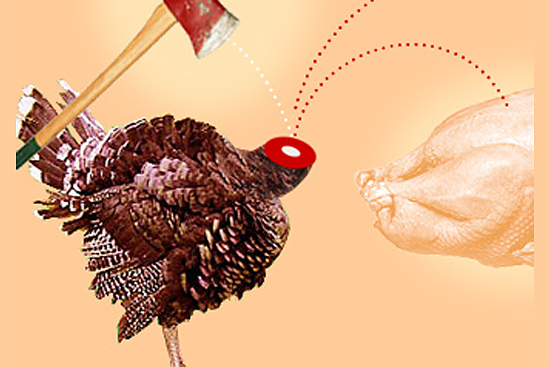
3. “The turkey may then be beheaded with an ax (a 2-person job, one to hold the turkey, and one to chop).”

The night before the big day, I was a wreck: worried, and scared that I would botch the execution, that Harold would feel pain, that his feathers wouldn’t come off, that I wouldn’t be able to clean the meat properly. I visualized, I rehearsed. First, ax to neck, then bleeding, then defeathering, then cleaning, I mumbled like a macabre lullaby before falling asleep.

The next day, at the appointed hour, the afternoon sun streaked the November sky orange — but Harold was nowhere to be found. I’ll admit it: I was relieved. My friend John had come to help and brought his 10-year-old son, TJ. The three of us stood in the garden, a pot of boiling water and a sharpened ax nearby, and wondered what to do.

Harold was smarter than I’d given him credit for, I thought. He knew what was afoot and simply flew away. But then I spotted him, perched on a low fence, watching us. “There he is,” I yelled. Harold stood and adjusted his perch. TJ wanted to pet him, so I picked him up. At 35 pounds Harold was quite an armful. But he had always liked being held and didn’t struggle.

TJ smoothed Harold’s iridescent feathers and looked with wonder at the giant wattle that covered his beak and hung low like an old man’s jowls. I told TJ about Harold’s life over the past six months, his adventures, his grief about Maude, and his future: on our Thanksgiving table. TJ took it in stride.

“OK, John. Ready?” I asked.

John looked nervous but steadfast; I could depend on him. We burned a little tobacco, a ritual a new-agey friend recommended. She said it was a Native American tradition that showed the animal’s spirit which way was up. In Harold’s case that seemed particularly appropriate.

It was almost dark when I finally laid Harold’s neck across the chopping block. For his part, Harold seemed resigned, bored even, as if this scene had played itself out a thousand times before. I felt a little like an ax murderer as I swung the ax the first time, and more like one as I swung again. Harold had a really big neck.

Muslim tradition says one must look an animal in the eye until its soul departs — and I was satisfied that Harold and I had a sufficient dialogue. He did gobble once, a warning sound that he and Maude regularly made, which made me a little sad that in the moment of his death he might have been scared. Mostly, though, it was a solemn moment. Head detached from body, I hefted what was once Harold to a bucket to bleed him out. Though headless he thrashed mightily. I felt relieved, giddy and shameful.

Although I usually call myself an atheist, a lonely universe offers little comfort to a person holding the feet of a struggling turkey corpse. My father, who is a voracious hunter and fisherman and never came “back from the land,” instilled in me a version of pantheism that usually has few applications for a city dweller. But being a begrudging killer made me recognize the sanctity of life. I took Harold’s life and would literally feed myself with it. It was a similar feeling to picking an apple off my own tree — I was experiencing the transfer directly.

- – - – - – - – - – - -

I took everything off Harold and used it, except for his enormous crop, which was filled with grain and greens. I chopped off his legs — my punk-rock vegan roommate wanted those even though she said she wouldn’t eat a bite of him. Her girlfriend wanted his wings — which spanned a good 3 feet — for a costume. The dog got his gizzard, ground up. The cat jumped up on the counter and ate his liver, which sat in a light blue bowl.

After he had “rested” in the refrigerator for a few days per Carla Emery’s instructions, I picked off all Harold’s little feathers and tweezed his wayward hairs, then slipped garlic cloves, herbs and butter under his skin.

As I prepared him, I thought about how much higher the stakes are when you raise and kill your own animal. Not only had I spent in excess of $100 for Harold, but if he had tasted bad, I would have wasted his life. The burden was on me. But while hard to shoulder, that burden was exactly what I had hoped to cultivate. Meat had became sacrifice, precious, not a casual dalliance.

So it was with more care than usual that I rubbed Harold with olive oil and salt, touched every surface of his body like a mom bathing her baby. It wasn’t until I put him into a 450 degree oven that the evening was transformed from a funeral into a dinner party.

That Thanksgiving happened to be the tastiest on record. The meal was simple — potatoes from the garden, cranberries and Harold. His thigh and leg meat were the color of milk chocolate. Buttery and savory, his flesh was perfectly moist, his skin crackled. Ten guests ate all of Harold, and when it was over, I was left with just a carcass, and all those fond memories.

Continue Reading Close