“Senile dementia,” the doctor told us. Hospital tests had revealed no abnormalities; my mother-in-law’s growing tendency to repeat a story several times in an hour was merely a regrettable, predictable aspect of aging. We shrugged: too bad she’d had to endure an MRI just to be told that she was getting older.
“Well, at least we know it’s not Alzheimer’s,” my husband concluded. His mother was still living independently; we’d simply have to make frequent cross-country visits to help out and keep tabs on her condition.
The Family Leave Act entitles me to eight days a year paid sick time to care for an in-law. Writing “senile dementia” on the application, I rather enjoyed the words’ archaic cadence, their lowercase modesty. No, it’s not Alzheimer’s, I told my boss. She’s got a condition, not a disease.
What I’ve learned since then is that a physician who’s still using the outmoded term “senile dementia” probably doesn’t know much about Alzheimer’s.
My mother-in-law’s situation worsened. We spent an anxious, ill-informed year before finally receiving an Alzheimer’s diagnosis — from a facility specializing in the aging brain — and then some fraught weeks trying to learn what the diagnosis might mean. But this time we lucked out; one evening my husband, a bookseller, brought home a prepublication copy of “The Forgetting,” David Shenk’s compelling new book on Alzheimer’s disease.
I was already familiar with Shenk’s “Data Smog,” an informed, eminently sensible work on the information society we live in.
“Could be interesting,” I said. “Let me take a look.”
A chapter later — two chapters later, I still didn’t want to give it back. The publisher’s rep sent us another copy. Gratefully, hungrily, we read it in tandem.
“The Forgetting” isn’t a caregivers’ reference. If you need one, get “There’s Still a Person in There,” by Michael Castleman, Dolores Gallagher-Thompson and Matthew Naythons. Shenk doesn’t explain durable power of attorney or the difference between a nursing home and an assisted living facility. His book doesn’t contain an “experts’ 10-step program for caregivers,” and it won’t provide the guidance through the diagnostic process that my husband and I had so sorely needed. Castleman’s book, which also contains well-chosen portraits of families coping with the disease, is an unimpeachable guide. It could have saved us a lot of anxiety during the year before the Alzheimer’s diagnosis, and now that we’ve got it on our shelves I know we’ll keep consulting it.
But Shenk’s wide-ranging, discursive meditation on Alzheimer’s is something else: By turns science popularization and cultural history, it’s written for a general audience and narrated with a storyteller’s urgency. His speculations about medical research sometimes wander into futurist, Wired magazine territory, but his quirky intellectual excitement adds to, rather than detracts from, the pathos of his story. In the end, like many great storytellers, he becomes part of the story himself. For what could be more tragically human than a human mind striving to comprehend the possibility of its own dissolution?
“The Forgetting” spreads out all over the place, from the threat of a new epidemic, through the mechanics of human memory, to a glimpse at the world of high-end, high-stakes medical research. Shenk intersperses his commentary with first-person accounts of the loss of function. He listens in on a support group for Alzheimer’s sufferers and looks back into literary history: Ralph Waldo Emerson and Jonathan Swift were probable Alzheimer’s sufferers and wrote about their advancing conditions with great poignancy and insight.
Shenk isn’t afraid to be fascinated by his subject, to evince wonder at the mind’s awesome complexity even while chronicling its deterioration. Like Jonathan Swift, he shuttles between the very small and very big: from the molecular level at which Alzheimer’s research is done to the overwhelming consequences that threaten the industrialized nations if that research doesn’t pan out.
Consider the demographics. In the U.S., people over 85 are the fastest-growing segment of the population — and 30 to 40 percent of people over 85 suffer from Alzheimer’s. The average Alzheimer’s patient lives eight years after being diagnosed, but this span will probably widen as a healthier, better-fed cohort gets the disease. One in nine baby boomers will live to be 100: All those hours on the Stairmaster could buy you 20 years of looking good, feeling fine and being totally unable to take care of yourself.
They have no Remembrance of anything but what they learned or observed in their Youth and middle Age, and even that is very imperfect … In talking they forget the common Appellation of Things, and the Names of Persons, even of those who are their nearest Friends and Relatives.
That’s how Swift’s Lemuel Gulliver described the Struldbruggs, a race whose members live forever but lose their mental faculties in their 80s. Horribly prescient, Swift had witnessed an uncle’s memory loss and was sure that the same thing would happen to him. It did.
“They can never amuse themselves with reading, because their Memory will not serve to carry them from the Beginning of a Sentence to the End.”
Powerless to help, I watched my mother-in-law struggle to read a newspaper article, her eyes anxiously and repeatedly darting back to the top of the page. Jonathan Swift, I realized, had not only been horribly prescient about the ravages of memory loss; he’d been absolutely, horribly precise.
The medical vocabulary describes Alzheimer’s as a disease of “insidious onset.” Insidious is a good word for a disease that begins so slowly and stealthily — “treacherously,” my dictionary says. Sufferers don’t forget everything at once: long-term memories (like my mother-in-law’s disapproval of my easily-stained hall carpeting) may remain untouched for years.
The old memories stick because at first Alzheimer’s doesn’t hinder memory retrieval. Instead — like Leonard in the recent film “Memento” — the Alzheimer’s sufferer can’t make new memories. Here’s how Shenk describes memory formation in the normal brain: “Each notable experience causes a unique set of neurons to fire in conjunction with one another. As a result, these connections become chemically more sensitive to one another so they can more easily trigger each other again. With that unique constellation of synapses, one has created a permanent physical trace of the original sensation.”
A memory is a physical trace, but not like the linear procession of ones and zeros marching across my hard disk as I type this. Memory is branching, multidimensional, a dense web of association and combination. Shenk reminds us that Memory was the mother of the muses — as though the arts had derived their multiplicity of techniques from her.
The normal memory is in a state of constant, imperceptible revision: Impressions are perpetually rewritten, exhaustively reworked. Old memories are durable because we’ve revisited and remade them every time we’ve experienced a related perception. They can be untrustworthy in a court of law because we’ve sifted and summarized them so extensively, perhaps integrating a chance resemblance or fortuitous suggestion. We even reshape them by selective forgetting, cutting back a tree here or there in order to keep the forest in view.
Sensations don’t go directly or easily into the brain’s long-term memory matrix. Short-term memory enables us to learn — to negotiate the new and unfamiliar, juggling them until we can fit them into our permanent data store. As we get older we sometimes have to make a conscious effort to remember something new, perhaps effectively “underlining” it in our short-term memory buffer by writing it down. But for an early Alzheimer’s sufferer, such efforts often fail. Malformations (“plaques and tangles”) have grown within the brain’s cortex, impeding the neurons’ initial firing, interfering with short-term memory creation.
Still in the early stage, my mother-in-law is pretty content right now: Friendly home health aides help her with the laundry and shopping, get the mail and tell her when to take her pills. A geriatric care manager makes sure the aides arrive on schedule and that prescriptions are refilled. My husband oversees her bill paying; my adult son balances her checkbook; I replace her clothes as they wear out. It takes a village to do the work of one normal brain, but for now she likes living in the jerry-rigged village we’ve built at the upper tip of Manhattan. She’s always wanted us to call every day and now we do. I’m not sure what my husband discusses with her, but she and I often happily revisit my home-decorating misadventures. She’s lost her impatience with my blunders, and I’ve begun to rather cherish them.
The future will doubtless be a lot tougher. As Alzheimer’s progresses — slowly, over years — the plaques and tangles spread and memory attenuates until, late in the second stage, identity itself is obliterated. In the final stage the brain “forgets” how to regulate basic body functions like swallowing.
“And I’m at risk for it, you know,” my husband commented. “But by then,” I replied — much too quickly — “there’ll be a cure. Or … or therapies. Something.”
Researchers do talk about the possibility of a cure — it’ll be here in 10 years, one of them tells Shenk exultantly. Responding to the prospect of millions of octogenarian boomers wandering around on a last long strange trip, Alzheimer’s research is well funded and promises rich rewards. Scientists are making progress: There are now a few drugs on the market that stimulate memory for a limited period, even as the disease continues to ravage the brain.
Shenk describes the research — theory, technique and furious rivalries between contending schools of opinion — in vivid, laypersons’ language. He goes further as well, to speculate on the limits of the human lifespan itself.
Little-understood environmental factors aside, the reason Alzheimer’s is so common nowadays is that we’re beginning to live on what biologists call “manufactured time.” Inherited traits that would have prevented us from reaching the age when we’re most likely to reproduce have been winnowed out by natural selection. What happens to us in our later years, however, doesn’t affect our chances of reproducing. And so diseases rarely seen before the 20th century have become more common as science has created new ways to keep us alive into our 80s and beyond.
Far beyond, perhaps: “I am now working on immortality,” Shenk quotes a biologist interviewed in the pages of Wired. Is this for real, I asked a friend who follows these developments. Oh yes, she told me, “Immortality is their killer app.” Not a bad reply, I thought: The Delphic Oracle would have relished the paradox.
But then, scientific innovation is often veiled in paradox. Wondrous improvements exaggerate intractable old problems. Longer lives remind us of ancient questions of how to live well. And high-tech solutions do little to untangle the riddles of social and family life, care and responsibility.
For some answers to these questions, Shenk looks to contemporary Alzheimer’s sufferers and their families and looks back to some real and imagined forebears. Although relatively few people lived to be very old before the 20th century, aging and senility have appeared in literature and mythology since the earliest times. After the Egyptian sun god Ra created the universe and all the other gods, he became old and senile, easy prey for usurpers. The notion of body outlasting mind and identity speaks not only to our astonishment at our mixed, mysterious natures, but to our fears about the limits of love and obligation.
“King Lear” is of course based on ancient legend, but according to Shenk, it’s only in Shakespeare’s version that the king enters a senile fog. Shenk speculates that Shakespeare might have been inspired by the case, two years before “Lear” was first presented, of a wealthy courtier who began publicly losing his wits. His oldest daughter, Grace, sued to have him declared a lunatic so she could take over his possessions; his youngest daughter, Cordell, succeeded in placing the estate in the custody of a loyal friend, ensuring “that he would have the most comfortable and dignified descent possible.”
Financial worries (and sometimes conflicts) will plague many families, but it’s the nature of mind and memory itself that makes Alzheimer’s so difficult for caregivers. Novelty stimulates the brain while redundancy numbs it. And yet, as Shenk says, “As their forgetful loved ones repeatedly stumble over the same tasks and information, caregivers must suffer through the oppressive repetition.” Order and category are natural and necessary, but sometimes a caregiver must sacrifice them. This quote that Shenk found in a caregivers’ listserv seems to me a small but remarkable achievement of the spirit: “I no longer scolded her but thanked her for bringing the frying pan into the bathroom. After that, life changed very much for the good.”
Shenk found evidence of a more ambitious spiritual quest on the same online discussion group: One of the caregivers, Morris Friedell, had himself been diagnosed with the disease. Friedell, a sociologist, used to teach a course called “Human Dignity,” examining the Holocaust and the work of authors like Martin Buber and Elie Wiesel.
Friedell is a pioneer, a sort of astronaut, part of a new class of Alzheimer’s sufferers who are developing the disease in full knowledge, “diagnosed,” as Shenk observes, “so early as to still be able to speak for themselves, to eloquently describe their experience, and to champion their rights.” The essays — personal and theoretical — on Friedell’s Web site combine a breadth of research on the brain and disability with a lifetime of study about humanity in extremis. Friedell says that in person he’s not so coherent anymore, but I found his writing profoundly articulate and thought-provoking, smart, humorous, humane and helpful. Consistently inspiring and not at all “inspirational,” Friedell continues, through his writing and by example, to teach the subject of “Human Dignity.”
We’re fortunate, these days, to have firsthand guides like Friedell, brilliant caretaker-memoirists like John Bayley (“Elegy to Iris”), and compassionate chroniclers like David Shenk. Of course no one will stop hoping fervently for a cure — and I don’t know if the lessons gained from suffering ever justify the suffering itself. Still, it wouldn’t be so bad if an understanding of Alzheimer’s made its way into the general culture. As perhaps it’s beginning to do.
Certainly we think a lot about memory these days: “Memento” has a devoted cult following; a surprising number of people are attempting Proust’s huge, slow meditation on memory, “In Search of Lost Time.” Shenk finds Alzheimer’s compelling because the gradual pace of deterioration “causes us to experience life’s constituent parts and understand better its resonances and quirks.” Imagining death is difficult, but Alzheimer’s forces us to try: “What is usually a quick flicker,” Shenk writes, “we see in super slow motion, over years. It is … perhaps the most poignant of reminders of why and how human life is so extraordinary.” Which, in a culture of quick fixes and killer apps, wouldn’t be such a bad thing to remember.
Fiction
Plowing the Dark
By Richard Powers
Farrar, Straus & Giroux, 415 pages
Do you remember virtual reality? No, not just recent movies like
href="/ent/movies/review/1999/04/23/existenz/index.html">“Existenz” and
href="/ent/movies/reviews/1999/04/02reviewa.html">“The Matrix” — I mean
do you
remember a decade back when virtual reality was the next big thing?
In the early ’90s, VR technology had produced only some fuzzy prototypes.
But the primitive
state of the art didn’t embarrass its promoters, who were heralding the
advent of full-fledged
computer-generated immersion environments to be generally available “around
the turn of the
century.” According to the hype, computer users would no longer peer into
the monitor like the
Little Match Girl. Virtual reality promised to dissolve the interface
between “user” and “world.”
When we booted up a VR system, developers promised, screen and desktop would
dissolve and
we’d seem to be there ourselves.
There was always some philosophical confusion, of course, about why being
there would
be any better than being here. But we never got there anyway, and we
don’t seem to miss
it. Huddled at our edge of the millennial divide, we’re happy, thanks to the
World Wide Web, to
stay home and order out.
So why, I wondered, would
href="/books/int/1998/07/cov_si_23inta.html">Richard
Powers set “Plowing the Dark,” his seventh novel, in a VR lab during the
late ’80s and early
’90s? What interest could an overhyped and underachieving technology hold
for a novelist who’s
taken on challenges as various as cognitive science (in “Galatea 2.2″), the
DNA code (in “The Gold
Bug Variations”) and, most recently (in “Gain”), the history of the American
corporation? Why
squander a prodigious ability to wed metaphor to scientific language on
material you can read
about in a seven-year-old issue of Wired?
And do we really want to follow a fairly generic group of techies through
400 pages? I wasn’t
sure I did at the beginning, when Adie Klarpol, artist and emotional
burnout, considers joining a
team of VR designers in a Seattle start-up called the Realization Lab. Adie
gets to state all the
requisite antitech arguments, to register amazement at the moods and
meshugas of Realization’s
hobbit-like denizens and, in record time, to tumble for the seductions of
simulated space.
Luckily, we’re seduced as well, because that’s about it for the plot setup.
The Realization
programmers, engineers, mathematicians and designers are mostly
interchangeable walking
woundeds and socially stunteds, but what we watch them make is achingly
beautiful. Their first
prototype, a 3-D simulation of the jungle in Henri Rousseau’s painting “The
Dream,” is a riot of
joyous creation both in its rendered images and (at simulation’s second
remove) in the words that
render the images:
Through the Jungle Room, birds wing at liberty. Define a feather
when condemned
to the wind. Say how the shaft tapers, straining to be weightless. Describe
what the vanes do on
the air, how they luff and ruffle and flute Their speculations about the political import of what they’re doing are
equally lovely and
extravagant. I’ll confess that I’d all but forgotten the flashes of loony
technological optimism that
accompanied world events like the Tianenmen Square demonstrations and the
demolition of the
Berlin Wall. “Maybe the spreading world machine was catalyzing this mass
revolution,” Spider,
the team’s hardware guy, muses. “Maybe silicon seeds had planted in the
human populace an
image of its own potential.” The vision, briefly shared by cultural-studies
radicals and hippie
technomystics, went something like this: If you could only see the
world — if by building
a complex enough simulation you could apprehend it both in its wholeness and
in its working
parts — then maybe you could fix it. Maybe computers could help us to find,
to create (in Powers’
words) “places where we can change all the rules, one at a time, to see what
happens.”
Or maybe not. Maybe, as
Ellen Ullman observes in the May issue of Harpers, what’s happened
instead is a radical
narrowing of vision and aspiration. Does anybody think nowadays that, with
the help of
technology, we can change all the rules? Does anybody think of much
at all beyond the
solipsistic and infantile “my computer, my Yahoo, my my
my”?
I don’t know if Powers would see it that way, but I do think he intends us
to consider the present
that’s rooted in the past he explores. “Plowing the Dark” is like
near-future cyberpunk science
fiction in a fun-house mirror: Powers evokes utopian technological
aspirations of the near past
and allows his readers to draw their own conclusions about the present.
But past and present are only one of the sets of oppositions upon which this
novel is built. Powers
lays down multiple coordinates, spins webs of interlocking narrative:
past/present,
real/simulated, macrocosm/microcosm. World-building isn’t only a political
matter; it’s also a
matter of how we find our bearings and balance within intimate social space.
Like speaking
prose, we do it every day.
And so an entirely unrelated narrative weaves its way through the VR story.
While the
programmers build Rousseau’s jungle, Tai Martin, an American hostage in
Lebanon, savors a
hard-won concession from his captors — a daily half-hour of freedom to move
around his room as
he pleases:
You pace about, astonished. From the once-mythical far side of
this cube, you look
back across the ocean of air. Seeing your corner like this, from a
distance — your mattress,
radiator, chain; the grubby country that swallowed you entire — it looks
bounded, known,
livable.A dirty, windowless room in Beirut becomes the novel’s ground zero. Martin’s
desperate and
brilliant expedients to stay sane and human (drawn by Powers from many
memoirs by political
hostages) are as compelling as any of the book’s computer wonder stories.
His struggle — to find
world-making tools in a cruelly deprived environment — is the thought
experiment at the book’s
core, the dark background against which the flashy VR technology is
projected.
“We’re all scientists every person running this little experiment in being
alive,” one character
observes. The problem to be solved is an inhospitable world not of our own
making. The
experiment — to remake it so as to make ourselves at home in it — is
consciousness, the ability to
see “the miraculous density of day’s data structure” in “a place wide enough
to house human
restlessness.”
Although sometimes heart rending, particularly in the Beirut sections,
“Plowing the Dark” is by
and large a work of great charm animated by the simple joy of making things.
“You type some
words,” says Stevie, a poet turned systems engineer, “the inner name of the
thing. You describe
how you want it. You build a topical outline of its behavior. Then you run
the description, and
there the idea is. Actual, working ”
I don’t suppose any real VR lab ever tried to grow Rousseau’s vegetation, or
to rebuild Van
Gogh’s room in Arles and open the window’s heavy shutters. But what a lovely
thought, and
what lovely language Powers bends around the imagined programming tasks:
Collision had already cost the team a tidy sum of man-months. It
wasn’t enough for
a garden-variety mushroom sprouting in the Cavern simply to look like one.
Even a toadstool
needed heft and weight and resistance. A simulated object had to bend or
droop or bruise or any
of several dozen other verbs that real things did when bumped up against
Various variables
toted up mass and speed and English, calculating the thresholds between
bounce and break,
between shatter and slide and spin.Think of the old Windows screen saver that sets two delicate polygons
rotating in space as their
angles narrow and widen and their colors traverse the spectrum. And then
imagine a blooming,
buzzing world in three dimensions, every object enabled to act to the extent
of its attributes — its
mass, its speed, its English. Powers’ fertile, restless English is
endlessly plastic, infinitely ready
to reshape itself around whatever world he’s exploring at the moment. Wildly
fecund in “The
Gold Bug Variations,” nearly desperate in “Operation Wandering Soul,” his
language here is as
hard and bright as the syntax of Java or C++.
A smaller-scale work than, say, “Gain,” “Plowing the Dark” remains rooted in
its historical
moment and insistent on human perception as the measure of things. Although
imbued with the
horrors of war and the unholy technologies of unmaking the world, it feels
almost optimistic in its
resolution, refreshing in its evocation of a time less cyberselfish than our
own. It’s a chamber
work, really, this meditation on rooms and other spaces, this smart, sweet,
harrowing novel that
reminds us how much the human prospect depends upon the homes — virtual and
otherwise –
that we build for ourselves on Earth.
Continue Reading
Close
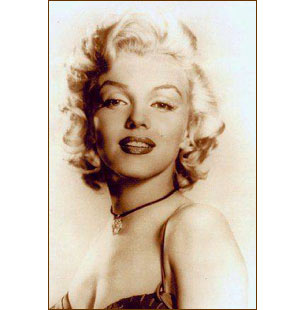
“What she has,” said one of Marilyn Monroe’s acting teachers, “this presence, this luminosity, this flickering intelligence … [is] so fragile and subtle, it can only be caught by the camera. It’s like a hummingbird in flight — only the camera can freeze the poetry of it.”
And indeed, hummingbirds dart through the pages of “Blonde” like tiny emblems of the imperceptible. Joyce Carol Oates’ scary and rhapsodic novel about the life of Marilyn Monroe is saturated with the mysteries of eye and camera — time, motion and stasis, light and dark — as well as the mystery of Monroe’s presence on-screen.
The still camera was always Monroe’s friend. But perhaps because she understood it so well, the motion picture camera terrified her. Moviemaking was an agony for her and became so for everybody she worked with. She’d hide in her dressing room for hours: The love scene in “Some Like It Hot” required 51 takes; one conversation in “Bus Stop” took six days to film. And yet the directness and naturalness she achieved during these harrowing sessions consistently astonished everyone who’d been on the set.
On-screen she looks startled, as though she’s so entirely present in the moment and in her glowing skin that she has lost track of the plot. Director Billy Wilder said she had “flesh impact,” her flesh “warm and alive even in black and white.” She hugs herself, wiggles her shoulders with the pleasure of inhabiting her body. The physical world is friendly, hospitable; even the air — from the subway grating, the air conditioner — makes love to her.
How did a perpetually frightened and insecure young woman summon up such powers of illusion? Out of what fathomless need did an illegitimate child who spent years in foster homes command so much attention and so much love, even 40 years after her death? How, out of a series of doomed affairs and marriages and some not-very-good scripts, did she manage to tell us so much about sex? And what kept her from ever satisfying her own needs for love and respect?
Oates presents her story as a tale of the grotesque, a horror story akin to Stephen King’s “Carrie,” another book about an unhappy child with a mad mother. Like most horror stories, “Blonde” is a tale of freakish overcompensation, impossible wishes granted, awesome power ill-used, demons finally undefeated — the story of an injured child who can’t be healed, even by the love of the millions. There’s nothing supernatural in it, of course, unless you consider the immense sway that movie images and technology hold over all our imaginations.
Unlike genre horror fiction, though, “Blonde” is a huge, incantatory, expressionistic work that doubles back on itself to retell stories again and again, building its themes and variations through a seeming infinity of retakes. Description approaches hallucination. The action is told by numerous voices, some singular and famous, some anonymous and plural. Sometimes the narrative voice is breathless, almost gasping — the ghostly Marilyn Monroe voice, oddly formal and well mannered, too high and thin for the body that produced it.
The childhood scenes in “Blonde” are pure irresistible Grand Guignol. In Oates’ telling, Monroe’s mother, Gladys Mortensen (also spelled Mortenson), is a frenzied, furious, star-stuck studio employee, fuming and quivering on the verge of psychic meltdown. Volatile, delusional, chain-smoking and sometimes setting the sheets on fire, she delivers endless apocalyptic rants based on serendipitous reading and a thousand movies. The reader (and little Norma Jeane, aka Norma Jean, as well) become transfixed, especially as Mortensen tells the terrified and adoring child on her sixth birthday that her father has promised to return and “claim” her.
He never does, of course, though Monroe waits all her life and calls all her husbands “Daddy.” Or, more ominously, he’s there all the time, in the movie reality at the back of her mind that always threatens to overwhelm her grip on everyday events.
Hyperreal and overwrought, the book stuns by its relentless energy. The most effective scenes (besides the opening ones of Mortensen) are the most brutally expressionist: the shooting of the famous nude calendar, the casual sadism of the studio heads, the icy cruelty of Kennedy and company. Less successful, I think, is a hokey, probably manufactured central episode having to do with Monroe’s obscure affair with a sad, sexy, druggy Charles Chaplin Jr.
At least according to one biography, this affair between the fatherless starlet and the rejected son of a famous father really did occur, but the melodramatic fallout from the episode seems contrived to give the voluminous story some centrifugal energy. Perhaps it’s necessary, as “Rosebud” was necessary to “Citizen Kane,” but it reveals about as much about Monroe as Rosebud did about William Randolph Hearst.
Still, like “Citizen Kane,” “Blonde” is a staggeringly effective piece of craftsmanship. The biographical aspect is fascinating and inescapable, but, as Oates warns us in an introductory note, “biographical facts regarding Marilyn Monroe are not to be sought in ‘Blonde.’” People and events are manipulated, elided, exaggerated or radically foreshortened until they become the big screen images we vaguely remember from film clips or newspaper stories about Monroe’s life. It’s as though we’re watching a series of movies, all with the same female lead: the Blond Actress and the Ex-Athlete; the Blond Actress and the Playwright. As Monroe painfully learned, once the studio had a winning formula, it wouldn’t let it go; in “Blonde,” Oates plays the studio’s game to chilling, claustrophobic effect.
For example, she makes the Playwright — the Arthur Miller character — 48 years old when he begins his relationship with Monroe, instead of 38 or 39, as Miller really was (he was only nine years older than Monroe, and younger than Joe DiMaggio). I think she does so because the story plays more “Hollywood” that way: Contemporary magazine shots of Monroe gripping the arm of a New York intellectual with a receding hairline seem to tell the story of a young wife and a much older husband, so that’s the story we get. The story the camera tells is always the primary story. “Blonde” shoots first and asks questions later, working from the outside in, faithful to the truth of appearances, both from Monroe’s life and especially from her last movies.
She did become a better and truer actress during the last years of her life. When asked what character she played in the wretched “Prince and the Showgirl,” she answered, “A person.” And it’s true. Silly and simple as Elsie the Showgirl is, she’s a mensch — the only one of Monroe’s characters whom I can imagine walking off the screen into real life, taking her rueful, down-to-earth, grown-up sexuality with her.
I’m being sentimental here, dreaming in the way that the movie image charms us into dreaming, imagining her walking into the shadows like Charlie Chaplin and Paulette Goddard at the end of “Modern Times.” But Oates has built “Blonde” of tougher stuff, a substratum of imagery culled from the technology of the movies, the paradoxes of acting and the uniqueness of Monroe’s screen image.
Laced with poetry about light and vision, “Blonde” doesn’t end with a soft, comforting fade to black, but in the brilliant, disquieting light that comes up when a movie ends. Oddly assorted snippets of poetry and philosophy expand upon fear, visibility, loneliness. Taken from Stanislavsky, Emily Dickinson and Pascal, among others, perhaps the citations are nods to Monroe’s constant, passionate, haphazard reading. In any case, I found them strange and beautiful, merging pop and poetics, metaphysics and melodrama, in an attempt to account for her personality’s absences, her image’s uncanny presence.
Was the power of her screen presence due to her audience’s unconscious apprehension of her fear and loneliness? Maybe so; it is certainly so in “Blonde.” But was her funny, intelligent and generous on-screen sexiness also the product of her personality’s dissolution? Stupid as her lines were, her persona was smart enough to know her flesh’s frailty, and self-conscious enough to find it amusing.
Monroe may have been cast as selfish, thoughtless, a gold digger, but her audience felt her eagerness to share the physical pleasure she seemed to take in being herself. In his book “Marilyn,” Norman Mailer muses that while sex might be dangerous with some people, with her one feels it will be “ice cream.” One of my girlfriends’ mothers, approaching 70, confides that she’s still sexually active — “and it makes me feel like Marilyn Monroe.” My husband and I rented half a dozen videos of Monroe’s films the week before I wrote this review — and felt pretty good ourselves.
“Blonde,” of course, is anything but a feel-good book. It’s eccentric, exhausting — and remarkable. Part horror, part melodrama, part wildly adventurous meditation, it sees in the dark — the way we all do at the movies — holding the remembered and cherished image in our eyes while we wait for the shutter to open and the frame to advance.
Continue Reading
Close
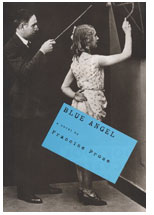
Ted Swenson has an enviable life as writer in residence at beautiful, bucolic Euston College. His teaching load is obscenely low: one two-hour session a week with a class of nine aspiring undergraduate writers. He has tenure, a witty, sexy wife and ample time to work on his next novel.
Only his novel stinks and his most closely guarded secret is that he hasn’t worked on it in years. His other two books are out of print and he’s approaching 50. In other words, the hero of Francine Prose’s 11th novel, “Blue Angel,” is in hell. And when he starts obsessing over the work of a talented and enigmatically seductive student — soon after the dean’s warning to the faculty about the growing threat of sexual harassment litigation — we know that life in hell is going to get a lot worse.
Prose has taught writing at numerous colleges and is clearly appalled by the puritanical mood on campus today. Yet her dissection of the chilly campus climate goes way beyond simple p.c.-bashing. Things weren’t so good in the old, pre-feminist days, either; Swenson’s wife, Sherrie, the college nurse, has seen enough students “destroyed by faculty Romeos.” But nowadays the students seem oddly childish and fearful. At the heart of the malaise lies an odd sense of entitlement — the students’ insistence that they don’t have to hear anything they might find disturbing or that might make them feel “unsafe.”
But learning is unsafe; thinking is unsafe. Swenson and his faculty colleagues take cover behind cautious language, and it’s this corrupting betrayal of language that makes Prose particularly furious. Her hero dumbs down his criticisms of student work, performing “the weekly miracle of healing the terminally ill with minor cosmetic surgery.” Some of the other, rather predictably portrayed English department members (its one deconstructionist, its one feminist) have taken an easier way out and actually believe the banalities they teach.
“Everything we read turns out to be the same story,” complains Angela, Swenson’s one talented student, “the dominant male patriarchy sticking it to women. Which I guess is sort of true … except that everything isn’t the same.”
This novel tells a different story. I trust I’m not spoiling anything for you if I reveal that a book called “Blue Angel” is about the young and heartless seducing the old and foolish. The seduction is as literary as it is sexual: Angela privately begins to hand Swenson pieces of the novel she’s writing, which Prose makes compelling enough to ensure that Swenson and we, Angela’s other readers, are hooked.
The erotic energy of the situation (writing as seduction and power trip, reading as willing submission) keeps “Blue Angel” hurtling ahead for perhaps its first half. And then, surprisingly, it becomes bleak and almost plodding. A lot of creaky plot mechanics get set in motion. A sense of inevitability creeps in: Swenson’s transgressions pile up like documents in a prosecutor’s dossier, unrelieved by any of the go-for-broke hilarity that Jack Nicholson, for example, brought to the male writer’s impotence in “The Shining.” (Why is it that the writer who can’t write has become our universally accepted emblem of the lost soul?)
It’s not that Prose can’t “do” male acting out — she did it brilliantly in “Guided Tours of Hell,” in which two participants in a Kafka symposium are helpless to stop one-upping each other, even while touring Auschwitz. But in this book she seems to have handed Swenson over to Angela: He becomes a sinner in the hands of an angry, uncontrolled and gleefully experimental student writer. Maybe this fate is intended as his punishment, but it still feels labored — or, as Angela might say, “technical.”
Many of Prose’s previous novels, including my favorites, “Bigfoot Dreams” and “Primitive People,” have loopy, meandering plots that don’t go much of anywhere but feel spacious all the same; they unfold into “the open destiny of life” that Grace Paley has said “everyone, real or invented,” deserves. “Blue Angel,” in piling up evidence, incident and literary reference, feels cramped and airless.
You could argue — as Swenson’s students might — that this constriction was intentional. In fact, I so enjoyed parts of “Blue Angel,” and so wanted it to work better than it did, that I briefly tried the ever feeble “meant to feel that way” defense myself. To no avail: Try as I might to explain away its shortcomings, “Blue Angel” definitely sags. Which is a shame, because it’s such a smart and savage take on a contemporary mood — a rueful meditation on the slippery slope from self-consciousness to self-regard to self-destruction, a study of the dumbed-down banality of mischief.
Continue Reading
Close
When my son was about 2, he had a beloved doll he called Clozer, one of those basic cheapies whose best trick (hence the name) was opening and closing its eyes. Wondering whether we should have sprung for something more anatomically correct, I asked him one day whether Clozer was a girl or boy.
“A boy,” he said.
“Why?” I asked.
“Because,” he explained, obviously surprised that I didn’t already know, “he’s got a penis.”
The “penis” he showed me was the little pee-hole between the doll’s legs. Not much of a penis — it wouldn’t have been much of a vagina either — but it served its signifying purpose admirably, allowing my son to impose a desired meaning on the matter at hand.
Gender is always a meeting of meaning and matter, and sometimes that meeting is fraught. Do we impose meanings on the matter of bodies — or is it, in Judith Butler’s phrase, the bodies that matter? The title “As Nature Made Him: The Boy Who Was Raised as a Girl” certainly makes the case for the primacy of nature — matter — as, ultimately, the book itself does. But author John Colapinto tells the story with enough richness to ensure that gender remains a complexly meaning-laden issue throughout.
Bruce Reimer lost his penis to a botched circumcision in infancy, in 1966. Phallic reconstruction was primitive at the time; desperate for a solution, his grieving and guilt-stricken young parents visited Dr. John Money at Johns Hopkins when Bruce was one-and-a-half years old. Money contended that it was possible to assign a baby a gender and — with the help of surgery, hormones and gender-specific socialization — successfully raise the child as either a girl or a boy.
Money told Ron and Janet Reimer that the baby could develop into a “normal” girl and woman. Surgery could provide her with a functional vagina adequate for intercourse and even orgasm. She wouldn’t be able to bear children, of course, but she would develop psychologically as a female and form erotic attachments toward men.
What Money may not have made entirely clear, according to Colapinto, was that all his experience had been with hermaphroditic or intersexed children. He had never worked with a child whose prenatal genital and sexual development had been entirely within normal limits. Turning baby Bruce into Brenda was — the words don’t seem too harsh — experimentation on a human subject.
In fact it was a researcher’s dream experiment, because Bruce was an identical twin, sharing DNA with his uninjured brother, Brian. If Bruce could be successfully reared as a girl, the case would serve as a dramatic illustration that socialization was the decisive influence in gender identity.
The “twins case” made headlines when Money described it in his 1972 book, “Man and Woman, Boy and Girl,” which the New York Times Book Review called “the most important volume in the social sciences to appear since the Kinsey Reports.” Summing up Money’s findings on sexual reassignment, the Times said, “If you tell a boy he is a girl, and raise him as one, he will want to do feminine things.”
The trouble was, “Brenda” didn’t want to do “feminine things.” The notes from Money’s yearly interviews with the twins do show that the little girl sometimes told him what he wanted to hear (although sometimes she manifestly did not). But in the distressingly univocal testimony of teachers, local therapists and relatives, she was an angry, miserably unhappy child who didn’t make girlfriends and hated dolls and dresses. Brenda was always a tougher, more enthusiastic fighter than Brian: Sometimes she’d defend him, sometimes she’d beat him up. And although her parents never told her that she’d been born a boy, one therapist reported that she repeatedly insisted she was “just a boy with long hair in girls’ clothes.”
“I sort of knew it wasn’t working after Brenda was 7 or something,” Ron Reimer told Colapinto. “But what were we going to do?” Ron sank into alcoholism and workaholism, Janet suffered from depression, Brian shoplifted in order to get attention from his parents. As for Brenda, her confused but consistent resistance to just about everything imposed upon her seems little short of heroic. Meanwhile, back at Johns Hopkins, Money was writing “Sexual Signatures,” a popular account assuring his readers that “the little girl … preferred dresses to pants, enjoyed wearing her hair ribbons, bracelets and frilly blouses, and loved being her daddy’s little sweetheart.”
The Reimers gave up the project when Brenda was 14, persuaded partly by the opinions of local therapists, but mostly by Brenda’s insistence that she’d kill herself if forced to see Money again or to undergo any more surgery. Brenda is now David, a name he chose after he’d learned the truth of his situation: He wanted to be either Joe (as in your average Joe) or David, after the biblical hero who had prevailed against an enormous enemy. In an eloquent and loving gesture, he asked his parents to choose between the names. He’s married to a woman whose three children he’s raising as a father. And you’ll probably want to know that phallic reconstruction has made considerable advances — he’s genitally sexually active.
I read David’s story deep into the night and sometimes through tears, both touched and outraged, and marveling that the Reimers survived as a family. And I also read it with considerable anxiety.
First of all, it’s the sort of story that cries out to be a sound bite. “That’s right, Biff, according to this riveting new book, nature is in and nurture is definitely out.”
And at least some of the sound bites will be aimed against feminists and their foolhardy attempts to challenge “nature.” Actually, the story has already been spun that way, though not by Colapinto. A few months before Colapinto’s prizewinning article, “The True Story of John/Joan,” was publishing in the Dec. 11, 1997, Rolling Stone, columnist John Leo delivered his own account in U.S. News and World Report. Indulging in some muted gloating at the expense of “campus feminists” and their wacky beliefs, Leo interpreted the case as a blow against the feminism of the “flower-power” ’60s and ’70s.
David’s story, moreover, has a fearsome Goliath. Now retired, Money has received numerous honors and published both academic and popular studies throughout his long, successful career. “He’s the guru,” one of David’s local therapists told Colapinto, explaining that he had hesitated to challenge Money publicly because he was “shit-scared” of him: “I didn’t know what he’d do to my career.”
Money’s pedagogical and clinical styles were often provocative, sometimes including sexual slang and pornography. I winced as Colapinto pushed all the panic buttons: pornography! prominently sexed African sculpture in his office! Money emerges from the narrative as an unpleasant avatar of self-regarding sexual permissiveness — the scientist as Playboy Advisor.
But it’s dangerous to infer too much from style, and anyhow, using pornography in a clinical setting is not necessarily a bad thing: Jeff Weinstein and Dorothy Allison, for example, have both written eloquently about how porn helped them understand their sexuality as gay youths. And I think you could make a case for the sexologist as rebel and provocateur in a puritanical society, as long as the provocation is not at his subjects’ expense — and as long as he is also responsive and responsible to his subjects.
How responsible was Money to the Reimers? Given the centrality of their case to his career, I’d think he would have wanted to follow it rather more closely than in yearly interviews. But it looks as if he’d already decided what he’d hear: Although he thanked one of Brenda’s therapists for her input, he never responded directly to its highly negative content. It’s also true that Janet Reimer reported any positive result she could find to Money — as anyone might do who needed to believe in the ultimate success of a scary and radical project. However, when Colapinto suggested to Money that Janet may have been presenting an unduly rosy picture, Money strongly disagreed, as though the assertion were an insult to his acuity as a psychologist (which I suppose it was).
Money seems to have told Colapinto very little of interest or value. And so it’s hard to extrapolate his side of the story, especially since he hasn’t commented publicly on the twins case since 1980, when doubts about its success began to air in the media. I wish it weren’t so easy to cast him as the story’s “destroying angel” (to borrow the title of one of his books); it makes for a gripping read, but it tends to short-circuit the reader’s effort to interpret and evaluate the story.
Money was crudely simplistic and overconfident; perhaps feminists who originally accepted his work should have cast a colder eye on his cooing over “daddy’s little sweetheart.” It’s tempting to swing the pendulum widely in the other direction and to see all of Brenda’s behaviors as responses to chromosomal or prenatal hormonal influences — indeed, you’d hardly want to dismiss these factors. But it would be equally simplistic to ignore the fact that Brenda (or more accurately, Bruce) had been a boy for his first 19 months, in a household whose central event had been the traumatic circumcision. And if we interpret the fact that Brenda was always more of a fighter than Brian as proof of Brenda’s hormonal or chromosomal “maleness,” what does this say about Brian and his “maleness”?
Still, Colapinto cites compelling cases of intersexed or hermaphroditic children who were sexually assigned in infancy — that is, castrated and raised as girls — but who, like Brenda, also always “knew” they were boys. And on a more mundane level, we can all recite stories of well-intentioned nonsexist parents who wound up with a little girl who demanded to go to school dressed as though she was attending her First Holy Communion, a little boy who’d commandeer anything in the house as a gun. And what of the emerging genre of narratives by and about gender-crossers, people who for whatever reason — biological or social — choose to live within a different gender than the one they were born into?
There does seem to exist what I can only call a strong will to gender — sometimes in the face of all opposing evidence and authority. But whether or not gender always originates within our bodies, it always takes on additional meanings.
Gender boundaries seem to harden under scrutiny. Money may have contended that gender was arbitrary and malleable, but he had no way of assigning gender identity except by imposing stereotypical behavior. Gender makes us anxious; we like to impose rules and standards. Paradoxically, some of the toughest rule makers are those who have broken the rules themselves: transsexuals who are creating new gender identities. I enjoyed and admired “Crossing,” Deirdre McCloskey’s intelligent memoir of her male-to-female transsexual odyssey, but I found myself tensing at her observations about feminine tidiness and what she calls “graceful living.” Just take a look at my kitchen, Deirdre, I thought, surprising myself by the fierce defensiveness of my response. Of course, McCloskey is hardly the gender police. But that’s how the gender conundrum works: As soon as you go searching for a road map you begin to sound like you’re writing the rulebook.
It’s not the purpose of “As Nature Made Him” to deconstruct the gender system. But interestingly and responsibly, Colapinto gives depth to his discussion by letting the system’s exceptions speak. In the past decade, intersexuals — people born with genitals that are not recognizably male or female — have begun to organize, to question their treatment (by Money and others) and to protest early surgery that has made some of them incapable of orgasm and made it harder for others to assume the gender that they ultimately chose.
“First do no harm” seems like a temperate enough demand, but intersex organizations have had remarkable difficulty getting a medical establishment that insists on early and irrevocable gender assignment to listen to them. These organizations do believe that a child needs to be reared in one gender or the other, but they ask for the recognition that a gender may be assigned mistakenly and for the confidence that, given patience and support, the subjects will best be able to sort things out for themselves. That is, in fact, a profound demand, because it asserts that “nature” is not always as simply, neatly and immediately bifurcated as we might like it to be.
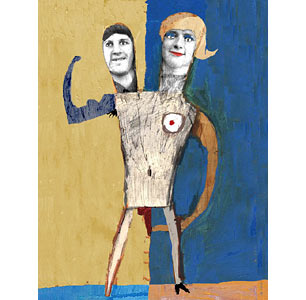
Einar Wegener, on whose life David Ebershoff’s novel “The Danish Girl” is based, may have been an intersexual; historical accounts differ, but he believed that he possessed a rudimentary set of ovaries. Wegener, a Danish painter, was the first transsexual to have a successful male-to-female sex-change operation: He became Lili Elbe at the Dresden Women’s Clinic in 1930. “The Danish Girl” is loosely based on his/her life.
An elegant fiction adorned with a profusion of lapidary detail, “The Danish Girl” has nothing formally in common with “As Nature Made Him.” But there’s an odd resonance, for both books situate their stories of gender identity within love relationships. “As Nature Made Him” is compelling partly because of Colapinto’s sensitivity to the Reimers’ deep family ties. “The Danish Girl” takes as its subject Wegener’s remarkable marriage to a woman who seems to have been his companion, accomplice, lover and impresario.
Gerda Wegener (here called Greta) was a successful painter and illustrator whose favorite model throughout the late 1920s was Einar, dressed as Lili. It makes for fascinating speculation: a transsexual’s partner who is not only supportive and encouraging but artistically and — in a rarefied sense — erotically involved in his/her transformation. In Ebershoff’s telling, Greta’s relationship with Einar/Lili is both sacrifice and adventure, devotion to another (who is about to become very other indeed) and fulfillment of her own talent.
The themes — of two selves becoming three becoming two, of sharing and separation, of Lili’s springing to life under Greta’s gaze and of Einar’s disappearance — should make for a powerful and original love story. But the novel remains curiously abstract, its characters wandering through marvelously rendered period landscapes with a sort of art-film vague purposefulness, as though they were trapped in some lovingly photographed Miramax-land.
For whatever reason, “The Danish Girl” lacks the urgency of the story as Lili told it herself, in Neils Hoyer’s compilation of her rather overheated memoirs. I read “Man Into Woman” with delight in the gay and lesbian section of the San Francisco Public Library’s historical collection, the yellowing pages of the 25-cent 1953 Mentor paperback almost dissolving under my fingers. “A nova vita,” Gerda thinks to herself, peering at Lili in her hospital bed. A new life. And the tellers of every gender-identity story I’ve encountered (including David Reimer’s) speak with comparable uniqueness and urgency, almost with awe, from the meeting place of meaning and matter of the mysterious conundrum of identity.
Continue Reading
Close