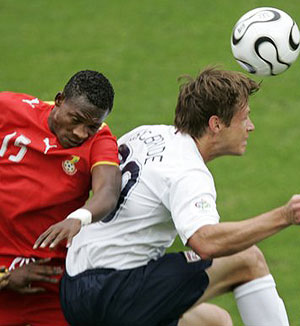
From where I was sitting in the epicenter of the Ghana-fan section, three seats away from drums that never ceased beating, American defender Oguchi Onyewu’s foul didn’t look like much of one. Indeed, my neighbor to the left seemed as puzzled as I was. But referee Markus Merk (now the most famous retired dentist in the world) was certain Onyewu had fouled Ghana forward Razak Pimpong from behind, and awarded a penalty kick to Ghana. Ecstasy broke out around me as midfielder Stephen Appiah fired home the shot that would send the West Africans into the next round and send the United States packing.
There was no ill will in either direction, though, not from Americans who felt they had been robbed, nor from triumphant Ghanaians gloating over their toppling of a superpower. A political superpower, that is. Despite its corniness, the motto for the 2006 World Cup — “a time to make friends” — was alive and well in Section 1b of the Nuremburg Frankenstadion on Thursday. I felt it throughout Germany in all the bars, trains and super-populated public viewing spaces I visited during the first two weeks of the world’s most popular sporting event.
Despite the disappointment, all was not lost for the Americans in Germany. Large contingents of fans from Virginia, California, Pennsylvania and Texas — no doubt inspired by midfielder, neophyte rapper and Texan Clint Dempsey (aka “Deuce”) — traveled to Nuremburg in support of their team. (No slight to residents of other states; these were the only contingents I could identify.) Allow me to pause for a minute to underline the importance of the words “their team.” Perhaps for the first time at a World Cup not played in the States, Americans were out in full, spirited and gregarious force. Even four Brits — two from Leicester City and two from Nottingham, diehard soccer fans because only the brave admit supporting those sides — told me they were impressed by the Yanks. America, the world’s football fans are proud of you!
Save the self-congratulatory pats on the back, though. There are four long years to consider this quick (and unnecessary) exit from the World Cup. Obviously there is still a long way to go in both footballing prowess and fan support, but that’s taking nothing away from the great turnout by Americans, who seemed to just about outnumber the Ghana supporters in the Frankenstadion. Sitting in the Ghana section, however, it was hard not to switch allegiances. Chants of “U-S-A!” are little match for rhythmic drumming, ultra-charismatic fan support and what I’m pretty sure was some low-grade marijuana, brought out just as the final five minutes of injury time was announced to the crowd.
Despondency looks the same whether it’s caked in red, white and blue makeup or worn as a frown by a tiny blond 10-year-old American girl who sits across from you on the train ride back from the stadium. The news that Italy had beaten the Czech Republic was more salt rubbed into the fresh wound. Had the U.S. managed to win, it would have been its flags waving on the long walk past the old Zeppelinfeld — the massive meadow surrounded by rows of columns facing a large tribune constructed from plans drawn by Nazi architect Albert Speer. It didn’t help that on this day, the Ghana side seemed eminently beatable. But baby steps, America, baby steps.
While culture critics feasted on the fascinating contradictions in Germany, there was some great football played in the first round of games, and highlights of public spectatorship were many. I spent the tournament’s first, absurdly sunny Saturday afternoon at an outdoor bar/club/lounge/pool/wonderland called, rather inexplicably, Platoon, replete with a massive screen and two-tiered stands to boot in (east) Berlin’s young and artsy Mitte district. The very fact that such a venue exists, and in total dedication to extracting maximum pleasure from a few football matches, is a testament to how saturated the country is in all things Weltmeisterschaft.
While not surprising, it is impressive to note that nary an advertisement on TV, in a magazine or newspaper, on a bus or on the metro does not have something to do with football. Halftime at matches is torturously rote: 15 minutes of what I’m convinced are the same commercials broadcast in exactly the same order. Even late-night television ads for phone sex lines feature pouting frauleins clad, momentarily, in full team kits, cavorting between studiobound goalposts, all the while daring you to, ahem, “score.” But, football fanatic that I am, and lascivious or not, such excess feels like paradise.
And paradise apparently serves grilled chicken Caesar salads and Alsterwasser (a mixture of lager and lemonade that, despite how that may sound, is perfectly refreshing on a hot afternoon) with a view of Hamburg’s famous harbor. Accuse me of Monday-morning quarterbacking (or centerbacking, as the case may be), but I wasn’t expecting the U.S. to upset the Czechs as easily as they did the Portuguese in their first match at the 2002 World Cup. The Czechs were the strongest team at the 2004 European Tournament until their captain, Pavel Nedved (whom many have rightly noted is a dead ringer for a “Roadhouse”-era Patrick Swayze), fell to injury. To shield myself from possible shame, I wanted to watch the match in as comfortable a public setting as possible — to ensconce myself in comfort to make the inevitable jibes and catcalls directed at yours truly less hurtful. Enter the phenomenon of the German beach club.
Often miles away from an open body of water, consisting of a boatload of sand dropped in the middle of open space in the middle of a city, beach clubs have become quite the rage in Germany. Uniting the beach and football is nothing new — just ask the Brazilians — but for the neutral spectator, the idea is tinged with genius. No doubt we have some Bauhaus-influenced brilliant mind to thank for this blessing. And though it pained me to see the U.S. so thoroughly beaten by the irresistible Czech attack, I cannot deny that the blow wasn’t cushioned by a comfortable deck chair and a cold Beck’s.
The other side of paradise can be found at Hamburg’s Fan Fest, held in a massive open field called Heilingengeistfeld, capable of hosting upward of 50,000 people, all in the shadow of an equally massive flak bunker, which, after the Second World War, was scheduled for demolition; it survived all attempts at its destruction. How’s that for German engineering? Four public seater stands (and one private one) face a gigantic LED flat screen, while smaller concourses snake around behind the stands, featuring tents dedicated to the cuisines of each of the 32 nations represented in the tournament. This is the province of both the diehard fan and the dilettante, equally welcoming to families and fanatics alike.
One of the things you notice very quickly about the World Cup’s propensity to bring people together from various countries who might never cross paths is that the smallest measures of shared cultural understanding can make for fast friends. In the wake of Iran’s 3-1 loss to Mexico, it’s entirely fine for the German Fan Fest emcee to sing “La Cucaracha” in Spanish and both Mexican and Iranian fans alike will dance around in a huge conga line, loving every second. Perhaps I’m discounting alcohol as a contributing factor, but I do think that soccer has a lot to do with it.
“Vaya Con Dios” sang the Argentine to a clutch of Serbian (or Montenegrin) fans as they walked down the pedestrian-only concourse leading from the Gelsenkirchen Hauptbanhof (train station). It was a fitting, and perhaps necessary, blessing given what was to transpire between the footballing representatives of these two (recently three) countries later in the day.
I took a 5:40 a.m. train from Hamburg to Gelsenkirchen, a ride besmirched not merely by drunken German fans who boarded in Bremen (how they were drunk by 6:40 a.m. I’ve no idea) but also by the weather. A smattering of rain dampened the journey, but let up by the time I heard that sweet Argentine serenade. Skies remained gray, but the mood in the streets and subways was spirited. It looked to be a grim day for football, yet in the minutes before the gates to the Arena auf Schalke were unlocked — and the cynical will not believe this — a chasm of bright blue and sunshine broke through the clouds directly over the stadium. It appeared that God had, once again, a hand in matters concerning Argentine football.
Wearing large, dark sunglasses, I felt free to gawk at the spectacle before me. You could lose yourself in color: Serbian navy blue, the albiceleste of the Argentines. Four inexplicable Poles wore their country’s red as if merely to complete the spectrum.
Beyond my comprehension, the doors opened three hours before game time. And despite plenty of evidence to the contrary — namely, the throngs of people entering on all sides of me — I couldn’t help feeling special, as if World Cup president Sepp Blatter had an eye out for me. To be seated alone in the giant stadium could be described as peaceful if not for the German pop blasting over the loudspeaker.
The game, alas, was over before it began. Maxi Rodriguez scored in the fifth minute as the Argentines pinged the ball about with single touches, between and behind the vaunted Serbian defense. But even so fluid an attack could not prepare the crowd for what will be regarded as “the Goal.” I’m almost certain countless babies were conceived in the moments after Esteban Cambiasso expertly finished Hernan Crespo’s cheeky back-heeled pass into the top left half of the net. It’s the kind of goal that creates football fans for life.
There were four more Argentina goals, one scored by budding genius Lionel Messi. Messi, who could be the best player at this tournament, is a stoop-shouldered kid with tousled hair who shuffles his weight gently, but perceptibly, from foot to foot, as if the tag of “the new Maradona” didn’t weigh a thing. Of course, he takes off like a shot when he wants to, and was too much for the Serbs, assisting a goal and scoring one in just 15 minutes of play.
A game like this makes everyone smile, even those humbled in defeat, as I witnessed after the match, watching the Netherlands-Ivory Coast match with five smiling Serbs in a crowded bar. But really, what else can you do but smile when you lose by a touchdown in American football? A Scotsman and an Englishman squeezed between us and we were able to share predictions for next year’s English premiership. They then told me about trying to buy scalped tickets from a “tout,” going to the ATM to withdraw the money for the tickets and returning only to find the tout in handcuffs, pressed chest-first onto a German police van.
Looking back on my first two weeks at the World Cup, I continually smile at how easy it has been to start conversations with strangers from not-so-strange lands. Granted, it helps to be able to say the name Bastian Schweinsteiger (a young, talented German midfielder) with the verve and excitement of a 12-year-old. But you have to credit soccer — like no other sport in the world — for the goodwill. Sure, there’s an aw-shucks quality to it, but then again, Americans are supposed to be good at this sort of thing. Now all we need is a domineering defensive center-mid and we’re back in business.
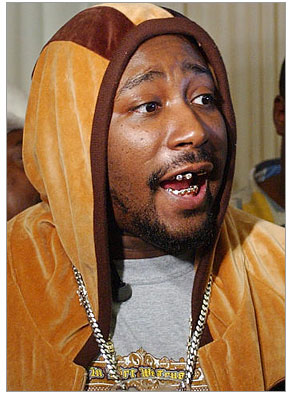
Outrageous. Unpredictable. Deranged, possibly. Irresponsible, certainly. But I don’t care what anybody says. Ol’ Dirty Bastard was avant-garde as hell.
“Avant-garde” was originally a military term, referring to an advanced group forging an assault on the enemy ahead. And O.D.B., whose given name was Russell Tyrone Jones, and his fellow members of the Wu-Tang Clan were way ahead of the rest — a radically unique collection of some of the most charismatic and creative rappers ever to rhyme two lines. Their 1993 album, “Enter the Wu-Tang: 36 Chambers,” not only did more for Timberland boots and black ski masks than any corporate ad campaign ever could, but put East Coast rap firmly back on the map, a full year before Puff Daddy and Bad Boy Records wrested the mike away from the West Coast’s Dr. Dre, Snoop Dogg and Suge Knight’s Death Row Records.
Wu-Tang artists RZA, GZA (Robert Diggs and Gary Grice, cousins to Jones), Method Man, Raekwon and Ghostface, among others, went on to have solo album success both critically and commercially, and the Wu were among the first groups to get involved in the licensed hip-hop fashion bonanza with their label, Wu-Wear.
But what made the Wu-Tang Clan — named in honor of the Wu-Tang school of sword fighting featured in the kung fu flicks so idolized by the rap group’s members — truly brilliant was their vibrant, irresistible aesthetic. Hip-hop always had its thugs, even thugs who wrote rhymes employing complex verse structures. But thugs who spliced arcane mythologies with intricately constructed, Asian-gothic beats with kung fu movie audio samples were a new phenomenon. Their self-mythologizing and pop culture referencing (preceded by Run D.M.C.’s shelltoe Adidas/gold rope chain aesthetic) came long before Quentin Tarantino exploited his love of Asian “grindhouse” cinema in “Kill Bill,” Vol. 1 and 2, which were, incidentally, scored by the RZA.
Wu-Tang hailed from Staten Island, and the tiny, oft-forgotten part of New York was transformed into Shaolin Island in their pan-Asian-ghetto-gangsta conception. Their radio-ready aesthetic evoked the nostalgia of Saturday afternoons spent embroiled in heady chop-socky dramas like “Five Deadly Venoms” or “Shaolin Temple II.” And it gave these gifted personalities their own individual legends, built out of a hybridized Afro-Asian folklore.
O.D.B., who died of as yet undetermined causes in a recording studio in Manhattan on Saturday, was an integral part of that aesthetic. Even in a group that featured larger-than-life personas, like the now near-ubiquitous(ly high) Method Man, or the GZA’s labyrinthine verse stylings, saying that O.D.B. managed to distinguish himself is a massive understatement. He was called Ol’ Dirty Bastard because, as stated in an interlude on “36 Chambers,” “There ain’t no father to his style.”
Ol’ Dirty’s gold-toothed, marble-mouthed, free-associative nonsense raps ran in topic from not-so-subtle threats (“Do you wanna get your teeth knocked the fuck out?”) to wistful remembrances of lost love and its painful aftermath (“Burn me/ I get into shit/ I let it out like diarrhea/ got burned once/ but that was only gonohrrea”). He wrote rhymes for the ladies too. Almost always playful — which was whenever he wasn’t inviting muthafuckas to step to him on his “Brooklyn Zoo” turf — O.D.B. famously rapped, “Me and Mariah/ go back like babies with pacifiers,” in a duet with Mariah Carey from 1995′s “Fantasy” (the remixed Tom Tom Club track). O.D.B. also saw his biggest hit come as a result of matching his gravelly tones with the sweet sounds of Kelis and a showy Neptunes beat on “Got Your Money,” off of his 1999 album, “Nigga Please.”
Raw energy loosed in lyrical form, O.D.B. had no qualms about singing — well, murdering — melodies in his songs, continuing in the fine tradition of notoriously off-key soloist and rap legend Biz Markie. It’s a tradition that has survived to today with Kanye West, André 3000, Mos Def and Pharrell Williams offering pitch-unperfect, but heartfelt, recordings.
As a performer, he was our raging, amphetamined id whose “non-style” of sorts reminds me of a classic James Brown lyric: “I don’t know karate, but I know c-razy.” O.D.B. knew crazy. He was the personification of the phrase “I just don’t give a fuck” long before Eminem had any claim to it, and O.D.B.’s trademark growl made it OK for rapper DMX to bark his way through his albums, selling millions of records with each successive “Ruff, Ruff.”
But such reckless disregard for any accepted conventions, especially those having to do with the law, will usually get you into trouble whenever you do step over the line. And O.D.B. was a habitual line-stepper.
In 1994, O.D.B. took MTV News cameras into a limousine with him and several of his kids (he was said to have more than a dozen, by numerous mothers, though his wife of 13 years, Icelene Jones, claims he only has three — with her), and drove to a welfare office to collect food stamps.
Arrested in 1997 for failing to pay nearly a year’s worth of child support for three children he had with his wife, O.D.B.’s rap sheet would get only longer. He pleaded guilty to attempted assault on his wife in 1998, then two months later was shot in the back in what he claimed was a robbery of his Brooklyn home. Later that year he was arrested for shoplifting $50 sneakers in Virginia Beach, Va., and was charged with making “terrorist threats” at the House of Blues in Los Angeles.
In a wonderful media moment of raw honesty and perhaps a little intoxication, O.D.B. attended the 1998 Grammys and, disappointed that Wu-Tang lost out to Puffy for best rap album, grabbed the microphone from a stunned Shawn Colvin and addressed the crowd. “Please calm down,” he said. “I went and bought me an outfit today that cost me a lot of money, because I figured that Wu-Tang was gonna win. I don’t know how you all see it, but when it comes to the children, Wu-Tang is for the children. We teach the children. Puffy is good, but Wu-Tang is the best. I want you all to know that this is O.D.B., and I love you all, peace.” The day before he had rescued a 4-year-old girl from a car wreck in Brooklyn.
Always a pioneer, O.D.B. became the first person arrested under a new California law that prevented convicted felons from wearing bulletproof vests in 1999. His legal troubles, particularly that year and beyond, were many — and certainly not to be glorified or glamorized — but he did manage to carry off some of these with a certain amount of panache. In October 2000, O.D.B. chose to escape from custody while being transported to court from a Pasadena, Calif., rehab center, but true to his iconoclast form, he didn’t keep a low profile like any ol’ fugitive. He not only recorded part of an album with RZA, but also appeared onstage to perform with the rest of the Clan at New York’s Hammerstein Ballroom in November 2000. He was finally arrested in the parking lot of a McDonald’s in Philadelphia two nights later by an officer who recognized him because her son was a fan. He was later sentenced to two years behind bars in upstate New York.
Upon his release, he immediately signed with Roc-A-Fella Records and began work on a new album, which was nearing completion at the time of his passing.
Say what you want to say about O.D.B. He certainly would have said whatever the fuck he wanted to say about you. Perhaps his is a case where person and persona were too tightly wrapped up within one another; one certainly fed off the other, for better or worse. A lot of his behavior was pretty indefensible, but the energy and eccentricity he brought to hip-hop will be missed — and nearly impossible to replace — as a result of his tragically young death. He would have been 36 years old Monday.
What more can say about O.D.B., Ol’ Dirty, Osirus, Joe Bannanas [sic], Dirt Dog, Unique Ason, Dirt McGirt, or however the matchless Mr. Jones chooses to refer to himself in the afterlife. My personal favorite was Big Baby Jesus, a name that, to questions regarding its provenance, he explained, “I always been Jesus. I don’t know what the big secret’s been all these years.” In fact, maybe it’s better to let him speak for himself one last time, from the intro to his first solo album, in all his proudly ignoble glory:
“My name is Mr. Russell Jones. ‘Scuse me for that one, I had to let that one loose. Tonight, you’re gonna see something that you’ve never seen before. Something that nobody in the history of rap ever set they self to do. This fucking guy that I speak to you about is something crazy, he’s something insane. He’s the greatest performer ever since. Uh. James Brown. He’s bad, and he’s a cool guy, and you need to really get to know him. Ladies and gentlemen, from all houses to all towns. From the Moon, to Pluto, back down to Earth. Ladies and gentlemen, one more time, give it up, for the Ol’ Dirty Doggie. I mean, the Ol’. Dirty. Bastard. I love that guy.”
Me too.
Continue Reading
Close
Timothy Greenfield-Sanders made his name photographing luminously iconic portraits of the artistically and intellectually accomplished. Andy Warhol, Jasper Johns, Orson Welles, Toni Morrison, Sidney Poitier and Hillary Clinton have all appeared before his camera. His photographs manage not merely to capture but also to powerfully radiate with the intensity of his featured subjects — their personalities pour forth from the frames.
Greenfield-Sanders has now re-focused his lens on a whole new crowd: porn stars. His latest book, “XXX: 30 Porn-Star Portraits,” released last month by Bulfinch Press, features 30 startling diptychs of some of porn’s most famous performers, gay and straight, shown in their day clothes and their birthday suits. (The photos are also on display through Dec. 18 at the Mary Boone Gallery in New York.) Jenna Jameson, Ron Jeremy, Tera Patrick and Gina Lynn are among those who strike twinned poses for the photographer, in some cases revealing far more confidence in the buff than in their blue jeans. The book also features 15 essays, both erudite and eccentric, about pornography and culture from a remarkable group of writers, thinkers and performers, including Gore Vidal, Francine du Plessix Gray, John Malkovich, Nancy Friday and John Waters.
Porn stars were a radical change of pace in many ways for the photographer, who’d never photographed nudes before. But with the subject of porn becoming increasingly visible in popular culture — Jenna Jameson’s well-received autobiography being one recent example — it became not only impossible to ignore, but also fascinating enough for the photographer to study. Though pornography has long existed in various forms, it may take the bright key lights of the mainstream — or of a prominent photographer for that matter — for us to honestly look at those who produce it. As Sunrise Adams, one of the porn stars who posed for Greenfield-Sanders, says in “Thinking XXX,” a documentary about the making of the book that recently aired on HBO and is set to return to regular rotation soon: “Everybody’s fucking somebody to get somewhere in life. We’re just doing it on film.”
Salon recently spoke to Greenfield-Sanders by phone:
What made you decide to put together this book?
Years ago, I saw “Boogie Nights” and was struck by how interesting porn stars were, and thought they’d be challenging for a portrait series. I never thought of shooting them nude. And it developed over the years, the idea. Eventually I met a porn star, and I did portraits of him. He asked to pose nude at the end of the shoot, and I was shocked and didn’t know what to do or how to shoot it. So I used the same pose as the clothed one. The next day when I saw the pictures, they were so striking that I realized that this was a great way to shoot them because they were equally interesting both as people and as nude studies. I only imagined them for a gallery show at first. I never thought of it as a book. But as I met more porn stars I realized how interesting, how diverse and how exceptional they were. I thought a book might be cool too.
How do you choose your poses?
As a photographer I think of the whole project at all times, not just that single portrait. “XXX” consists of 30 portraits, so you don’t want to do the same pose over and over again, even though 10 or 15 people might look great in that pose. One uses up the limited body positions quickly. The trick is to get everyone to be different in some way, and at the same time look powerful, and interesting, have dignity, and look like himself or herself.
You’ve said that your photo of Briana Banks was inspired by a Cézanne painting of a young boy. Were many of the other poses similarly inspired by works of art?
I have a B.A. in art history, so I often think in art historical terms. I look at a pose and think, “Oh, that’s the pose of George Washington with his hand up at his chest,” or, “That’s Mona Lisa.” I think the Cézanne painting of the bather is such a great pose, and it was an interesting start-off point for her.
Goya is mentioned in the introduction to your book as one of the primary inspirations for the diptych form you’ve chosen, primarily his “Maja, Clothed and Nude” paintings.
When Goya did the Maja paintings, those were radically controversial. [Labeled "obscene works," they were seized by the authorities.] I think in some parts of this country, there are probably people who feel the same way about my book. So while in some ways a lot has changed — these porn stars can be nude and confident, and powerfully nude — there are people that still view it as they did 300 years ago.
Are you hoping your project will change their minds?
I don’t know if I can change people’s minds, but I would like to create a dialogue about the subject and these people — about porn stars — and what they do, and about sex.
What did you learn about porn stars from working on this project?
I was very lucky to pick porn stars to pose for the first nudes I’ve ever done because these are very accomplished people in front of the camera. They’re great at posing, so it was easier for me than it would have been with another group who wasn’t really comfortable with their bodies. Porn stars are very exhibitionistic and very at ease naked. Nudity empowering to them.
Did your porn star subjects ever remark about how different your photo shoots are from, or how similar they are to, what they’re used to?
I think that they would agree that it was a very different experience for them, because I was there to bring them out as people, to emphasize that and to make them look good, but in a very different way than they’re used to. They’re used to doing a box cover or magazine layouts — it’s a different aesthetic. I think they felt that I respected them and I don’t think that is always the case on other photo shoots.
Were any of them surprisingly shy?
I think that it takes a certain personality to be a porn star. I think exhibitionism is a big trait; an incredible drive to be successful is another one. I’ve only shot these 30, plus a few that didn’t make the book. They all have that in common — this push to be somebody, whether it’s for the money or whether it’s for the fame — and I think there’s a certain commonality to them all in terms of that.
Your portraiture generally manages to convey your subjects’ fierce intellect and self-assuredness. These photos convey a different type of confidence and self-assurance. Were you concerned that this series might not carry the same power because of who you were shooting?
I approach all my shoots the same. There’s this dance that goes on where I try to make the person feel comfortable, to get them in a certain mood, so that by the time I get them in front of the camera, I can get the best out of them. And whether that person is Madeleine Albright or George Bush or John Kerry or Briana Banks or Tera Patrick, it’s the same for me.
Continue Reading
Close