Richard Lardner

Panel examining flaws in food-for-troops contract

  • more
    • All Share Services

WASHINGTON (AP) — Lawmakers say a Pentagon agency and the contractor it hired to supply troops in Afghanistan with food and water are both to blame for a massive billing dispute that has heightened concerns over the use of American tax dollars in war zones.

In separate letters sent Thursday to the Defense Logistics Agency and Supreme Foodservice, a House oversight subcommittee investigating the $5.5 billion contract said the two sides never agreed on pricing terms even as the scope of the contract expanded rapidly with the arrival of thousands more U.S. combat forces to combat a Taliban surge.

The logistics agency is demanding that Supreme of Ziegelbrucke, Switzerland, return more than $750 million in overpayments. But the company has claimed it is owed $1 billion more than it has already been paid.

Budget official picked for top cybersecurity post

  • more
    • All Share Services

WASHINGTON (AP) — The White House has selected the head of the intelligence branch in its budget office to be President Barack Obama’s top adviser on cybersecurity issues, a move that comes as Congress and the Obama administration are at odds over how best to protect critical U.S. industries from crippling electronic attacks by cybercriminals, foreign governments and terrorists.

Michael Daniel, a 17-year veteran of the Office of Management and Budget’s national security division, will replace Howard Schmidt as Obama’s cybersecurity coordinator, the White House announced Thursday. Schmidt, who was appointed by Obama in December 2009, is retiring and returning to private life, according to the announcement. Before his White House appointment, Schmidt had worked as chief information security officer at eBay and chief security officer at Microsoft.

As the budget office’s intelligence chief, Daniel has overseen classified programs being run by U.S. spy agencies and the Defense Department. He has also coordinated the budgets for the government’s cybersecurity programs.

Daniel’s new job puts him squarely in the middle of a contentious debate between the White House and congressional Republicans over legislation that would permit the government and the private sector to exchange information about threats in cyberspace. The White House supports the creation of an information-sharing system, but threatened to veto a bill passed last month by the GOP-led House because it said the measure failed to protect the privacy rights of Americans.

The White House is also demanding that any bill Congress passes to include provisions that require the companies that operate electric power plants, water supply, banking systems and more to meet basic security standards so their computer networks are protected from cyberattacks. But Republicans are opposed to new government regulations on businesses. They say the private sector knows best how to guard its computers.

Continue Reading Close

US needs top-level approval to launch cyberattacks

  • more
    • All Share Services

WASHINGTON (AP) — The United States would use cyber weapons against an adversary’s computer networks only after officials at the highest levels of government approved of the operation because of the risks of collateral damage, a senior U.S. military official said Tuesday.

The director of intelligence at U.S. Cyber Command, Rear Adm. Samuel Cox, said that cyberattacks can do significant damage to a country’s infrastructure and should never be carried out in a cavalier manner. Offensive cyber operations are difficult to conduct with precision to avoid casualties and collateral damage to unrelated systems, he said.

“If you’re trying to do precision strike in cyberspace with a very high degree of confidence,” Cox said, “that takes enormous amounts of intelligence, planning, great care and very carefully crafted cyber tools that won’t boomerang against you down the road.”

Cox also downplayed the prospect that an enemy of the United States could completely disable the nation’s electric power grid or shut down the Internet because these systems are designed to withstand severe cyberattacks.

“There’s huge amounts of resiliency and redundancy built into the system nowadays that makes that kind of catastrophic thing very difficult,” he said.

Cox’s remarks at a cybersecurity conference in Arlington, Va., opened a small window into a subject U.S. authorities rarely discuss in public.

Cyber Command is in charge of defending U.S. military networks from attacks and intrusions. The command’s top officer, Army Gen. Keith Alexander, also is the director of the secretive National Security Agency, which gathers electronic intelligence from foreign governments. Both NSA and Cyber Command are headquartered at Fort Meade, Md.

The Defense Department is developing rules of engagement for how commanders will operate in cyberspace and what missions they can conduct under their own authority.

During congressional testimony last month, Alexander said decisions on how to respond to adversaries in cyberspace would be made by the president and secretary of defense. But military commanders would have authority to take action if the cyberattack were about to cause harm and immediate action was needed.

“Our job would be to defend and protect and to stop some of these attacks analogous to the missiles coming in and give the administration options of what they could do to take it to the next step, if they choose,” Alexander told the Senate Armed Services Committee.

Continue Reading Close

U.S. tells court bin Laden photos must stay secret

Obama administration argues that public disclosure of images would compromise safety of Americans abroad

  • more
    • All Share Services

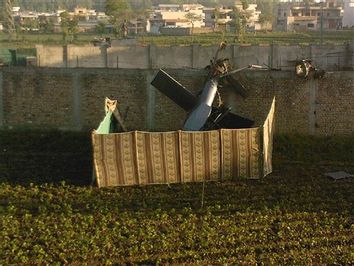
U.S. tells court bin Laden photos must stay secretFILE - In this May 2, 2011 file photo taken by a local resident, the wreckage of a helicopter next to the wall of the compound where according to officials, Osama bin Laden was shot and killed in a firefight with U.S. forces in Abbottabad, Pakistan. The U.S. suspects that Pakistan retaliated for the humiliating American raid that killed Osama bin Laden by letting the Chinese military see secret American technology used in the mission. (AP Photo/Mohammad Zubair, File)(Credit: AP/Mohammad Zubair)

Public disclosure of graphic photos and video taken of Osama bin Laden after he was killed in May by U.S. commandos would damage national security and lead to attacks on American property and personnel, the Obama administration contends in a court documents.

In a response late Monday to a Freedom of Information Act lawsuit filed by Judicial Watch, a conservative watchdog group seeking the imagery, Justice Department attorneys said the CIA has located 52 photographs and video recordings. But they argued the images of the deceased bin Laden are classified and are being withheld from the public to avoid inciting violence against Americans overseas and compromising secret systems and techniques used by the CIA and the military.

The Justice Department has asked the court to dismiss Judicial Watch’s lawsuit because the records the group wants are “wholly exempt from disclosure,” according to the filing.

Tom Fitton, president of Judicial Watch, accused the Obama administration of making a “political decision” to keep the bin Laden imagery secret. “We shouldn’t throw out our transparency laws because complying with them might offend terrorists,” Fitton said in a statement. “The historical record of Osama bin Laden’s death should be released to the American people as the law requires.”

The Associated Press has filed Freedom of Information Act requests to review a range of materials, such as contingency plans for bin Laden’s capture, reports on the performance of equipment during the May 1 assault on his compound in Abbottabad, Pakistan, and copies of DNA tests confirming the al-Qaida leader’s identity. The AP also has asked for video and photographs taken from the mission, including photos made of bin Laden after he was killed.

The Obama administration refused AP’s request to quickly consider its request for the records. AP appealed the decision, arguing that unnecessary bureaucratic delays harm the public interest and allow anonymous U.S. officials to selectively leak details of the mission. Without expedited processing, requests for sensitive materials can be delayed for months and even years. The AP submitted its request to the Pentagon less than one day after bin Laden’s death.

In a declaration included in the documents, John Bennett, director of the CIA’s National Clandestine Service, said many of the photos and video recordings are “quite graphic, as they depict the fatal bullet wound to (bin Laden) and other similarly gruesome images of his corpse.” Images were taken of bin Laden’s body at the Abbottabad compound, where he was killed by a Navy SEAL team, and during his burial at sea from the USS Carl Vinson, Bennett said.

“The public release of the responsive records would provide terrorist groups and other entities hostile to the United States with information to create propaganda which, in turn, could be used to recruit, raise funds, inflame tensions, or rally support for causes and actions that reasonably could be expected to result in exceptionally grave damage to both the national defense and foreign relations of the United States,” Bennett wrote.

Navy Adm. William McRaven, the top officer at U.S. Special Operations Command, said in a separate declaration that releasing the imagery could put the special operations team that carried out the assault on bin Laden’s compound at risk by making them “more readily identifiable in the future.” Before his current assignment, McRaven led the Joint Special Operations Command, the organization in charge of the military specialized counterterrorism units.

Continue Reading Close

Decades after leak, Pentagon Papers coming out

Release is timed 40 years to the day after The New York Times published its first story on the report's findings

  • more
    • All Share Services

Decades after leak, Pentagon Papers coming outThe Pentagon.

Forty years after the explosive leak of the Pentagon Papers, a secret government study chronicling deception and misadventure in U.S. conduct of the Vietnam War, the report is coming out in its entirety on Monday.

The 7,000-page report was the WikiLeaks disclosure of its time, a sensational breach of government confidentiality that shook Richard Nixon’s presidency and prompted a Supreme Court fight that advanced press freedom. Prepared near the end of Lyndon Johnson’s term by Defense Department and private foreign policy analysts, the report was leaked primarily by one of them, Daniel Ellsberg, in a brash act of defiance that stands as one of the most dramatic episodes of whistleblowing in U.S. history.

The National Archives and presidential libraries are releasing the report in full, long after most of its secrets had spilled. The release is timed 40 years to the day after The New York Times published the first in its series of stories about the findings, on June 13, 1971. The papers showed that the Johnson, Kennedy and prior administrations had been escalating the conflict in Vietnam while misleading Congress, the public and allies.

As scholars pore over the 47-volume report, Ellsberg says the chance of them finding great new revelations is dim. Most of it has come out in congressional forums and by other means, and Ellsberg plucked out the best when he painstakingly photocopied pages that he spirited from a safe night after night, and returned in the mornings. He told The Associated Press the value in Monday’s release was in having the entire study finally brought together and put online, giving today’s generations ready access to it.

At the time, Nixon was delighted that people were reading about bumbling and lies by his predecessor, which he thought would take some anti-war heat off him. But if he loved the substance of the leak, he hated the leaker.

He called the leak an act of treachery and vowed that the people behind it “have to be put to the torch.” He feared that Ellsberg represented a left-wing cabal that would undermine his own administration with damaging disclosures if the government did not crush him and make him an example for all others with loose lips. It was his belief in such a conspiracy, and his willingness to combat it by illegal means, that put him on the path to the Watergate scandal that destroyed his presidency.

Nixon’s attempt to avenge the Pentagon Papers leak failed. First the Supreme Court backed the Times, The Washington Post and others in the press and allowed them to continue publishing stories on the study in a landmark case for the First Amendment. Then the government’s espionage and conspiracy prosecution of Ellsberg and his colleague Anthony J. Russo Jr. fell apart, a mistrial declared because of government misconduct.

The judge threw out the case after agents of the White House broke into the office of Ellsberg’s psychiatrist to steal records in hopes of discrediting him, and after it surfaced that Ellsberg’s phone had been tapped illegally. That September 1971 break-in was tied to the Plumbers, a shady White House operation formed after the Pentagon Papers disclosures to stop leaks, smear Nixon’s opponents and serve his political ends. The next year, the Plumbers were implicated in the break-in at the Democratic Party headquarters in the Watergate building.

Ellsberg remains convinced the report — a thick, often turgid read — would have had much less impact if Nixon had not temporarily suppressed publication with a lower court order and had not prolonged the headlines even more by going after him so hard. “Very few are going to read the whole thing,” he said in an interview, meaning both then and now. “That’s why it was good to have the great drama of the injunction.”

The declassified report includes 2,384 pages missing from what was regarded as the most complete version of the Pentagon Papers, published in 1971 by Democratic Sen. Mike Gravel of Alaska. But some of the material absent from that version appeared — with redactions — in a report of the House Armed Services Committee, also in 1971. In addition, at the time, Ellsberg did not disclose a section on peace negotiations with Hanoi, in fear of complicating the talks, but that part was declassified separately years later.

Ellsberg served with the Marines in Vietnam and came back disillusioned. A protege of Nixon adviser Henry Kissinger, who called the young man his most brilliant student, Ellsberg served the administration as an analyst, tied to the Rand Corporation. The report was by a team of analysts, some in favor of the war, some against it, some ambivalent, but joined in a no-holds-barred appraisal of U.S. policy and the fraught history of the region.

To this day, Ellsberg regrets staying mum for as long as he did.

“I was part, on a middle level, of what is best described as a conspiracy by the government to get us into war,” he said. Johnson publicly vowed that he sought no wider war, Ellsberg recalled, a message that played out in the 1964 presidential campaign as LBJ portrayed himself as the peacemaker against the hawkish Republican Barry Goldwater.

Meantime, his administration manipulated South Vietnam into asking for U.S. combat troops and responded to phantom provocations from North Vietnam with stepped-up force.

“It couldn’t have been a more dramatic fraud,” Ellsberg said. “Everything the president said was false during the campaign.”

His message to whistleblowers now: Speak up sooner. “Don’t do what I did. Don’t wait until the bombs start falling.”

Continue Reading Close

U.S. extends airstrike role in Libya through Monday

American forces will maintain participation in coalition airstrikes an extra 48 hours

  • more
    • All Share Services

U.S. extends airstrike role in Libya through MondayLibyan rebels run for cover after coming under heavy artillery fire from pro-Gadhafi forces along the front line near Brega, Libya, Friday, April 1, 2011. Libya's rebels will agree to a cease-fire if Moammar Gadhafi pulls his military forces out of cities and allows peaceful protests against his regime, an opposition leader said Friday as rebels showed signs that their front-line organization is improving. (AP Photo/Altaf Qadri)(Credit: AP)

The U.S. agreed to NATO’s request for a 48-hour extension of American participation in coalition airstrikes against targets in Libya and U.S. lawmakers cautioned Sunday the allies need to know more about the rebels fighting Moammar Gadhafi’s forces before providing them with weapons.

Two weeks into the assault on Gadhafi, Republican lawmakers expressed concern that a stalemate could leave him in control of portions of Libya and with access to stockpiles of chemical weapons.

The U.S. is shifting the combat role to Britain, France and other NATO allies, but American air power is still in demand. Air Force AC-130 gunships and A-10 Thunderbolts and Marine Corps AV-8B Harriers will continue to attack Gadhafi’s troops and other sites through Monday evening. These aircraft are among the most precise in the American arsenal.

After Saturday, no U.S. combat aircraft were to fly strike missions over Libya unless NATO officials specifically asked and authorities in Washington gave their approval. NATO assumed full control last week from the U.S.-led international force for all aspects of the operation in Libya as authorized by U.N. resolutions that include an arms embargo, enforcing the no-fly zone, and protecting civilians from Gadhafi’s forces.

In an emailed statement, NATO spokeswoman Oana Lungescu said Sunday that “poor weather conditions over the last few days” were the reason the alliance made the request. She would not elaborate. “This is a short-term extension which expires on Monday,” she said.

A senior U.S. military official said heavy cloud cover over Libya late last week curtailed allied airstrikes. Gadhafi took advantage of the lull, pushing east into the port cities of Ras Lanouf and Brega, the official said on condition of anonymity to discuss sensitive military planning. The 48-hour extension is intended to roll back the progress made by Gadhafi’s army, the official said.

A decision yet to be made by the Obama administration is whether to arm the rebels with the firepower they need to take and hold ground against Gadhafi’s forces.

Rep. Mike Rogers, R-Mich., the chairman of the House Intelligence Committee, said there may be strains of al-Qaida within the rebel ranks and that the coalition should proceed with caution before arming them.

“We know they’re against Moammar Gadhafi remaining in power, but we don’t know what they are for,” Rogers said.

Senate Majority Leader Harry Reid advocated a “wait and see” approach to giving the opposition forces weapons.

“I think at this stage we really don’t know who the leaders of this rebel group are,” said Reid, D-Nev.

But Rogers also warned that if there were a stalemate in Libya, a cornered Gadhafi might resort to extreme measures against the opposition forces, such as the use of chemical weapons. Rogers said he has been to Libya and seen Gadhafi’s chemical weapons.

“I think you have to worry that he’s a terrorist threat,” Rogers said.

Sen. Lindsey Graham, R-S.C., said the coalition needs to take the air war to Libya’s capital where Gadhafi and his inner circle are located. Striking targets in Tripoli will further fracture Gadhafi’s government and push the Libyan leader from power, he said.

“The way to end this war is to have Gadhafi’s inner circle to crack,” Graham said. “The way to get his inner circle to crack is to go after them directly.”

Like Rogers, Graham said he’s concerned over the prospect of a stalemate in Libya. A member of the Senate Armed Services Committee, he faulted President Barack Obama for putting the U.S. into a supporting role and shifting the main combat burden to Britain, France and other NATO allies.

“To take the best air force in the world and park it during this fight is outrageous,” Graham said. “When we called for a no-fly zone, we didn’t mean our planes.”

Allied military operations against Gadhafi’s forces began March 19 with missiles and bombs targeting Libya’s air defenses, communications networks, and ground forces. Obama has ruled out the use of U.S. ground troops in Libya. But the opposition lacks the proper organization and equipment to push back Gadhafi’s army on its own.

Sen. John McCain, the top Republican on the Senate Armed Services Committee, said failing to arm the rebels could allow Gadhafi to maintain control over large swaths of Libya.

“We are concerned that regional support will waver if Western forces are perceived as presiding over a military deadlock,” McCain and Sen. Joe Lieberman, a Connecticut independent, wrote Friday in The Wall Street Journal. “We cannot allow Gadhafi to consolidate his grip over part of the country and settle in for the long haul.”

Navy Adm. Mike Mullen, the chairman of the Joint Chiefs of Staff, said in congressional testimony on Thursday that as few as 1,000 among the rebels are former members of Gadhafi’s military.

The rest are simply “guys with guns,” said James Dubik, a retired Army three-star general who says they need American or NATO advisers and trainers to be effective. “They need help,” Dubik wrote in an assessment for the Institute for the Study of War, a think tank in Washington.

Rogers appeared Sunday on NBC’s “Meet the Press.” Reid and Graham appeared on CBS’s “Face The Nation.

Associated Press writer Robert Burns contributed to this report.

Continue Reading Close

Page 1 of 2 in Richard Lardner