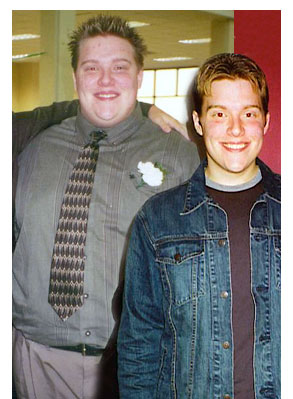
Even as a child, Natalie Moore, 19, was aware of her weight. When she announced to her Yoder, Ind., kindergarten that her favorite animals were pigs, a classmate shouted, “That’s because you are a little piggy!” By age 10, Natalie, already a Size 28, had been called “pig, cow, hippo — really any type of large animal,” she says. “When I walked down the hall, kids would say, ‘Here comes an earthquake!’”
Coming home from school in tears was bad enough, but in eighth grade, Natalie, weighing well over 250 pounds, began experiencing mild heart attacks. “It was very scary,” she says. “My doctor told me I only had a year to live if I didn’t lose weight.”
Going on a strict 1,500-calorie-a-day diet, Natalie managed to lose 40 pounds in six months, but the weight — due to a family history of obesity as well as a sedentary lifestyle and cravings for Mountain Dew and HoHos — gradually crept back on. After reading about weight-loss surgery on the Internet, and then discussing the procedure with her parents and her pediatrician, Natalie went for a consultation at Cincinnati Children’s Hospital’s Comprehensive Weight Management Center, one of the only places in the country that performs gastric bypass surgery on adolescents. On May 18, 2001 — a month before her 16th birthday — Natalie’s insurance paid for her to undergo a gastric bypass, in which her stomach was divided and stapled down to the size of an egg.
Despite medical complications — including a distended bowel that required immediate follow-up surgery — and a drastic change in lifestyle that requires Natalie to subsist primarily on skinless chicken breasts, sugar-free Flintstone vitamins, and 64 ounces of water or Crystal Light a day, the college freshman, who now weighs 150 lbs, is absolutely convinced the surgery was worth it.
“I would do it a hundred times again if I had to,” she says.
The popularity of gastric bypass surgery has soared in recent years, thanks in part to the dramatic weight losses of celebrities such as Carnie Wilson and Al Roker. According to the American Society of Bariatric Surgery (ASBS), more than 100,000 adults underwent weight-loss surgery in 2003, up from only 16,200 in 1992. Many insurance companies now cover at least part of the cost, which averages $25,000. While there are no official statistics as to how many adolescents have undergone weight-loss surgery — estimates range from 150 to 1,000 — the numbers, like those for adults, appear to be on the rise. And with childhood and adolescent obesity a national epidemic, Dr. Thomas Inge, surgical director at Cincinnati Children’s Comprehensive Weight Management Center, believes as many as 250,000 teenagers may be good candidates.
“Obviously, prevention of obesity is key,” he says, “but prevention failed a decade ago for Johnny, who’s now 400 pounds.”
But the question remains: Do the results outweigh the risks? The fatality rates, at least among adults, are relatively high — about one in 200 adult patients die from weight-loss surgery each year in the United States, and many develop hernias, blood clots and serious infections. During a gastric bypass operation, which typically lasts between one and three hours, doctors divide the stomach, stapling the lower section into a pouch. The gastric tract is then rerouted so digestion occurs in the lower small intestine, reducing the amount of calories and nutrients the body can absorb and making long-term nutritional deprivation a potential problem. Critics contend these complications may be exacerbated in adolescents, whose bodies aren’t yet fully developed. They also worry that many young patients might not be mature enough to understand that by undergoing bypass surgery, they are signing up for a drastic lifestyle change.
“We’re looking at a 50-year postoperative period,” says Paul Ernsberger, associate professor of nutrition at Case Western Reserve University in Cleveland. “What are the chances the weight loss will last that long? What are the long-term consequences of deliberately sabotaging the digestive process? … Teens are not qualified to make decisions that will affect their health for the rest of their lives.”
Still, despite the risks, and the dearth of long-term data, gastric bypass surgery is one of the only proven methods for achieving rapid and significant weight loss. Which is why it’s not surprising that teens are lining up to have the procedure. According to the American Obesity Association (AOA), about 15.5 percent of adolescents (ages 12-19) and 15.3 percent of children (ages 6-11) in the U.S. are obese. That’s a dramatic rise since the late ’70s, when the same numbers stood at 5 percent and 7 percent. And while experts argue over what’s caused this alarming increase — calorie-dense fast food? Increased TV watching? Reduction of physical education curriculum in schools? All of the above? — many severely overweight adolescents just want a solution to their weight problems now.
Eighteen-year-old Eric Decker of Columbia, S.C., began dieting at age 10, when his weight had already climbed to 150 pounds. He tried at least 25 different weight-loss plans, including popping Dexatrim pills and accompanying his mother to Weight Watchers meetings. Each time, he’d lose 15 or 20 pounds, then gain 30 or 40 back. “The weight never came off,” he says.
Soon, Eric’s health began suffering as a result. He felt “suffocated” when he slept, had difficulty breathing when he climbed stairs, and developed chronic pain in his knees and back. Kids at school constantly ribbed him about his size, dubbing him “Double Decker” and “Fat Boy.” While Eric always had a comeback ready — “I learned early on I’d either have to lose the weight or gain a thick skin” — the more teasing he endured, the more food he’d eat when he came home.
“I’d have a Supersize Big Mac meal, or nine pieces of pizza at one sitting,” he says. “I would snack all day. It was never-ending.”
After listening to Carnie Wilson praise her surgery on TV in 2002, Eric, then 17 years old and 385 pounds, proposed the idea of surgery to his parents.
“My immediate reaction was, ‘No way in hell!’” says his mother, Karen Decker, 48, a commercial loan specialist. “I thought, there has to be a better way.” Particularly unsettling to her was the high mortality rate. But attending support groups and reading more about the surgery soon changed her mind. “Yes, the death rates [still] scared me,” Karen says, “but I think it was a bigger risk for him to be that obese and not have the surgery.”
Last January, Eric’s insurance company agreed to pay 80 percent of the costs for him to undergo gastric bypass surgery at Cincinnati Children’s Hospital. And like Natalie, Eric had immediate complications. The day after the procedure, he underwent an emergency operation to fix an accidental puncture in his stomach. But despite a two-week hospital stay, having to return to school with two “embarrassing” drainage tubes in his stomach, and several classmates who accused him of “taking the easy way out,” nothing put a damper on Eric’s excitement at becoming thin.
“I lost 15 pounds the first week after my surgery, and to see the weight pouring off me like that was such a catalyst,” he says. “I was ecstatic.”
To date, he has lost 195 pounds and is only 10 pounds away from reaching his dream weight of 180. “Every time I look at him, I just can’t believe it,” says Karen. “I mean, now he loves to do things that before would be a major physical challenge. He walks the dog, rides a bike, hikes, exercises. He’s a happier person because his focus is no longer how overweight he is, but what he can do to further himself.”
Eric, an aspiring actor and freshman at Coker College in Hartsville, S.C., just won his first romantic lead: Curly, in his college’s production of “Oklahoma!” “Before, in high school, my weight was always worked into the scripts,” he says. “I’d have to say something like, ‘If you don’t do this, I’ll sit on you!’ Now, it’s not an issue anymore. It’s not, ‘That kid’s huge!’ but ‘Oh, look. There’s Eric.’”
According to the American Obesity Association, obese children are at risk for Type 2 diabetes, hypertension, orthopedic complications, sleep apnea and “psychosocial effects and stigma,” in other words, teasing and prejudice. But some critics argue that teens who opt for a surgical weight loss solution may only trade in these complications for others. While normal recovery time is relatively short — two to three days in the hospital, followed by two to three weeks off from school — patients must drastically alter their diet forever. Because of their newly resized stomachs, meals consist of less than one cup of food, well chewed to aid digestion. Sugars and high-fat foods must be severely limited, since ingesting too much can lead to violent vomiting and diarrhea, or what’s known as “dumping syndrome.” Patients are also put on a lifelong daily regimen of vitamins, calcium carbonate tablets (like Tums), iron and Vitamin B-12. All of these restrictions might make it awkward for teens to participate in everyday activities such as eating in the school lunchroom, attending birthday parties or ordering a box of Milk Duds at the movie theater.
Because of these extreme lifestyle changes, Inge, who co-authored adolescent weight-loss surgery guidelines to be published later this year in the journal Pediatrics, believes a child needs more than some extra pounds to be a good candidate for the surgery. Those approved at Cincinnati Children’s must have a minimum body mass index (the ratio between height and weight) of 40, rather than 35, the adult standard of obesity. Doctors also look for signs of “co-morbidity,” or physical conditions such as Type 2 diabetes or obstructive sleep apnea for which obesity might be an underlying cause. All patients also undergo a rigorous series of evaluations, including hand and wrist X-rays to test skeletal maturity, and meetings with a dietitian, psychologist, obesity specialist and pediatrician who gauge psychological maturity as well. “We want patients who can understand the nutritional regimen they have to follow,” says Inge. “And have a family life which will support them.”
Since he and his staff began performing the surgery in 2001, only 28 adolescents have been approved for and undergone the procedure, Inge says. Twice as many more have been turned away.
To critics, that number is still too high. “Any adolescent who has this surgery is a guinea pig,” says Joanne P. Ikeda, co-director of the Center for Weight and Health at the University of California at Berkeley and an expert in pediatric obesity. “No one knows yet whether it will treat obesity, whether it will reduce chronic disease, or whether it will lengthen an adolescent’s life span. And anyone who says they do know either has a crystal ball or is lying.” Ikeda also worries that adolescents who undergo the procedure will suffer from long-term nutritional deficits that will lead to diseases such as osteoporosis and anemia.
To Dr. Jenn Berman, a Beverly Hills, Calif., psychotherapist who treats both pre- and post-gastric bypass adolescent patients, weight-loss surgery doesn’t cure people of their food issues, it only gives them a different body in which to harbor them. “When a teen is overweight or obese, many times it’s because they never learned emotional coping skills and turned to food [as comfort] instead. When you take that one coping skill away, it can be dangerous because the tendency is to look for another one. As harmful as overeating can be, it’s way down the list compared to drugs, alcohol and acting out sexually. Kids aren’t prepared to deal with such an extremely drastic change.”
Still, among her patients who have undergone weight-loss surgery, Berman acknowledges a strange loyalty. “I’ve worked with people who’ve been hospitalized for malnutrition and people who’ve had to give up their lives as they knew it, and they still speak highly of the surgery,” she says. “It’s almost an anorexic-type mentality.”
“This surgery may not be perfect, but it’s a lot better than any other alternatives these kids have,” says Dr. Louis Flancbaum, chief of bariatric surgery at St. Luke’s-Roosevelt Hospital in New York, and the author of “The Doctor’s Guide to Weight Loss Surgery: How to Make the Decision That Could Save Your Life.” “No matter how sick or miserable they may be afterward, they never want to have their surgery reversed. That’s as much a commentary on what it’s like to be morbidly obese in our society as it is the surgery.”
Two years ago, as a freshman at Rutgers University in New Brunswick, N.J., Jennifer Ortiz weighed 256 pounds. The excess weight put incredible stress on her 5-foot frame; the arches in her feet collapsed, and arthritis in her right knee made it painful for her to stand long enough to brush her teeth. Self-conscious about her weight and stressed about schoolwork, Jennifer isolated herself in her dorm room and subsisted primarily on junk food: gas station coffee with Irish Delight creamers, Hershey’s chocolate bars from the campus vending machines. “It was a vicious cycle,” she says. “Because the more I gained weight, the more I stayed home.”
Still, it took months of soul-searching before she decided to have a consultation with Flancbaum that fall. “I was so scared to get it done,” Jennifer, now 20, says. “Not so much because of the risk of dying, but because I didn’t want to admit to myself or anyone else that I was that overweight.”
On May 20, 2002, just two days after her final exams, Jennifer underwent the surgery, which her insurance paid for in full. The biggest complication she experienced was vomiting four days after her return home from the hospital. “I tried to eat steak,” she says. “Not a very smart move.”
Jennifer quickly learned her lesson, and began carefully following Flancbaum’s orders: food and drink ingested separately at first, slowly, and in very small amounts. Within one month, she lost 30 pounds, and began feeling “normal” for the first time in her life. “Who I really was on the inside finally came out,” she says.
Since October 2003, Jennifer has maintained her current weight of 140. She says she’s now more active in school, and more willing to speak up in class. (“If I ask a stupid question, it’s not like people will still look at me and go, ‘Ugh. And she’s fat, too.’”) She goes dancing with friends and, for the first time, has guys falling over themselves to buy her apple martinis. Even her friendships have become more honest. “I won’t let people walk all over me like they did before,” she says. “Before, I would have done [anything] in a heartbeat to get you to like me.”
But getting used to her new shape hasn’t been entirely easy. Jennifer and her boyfriend of three years broke up a few months ago, and she acknowledges all the new attention she’s getting may have been a factor. Last month, when she was too busy going clubbing with friends and doing schoolwork to follow her prescribed routine of four to six small meals a day and continuously sipping fluids, Jennifer passed out from dehydration and had to be rushed to the hospital.
Even so, “the hardest thing [about the surgery] is having my freedom and not taking advantage of it,” she says. “I was stuck in that body for 18 years. Self-respect is what keeps me from sleeping with every guy I’m attracted to, doing drugs and going out drinking every night. The only bad thing I’ve done is pierce my tongue.”
Feeling overwhelmed by opportunities is a typical reaction for patients who’ve undergone weight-loss surgery, according to Berman. “When you’re placed in a new body, practically overnight, it can be overwhelming and anxiety-producing — even if it’s the body you’ve wanted for years,” she says. “It takes a lot of energy to resist your impulses.”
Now in college, Natalie Moore finds herself constantly invited to frat parties, where drinking beer is the activity of choice. Since even one cup would cause her system to “dump” — that is, cause severe vomiting and diarrhea — she’s forced to abstain.
“It’s not hard,” she says. “It’s more fun to sit around and make fun of the people who get drunk.”
Late-night pizza in the dorm with her friends is still doable, so long as she eats a tiny amount and skips the crust entirely. And while there are days she still craves a nice, cold can of Mountain Dew, drinking only water or sugar-free Kool-Aid is a small price to pay for her new Size 6 body. Natalie can finally fit into the low-riding jeans and belly shirts she coveted throughout high school. “I have a big scar on my stomach from the surgery and some people ask me, ‘Why are you wearing clothes like that?’” she says. “I say, ‘Those are my battle scars. I’m proud of them.’”
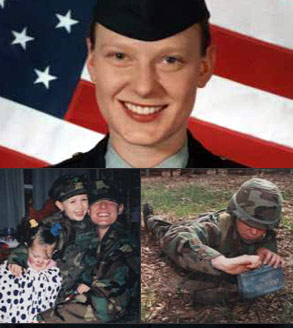
In the early evening of May 18, 40-year-old Fizoon Ashraf was cooking steaks in the small kitchen of her Brooklyn home when there was a knock at the front door. Her two youngest children — Safraz, age 7, and Shavana, 10, jumped up from the TV to answer it while she continued draining vegetables over the sink.
They returned to the kitchen, confused. “Mom,” Shavana said, “two strangers dressed in uniforms like Rasheed are at the door.”
That was all Fizoon needed to hear to know something very bad had happened to her son, 22-year-old Rasheed Sahib. Fizoon’s eldest, and a specialist with the Army’s 4th Infantry Division, Rasheed had shipped out to Iraq on April 1. Fizoon had been deeply against his going; she worried constantly about his safety and about his being so far away from his family. Two days before he left, she had demanded, “How will I know if something bad happens to you?”
Relying on the good nature and patience that had earned him the nickname “Smiley” from his friends, Rasheed had tried to comfort his mother. “Everything’s already taken care of, Mom,” he’d said. “People will get to you if I have an accident. Two soldiers will come to the door and they’ll have a sheet of paper that will explain what’s happened to me.”
Fizoon had ordered Rasheed to be quiet. She didn’t want to hear words bringing her worst imaginable fear to life. A little over six weeks later, the knock came anyway. Without thinking, she screamed at her children for answering the door and allowing a tragedy to enter their home. Her entire body shaking, feet suddenly heavy, Fizoon struggled to walk the few steps to the front of the house. There the soldiers were, just as Rasheed had described.
“No,” she told them, her voice trembling. “You are not bringing a message about my son.”
They began to apologize, explaining there had been an accident. That’s all Fizoon heard before fainting to the floor.
“I used to say, when I heard that soldiers passed away, ‘How do [their families] go on and live?’” Fizoon says. “Now, it’s happened to me, and I don’t know what to do. Every day, I cry for my son. I know God will hate me for this, but God is unfair.”
- – - – - – - – - – - -
Since President Bush declared the end of major hostilities in Iraq on May 1, 149 American troops have been killed, 68 from hostile fire, and 81 from non-hostile circumstances such as accidents, illness, etc. But Rasheed Sahib’s death is something of an anomaly. He was fatally shot in the chest by another soldier in the unit who was cleaning his gun. While a criminal investigation by senior Army officials is still underway, the Department of Defense has so far declared the incident an accident. Rasheed’s family isn’t convinced. They worry the Army is withholding the truth from them and that perhaps Rasheed was even targeted because he was a Muslim.
“My son is being treated like no one,” Fizoon says now, her voice breaking. “But he is someone to me. There have been hundreds of deaths and the government says it will help families, but no one is trying to help us. Bring the truth to me! That’s the least you can do for me!”
Rasheed’s family — his mother, stepfather, two sisters and brother — all live in an immaculate two-story row home on a quiet street near the border of Brooklyn and Queens, N.Y. Their small home is well-tended, a bouquet of silk flowers adorning a table in the narrow hallway that stretches from the foyer back to the kitchen.
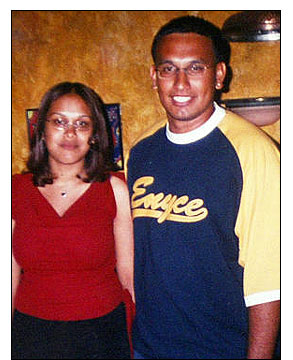
The living room, painted the color of yellow lemonade, is filled with enough seating — two couches, a table and chairs — to comfortably sit the members of Rasheed’s extended family who showed up on a recent weekday evening to discuss his sudden and bizarre death. His grandmother, Jainab Ashraf, sits quietly on a chair, arms folded in her lap, her lips drawn into a tight line. Two of Rasheed’s aunts, Nazeea, 21, and Fareena, 27, could easily be mistaken for fashion models; they have long dark hair and penetrating eyes, and they are dressed in hip-hugger jeans. Rasheed’s youngest sister, Shavana, and 7-year-old brother, Safraz, alternate between watching TV in the other room and returning to study the faces of their relatives, not entirely sure what’s going on. With her coffee-colored skin, wire-rimmed glasses and ready smile, Rasheed’s 20-year-old sister, Nafeeza, resembles her brother the most.
The grief of Rasheed’s mother, Fizoon, is most palpable. Although a photo of her, taken at a family party last year, shows a smiling woman with a bright expression, enormous black circles now ring her eyes. At times, she stares off in space, as if wishing herself somewhere else. She cries when she speaks of her son — many times referring to him in the present tense. Halfway through the interview, she curls into a fetal position on the couch, seemingly oblivious to anyone else in the room.
“I miss my son so much. I have no one to walk through my door now,” she says. “May 18, he died. That was after the war was over! He was just standing there, doing his work, and someone shot him. I have no life no more. He was my life.”
Rasheed was born in Guyana in 1982. His family’s life there was difficult: His father harvested sugar cane, and money was scarce. When Rasheed was just 2 years old, his father was killed in a hit-and-run car accident. It was a tragedy that would eventually shape Rasheed’s own life.
“Ever since he was little and his father passed away, Rasheed wanted to be a cop to help catch bad people, like the one who killed his father,” Fizoon says. “That was his goal. To help people. To be there for them.”
Fizoon remarried Seenarine Jonathan three years later, and the family moved to America in 1989 — in part to be closer to their relatives, but also to get a fresh start. Rasheed was just 7 years old when he arrived in New York and instantly loved everything about it: the Yankees, WWF wrestling, action movies. He loved to rap and taught himself how to draw his own comic strips.
As he grew older, Rasheed developed a fondness for souping up cars, teaching himself not only how to repair them, but also how to install the best stereos and wheel rims he could afford. And he loved barbecuing.
“Last summer, during a huge downpour, Rasheed even went outside with an umbrella to barbecue steaks,” his sister Nafeeza says. “He always tried to make the best out of any situation.”
“He never stopped smiling,” is how 19-year-old Louie Permaul remembers him. As kids, the two became instant best friends when Rasheed offered Louie half an ice cream sandwich he’d just bought at the store. “He didn’t even know me,” Louie remembers. “But that was just Rasheed. Always helping people out, keeping everything together.”
Rasheed was fastidious, carefully organizing everything he owned. When his mother advised him to file away important receipts or papers he might need in the future, he took her counsel to heart and began saving every receipt he was ever given — even from Kentucky Fried Chicken. Once Rasheed began working at Dunkin’ Donuts during high school, he made sure to have his uniform dry-cleaned every week.
His aunt Fareena laughs. “I said, ‘You only make $100 a week and you spend money on dry-cleaning?’ But he wouldn’t just iron his uniform. He said the cleaners did a better job.”
Rasheed was close to his sisters and aunts, although they teased him mercilessly — joking that his name sounded like a girl’s and he might as well be called “Rasheeda,” or that his ears stuck out like a bat’s.
“He never tried to defend himself,” says Fareena. “He didn’t care. He’d just smile and be like, ‘Whatever.’”
Rasheed’s bond with his mother was especially tight. From an early age, he helped her cook, clean and take care of his younger brother and sisters. But because he knew how much Fizoon worried about his well-being, Rasheed never asked her advice about enlisting in the Army. He had dreams of one day becoming an FBI agent and felt the military would provide a solid way in. He also knew Fizoon would be against his going away for long periods of time and into potentially dangerous situations. So, secretly, he signed up for the Army in the fall of 2000, after he turned 18. Not until two days before he left for boot camp at Fort Bragg, N.C., did he finally tell his mother.
“I wasn’t angry,” Fizoon says. “Just scared. He had so many other options, so many other things he could have done … But he looked so happy when he came back [after boot camp], that I wasn’t scared. I wasn’t worried for him no more.”
“The Army made him more of a man,” agrees Fareena. “He was still a kid when he left, but I didn’t know him when he came back. He was over 6 feet tall! So strong, and he looked so handsome. ”
Rasheed loved being in the military, but it wasn’t always easy for him. During a training incident in spring 2001, he was accidentally shot in the leg and had to spend time in the hospital. After 9/11, he confided in Louie that other soldiers in his unit (then at Fort Hood, Texas) admitted they felt like jumping him simply because he was Muslim. Although he was not a devout practitioner of Islam who prayed five times a day, his mother believes Rasheed found time to pray each night before bed and read the Quran.
“He sounded scared on the phone when he told me about [the soldiers threatening him],” Louie says. “[When Rasheed joined the Army] nobody had fears about him being Muslim. He was an American soldier. But you never know about ignorant people.”
Knowing that these incidents would make his mother frantic with worry, Rasheed never said a word to her about them.
“He never told anyone if he had a problem,” Nazeea says. “He would just try to find his own solution.”
Although Rasheed was due to be discharged from the Army in February, he was happy enough with his position to reenlist for one more year. When his unit, the 20th Field Artillery, shipped out to Iraq in the spring, he assured his relatives he wouldn’t be anywhere near the line of fire. He’d be safe, he said, distributing weapons to soldiers just outside of Kuwait. Only after his death did they learn he was in the midst of major combat action just north of Baghdad. In a letter to Louie, postmarked May 9 but not received until two weeks after his funeral, Rasheed confides he’s with a group of 11 other soldiers who’ve nicknamed themselves “the Dirty Dozen.” Their goal: tracking down Iraqi war criminals and ex-leaders, who many times used the women and children in their villages as human shields. “We’re doing ‘Black Hawk Down’ stuff, but without the helicopters,” he writes. He remarks he’s lost close to 20 pounds, and says the bugs in the desert are eating him alive. “There are even dead bodies in the same building we’re sleeping in now,” he writes, although not specifying if they are Iraqi or American. He implores Louie to send him letters, photos and Sean Paul reggae CDs, and to ask his family to do the same. “I need shit like that to keep my sanity,” he writes.
His sister, Nafeeza, can barely conceive of her brother in such gruesome circumstances. “Once, Rasheed cut his finger on a laundry line pulley while he was hanging up clothes,” she remembers. “He saw a little blood and he got all dizzy … Even getting a mosquito bite, he’d feel hurt. I’d see the news during the war and think, ‘Thank God Rasheed isn’t on the battlefield.’ But he really was.”
Still, no one doubts that Rasheed was proud to be serving the country of which he had only recently become a citizen. “He didn’t regret being over there,” says Fareena. “He wrote that he felt so good when people came up and thanked him. He saw so many devastating things that Saddam Hussein had done, so many starving children, and in the end, he was glad to be there.”
“I didn’t ever watch the news,” Fizoon says.” I didn’t want to know what condition he was in. Did he have enough food? Enough water? I don’t want to be happy if he’s not happy.”
Rasheed never called after he shipped out in April, although his mother waited constantly by the phone to hear his voice. On May 18, less than half an hour before two soldiers appeared at her door, she had even picked up a photo of her son and said aloud, “Rasheed, I’m still waiting for you to call me.”
At that point, he couldn’t. According to the Pentagon, one of Rasheed’s fellow soldiers (whose name has not yet been released to the public, or to Rasheed’s family) was cleaning a gun that accidentally discharged. The bullet entered Rasheed’s chest and killed him, although it has yet to be revealed if he died immediately.
Rasheed’s body was sent home five days after his death. Although Muslim tradition dictates a ceremonial washing of the body before burial, his was in such an extreme state of decay that the director of the funeral home decided excessive handling would be unsafe.
“He was hard to look at,” says Nazeea. “He wasn’t the Rasheed we know.”
“I keep thinking, ‘Maybe that’s not my son. Maybe they made a mistake,’” says Fizoon. “That’s what I was hoping.”
Six days after his death, Rasheed was buried with full military honors at Rose Hill Cemetery in Linden, N.J. More than 100 family members and friends showed up to pay their respects to Smiley one last time. A voluminous program was hurriedly put together, with those closest to Rasheed reading him heartfelt goodbye letters, and even poems. “Those were all good times that we all shared,” wrote Louie’s 24-year-old sister, Priya. “I just wish that you were spared/ But don’t worry baby boy, your crew will soon be there/ So we can continue with our barbecue in the rain.”
On the back cover are the solemn signatures of his friends, like a yearbook Rasheed will never get the chance to read.
After the initial news of a tragedy, many families of fallen soldiers carry through the bittersweet process of gaining some closure — learning more details of their child’s death, receiving letters of condolence from other soldiers in the unit, taking stock of their beloved’s possessions. But Rasheed’s family has remained stuck in the uncertainty of that very first day, over three months ago, when Army officials first arrived on their doorstep. There has been no autopsy report given to them, although an autopsy on Rasheed was supposedly done. Only days ago did Fizoon finally receive a death certificate — but a Xerox copy, not an original. While Rasheed’s military uniforms have been mailed to the house, his $300 watch is still missing, as are the gold stars and crescent medallion he constantly wore around his neck. Even his car — a beloved, souped-up 1994 Honda Civic that he left behind at Fort Hood — has not been located or returned to the family.
“[Army officials] keep saying, ‘It takes time, it takes time. You’re not the only one who had someone killed,’ Fareena says. “But Rasheed was doing the same thing as the other soldiers over in Iraq. He should be treated with respect. He was there to help everyone … The military claimed one shot and he died, and it takes over three months to do an autopsy report?”
“We just want some answers. Some closure,” interrupts Nazeea. “Every day seems like another year to us.”
According to Marc Raimondi, spokesman for the U.S. Army Criminal Investigation Division, Rasheed’s death is part of an ongoing investigation. “We have a lot of pieces of the puzzle together, but not all, although I fully anticipate we will,” he says. “We have a very, very good idea of what happened and who is involved.”
Asked if Rasheed may have been targeted because he was Muslim, or whether his death may not have been accidental, Raimondi declines to speculate. “At this point in time, we have no reason to believe it was anything but a tragic occurrence, but there won’t be any questions left unasked by our agents. I understand the family’s desire to have every bit of information they can. They deserve no less. And I can assure them that we are doing everything in our power to get them the answers they want.”
Raimondi said he did not know when the investigation would be complete.
Rasheed’s family has no option but to wait. Meanwhile, the grief they feel has infiltrated each of their lives.
Since Rasheed’s death, Fizoon has been too emotionally distraught to return to her job as a home healthcare attendant. Although her doctor has prescribed antidepressants and anti-anxiety medication, she’s not sure she’ll be able to continue them, since her prolonged leave of absence has caused her family’s health insurance to be suspended. Instead of applying to colleges, Nafeeza has taken a job at a local hardware store so she can help her mother care for her younger brother and sister. Her distress over Rasheed’s death has manifested itself as a bleeding ulcer; twice, she’s had to be rushed to the hospital. Even Safraz has become suddenly aware of the concept of dying, asking his mother, “Mom, how old is Rasheed? Why did he get killed so young? Don’t you have to be old and sick to die?”
“He’s still waiting for his brother to come home,” Fizoon says. “He wants me to keep Rasheed’s clothes so he can wear them when he turns 22.”
Fizoon’s voice dissolves into sobs. “First his father, now Rasheed. This one, I can’t steady myself. He took my whole life away. ‘I’m going to be taking care of you, Mom,’ he said. ‘Everything’s going to be OK.’ That’s what I’m living with: When? When will it be OK? My house was full of joy when my son was here. Now, it’s full of sadness.”
Continue Reading
Close
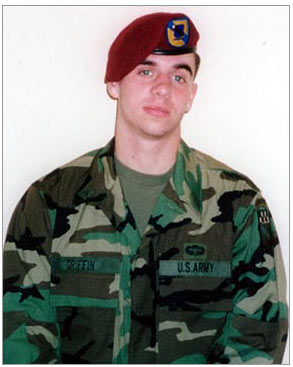
Just past midnight on May 30, Ron Griffin stepped outside his ranch-style home to light up a cigar. As production supervisor at a cheese factory, Ron had become accustomed to late hours. His wife, Robin, was already asleep, as were the couple’s two teenagers. The Griffins’ eldest son, 20-year-old Kyle, a specialist in the Army, had shipped off to Iraq in February, so Ron had the night sky to himself. Not until the family’s 4-year-old yellow Lab, Bailey, began to bark from inside the house, did Ron notice two shadowy forms coming toward him across the lawn.
“Are you Mr. Griffin?” one of the men asked. Suddenly realizing the two men standing before him were dressed in Army uniforms — and that his family’s worst fear was about to become a reality — Ron blurted out, “No.” Running into the family’s living room, he dropped to his knees and yelled to his wife. “Robin! I need you! Come here!”
Robin emerged from the bedroom to find an Army chaplain and notification officer standing in her kitchen. In soft tones, they explained that the Griffin’s son, Kyle, had been killed the morning before in a car accident in Iraq.
Unwilling to believe the news, Robin and Ron told the officers they didn’t have the right house. They said when Kyle went on reconnaissance missions in the field, he never wore his dog tags, that someone must have mistakenly identified the body.
It took nearly 15 minutes for the officers to finally convince the Griffins that there had been no mistake. They brought out every official paper they had, explaining that Kyle’s sergeant had identified the body himself.
“We were in total shock,” says Ron. “It hadn’t even hit us yet that Kyle was dead and already, we felt completely, totally lost.”
Since President Bush declared major combat operations in Iraq officially over on May 1, 132 American soldiers have died. Unlike some families of fallen soldiers, who struggle with feelings of anger toward their government and confusion over the nature of the war, the Griffin family has no doubts that Kyle died for a good and just cause. They fully support President Bush and the war in Iraq. And though they are suffering a profound loss, they’ve sought comfort from their community and from the U.S. military.
- – - – - – - – - – - -
Even before one enters the Griffins’ suburban home in northern New Jersey, it is clear that this is a fiercely patriotic family. A yellow ribbon is tied into a neat bow around a tree on the lawn. A bumper sticker on a car in the driveway reads, “I’m proud my son is serving in the military.” Another car, which used to belong to Kyle, boasts an “Airborne” sticker and infantry insignia. Even Bailey, the Griffins’ dog, trots proudly through the house with a camouflage bandana knotted around his neck.
But while the Griffins are very comfortable displaying their pride in the United States military, they are not so comfortable talking about it. In the nearly three months since Kyle was killed, they have only granted a few interviews to the media. A self-proclaimed “cable news freak,” Ron has a strong distrust of journalists. “With news reporters’ instant deadlines, they often can’t — or won’t — take the time to get beyond what’s superficial and go into the depth that a story requires,” he explains.
Because of that, Ron worries that his family’s words will be somehow twisted in print or edited on-camera to convey a simmering resentment against the U.S. military or a loss of faith in the war in Iraq — sentiments that do not at all reflect his family’s feelings. When the Griffins did agree to talk to Salon, it was only on the condition that an Army Public Affairs representative be present during the interview. Several times during the course of our three-hour visit, the public affairs representative politely interrupted the conversation and asked the Griffins to reconsider what they had said. Not surprisingly, more than a few things — most having to do with politics — were struck from the record.
“I’m a political person,” explains Ron, “but [Kyle's death] isn’t political. The only politics of this story is everybody [in our community] coming together.”
Ron is a silver-haired teddy bear of a man with a thick Bronx accent, a booming voice, and a strong handshake. His wife, Robin, is 50, but could easily pass for much younger, thanks to her toe ring, ankle bracelet and deep summer tan. She looks more like a new mother than one who has just lost a 20-year-old son.
Despite their suspicions about the media, the Griffins are unfailingly gracious to a reporter in their home. Robin jumps up from her armchair in the cozy, apricot-walled living room, offering coffee, glasses of water, bagels and cream cheese. Ron greets the Army representative with a bear hug, and even stretches his arms out to a reporter when she leaves. He proudly admits he cajoled Kyle — who was famously non-demonstrative — to not only hug him, but kiss him on the lips the last time they visited him on base at Fort Bragg, N.C.
“Kyle was not a warm and fuzzy kid,” Robin explains. “There were a lot of days you loved him, but you didn’t like him. But he grew up to be a very warm and fuzzy man.”
From the time Kyle was a young boy, he knew he wanted to be a soldier. His parents have no idea where his passion originated. Although Ron spent a year in Vietnam, he never talked about his tour of duty or suffered flashbacks; the Griffin’s home never teemed with guns or ammo. Kyle’s interest seemed to be innate. By the age of 4, he insisted on attending his younger brother’s baptism decked out in camouflage shorts and bandana, a toy gun slung around his hip. He kept an arsenal of toy guns in the basement — many with pretend sights, or eyepieces, carefully duct-taped on — with which he and the neighborhood kids used to play “Army.” Years later, after reading about “gilly suits” — garments worn by snipers to blend into their surroundings — Kyle even decided to make his own, painstakingly dying a swath of burlap he bought from an Army store in Hackensack.
Growing up, Kyle was well-liked, his parents say, but didn’t have a circle of close friends. He was bright, but not necessarily a good student; school bored him. “Kyle was a lot like me — stubborn, quite smart, moody,” says Ron. “He always wanted to be outside. He’d rather go on a 50-mile march than do nothing.”
On the day he was supposed to take his SATs, Kyle skipped the test and spent the day in the woods instead. What he did there is still a mystery to his parents.
“He was very quiet, and didn’t share a lot of things with us,” says Robin. “We had to pull it out of him. We would ask, ‘Where are you going?’ and he’d just say ‘OUT.’”
Kyle wanted to join the Marines as soon as he graduated from high school in 2000. Robin felt he was too young and encouraged him to try college first. Reluctantly, he began attending classes at Bergen Community College and working part-time loading and unloading trucks at UPS. His heart wasn’t in it, though, and in April 2001, Kyle signed his enlistment papers.
Kyle’s 17-year-old brother, Ryan, is neurologically impaired and was unavailable for the interview. But his sister, Blair, eventually emerges from her room and curls up in an armchair near her parents, and brings her knees up to her chest. At 15, she is the spitting image of her brother, although with long, dark hair. Kyle’s dog tags dangle from her neck, and she says she only takes them off to go in the swimming pool. She wears shorts and a Hooters T-shirt Kyle bought while stationed last year in Argentina; her expression remains impassive when she talks about her brother, though tears stream down her cheeks. “Joining the Army changed Kyle,” she says. “He was finally doing something he liked.”
After boot camp and Army Airborne School, Kyle attended a pre-Ranger course in Fort Bragg. He excelled at the two-week class, designed to prepare soldiers for the intensive training required for becoming an Army Ranger, one of the most elite combat soldiers in the world. But even though he was at the top of his class for the first time in his life, he never shared his accomplishments with his family. They only learned of them after his death, from a stream of letters written by his instructors and commanding officers. These letters describe Kyle as “a true Ranger in heart and soul,” “a great American, and a super soldier,” “someone who approached everything he did with a sense of perfection” and “one of the very best.”
Kyle was handpicked to begin Ranger school in the spring — a 66-day course at Fort Benning, Ga., so physically and mentally grueling that only a small portion of participants ever finish. But at the beginning of the year his unit — the 519th Military Intelligence Battalion Unit, part of the Army’s 101st Airborne Division — was told they would be shipping out to Iraq. Although disappointed about postponing Ranger school, he seemed eager to go to the Middle East.
He explained to Blair that if he didn’t go, it would be like training for softball but never getting to play on the team. For his mother, he equated it with learning to be a surgeon and never getting to operate.
“He said to me, ‘Mom, I know my training inside and out,’” Robin remembers. “‘Don’t worry. I’m coming home.’”
On Feb. 5, just 10 days just after he’d been home for a Super Bowl party, Kyle shipped out to Iraq. The Griffins immediately mailed off care packages of vitamins, Oreos, Powerades, Chapstick and crossword puzzles. Kyle wrote every few weeks and called when he could, although the conversations were usually brief. Once, he told Blair, troops had been lined up for as long as six hours waiting to use the phone.
The last letter the Griffins received from Kyle is dated April 28, but didn’t arrive in their mailbox until May 29, the day before the accident. In it, Kyle describes the Iraqi civilians he’d met as “warm and nice,” and pronounced his first camel burger “pretty good.” He cordially asks if his mother has mastered the new phone system at the doctor’s office where she works as a receptionist. In his father’s portion of the letter, he confides he’s “doing a lot of shit,” then goes on to ask if he can find Kyle a specific model of gun to purchase and whether or not the county has a SWAT team — something Kyle was considering as a career option. “I try not to think about home a lot,” he wrote in a flash of introspection, “but it’s hard.”
The morning after the Griffins received that letter, Kyle and two other troops, including one of his closest friends in the unit, Zachariah Long, were traveling in a three-vehicle convoy between Mosul and Tikrit, Iraq. A rainstorm had begun, and a civilian driving in the other direction swerved to miss a pothole, and skidded into the soldiers’ path. While the two Humvees of the convoy veered to miss him, the truck carrying Kyle turned too sharply, rolled over and crashed. All three occupants were killed.
“You win medals, you do all that you can as an infantryman, and then you die in an accident? I had a hard time with that,” admits Ron. “But then Zachariah Long’s mother told me, ‘Zach and Kyle didn’t make mistakes. If they had died in combat, then they would have done something wrong.’ That changed my whole outlook.”
While many families find themselves grieving in a vacuum for the loved ones they’ve lost, the Griffins have experienced just the opposite — an outpouring of sympathy that has gone far beyond the occasional casserole and condolence card. (Although there were plenty of both — hundreds of cards from friends and strangers are displayed prominently in a wicker basket in the Griffins’ living room, too heavy now for Robin to lift on her own. And so much food was dropped off for the family, from vast amounts of Chinese takeout to home-cooked lasagnas, that only recently have they had a need to grocery shop for themselves.)
As soon the community of Emerson learned of Kyle’s death, the two-square-mile town of only 7,200 people mobilized. Each day brought dozens of people to the Griffins’ house. Robin’s doctor brought coffee in the morning and vacuumed her living room. A girl Kyle had known in high school began a petition to rename a street after him. A neighbor made a chalk drawing of Kyle that now hangs in the Griffin dining room. Still other friends established the Kyle Griffin Foundation, a scholarship fund; so far, over $23,000 has been raised. And when it came time to pick up Kyle’s remains, Emerson’s chief of police personally drove the Griffins to Dover Air Force Base in Delaware in his 42-foot motor home. On the day that Kyle was buried, Ron’s boss closed the factory and paid all his workers so they could attend the service.
Even Army Sgt. 1st Class Tyrone Russell, the casualty assistance officer assigned to the Griffins’ case, gave them a poem he wrote about Kyle after listening to them talk about him. “[The Army] doesn’t want you to get too emotionally attached to families, but you can’t help it,” he says. “This was just something from a soldier to a soldier. I thought it’d help them get some closure.”
Ron and Robin are sure it has.
“[All of] this has restored my faith in humanity,” Robin says. “We had such an absolute outpouring of love and support. It’s lifted us and gotten us through this. Emotionally, we would have been invalids without it.”
“People did everything right, they said everything right,” says Ron. “Every little kindness — and there are thousands of stories — meant so much to us.”
Ron is emphatic that he and his family have no bitterness, no anger about their son’s death, especially where the war is concerned. “We have nobody to get angry at,” he says. “Who do you get mad at?”
Robin is bewildered when people say, “Thank you for giving your son to us.” “People are trying to give us kudos because we ‘gave’ them our son. But we didn’t. He wanted to go. He told me, ‘Mom, if I die, I die. It’s the chance I take.’ I don’t know where he got his bravery,” she says. “I would have run the other way.”
The Griffins have always have been “110 percent for the war,” Robin says. “We started it, so let’s finish it. It’ll bite us if we don’t. And it’s awful. It’s unfortunate to have to lose lives. No one knows this better than us.”
“Ninety five percent of the soldiers [in Iraq] want to do the best they can do,” says Ron. “They love what they do. And that doesn’t come through in the media … I was in Vietnam. I know what it’s like when you walk by and a little kid looks up at you in your uniform, carrying your weapon and smiles. American soldiers — when they do their job, they do it well and they love it. Kyle loved it out there. He wanted to be there and he wanted to do his job.”
Continue Reading
Close
When Sgt. Micheal Dooley, 23, shipped out from Fort Carson, Colo., to Iraq on April 11, his wife, Christine, began taking the phone to bed with her. Around 3 a.m. every Monday, Micheal would call without fail. The connection could be frustrating — a few seconds delay followed every sentence, and sometimes there were so many soldiers waiting in line to call home that Micheal could only talk for five minutes — but still, Christine lived for those calls. They were her only connection to her new husband. She wanted to know everything about what Micheal’s unit, the 3rd Armored Cavalry Regiment, was doing and seeing in Iraq, but he always managed to steer the conversation back to Christine, who is due to give birth to their first child — a son — in October. Was she having morning sickness? Was her belly growing? Did she feel tired? He told Christine that he kissed photos of her and their baby’s ultrasound every night before he went to sleep.
On Sunday, June 8, Christine took the phone to bed with her as usual, but it never rang. Instead of her weekly conversation with Micheal, Christine had vivid dreams of him instead. She dreamt of the things he would do when he returned home: renovating the deck on the house they’d recently bought, taking their two dogs — a cocker spaniel and a boxer — to a nearby dog park, painting their baby’s room. “Normal life things,” she says. The dreams were peaceful, the sleep the best Christine had had in weeks. So much so that when there was a knock on the front door just past noon the next day, Christine was still in bed. She felt sick to her stomach, and slowly got dressed. When Christine opened the door, an Army major informed her that her husband was dead. “I didn’t feel anything, I was just numb,” she says. “Part of me was hoping that it was a joke. I knew it wasn’t, but I was hoping.”
Since May 1, when President Bush landed on the deck of the USS Abraham Lincoln and triumphantly declared the end to “major combat operations” in Iraq, 93 soldiers have been killed there, including nine in the past week alone. While the White House struggles to convince an increasingly concerned public that ongoing military operations in Iraq are worth both the human and monetary costs, people like Christine Dooley are left to mourn the loss of loved ones — and wonder whether they died in vain.
Like many soldiers who have fallen in the three months since the official end of the war, Micheal Dooley’s death was not combat-related. On June 8, while working security at a traffic checkpoint in western Iraq, near the Syrian border, Micheal was ambushed by three Iraqis who claimed to need immediate medical attention. When Micheal approached their car to offer help, he was shot at the base of his skull. Two of his assailants were killed by American soldiers, and the other escaped. “I’ve been told he went quickly,” Christine says. “I don’t know what I’d do if he had suffered like some soldiers I’ve heard about.”
Born Feb. 2, 1980, to a 16-year-old struggling single mother in Pulaski, Va., Micheal was the quintessential all-American kid who played baseball and basketball, loved Nintendo, and rode a skateboard. He had a wide, open smile and “couldn’t say no to anyone,” says his mother, Ann Davis, 40, who speaks in a honeyed Southern drawl. “He’d give a stranger the shirt off his back.”
After graduating from high school in 1998, Micheal began feeling restless in Pulaski, but wasn’t ready to go to college. He enlisted in the Army and was stationed in Fort Stewart, Ga., but still found time to come home and hang out with his 11-year-old half-brother, Jacob, who was born hearing-impaired. For hours, Micheal would lie on the living room floor with Jacob, patiently working with him on his homework. They rode bikes together and even went to the barbershop together, Micheal always instructing the barber to cut and shape their chestnut hair the same way — “short on the sides, high in height,” says Jacob.
In 2000, Micheal was in the midst of a peacekeeping tour in Bosnia when he received a letter from a biology student at La Roche College in Pittsburgh. Christine, then just 19, had been complaining to her parents that she never got mail at school. So on her mother’s advice, she contacted an organization called Adopt a Platoon and was assigned a military pen pal: Micheal Dooley.
“There was nothing romantic about it at first,” Christine remembers. “We were just two strangers writing each other.” But after months of frequent letters and e-mails — Christine wrote about her studies, Micheal about life in Bosnia and how much he liked the people there — the two became close friends. When Micheal returned to the States in May 2001, he immediately drove to Pittsburgh for the day to finally meet Christine face to face. Although she wasn’t expecting romantic fireworks, that’s exactly what she got. “As soon as I walked into the hotel and saw him sitting there in the lobby, I instantly knew I would marry him,” she says. “I started shaking and my heart was racing. He asked me what was wrong,” she laughs. “But I definitely wasn’t going to tell him.”
Micheal’s day trip turned into a weeklong stay. By July, he had chosen a princess-cut diamond engagement ring for Christine, and by the end of the year, she had moved out of her dorm room and into an apartment near Fort Stewart. The two married in a civil ceremony on March 7, 2002. “Just us,” says Christine, “in T-shirts and jeans.”
Soon after the wedding, with war in Iraq brewing, Micheal decided to reenlist in the Army for another four years. He and Christine were talking about starting a family and the promise of a steady job and salary — even more than patriotic duty — convinced him to stay in the military. But Micheal asked to be transferred to Colorado — partly because he was ready for a change of scenery, partly because he wanted to try to avoid being sent overseas. (His old unit, the 3rd Infantry Division, was one of the most active, and was the first unit sent to Iraq.) “I know he believed this was his job and he would go if he had to,” says Christine. “If he’d still been single, [being deployed] wouldn’t have even fazed him. But we hated being separated. It broke our hearts.”
In January 2003, Micheal and Christine bought a three-bedroom, two-bathroom house in Colorado Springs. Then in February, they returned to Christine’s hometown in Plum, Pa., for a “real” wedding — a huge church ceremony with all the trimmings, a DJ spinning Tim McGraw and Faith Hill at the reception. That same month, Christine also learned she was pregnant with their first child — and that Micheal would be shipping out to the Middle East in April. “We didn’t really talk about how we felt about the war,” Christine says. “We didn’t have political feelings about it. We were just scared on a personal level.” Worried he wouldn’t be home in time to see their baby being born in the fall, Micheal presented Christine with a going-away present before he shipped out: a small stuffed teddy bear dressed in scrubs to take with her when she went to the hospital.
As soon as Micheal left, Christine starting sending him care packages of Reese’s Peanut Butter Cups, beef jerky, Newport cigarettes and cans of his favorite ravioli. They started writing letters to each other again — Micheal liked Christine to spray every one with her perfume, Calvin Klein Escape –although the mail was incredibly slow and it sometimes took weeks to receive them. In his first letters, Micheal seemed optimistic about his mission, writing of how the Iraqis seemed happy to see the U.S troops. But as his unit drove deeper into the heart of Iraq, he wrote of the increased hostility toward Americans.
In a letter Micheal wrote to his mother on May 9 (which she received the day he died) he spoke mainly of dusty, hot hours of boredom, but gave no sense that he was in danger. “Just sitting around with nothing to do now that the war’s over,” he wrote. “I hope we don’t stay here much longer … I’m so excited about being a dad.” “He never wrote me of being scared, mostly just how he wanted to come home as quickly as possible,” says Christine.
Even before Micheal left for Iraq, his mother had a strong sense that her son would not be coming home. In February, she began having severe panic attacks. “I couldn’t breathe, I felt my heart was pumping out of my chest,” she says. “I couldn’t eat, I couldn’t sleep.” She tried to hide her anxiety from Micheal, but he could hear it in her voice when they spoke on the phone. “Don’t cry, Mom,” he told her. “I’ll be OK.”
On the weekend her son was killed, Ann started to cry uncontrollably while at the furniture factory where she works, wrapping curio cabinets before they’re boxed and shipped out. She had a nagging feeling in the pit of her stomach and says that instinctively she knew Micheal was in grave danger. “I knew my boy would come home in a box,” she says. “I knew he would, but I never shared it with anyone.” The unspeakable grief that gnaws at Ann every moment — “I feel robbed by my son’s death” — is mixed with a bitter anger over the fact that she believes Micheal died for an unworthy cause.
“This war’s political bullshit,” Ann says, with fury in her voice. “It’s all about oil and land. I think we should pack up the rest of the soldiers, bring ‘em home, build a fence around the United States and fuck everybody who ain’t American. Let ‘em fight amongst their damn selves and let’s take care of our own.”
On Tuesday, June 17, during a thunderstorm, 100 people gathered for a memorial service in honor of Micheal at Holiday Park United Methodist Church in Plum, Pa., the same church where Micheal and Christine exchanged wedding vows just four months before. Micheal, who was promoted to staff sergeant two days before he died, was awarded the Bronze Star, Purple Heart and Army Commendation Medal after his death. The awards were presented to Christine by an Army colonel at the service. Although Micheal’s mother and brother still live in Pulaski, Va., Christine chose to have Micheal’s body laid to rest near her parents’ home, where she’s now living. “I want to be able to take the baby to see him,” says Christine. “I know Micheal would want to be nearby.”
Getting on without Micheal has been excruciating for his family members. Ann Davis is starting grief counseling this week. Jacob, who says he feels “numb” most of the time, spent the the spring trying not to fail out of school. After selling their home in Colorado Springs, Christine moved back in with her parents. She uses Micheal’s shaving cream, she smells his deodorant. She takes the teddy bear with the surgical scrubs everywhere she goes, and it’ll be at the hospital in October, when Shea Micheal Dooley is born.
“It’s not like Micheal and I spent 50 or 60 years together and then he died of cancer,” Christine says quietly. “We still had so much to do. We depended on each other for everything. And now he’s gone … Everything’s like a funeral. I know it’ll be the same with having the baby. Micheal’s death is going to be fresh in my mind for a long time.”
Continue Reading
Close
For the first time since 1973, when the U.S. Supreme Court legalized abortion, the federal government is poised to restrict women’s right to terminate their pregnancies. In early March, the Senate passed a bill to ban late-term, or what abortion opponents call “partial-birth,” abortions. On Wednesday, the bill, HR-760, easily won the support of the House, with a vote of 282-139. Former President Clinton vetoed earlier versions of the ban, and the Supreme Court ruled three years ago that similar state bans were unconstitutional. But President Bush has promised he will sign HR-760 into law, making illegal a procedure that he has called “an abhorrent procedure that offends human dignity.”
“Partial-birth abortion” is not a medically recognized term — it’s an expression born of politics. It refers to an abortion procedure called an “intact dilation and extraction” (D&X), performed in the second or third trimester, in which a physician partially delivers a fetus, punctures its head while it’s still inside the mother, and then delivers it dead. Opponents say the procedure is tantamount to infanticide. Supporters argue that there are a host of reasons, both medical and psychological, why women need to have the right to have late-term abortions.
One of the key questions surrounding the controversy is why women have late-term abortions. Opponents claim that women, especially young women, often have them simply to get rid of unwanted pregnancies, while defenders argue that most women who have them do so because of health problems, including severe deformities with the unborn baby. The only thing clear is that the procedure is quite rare: According to the Alan Guttmacher Institute (AGI), an estimated 31 providers performed a total of 2,200 such procedures in 2000 (the most recent year statistics are available), a number that represents only 0.17 percent of all abortions performed that year. Beyond that, however, the data is inconclusive. A 1987 AGI study indicated that only 6 percent of women who had abortions after 16 weeks cited concerns for their own or their baby’s health as the most important reason they had the procedure. But there is no current data to support that claim, and opponents of the bill — including AGI — claim the research is too outdated to have significance. In any case, many defenders of late-term abortions argue that the procedure should be legal whatever the reasons the woman may have, and that the issue has been seized on by abortion opponents as a beachhead to outlaw all abortions.
Easily forgotten amid the political posturing and endless moral arguments over late-term abortion are the real women who make what can be an agonizing decision to go through the procedures that HR-760 outlaws. Following are the stories of two such women, both of whose unborn babies suffered from severe health problems.
Kim, 34, New Orleans
My daughter existed for years before she was even conceived, a dark-curled, green-eyed gamine who spoke early, read early, delighted her parents with her inquisitiveness and intelligence. I saw her holding every stuffed animal, reading every children’s book. I could look out a window and see her playing in the yard, tramping down the sidewalk from school, riding a bicycle down the street. My husband and I named her Kate the year we were married. My parents bought into the dream, too, my mother going so far as to buy the not-yet-born Kate books, even getting an autograph for her from Harper Lee. “To Kate,” it read, in a fine script. “May you have a long and happy life.” My brother framed the slip of paper, and they all gave it to me for our first married Christmas.
My husband at the time, Barry, was still researching his Ph.D. in Birmingham, Ala., and was years away from finishing and getting the job that would enable us to start our family. Those years were difficult ones — waiting to start our future. But as soon as Barry graduated in 1996 with his computer science degree, we moved to Iowa. We thought it would be the perfect place to raise our family.
At 28, I became pregnant almost immediately, my first trimester a blur of nausea, exhaustion and anticipation. Barry and I were typical Type A parents-to-be: reading every book we could get our hands on, playing Mozart CDs. We considered ourselves well-informed, especially since my mother held a degree in early childhood development. But our routine ultrasound at 20 weeks — which we hoped would confirm that Kate was indeed a Kate — revealed shocking news. Our child suffered from anencephaly, a neural tube defect in which the brain doesn’t develop past a very rudimentary stage. Essentially, our daughter’s brain and skull were not there. We were heartbroken to learn that for all intents and purposes, there was no baby, no reason to continue the pregnancy.
The doctor’s diagnosis came on Friday; on Monday, Barry and I drove to Iowa City, to the University Hospital’s special gynecology clinic, to bring my pregnancy to an end. The clinic was in the basement of a building, tucked away on the college campus, and because this was less than a year after the shootings at the Planned Parenthood in Brookline, Mass., I remember we were surrounded by closed-circuit cameras, the reception area cased in bulletproof glass. The doctors did another series of ultrasounds and an amniocentesis to confirm the diagnosis. We wanted to know what was going on and so the doctors explained everything they could, from pointing out what was happening on the monitor to showing me the cloudiness of the amnio fluid.
As for the procedure itself, I don’t remember much. I recall the faint sound of a vacuum and feeling some pressure as the doctors worked to extract the fetus, using speculums, curettes, forceps and suction. I don’t know how long the fetus was intact; it could have been intact all the way into the birth canal. Unlike the step in the procedure that anti-choice activists like to present in graphic detail, there was no need to compress the skull. It was because my daughter’s skull and brain had not developed that we had to have the procedure.
When I sit here at my desk and close my eyes and think about it, I can see the light on the clinic ceiling and feel Barry holding my hand as I cried. Not because what the doctors were doing frightened me — the anencephaly had prevented our daughter’s brain from developing enough to ever register consciousness so I knew she wasn’t in pain — but because I had just lost my child.
The very week of the procedure, I became an ardent activist for abortion rights, writing letters to politicians, telling the story of our loss, hoping to show the reality behind later abortions. I went from writing those letters to working with Planned Parenthood and the National Abortion Federation, and as that first year without our child went on, I found myself in state capitals all over the country, cornering legislators, giving interviews, making myself heard.
Although my specific procedure wasn’t directly referenced in the so-called partial-birth abortion ban being circulated at that time, the broad language of the bill still would have made it a target. If President Clinton hadn’t ultimately vetoed the legislation, the procedure I’d undergone would not have been available to me. The language of hr-760 is only slightly less vague.
Just over a year later, Barry and I discovered we were, thankfully, joyfully, a little scarily, pregnant again. But at 17 weeks, an ultrasound showed that this, too, was an anencephalic pregnancy. Again, I had to end my pregnancy. Again, full of grief, we drove back to the clinic in Iowa City and were ushered behind the bulletproof glass. Last year, Barry asked for a divorce. I don’t know if I’ll have the chance to try to have children again. I don’t know if I can have a healthy baby. And I don’t know if I even want to try — again, it’s partly because of the legislation the president has said he’ll sign into law. I don’t believe people understand the impact of this ban. It will take options away from women like me — a woman who finds herself 20, 22, 24 weeks pregnant with a fetal anomaly will not have an option.
Michelle, 33, Houston
My husband, Rob, and I had tried so hard to conceive our second child — I’d even been on Clomid, a fertility drug, for a year — that when I became pregnant in April of 2001, we felt the difficult part was behind us. Although I knew of things that could go wrong during a pregnancy, I never thought they would happen to me.
We scheduled an ultrasound at 21 weeks to learn the gender of our child. When the technician suggested I go to the bathroom and release my bladder so they could get a better view of our baby on the monitor, I didn’t sense any apprehension in his voice. But when I came back into the exam room, our obstetrician was there. And when he looked at the screen, he told me there was terrible news. My baby had anencephaly — basically no skullcap from the eyebrows back, and no brain. There is no cure.
My options were to terminate the pregnancy, either through induced labor or through a medical extraction. Or I could continue my pregnancy and deliver a baby that was most likely dead or would die very soon afterwards. It was also quite possible that because I wasn’t producing as many hormones as I would during a normal pregnancy, my body wouldn’t know when it was time to go into labor. I could carry this child for 42 or 44 weeks, and even then labor might have to be induced. So many other things could happen to put my health at risk: I stood an increased chance of placental abruption and uterine rupture, and future pregnancies might be made much more difficult.
I chose to terminate my pregnancy as soon as possible. It was a very difficult decision for my husband and I to make, but the one we felt was right for us: I have always associated giving birth with life, not with death. My baby had already started kicking and moving. I couldn’t imagine wondering for the next 20 or so weeks, “Did she die today? What about today?” And what was I going to tell my 2-year-old daughter? How would I explain that the baby growing inside Mommy’s tummy wasn’t coming home with us? I think I might have considered carrying my baby to term if I’d been able to donate her organs. Maybe then her dying would have felt like it had a purpose — if I’d been able to give life to four or five other little babies. But the legal system considers this “harvesting” — giving birth to a baby just for its organs — and so it wasn’t an available option.
My own doctor couldn’t do the procedure because he worked out of a Catholic hospital. That was also an issue for me: I was raised Catholic. And although I’ve always been staunchly pro-choice, it was unsettling not to have my faith backing me in such a time of need. But although my mom has very strong faith in the Catholic Church and my aunt is a teacher at a Catholic school, they were extremely supportive of me. Everyone in my family was, which surprised me a little. I worried someone might try to talk me out of the procedure, but the attitude I encountered instead was, “What’s best for you, is best for you.”
The procedure was scheduled over two days. The first day, my cervix was dilated, and a final ultrasound was done. I turned my head so I wouldn’t see the screen. The second day, I went back in to the clinic and had the actual procedure. I did have the option of staying awake (with only my body numbed), but I choose to be asleep.
Physically, I responded fairly well to the procedure. But emotionally, I was devastated. I couldn’t sleep or eat. I felt phantom kicks for weeks. I’d taken a month off work, only saying that I’d lost my child, but as soon as I got back, co-workers were constantly asking how I was. I know they meant to be kind, but I just couldn’t handle talking about it. I decided to resign. I needed time to mourn the loss of my baby.
If I’d been forced to carry my baby to term, I can’t imagine what my state of mind would have been. I would have gone crazy. I look and listen to protesters and think, “They’ve never been in our shoes.” If they actually have, and are still protesting, then I respect that. And I know a lot of women do discover their baby has a problem and still decide to carry to term. I completely respect that, too. Each woman knows what is best for herself, what she can and cannot handle or endure. We’re the ones who have to be at peace with our decision.
Continue Reading
Close
Two years ago, Jake, an engineer with a major telecom firm in Northern California, found himself snorting up to 10 lines of crack a day — on his lunch break from work or, because his job required him to travel, in airport restrooms around the world. After staying awake for days at a time, Jake learned to down eight ounces of straight tequila and pop a few Xanax in order to get a few hours of sleep. Then, he’d start the whole process again.
When Jake’s girlfriend threatened to leave because of his drug abuse, the 29-year-old California native quit his job and sought help for his addiction. Not able to afford the high cost of rehab, Jake searched the Internet for alternatives and signed up with eGetgoing, the only online drug treatment program.
Armed with a headset microphone and special software, Jake began “attending” twice-weekly group therapy sessions. Although he already had several weeks of Narcotics Anonymous (N.A.) meetings under his belt by the time he began eGetgoing, Jake attributes his ability to get clean with the online program.
“N.A. is a lot of people sharing what goes on in their lives, and how they’re dealing with cravings or with their mother-in-law staying over,” Jake explains. “EGetgoing is more like a clinical program. It gives you an incredible amount of scientific information, like how drugs affect your brain chemistry, and really teaches you how to change your behavior.”
Since its launch in March 2001, eGetgoing (“e” for electronic, and “get going” shorthand for the chirpy “Let’s get moving toward a new, healthy, positive future!”) has offered “online, real-time, interactive audio and video-based out-patient counseling” to approximately 50 clients. This March, it expanded into the teen market with teenGetgoing, which offers drug abuse awareness and treatment for the high school set. While the Internet has long been criticized for encouraging anonymity and depriving users of “real” experience, eGetgoing is betting that hiding behind screen names might be just what some substance abusers need to get clean and stay sober.
“Chemical dependency is a disease like cancer or heart disease, but there remains a stigma about it,” explains eGetgoing’s CEO and founder Barry Karlin. “A great number of people are not willing to go into a treatment center and announce they have a problem.”
Karlin knows a lot about addicts. He’s also the CEO of CRC Health Corp., eGetgoing’s parent company and the largest drug treatment provider in the United States. Since CRC was founded in 1995, the company has grown from one center in Northern California (where CRC is based) to 71 facilities in 15 states. CRC claims to have helped some 30,000 drug abusers, but there are plenty more waiting in the wings: According to the Substance Abuse and Mental Health Service Administration (SAMHSA), 16 million Americans are in need of drug or alcohol treatment. While 5 million actually contact traditional treatment centers each year, only 20 percent are admitted. Reasons for this vary, from the centers’ limited space and high cost (on average, a three-month outpatient program runs $3,000, while residential costs often exceed $10,000), to privacy concerns.
Enter eGetgoing, which claims to offer anonymity, affordability and convenience. And while the company states that it’s not a substitute for traditional rehab (interested visitors can follow links to CRC’s offline treatment centers), Karlin’s ambition to bring at least part of the mountain to Mohammed, so to speak, has motivated big-name addiction experts such as former White House drug czar Barry McCaffrey to join eGetgoing’s advisory board.
Fifty clients in two years may not sound like a lot, but Karlin notes that eGetgoing hasn’t done any advertising. For now, its clients come through referrals from treatment facilities, private practitioners, corporations and school districts.
Because eGetgoing promises to keep its clients anonymous, it’s difficult to paint a picture of just who, exactly, is using the program. According to Cynthia Reinbach, vice president of eGetgoing’s compliance and quality management, the average age of its clients is early to mid-30s, and slightly more than half are male. The clients “tend to have jobs,” says Reinbach, and own or rent their homes. While 15 percent of the clients live outside the United States, eGetgoing won’t disclose their exact locations.
“Anonymity is a big factor in why people choose to enroll in the program,” Reinbach explains. “That’s the feedback we hear over and over. People feel they have nothing to lose by telling the truth.”
Visitors to eGetgoing’s site are invited to take a confidential questionnaire that asks them to respond to such statements as “I hide how much I use or drink from those around me” and “I promise I’ll get myself together but it never works out that way.” In seconds, an automatic assessment based on their answers pops up on-screen, along with links to treatment options. Those who choose to click on the button “I Can Handle It Myself” are offered the opportunity to prove it: They can sign up as a member (for free) and state their goals for getting clean. EGetgoing will chart their progress for up to seven days, even graphing the results.
Technical requirements for people who decide to enroll in one of eGetgoing’s six-week ($800) or 12-week ($1,200) programs include a PC that runs Windows (Macintosh users are out of luck), broadband access, and a “quiet, uninterrupted, PRIVATE environment.” EGetgoing provides the rest, including software to enable real-time audio and text chat, CD-ROMs containing slides and videos utilized in group sessions, a headset, and tech support.
Twice a week, up to 10 clients meet for an hourlong group session led by one of eGetgoing’s four counselors, all of whom have the same credentials and level of work experience as counselors at CRC’s “real” treatment centers. While each client is able to watch the counselor in a small box on the left-hand corner of the computer screen, the clients can’t see each other. No real names are used, only screen names, and giving out phone numbers or private e-mail addresses is strongly discouraged.
In Jake’s group, short videos showing a fictional group in treatment served as a springboard for each discussion. “They have actors playing all the different character stereotypes — the angry drunk, the pill-popping lady, the guy with his arms crossed, saying, ‘I’m not in denial,’” says Jake. “But I was pretty impressed with it. You really get to know the characters and see them progress from week to week. It’s like they’re going through the same things you are.”
Jake describes the group session as having “a classroom atmosphere,” and much like a teacher, the counselor has access to a virtual white board where he or she can illustrate various points. Clients ask questions by raising their hands, responding verbally, or clicking a Yes or No button that appears on the screen. Private messages like “I’ll be right back. I’m going to the bathroom” are instant-messaged only to the counselor.
Each client signs off with a “plan of action” to stay sober until the next session. Homework assignments — identifying “relapse triggers,” for instance, or “negative self-talk” — are assessed by eGetgoing’s counseling staff, who then personally e-mail the client with direct feedback.
“Because you never see anyone, you’re going to either be a complete liar, or completely, completely honest,” Jake says. “I’d found my bottom and knew I needed to quit, so I was very willing to soak up the sobriety.” But while his group began with nine people, by the end of their eight-week session only Jake and another man remained.
Jake feels the dropout rate is on par with what he’s experienced at N.A. meetings. But Jeff Schaler, the author of “Addiction Is a Choice” and a psychologist who teaches at American University, asserts that eGetgoing’s “one size fits all” approach is “doomed to fail.”
“EGetgoing views the addict population as homogenous,” Schaler says. “We know for a fact that the addict population is a heterogeneous one: that is, everyone uses drugs and alcohol for different reasons, in different ways, and with different results. eGetgoing’s program doesn’t appear to look at the psychological aspects that drive people to addiction.”
John Avery, the public policy director of NAADAC, the Association for Addiction Professionals, and a licensed social worker specializing in addiction, feels eGetgoing’s therapeutic process raises some important questions. “It’s an impressive site and the board of advisors is full of great minds from the field [of addiction treatment],” he says. “But there’s a barrier here to interpersonal communication and interaction. How do you gauge someone’s level of anger or indifference if you can’t see them? What makes group therapy so therapeutic is that people get together in one place and have to interact with each other. This skews that interaction.”
Jerry, a 60-year-old retired construction worker from Livermore, Calif., enrolled in eGetgoing for aftercare once he was released from a CRC residential treatment center in Scotts Valley, Calif., last May. “A few [people in the eGetgoing group] thought, This isn’t the real thing, and dropped out,” says Jerry, who’s a recovering alcoholic. “Or they came in loaded or drunk. But I have news for them. They didn’t give it a chance. Of the people who stayed with it, I’d say they think the world of it.”
Jerry was so pleased with the support system he found at eGetgoing, he followed up his first session with another. “I couldn’t have gotten sober just by using eGetgoing,” he admits. “Some people like me need to physically be around other addicts to get better. But you learn so much in this program. It’s total information — what drugs do to your body, what they do to your brain. And learning is power, right?”
Barry Karlin hopes teens will think learning about drugs is cool, too. TeenGetgoing –with its pulsating dance music, vivid colors and hip fonts — launched last November. Seven school districts in four states are currently using it. It’s still too early to tell if the program will boost recovery rates for teens — historically one of the most difficult groups of drug abusers to treat — but so far, teen clients have logged on to the site 150 times.
While eGetgoing’s site relies on lengthy FAQs that can be frustratingly slow to open even through a DSL line, teenGetgoing moves at warp speed and offers polls (“Do you have trouble saying no to pot?”) and video presentations of the site’s two programs. “Aware” educates teens about the dangers of drug use, and “Discover” features clips of teen actors using or getting drugs. A dramatization of a group therapy session is careful to include a character everyone can relate to: the angry, hoodie-wearing Eminem type, a pasty-faced nerd, the popular girl who doesn’t understand why people think she has a problem.
“You’re in trouble if you don’t tell kids upfront that the kids they see in the videos are actors,” notes Jacklyn Guevara, director of alternative education in the Eastside Union High School District in San Jose, where more than 100 students have been participating in teenGetgoing’s pilot program since the fall. Guevara says students were disappointed at first that they weren’t going to be viewing the confessions of real druggies and gangstas and spent more time critiquing the actors’ clothes than listening to the dialogue.
“I just told them to pay attention to the scripts, that they’re based on real life,” she says. “After that, they seemed to relate to it.”
Guevara estimates three-fourths of the nearly 1,000 alternative education students she oversees are involved with some sort of drug use. Because most school budgets allow for only one counselor on staff, or none at all, Guevara jumped at the chance to have students participate in teenGetgoing’s pilot program. When it ends later this month, Guevara says she will gauge from student evaluations how helpful it’s been. “So far, I think the program’s outstanding, but I need to make sure it makes a difference in kids’ lives,” she says.
That seems to be the consensus: Organizations such as the National Institute on Drug Abuse and SAMHSA have chosen not to comment on eGetgoing, citing a lack of empirical data. Even eGetgoing’s management isn’t certain how successful it’s been. Graduates are tracked only through a series of phone calls for one year (and can opt out of participating). Data on how many people have managed to stay sober is still being collected.
“The only thing really novel about [eGetgoing] is its medium,” says Peter Graham, an expert on addiction and the director of psychology services at the Professional Renewal Center in Lawrence, Kan. “It’s got everything else that other treatment centers have, except for a physical presence.”
And just how crucial is it for counselors to make eye contact with their patients? Or notice that someone is tapping a foot, staring out the window, or nodding off? At this point, the jury’s still out.
“I don’t want to prejudge eGetgoing and say it can’t be effective,” NAADAC’s Avery says. “After all, 100 years ago, no one believed that Freud’s talk therapy would work, either. But face-to-face counseling sessions provide the opportunity for personal reinforcement — echoing what someone’s saying, mirroring their body language. And how do you get that from a computer rather than a person?”
Continue Reading
Close