Tomoko A. Hosaka

Workers re-enter Japan nuclear reactor building

First incursion since devastating earthquake a month-and-a-half ago

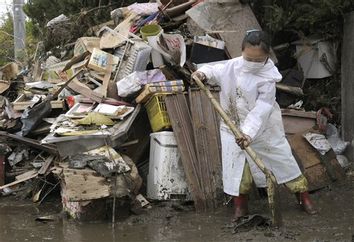
A volunteer girl from Tokyo works to clean the debris of a house in Higashimatsushima, northern Japan Saturday, April 30, 2011. She is a member of a Tokyo's volunteer group which helps earthquake and tsunami devastated areas on weekend. (AP Photo/Kyodo News) JAPAN OUT, MANDATORY CREDIT, NO LICENSING IN CHINA, HONG KONG, JAPAN, SOUTH KOREA AND FRANCE(Credit: AP)

Workers entered one of the damaged reactor buildings at Japan’s stricken nuclear power plant Thursday for the first time since it was rocked by an explosion in the days after a devastating earthquake, the plant’s operator said.

Tokyo Electric Power Co. said workers connected ventilation and air filtration equipment in Unit 1 in an attempt to reduce radiation levels in the air inside the building.

The utility must lower radiation levels before it can proceed with the key step of replacing the cooling system that was knocked out by the March 11 quake and subsequent tsunami that left more than 25,000 people dead or missing along Japan’s northeastern coast.

Workers have not been able to enter the reactor buildings at the Fukushima Dai-ichi nuclear power plant, about 140 miles (230 kilometers) northeast of Tokyo, since the first days after the tsunami. Hydrogen explosions at four of the buildings at the six-reactor complex in the first few days destroyed some of their roofs and walls and scattered radioactive debris.

TEPCO spokesman Junichi Matsumoto called Thursday’s development “a first step toward a cool and stable shutdown,” which the utility hopes to achieve in six to nine months.

In mid-April, a robot recorded radioactivity of about 50 millisieverts per hour inside Unit 1′s reactor building — a level too high for workers to realistically enter. Readings taken later in April in another part of the building were as high as 1,200 millisieverts.

The decision to send the workers in was made after robots last Friday collected fresh data that showed radiation levels in some areas inside the building were safe enough for workers to enter, said Taisuke Tomikawa, another TEPCO spokesman.

Two utility workers, wearing a mask and air tank similar to those used by scuba divers, entered the reactor building for about 25 minutes to check radiation levels. They were exposed to 2 millisieverts during that time, Tomikawa said. Outside the building, the utility erected a temporary tent designed to prevent radioactive air from escaping.

Later, 11 other workers — two from TEPCO and nine from its subcontractors — wearing similar gear went into the reactor building to install ducts for the air filtering equipment. Twenty other workers provided help from outside.

The utility hopes to start allowing workers into the building to set up a cooling system around mid-May. In addition to reducing radioactivity with the new air filtering system, it hopes to reduce it further by removing or covering up contaminated debris inside the building, Matsumoto said.

TEPCO is proceeding with a plan to fill the Unit 1 containment vessel with water to soak the core and cool it, and also plans to install big fans as an external cooling system, he said. TEPCO hopes to take similar steps at Units 2 and 3 but is struggling with tougher obstacles such as contaminated water leaks and debris.

Radiation leaking from the Fukushima plant has forced 80,000 people living within a 12-mile (20-kilometer) radius to leave their homes. Many are staying in gymnasiums and community centers.

——

Associated Press writer Mari Yamaguchi contributed to this report.

Strong aftershock slams weary Japan, kills 2

In a country still devastated from 2 earthquakes, an aftershock rippled through early this morning, causing damage

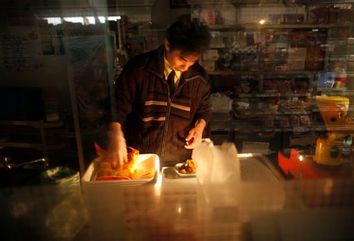
A staff of a supermarket prepares foods at the facilities with no electricity in Ishinomaki, Miyagi Prefecture, northern Japan Friday, April 8, 2011. A big aftershock rocked quake-weary Japan late Thursday, rattling nerves as it knocked out power to the northern part of the country and prompted tsunami warnings that were later canceled. (AP Photo/Vincent Yu)(Credit: AP)

A strong aftershock ripped through northeastern Japan, killing two people, knocking out power to vast areas Friday and piling misery on a region still buried under the rubble of last month’s devastating tsunami.

The northeastern coast was still reeling from the destruction wrought by a jumbo 9.0-magnitude earthquake on March 11, with tens of thousands of households without power or water. The 7.1 tremor has now thrown even more areas into disarray and sent communities that had made some gains back to square one.

Gasoline that had become more available after weeks of shortages was scarce again, and long lines formed at stations. Stores that had restocked shelves sold out of basics Friday and were forced to ration purchases again.

Still, the latest quake did far less damage, generated no tsunami and largely spared the region’s nuclear plants. Some slightly radioactive water spilled at one plant, but the tsunami-crippled Fukushima Dai-ichi complex reported no new problems.

Matsuko Ito, who has been living in a shelter in the small northeastern city of Natori since the tsunami, said there’s no getting used to the terror of being awoken by shaking. She said she started screaming when the quake struck around 11:30 p.m.

“It’s enough,” the 64-year-old while smoking a cigarette outside. “Something has changed. The world feels strange now. Even the way the clouds move isn’t right.”

The latest tremor — the strongest since the day of the tsunami — sunk more homes into blackness, though power was quickly restored to many. About 950,000 households were still dark Friday evening, said Souta Nozu, a spokesman for Tohoku Electric Power Co., which serves northern Japan. That includes homes in prefectures in Japan’s northwest that had been spared in the first quake.

Six conventional plants in the area were knocked out, though three have since come back online and the others should be up again within hours, Nozu said. But with power lines throughout the area damaged, it was not clear whether normal operations would be restored, he said.

In Ichinoseki, lines formed outside a supermarket when it opened Friday morning. An employee with a flashlight escorted each customer around the store and jotted the price of each selected item in a pad.

Most businesses were closed in the city, 240 miles (390 kilometers) northeast of Tokyo. One restaurant owner, Suzuki Koya, bought a small gas stove and made free meals in big boiling pot.

“I saw the meat at the supermarket and I thought, ‘We should do a hot pot,’” the 47-year-old said. “It’s good to keep warm in times like these.”

Several nuclear power plants briefly switched to diesel generators but were reconnected to the grid by Friday afternoon. One plant north of Sendai briefly lost the ability to cool its spent fuel pools, but quickly got it back.

At a plant in Onagawa, some radioactive water splashed out of the pools but did not leave a containment building, Tohoku Electric said. Such splash-out is “not unusual, although it is preferable that it doesn’t happen,” according to Japanese nuclear safety agency official Tomoho Yamada.

“Closer inspection could find more problems,” said agency spokesman Hidehiko Nishiyama, but no radiation was released into the environment at Onagawa.

The plant began leaking oil into the ocean in the first earthquake, and the flow escaped a containment boom in Thursday’s tremor but was contained again by Friday, coast guard spokesman Hideaki Takase said.

Thursday’s quake prompted a tsunami warning of its own, but it was later canceled. Two people were killed, national fire and disaster agency spokesman Junichi Sawada reported Friday. A 79-year-old man died of shock and a woman in her 60s was killed when power was cut to her oxygen tank. More than 130 people were injured, according to the national police agency.

That pales in comparison to the original quake and tsunami, in which more than 25,000 people are believed to have died.

Many of those bodies have still not been found: A significant portion were likely washed out to sea and never will be, but some are buried in areas that have been largely off-limits to search teams.

As radiation spilling from the troubled Fukushima Dai-ichi plant has fallen in recent days, however, police have fanned out inside a no-go zone near the complex to dig for the dead.

On Friday, hundreds of police, many mobilized from Tokyo, used their hands or small shovels, pulling four bodies in an hour from one small area in the city of Minami Soma. The had found only five bodies the previous day.

The searchers, wearing white radiation gear and blue gloves, struggled to bring the remains across the rubble to vans and minibuses that would take them to the nearest morgue. Each body was carefully hosed off to rid it of radiation before being placed in the vehicles.

“The area is literally a mountain of debris. It is an extremely difficult task,” said an official with police in Fukushima prefecture who declined to be named because he was not authorized to talk to the media.

The epicenter of Thursday’s temblor was in about the same location as the original 9.0-magnitude tremor, off the eastern coast and about 40 miles (65 kilometers) from Sendai, an industrial city on the eastern coast, according to the U.S. Geological Survey. It was strong enough to shake buildings for about a minute as far away as Tokyo, about 200 miles (330 kilometers) away.

At a Toyota dealership in Sendai, most of a two-story show window was shattered, and thick shards of glass were heaped in front of the building. Police directed cars through intersections throughout the city on Friday because traffic lights were out. Small electrical fires were reported.

At the Fukushima Dai-ichi plant, where nuclear workers have been toiling to plug radiation leaks and restore cooling systems ruined in the March 11 quake and tsunami, workers briefly retreated to a shelter and suffered no injuries. The plant operator said the tremor caused no new problems there.

Despite the new aftershock, automakers announced Friday that they were beginning to bounce back from the March monster. Toyota will resume car production at all its plants in Japan at half capacity from April 18 to 27.

The world’s No. 1 automaker said it remained unclear when it would return to full production in Japan.

Nissan also said it would start up domestic production at half capacity from April 11.

Operations had been halted at both companies because of part shortages.

——

Associated Press writers Shino Yuasa, Malcolm Foster, Ryan Nakashima, Mari Yamaguchi and Cara Rubinsky in Tokyo, Eric Talmadge in Minami Soma, and Colleen Slevin in Denver contributed to this report.

Continue Reading Close

Japan concerned about radiation in tap water

Anxiety spreads after officials report elevated radioactive iodine levels in the system

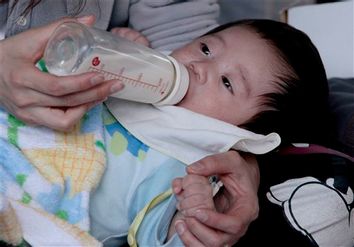
A mother feeds her baby at an evacuation center in Yamagata Prefecture, northern Japan, Thursday, March 24, 2011. Hundreds of thousands remain homeless, squeezed into temporary shelters without heat, warm food or medicine and no idea what to call home after the March 11 tsunami swallowed up communities along the coast and dozens of strong aftershocks continued to shake the nation. (AP Photo/Mark Baker)(Credit: AP)

Shops across Tokyo began rationing goods — milk, toilet paper, rice and water — as a run on bottled water coupled with delivery disruptions left shelves bare Thursday nearly two weeks after the earthquake and tsunami to the north.

Anxiety over food and water remained high a day after Tokyo officials reported that the radioactive iodine in the city’s tap water measured more than twice the level considered safe for babies.

Radiation has been leaking from a nuclear plant 140 miles (220 kilometers) northeast of Tokyo since it was struck by the March 11 quake and engulfed by the ensuing tsunami. Feverish efforts to get the plant’s crucial cooling system operating have been beset by explosions, fire and radiation scares.

On Thursday, three workers at the Fukushima plant were exposed to radiactive elements, with two of them injured, while laying electrical cables in one unit, said Fumio Matsuda, a spokesman for the Nuclear and Industry Safety.

The two had injuries to their feet and were taken to a hospital for treatment, he said. They were exposed to radiation levels up to 180 millisieverts, less than the maximum amount of 250 millisieverts that the government is allowing for workers at the plant, he said.

More than two dozen people have been injured trying to bring the Fukushima Dai-ichi plant under control.

The developments highlighted the challenges Japan faces as officials scramble to avert a major nuclear crisis after a magnitude-9 quake off Sendai triggered a tsunami that killed an estimated 18,000 people and left hundreds of thousands homeless.

Radiation has seeped into raw milk, seawater and 11 kinds of vegetables, including broccoli, cauliflower and turnips, grown in areas around the plant.

The U.S. and Australia were halting imports of Japanese dairy and produce from the region; Hong Kong said it would require that Japan perform safety checks on meat, eggs and seafood, and Canada said it would upgrade controls on imports of Japanese food products.

Concerns also spread to Europe. In Iceland, officials said they measured trace amounts of radioactive iodine in the air but assured residents it was “less than a millionth” of levels found in European countries in the wake of the 1986 Chernobyl disaster.

In Tokyo, government spokesman Yukio Edano pleaded for calm. Officials urged residents to avoid panicked stockpiling, sending workers to distribute three small bottles of water each to an estimated 80,000 families with babies of 12 months or younger.

That didn’t stop Reiko Matsumoto, mother of 5-year-old Reina, from rushing to a nearby store to stock up.

“The first thought was that I need to buy bottles of water,” the Tokyo real estate agent said. “I also don’t know whether I can let her take a bath.”

New readings showed Tokyo tap water was back to safe levels Thursday but the relief was tempered by elevated levels in two neighboring prefectures of the cancer-causing element: Chiba and Saitama.

Continue Reading Close

Japan: Woman, grandson rescued from collapsed home

80-year-old woman and boy found alive nine days after earthquake trapped them in house

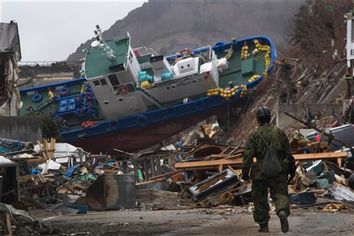
A Japanese soldier walks towards a ship which was blocking a road that his men were trying to clear in the earthquake and tsunami destroyed town of Onagawa, Miyagi Prefecture, northeastern Japan Sunday, March 20, 2011. (AP Photo/David Guttenfelder)(Credit: AP)

The voice rang out suddenly, unexpectedly, from the wreckage left behind by the monstrous earthquake and tsunami that ripped through the country’s northeast nine days ago.

“Please help! Please help!”

There, on the roof of his collapsed wooden home, stood a shivering Jin Abe, so cold that he had draped layers of towels around his body. His grandmother, Sumi Abe, was trapped inside, too, the 16-year-old told the team of Ishinomaki police officers who had been patrolling the hard-hit city on Sunday.

The two had been stuck there since the March 11 magnitude-9.0 quake struck off the coast of Japan, triggering a massive tsunami that obliterated much of the northeastern coastline. Their neighborhood, too, lay in ruins.

The 80-year-old woman’s weak legs kept her from walking, and the teenager had been unable until Sunday to crawl out of the wreckage, police spokesman Shizuo Kawamura said.

Police called in personnel with better equipment to help rescue the woman, whom police found wrapped in several blankets, on top of a collapsed closet.

Grandmother and grandson were weak but conscious, having survived on the food they had in their refrigerator, Kawamura told The Associated Press by telephone. The earthquake and tsunami knocked out power and telephone service throughout the northeast coast.

National broadcaster NHK aired dramatic video of the rescue, which showed a stunned, though coherent, woman. She gave her name when asked.

“Are you hurt?” a rescuer said.

“No,” she replied, and asked about her grandson.

Both she and Jin were taken to a nearby hospital.

A couple days after the disaster, an aunt asked police to search for the two. On Sunday, Jin’s father, Akira Abe, told reporters gathered at the hospital that he had never given up hope.

“I always believed they were alive,” he said.

The rescue offered Japan an uplifting piece of news amid colossal devastation and sadness with thousands of dead and missing. Still, Kawamura said he wasn’t smiling.

“We have too many other victims to find to take the time to celebrate,” he said.

Continue Reading Close

More governments advising citizens to leave Tokyo

Australia, France, U.K. and others all urge those with nonessential business in Japan's capital to evacuate

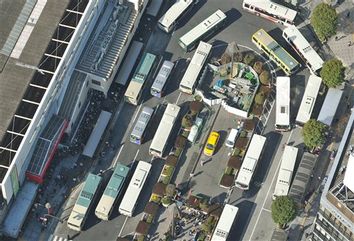
Buses crowd at bus terminal in Musashino, on the outskirts of Tokyo Monday, March 14, 2011. In Tokyo and elsewhere, authorities began rolling blackouts to conserve power as they tried desperately to stabilize the nuclear reactors at risk of meltdown in the aftermath of the earthquake and tsunami. (AP Photo/Kyodo News) JAPAN OUT, MANDATORY CREDIT, NO SALES IN CHINA, HONG KONG, JAPAN, SOUTH KOREA AND FRANCE(Credit: AP)

Australia advised its citizens in Japan on Wednesday to consider leaving Tokyo and earthquake-affected areas, joining a growing number of governments and businesses telling their people it may be safer elsewhere.

The Department of Foreign Affairs and Trade said in a travel advice update that Australians with no need to be in the area should think about leaving but added that the decision had nothing to do with the threat of nuclear contamination from a damaged nuclear power plant.

“We are providing this advice because of the continuing disruption to major infrastructure, its impact on the welfare of people on the ground and continuing aftershocks,” the notice said.

Concerns about radiation, however, were at the forefront of other countries’ worries as the situation at the Fukushima Dai-ichi nuclear plant appeared to worsen. Surging radiation levels forced Japan to order emergency workers to temporarily withdraw from its crippled nuclear plant Wednesday, losing time in a desperate operation to cool the overheating reactors.

Tokyo, which is about 170 miles (270 kilometers) from the stricken nuclear complex, reported slightly elevated radiation levels Tuesday, but officials said the increase was too small to threaten the 39 million people in and around the capital.

France urged its citizens with no reason to stay in Tokyo return to France or head to southern Japan. The government has asked Air France to mobilize aircraft in Asia to assist with departures.

More than 3,000 Chinese have already been evacuated from Japan’s northeast to Niigata on Japan’s western coast, according to Xinhua News Agency. On Tuesday, Beijing became the first government to organize a mass evacuation of its citizens from the quake-affected area.

Other governments, including the U.S. and U.K., are taking a more measured approach.

The U.K Foreign & Commonwealth Office advises against all nonessential travel to Tokyo and northeastern Japan. It urges British citizens in the country to observe Japanese authorities’ advice, which includes a 20-kilometer (12.4-mile) exclusion zone around the Fukushima nuclear plant.

It said it is actively monitoring the situation.

U.S. Ambassador to Japan John Roos briefed reporters Wednesday night, saying American officials are carefully monitoring radiation levels.

“If we assess that the radiation poses a threat to public health, we will share that information and provide relevant guidance immediately,” Roos said.

The Philippine Embassy in Tokyo told its citizens to follow advisories issued by Japanese authorities. It added, however, that Filipinos who are concerned about possible radiation exposure “may wish to voluntary relocate to areas further away, or depart voluntarily from the country using their own means.”

If relocation and repatriation become necessary, the Philippine government will defray the costs involved, the Department of Foreign Affairs said in a statement.

An Indian software services company, L&T Infotech, on Wednesday ordered the temporary evacuation of 185 employees and their family members from Japan. It said in a release that it had chartered a special Kingfisher Airlines flight that will depart Friday to Chennai, India.

Cirque du Soleil has also decided to move its performers and staff working in Japan to Macau, said spokeswoman Chantal Cote in an e-mail. Its show “ZED” is based at Tokyo Disneyland, the touring “KOOZA” show was performing at the Fuji Dome in Tokyo.

——

Associated Press writers Rod McGuirk in Canberra, Australia, Erika Kinetz in Mumbai, Camille Rustici in Paris and Joe McDonald in Tokyo contributed to this report.

Continue Reading Close

As Greece falters, fears stretch around world

Concern over the country's debt has triggered talk of global contagion and market panic

The debt troubles in Greece are intensifying and, even more dangerous, spreading fear across Europe and beyond.

That is triggering talk of a potential global contagion, similar to what happened after the investment bank Lehman Brothers collapsed in 2008, setting off the worst financial crisis in the United States since the 1930s and contributing to a deep global recession.

“Greece as an economy is tiny but the danger is contagion and market panic,” said David Wyss, chief economist at Standard & Poor’s in New York.

“If people get scared that Greece could default, they are going to be scared that Portugal will default and then other countries. Once people panic, they panic about everything. We saw that in the wake of the Lehman Brothers failure.”

Markets worldwide have been roiled by a wave of bad news from Europe, starting with a downgrade of Greece’s heavy debt load and then downgrades of the debt held by Portugal and Spain.

In Asia, there are not yet significant concerns about the creditworthiness of the region’s governments but big economies like China and Japan still have much at stake. Europe is an important export market for both and their manufacturers are counting on sending ever more goods to the continent. China and Japan are also among the biggest investors in the debt issued by other nations, the U.S. especially, with holdings worth hundreds of billions of dollars.

Some lenders in the region, meanwhile, are already fretting that Europe’s problems will chill the financial system, making it harder for banks to borrow the short and long-term money that helps fund their own lending to businesses and consumers. There are also concerns the turmoil in Europe could convince China to delay any appreciation of its currency — widely viewed as undervalued — aggravating tensions with the U.S. and other trading partners.

Nariman Behravesh, chief economist at IHS Global Insight, a U.S. forecasting firm, said the challenge will be for the International Monetary Fund, the world’s lender of last resort, and other European countries to come up with a rescue package credible enough to convince financial markets that authorities are determined to limit the spread of the problem.

Economists note that countries that endure banking crises often end up having debt crises a short time later. That is because governments borrow heavily to prop up their banking systems, which sends their own debt burdens soaring.

That debt buildup has occurred in the United States, which has seen its publicly held debt jump from 36 percent of the total economy in 2007, before the crisis hit, to 64 percent this year. That’s the highest level since 1951, when the country was still paying off the debt run up to fight World War II.

Debt levels of all developing countries are rising to levels not seen over the past 60 years, the IMF said in an economic survey released last week.

The U.S. government forecasts that its publicly traded debt as a percentage of the total economy will reach 77 percent by 2020. By comparison, Greece’s debt burden exceeds 100 percent.

“The Greek problem highlights a broader problem across the globe,” said Mark Zandi, chief economist at Moody’s Economy.com. “Governments used their resources to end the financial panic and the Great Recession, but now they have to figure out how to pay for it.”

He added, however, that the United States has one thing in its favor that other countries such as Greece do not: A competitive economy capable of producing solid growth to increase government revenue.

Japan, the world’s second biggest economy, isn’t Greece either, economists say.

Even though it shoulders the biggest public debt burden in the industrialized world, the country does not face an imminent crisis.

More than 90 percent of its debt is funded domestically, putting the country at low risk for capital flight. Servicing that debt remains manageable because of low interest rates. Moreover, Japan holds the world’s second largest store of foreign reserves and consistently posts a current account surplus.

The turmoil in Greece has in fact led investors to turn to Japanese government bonds as a safe haven.

“Claims that Japan’s debt mountain is about to explode have been around for over a decade,” said Richard Jerram, head of Asian economics at Macquarie Capital Securities, in a recent report.

But the future is another matter.

Prime Minister Yukio Hatoyama’s government will issue a record 44 trillion yen ($473 billion) in bonds to fund this fiscal year’s budget. Fitch Ratings warned last week that Japan’s credit rating could worsen if Tokyo does not rein in snowballing debt, which reached 201 percent of gross domestic product in 2009. Deflation, slow growth and dwindling household savings could eventually undermine Japan’s ability to fund itself.

The rest of Asia is on sounder financial footing, especially considering its rapid growth. The region underwent a “profound deleveraging” in the 1990s following its own financial crisis, mandated by the IMF’s strict bailout conditions, said Glen Maguire, chief Asia economist at Societe Generale.

China’s government reports its debt at about 20 percent of GDP. But Tom Orlik, an analyst in Beijing for Stone & McCarthy Research Associates, says the figure is far higher than official numbers suggest. Add in local government debt and nonperforming loans in the government-owned banks, and the level tops 50 percent of GDP, he said.

“The number is higher than the government acknowledges, and that is well known, but it is still not a very alarming number,” Orlik said.

The European turmoil, however, may compel Beijing to postpone any moves to allow its currency to rise until the international outlook is clearer, said Ken Peng, China economist for Citigroup in Beijing.

China has tied its yuan to the dollar since late 2008 to help its exporters compete amid weak global demand. Washington and others complain that keeps the yuan undervalued, giving China’s exporters an unfair price advantage and swelling its trade surplus.

“The government reaction to any major disturbance is to avoid moving,” Peng said. “The enthusiasm for de-pegging has probably fallen.”

While Asia appears strong enough to avoid the debt problems engulfing Greece and Europe, it hasn’t been immune to the anxiety the turmoil has produced. Asian equity markets have been hammered this week, in line with deep share declines in Europe and the U.S.

Signaling what may lie ahead, the chief executive of ANZ Banking Group Ltd., an Australian lender with operations across Asia, warned Thursday that the sovereign debt crisis in Europe could make it harder for banks to access credit.

“I am still quite worried about the global economy,” Smith told reporters. “Europe is a mess.”

——–

AP Business Writer Joe McDonald in Beijing and AP Writer Rod McGuirk in Canberra, Australia contributed to this report.

Continue Reading Close

Page 1 of 2 in Tomoko A. Hosaka