Trey Ellis

A single dad spills his secrets

As my daughter turns 10, I wonder how to help her grow up -- and shield her from my racy memoir

Of course all dads love their daughters, but a single dad’s bond is more complicated than that. Ever since my wife moved out seven years ago, leaving me to raise a 3½-year-old daughter and her 6-month-old brother Chet, I’ve been Ava’s daddy and in some sense her mommy too. I reveled in the challenge of single parenting, smug in my holy martyrdom. I guess it runs in the family. My father raised me from the time I was 16, after my mother killed herself. Then, six years later, I nursed my dad through his short and losing battle with HIV. So by the time I was 22, I’d decided we Ellises were good at surmounting the seemingly insurmountable. If we were destined to be tragic heroes, I dedicated myself to being the best tragic hero ever. The most noble single dad in all of single dad-dom.

Somewhere along the line I think I forgot that raising kids was a marathon and not a dash. I foolishly believed that conscientious parenting covered zero to five years, and with that good base, the kids were set for life. They’re in school now, my job is done, I tried to make myself believe.

The reality is that, as I write this, Ava will soon graduate from middle school, and I don’t know if I’ve ever felt less prepared.

I should’ve known I was heading for trouble when Ava was 8. The wife of one of my best friends asked me how, when the time came, I would explain to Ava puberty and menstruation. Back then I thought I’d just consult what I always consult when I want to know more about something, but then I realized that doing a Web search on “training bra” and “menstruation” was not only ineffective but seemed like a great way to get Chris Hanson from “To Catch a Predator” breaking down my door.

So my friend’s wife urged me, when the time was right, to buy the American Girl book, “The Care and Keeping of You.” Being addicted to the near-instant gratification of Amazon’s one-click , and even though my daughter was only in the second grade, I immediately ordered it. Two days later I unzipped the cardboard envelope and pried off the shrink wrap — and the book fell open to a two-page spread of a cartoon vagina.

I instantly closed the book and haven’t touched it since. It wasn’t a total waste, however. Just last month I discovered that Ava had rediscovered it, but of course when I gingerly tried to quiz her on its contents, she offered only her name, rank and serial number. I was hurt. I realize that most daughters can’t talk about such things with most dads, but c’mon, me? The guy who makes her lunches for field trips? The guy who volunteers to run the Hot Wheels racing booth at the school fair? The guy who sits down for an hour every Sunday and conditions and detangles her magnificent hair?

Ava’s hair. A young black woman’s hair. Volumes have been written on those voluminous manes. I pride myself on my prowess wrestling with my little girl’s locks, yet for her middle-school graduation she wants braids. “You can do it, Daddy,” she told me. Flattered as I was, I’m afraid she’ll end up looking like she’d been electrocuted. I’m working on getting her mom up here from her home in Atlanta, not just to be there to watch her daughter march, but the day before to do her hair.

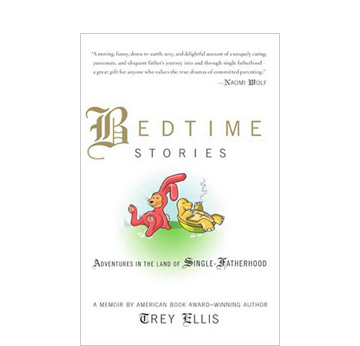
But there is another, more personal part of Ava growing up that has recently made me nervous. Two years ago, I wrote a book of creative nonfiction laying bare the most painful events of my nuclear family’s young life. I began the book, “Bedtime Stories,” when Ava was in the second grade, so there was no chance of her reading it. Now that she’s heading into the sixth, I’m petrified that I’ll come home and see her nose in the (sometimes steamy) pages.

Novelist Meg Wolitzer, daughter of novelist Hilma Wolitzer, wrote about this writer-parent dilemma in Salon five years ago. When a boy in her high school discovered that Meg’s mother had written a scene about a blowjob in her latest book, it instantly became the scandal of the school. My memoir is not only dirtier but also involves tough family secrets. While I tried my best not to make Ava’s mother my story’s villain, the question hangs there, nevertheless, between every line and piece of punctuation: Why did a woman walk out on raising her babies?

Amanda, my amazing girlfriend, is convinced that Ava will sometime soon open the book. I’m not so sure. Ava’s heart is as finely tuned as a Stradivarius. I think she intuits that at just 10 now, she’s still way too young to understand her father’s complicated, R-rated life. Kids are amazingly adept at self-preservation. Just because they can hear their parents going at it if they press their ear up against the bedroom wall doesn’t mean they necessarily want to.

Still, if I were writing the same book now, I know I’d greatly abridge the story of my recovery from divorce and learning to raise two little ones alone.

Maybe what I’m writing here is an explanation, an addendum, to what I wrote in the book — this time tailor-made for the most amazing little girl on the planet. Few things are more important to me than loving her through the difficult tween and teen years. As I wrote in the book, “Almost every woman whom I have ever dated has also had a troubled, contentious, aggressive relationship with their own fathers. Perhaps for me it’s a prerequisite. In my lowest points, when everything around me seems to be disintegrating, I terrify myself with the thought that my own little girl will one day stop loving me. After all there was a time when her mother looked at me the way Ava looks at me now.”

But I didn’t realize how much stronger my bond was with Ava than, I think, most dads have with their daughters, until I met Amanda. Amanda sometimes calls Ava my other girlfriend. Ava isn’t classically jealous. Around Amanda she’s been less jealous than her brother in general, but I do get the sense not only that am I her “best friend,” as she tells me daily while she squeezes her whole body against my arm, but that I’m also “her man.” It’s unbelievably cute to watch her just now as she begins to separate. She became addicted, instantly, to the “Twilight” books and it was so lovely to see in her the precise moment that she felt romantic love for another man. She is “Twilight’s” Bella Swan, and Edward the vampire is taking her away from me. She actually told me, “Don’t worry, Daddy.”

It’s hard to know what she will make of love, of mating. With my loving, long-term relationship with Amanda (we plan on marrying), I hope to model for Ava a counter-argument to the failed relationship that hatched her.

The more that I think about it, perhaps reading the book, when she’s ready, will answer some questions for her. Or at the very least it should be the start of something else: a pretty interesting conversation with a newly minted adult.

Trey Ellis is a novelist, screenwriter and assistant professor at Columbia University.

How does a single father ever get laid?

I have two kids to raise, a dating scene to navigate, and a rubber vagina in my drawer. Bachelorhood is off to a rough start.

At the end of the day, I was bathing the kids, unloading much of a bottle of conditioner onto Ava’s scalp so I could run the padded brush through her hair without making her cry. The explosion on top of her head is her most dramatic feature. When it’s clean and out, she looks like a miniature Macy Gray, a mini-supermodel-rock star. She looks like her mother, Carmen. It was usually her mother or our weekday nanny who wrestled with Ava’s hair, but I was slowly learning. In attempting a braid, I could only get through a turn or two before the hair rioted, so I’d just seal off the relatively controlled part with a barrette and let the rest poof out like fireworks. Almost always the braid would be high and outside, but Ava was sweet enough not to complain. Instead, while looking at herself in the mirror, she would tilt her head over her shoulder to center the poof and say, It’s good, Daddy.

Back when Carmen and I were still together, Ava often asked me why she didn’t have straight hair like all her friends. The first time it happened I lifted her up to my height. Carmen and I had dreaded this day. We had read her “Happy to Be Nappy” and “Nappy Hair,” but how could that counterbalance being the only brown-skinned person in her preschool? I explained to her, as many times as she needed to hear it, that girls with straight hair pay thousands of dollars to make their hair curly, and girls with curly hair pay thousands to make theirs straight. The trick is to love yourself for the way you are (and spend all that money you save on chocolate).

After the kids were dry, I put them to bed (I think I ended that night with a creaky but oddly soulful rendition of James Taylor’s “Sweet Baby James”) and went down to my default dinner: a bag or two of the prewashed carrots the nanny always popped into Ava’s lunch and a few jagged slabs of supermarket rotisserie chicken. Instead of swiping a couple of juice boxes from my kids, this night I rubbed my hands with glee in anticipation of the treat that awaited me. Tonight I didn’t despair that this burnt orange piece of crap refrigerator with the broken plastic shelves and jangly handles was an insult to all of refrigeratordom. I didn’t despair because I had bought a six-pack of Pepsi the other day, something I do only a very few times a year because as soon as it’s in the house, I end up sucking them all down like crack.

I laid out my bachelor’s feast on the table in front of the TV and loaded a DVD of the documentary “Dogtown and Z-Boys.” I turned out the lights so it would seem more like the movies, and I’d snuck in food. Just as I pressed play, our new 24-year-old weekend nanny Linda walked in.

“Hel-lo,” she said, as if singing a song. “Whatcha watching?”

I told her.

“Cool.”

She dropped to the couch, caving us into each other.

“Oops,” she said. And then, “Pepsi! Can I have one?”

A great excuse for me to rebound off the couch.

“Sit, silly. I’ll get it.”

It occurred to me that back in ’78, when this house was full of promise, the carpet was a recognizable color, and my side-by-side refrigerator was a symbol of status, Linda was just being born.

Linda fidgeted. “You’re really into this, aren’t you?” She asked.

“I remember watching these guys on TV and then begging my parents for my own skateboard with polyurethane wheels and sealed bearings.”

“Well, boss, enjoy your trip down memory lane.”

She pushed off from the couch and took all the dishes to the kitchen with her on her way upstairs to the bathroom. A few minutes later, she clattered down the stairs holding her clothes, one towel around her body and another around her hair.

“Good… night?” My voice cracked for maybe the first time in two decades. I winced, but it was too dark in the TV room for her to have seen me.

“Sweet dreams,” she said. “Dream about me.”

I stopped the DVD to collect my thoughts. The direction that our nascent relationship was going was leading me straight toward a tawdry, scandal-ridden hell. I had hired her so that I could get out and begin living like the newly single man that I now was. Yes, there were issues. I didn’t really drink, hated bars and the last time I’d been on the prowl Phil Collins was topping the charts.

All right, that wasn’t completely true. I had gone out once a few months ago, right as Carmen was leaving me. My friend Yule had dragged me to The Brig, our local meat market. It was a Friday night, and when the big, black bouncer eyed my driver’s license, I joked that I was almost old enough to be legal two times over. His only response was to tug his huge head toward the door. Inside, as I watched a carpet of twenty- and thirtysomethings shout at each other and spill beer on each other in an attempt to have sex with each other, my stomach convulsed. Out of the hundreds of sweaty yuppie girls in this room, I was positive that not one of them could I ever love. I could have collapsed to the floor in a sobbing heap — if it hadn’t been so crowded that my arms were pinned to my sides.

“I’ve gotta get out of here,” I told Yule.

“We just got here.”

“I am about to throw up in my mouth.”

I turned to shoulder my way back out the front door. A blonde woman, and just about the only woman there my age, blocked my way and wasn’t moving. Who knows what she might have looked like if she hadn’t been so damn drunk, but as it was, all her facial muscles were so relaxed by alcohol that she looked as if she were melting.

“You are fine!”

“Excuse me?” My words served two purposes. I didn’t understand what she had just said, and I wanted to get around her quickly.

“You are fine! I saw you as soon as you came in, and I said to myself, He is fine!”

I looked at her more closely this time. Was she just messing with me?

“Uh … thank you. Wow. Thanks.”

Circling each other, we traded places so I was now nearer the exit.

“Um. Bye.”

As the cool and the quiet of the outside hit me, I cackled.

She called me fine! I am knocking on 40 and had never been called fine by anybody, not once in my life. Perhaps she was some sort of drunken angel, come to earth to help me through.

- – - – - – - – - – - -

In the first months after Carmen moved out, I of course was too emotionally gutted and too preoccupied with getting Ava to preschool and bribing her to poop in a potty, changing Chet, bathing both of them in the evenings and singing them to sleep at night to think about dating. The Playboy Channel was the closest thing I had to a lover. Satellite TV with benefits. I was fishing for sympathy about my plight with a wild friend when he suggested CyberSkin.

I thought he was talking about Internet porn, of which I was already familiar, until he explained that it was a space-age substance that was actually quite spongy and lifelike.

I told him that it sounded like something they should pass out in prisons.

“It will change your life, my friend, and save your wrist.”

Though there was a sex shop just minutes away, for weeks I could not bring myself to enter it. Finally, however, I did, and I bought the floppy rubber thing from a woman behind the counter who weighed more than I do. I can’t tell you what she looked like, because I pretended to be hypnotized by the dirty floor at my feet. I even feebly tried to disguise my voice when I said thank you and hurriedly scooped up my change. Anything to make it harder for her to recognize me in a lineup if the cops were ever looking to round up the neighborhood perverts, losers and freaks.

As soon as I got home, I buried the thing at the back of my dresser drawer. Now that it was safely secreted inside my home I was actually very excited about our date this evening, after putting the kids to bed.

Then I rushed off to yoga. Two hours later I was driving home singing to myself. A few of the yoginis in class had been especially flirty, maybe soon I wouldn’t even need the thing that waited for me at home. And the class itself was an ass-kicker. Every part of me sweated. My eyeballs sweated. For the first time in weeks, my brain was pleasantly stewing in endorphins. I was persevering through what was so far the hardest test in a fairly hard life. I was proud of myself. Each day, I could almost feel the wound inside me closing just a little bit more.

I opened the door to my house and heard Ava and her playdate screaming happily, as Chet chased them. When I came in they all gathered around my knees like sheep. My ex Carmen was in the kitchen, my kitchen, chopping a hill of kale. She insisted that her little studio around the corner, right off the Venice boardwalk, was too tiny for playdates, so I gave her a key to the house my kids and I were renting. In fact, she explained to Ava that she had two homes, ours and hers. Her newest obsession was raw vegan cooking so she was using our kitchen to prepare food (I guess you can’t call it cooking) for rich, raw foodies too lazy to chop up their own.

As had happened every time I saw her again ever since the night she left, as soon as our eyes met, my stomach lava lamped and I had to look away or fall over. It was all so fucking hard. How could I pretend she was dead when here she was, in my fucking kitchen five afternoons a week?

I hurried past to take a shower.

“Um. Trey,” she began, speaking so quietly that at first I did not hear her. “The girls were playing in your room and they found your thing. I took it from them but…”

On the counter by the sink, far away from the chopped up kale and my soon-to-be-ex wife, lay my new, spongy, pink plastic pussy.

If it were only sharp and pointy instead of springy and soft I could have plunged it into my chest and instantly ended my humiliation.

“The girls were fighting with it,” Carmen added helpfully.

A coherent verbal response eluded me. I marched the 40 bucks worth of silicon (or whatever the hell it’s made of) out the back door to the trash, then took the back stairs up to my room. To begin our new lives apart Carmen had Doug, her white rasta guru boy. I had been willing to settle for a lousy rubbery cutlet.

Continue Reading Close

Black self-sabotage

An African-American scholar says we're holding ourselves back. I say, "Who're you calling 'we'?"

Every other black person I know aches to write a book that will tell the rest of us what we’ve been doing wrong. I call it the “My People, My People” syndrome. You throw a dinner party and your black friends don’t arrive till the risotto’s cold — “My people, my people.” You go to the soul-food restaurant and the surly waitress forgets your order — “My people, my people.” No matter how many times we publicly “say it loud, we’re black and we’re proud,” in private we’re pretty hard on our own.

John McWhorter, associate professor of linguistics at the University of California-Berkeley, is hard on us in public in his new book, “Losing the Race: Self-Sabotage in Black America.” He attempts to call a spade a spade, and more power to him. If only his reasoning weren’t sometimes so reductive. The result is a collection of half-thought-through ideas that never bothers to truly tackle the complexities of post-civil-rights era America.

McWhorter reminds us of what every other black conservative has been reminding us of for decades: There exists within our community what he terms a “cult of victimology.” McWhorter and his ideological forefathers Shelby Steele and Thomas Sowell feel that a passive sense of whiny self-pity so pervades most of the rest of us black people that we’ve stopped trying to excel and instead wait around for whites to give us things (like entrance into elite universities).

He and his mentors are not completely wrong. There certainly are black people whose perception of the degree to which the white world is arrayed against them is several years out of date. It’s the “Jew eat” effect. In “Annie Hall” Woody Allen is convinced the network executive he was meeting with said, “Jew eat,” instead of “Did you eat?” What’s lovely about this exchange in the movie and maddening about it in real life is that yes, the Woody Allen character is paranoid but, no, that doesn’t mean he doesn’t live in a world still steeped in anti-Semitism.

The main flaw in McWhorter’s thesis is the extent to which this “cult of victimology” affects the vast majority of black people today. Proof of the flaw comes from McWhorter himself. In his “Article of Faith Number One: Most Black People Are Poor,” he reminds us that three-quarters of African-Americans are not poor. We blacks and whites just think of black folks as a people of the poor.

So if we’re no longer poor then what “race” are we “losing”? How many of us are “self-sabotaging” if most of us hold some sort of job and have had some sort of schooling?

For the corollary to McWhorter’s “cult of victimology,” he echoes Steele and Stephan and Abigail Thernstrom by saying that the white majority has encouraged this black victim mentality “out of a sense of moral obligation.” The Thernstroms obsessed over this notion in their immense and confused work, “America in Black and White: One Nation, Indivisible,” and McWhorter scrupulously follows their party line. McWhorter believes that a majority of white Americans are “cowed by the insistence of so many black people that the country is still a racist war zone.”

Perhaps he is thinking of the 1970s, during the first years of cushy CETA summer jobs and 3-foot-long slabs of government cheese. Back then it did sometimes feel that we were challenging Native Americans for the title of white America’s most revered and pitied minority.

Alas, those good ol’ days are gone forever. The Supreme Court’s Bakke decision in 1978 followed by the election of Ronald Reagan two years later made it clear to all the black folks I know that the gravy train of reparations was over. Though state-sanctioned oppression of people of African descent endured in this country from the 1780s to the Civil Rights Act of 1964, a concerted effort to right those 184 years of wrongs lasted just 15 years, from President Lyndon B. Johnson’s Great Society programs to the Reagan era. Though every possible economic indicator still registered a sizable gap between the races, the federal government was once again hostile or at best indifferent to our needs. The meal of white guilt we had been looking forward to feasting on turned out to be little more than a soda cracker.

McWhorter’s main thesis is that black people are caught in a perceptual time warp. Ironically, the same can be said about him. Though you can still find the odd black person crying about “the man” (he or she’s also still wearing an Afro), please don’t tar us all with that same brush. The vast majority of black people have come to the conclusion that, yes, we live in a racist world; now let’s get on with our lives — and we have done just that.

McWhorter writes that there is only a “flutter of awareness in the black community that crying about victimhood is not exactly the best way to go about solving it.” The truth is that for more than a decade many influential black thinkers and artists have preached the same message. McWhorter describes Damon Wayans’ hilarious “In Living Color” character Homey the Clown (invented by comedian Paul Mooney) as what he calls the rare example of a black artist ridiculing the black victim mentality. That was in 1990. McWhorter must not have ever heard the late, great standup Robin Harris in the 1980s. (“You want some spare change? Shoot. Get you a spare job.”) And hasn’t he ever listened to Chris Rock, perhaps today’s most influential black pundit? Rock famously ridiculed a black man who proudly declaimed, “I ain’t never been to jail.” “What do you want, a cookie?” replied Rock. “You’re not supposed to go to jail, you low-expectation-having motherfucker.”

From Spike Lee to the Nation of Islam, black leaders have been exhorting blacks to take control of their own destinies. As James Brown shouted in 1969, “I don’t want nobody to give me nothing. Open up the door — heah! — I’ll get it myself.”

McWhorter is on much more stable ground when he decries the black community’s “cult of anti-intellectualism.” It is certainly true that for far too many young black people (mainly young black men, but McWhorter doesn’t bother differentiating), “keeping it real” means not opening a book and not becoming fluent in standard written English. This is a plague on young black men, and we need to do everything in our power to eradicate it. What McWhorter fails to mention, however, is that America as a whole shares this anti-intellectual prejudice (with the notable exceptions of what academics like to call the “model minorities,” Jews and Asians). As a whole we are a nation proud to be dumb. How else can you explain the popularity of George W. Bush?

Where I agree with McWhorter is when he decries affirmative action for blacks born into relative affluence. I am one of those people. We weren’t exactly rich, but my dad was a psychiatrist for the students at Yale. In no way did I deserve to take spots at Andover or Stanford away from poor kids of any color. Poverty is as damning a marker as race and needs to be taken into account to the same degree. Elite colleges and boarding schools give students much more than an education, they give them entrie into corridors of power undreamed of at most local, lower-level institutions. If you were born upper-middle-class and above, regardless of your schooling, you will know enough people, your parents will know enough people, to land you the job interviews, the business contacts and the venture capital to remain at the economic level to which you have become accustomed.

Unfortunately, McWhorter goes on at great length denigrating affirmative action as a whole. He feels it removes the quest for academic excellence from black students since they know they can slide by on less. He also says it makes whites believe that all black kids are intellectually inferior. He uses himself as an example of the first point. He claims he didn’t try very hard in high school since he knew, as a black kid in the ’80s, that the bar had been so lowered that he could get into any college he chose. He is a middle-class kid from New Jersey and ended up attending Rutgers, the state university of New Jersey. He is a very smart man who admits he didn’t study a lot in high school and didn’t go to Princeton. It seems like the system worked just fine.

I’m a middle-class black kid from Connecticut about the same age as McWhorter who excelled in my local high school, transferred to Andover in the 10th grade, busted my ass to make Honor Roll and got into Stanford. Sure, I knew my color gave me a leg up with college admissions officers. I also knew that the two Kennedys, the one Rockefeller and the several kids whose last names were on the buildings at nearby Harvard were going to get in most anywhere they wanted as well. Affirmative action for minorities has been going on for less than 30 years. Affirmative action for the well-connected has been around generations before George W. Bush limped through Andover, limped through Yale and then limped through Harvard Business School.

The oddest reason McWhorter and University of California Regent Ward Connerly have for dismantling affirmative action is their fear that it makes white people think we black people are not very bright. Americans are notoriously lousy at history, but can these two honestly believe that white notions of black intellectual inferiority began with affirmative action? Do they really believe that now, with affirmative action rapidly disappearing across the landscape, white kids are going to walk right past the Asian kid to ask the black kid for help with organic chemistry?

The truth is jocks, rich kids, minorities, fat kids, foreign kids, you name it — are all “stigmatized” to some degree on college campuses. So what? Grow up. Others will think about you whatever they want. If you cede your feelings of self-worth to strangers you’re lost.

Further muddling his point, McWhorter agrees with affirmative action in the workplace. He admits that blacks are generally at a disadvantage when it comes to personal business contacts, and sometimes need help getting in the door. McWhorter doesn’t realize that the American equivalent of “the playing fields of Eton” have been our most powerful tools for moving significant numbers of black poor and working-class kids into the middle- and upper-middle classes. By the time they’re looking for a job, it may be too late.

By the end of the book, McWhorter’s wrath at affirmative action seems personal. He admits it got him his own teaching post at Berkeley but quickly adds, “I will never get beyond the sense of diminishment in having gotten it to such an extent ‘through the back door.’” A paragraph later he reverses himself and writes, “As it happens, I am secure in the fact that in the end I am qualified for my job.”

Though McWhorter set out to condemn a “cult of victimology,” he ended up wallowing in his own. I in no way condemn him for this. In his lusting after white acceptance he is hardly alone. We black folks still define ourselves as a part of a whole black community, most of whom we have never known and will never meet. We cringe when the news reports a heinous crime, then flashes a picture of a black man. The majority doesn’t share our neurosis. I mean how many white people, the day Jeffrey Dahmer was arrested, shouted, “Damn! Why’d he have to go and be white?” The souls of black folks are vast labyrinths and unfortunately, “Losing the Race” barely excavates the first couple of rooms.

Continue Reading Close
www.salon.com/writer/trey_ellis/index.html