

At least since the Republican Party suffered a comprehensive defeat in last month’s off-year elections, Donald Trump’s public support has been spiraling downward even faster than before. A new YouGov/Economist poll reports that Trump’s approval rating is now down to 38 percent.
With three years remaining in Trump’s second term, and further losses in next year’s midterms looking likely, the question now is whether he can regain control or is headed for a devastating crash.
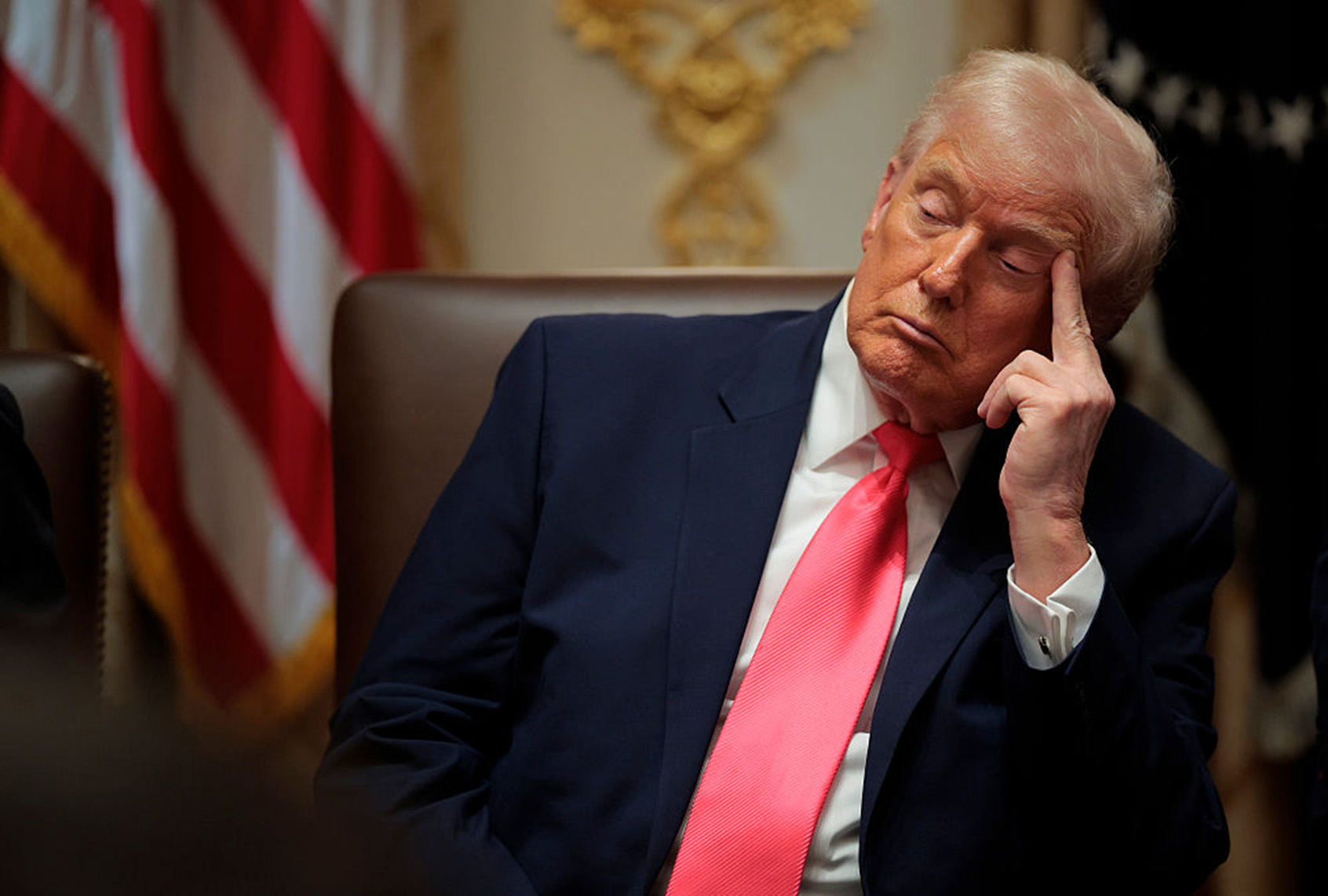
Trump’s softening support is amplified by growing rumors about his health and reports on his reduced public schedule. Even the mainstream media noticed that he repeatedly appeared to fall asleep during Tuesday’s Cabinet meeting. While he sends out numerous social media posts in the middle of the night, he seems increasingly disconnected from real-world events by daylight. Any appearance of physical weakness or frailty in a man who is nearly 80 years old, threatens to undermine his carefully constructed persona as a vital and dynamic political strongman.
In an effort to reassert his control of the attention economy, Trump spent much of last week — including the Thanksgiving holiday — posting rage-bait on his Truth Social platform. He called Minnesota Gov. Tim Walz “seriously retarded,” continued his tirade of hateful comments against Rep. Ilhan Omar, D-Minn., declared he would end migration from “Third World countries” (which to him obviously means nonwhite countries), and suggested stripping U.S. citizenship from naturalized immigrants and forcing them to leave the country.
But none of Trump’s attention-seeking behavior changes the fact that across a range of polls, his policies — including on his supposed signature issues, such as immigration and the economy — are broadly and increasingly unpopular. This includes a first: Trump now has a net negative approval rating across all the major polls aggregated by the New York Times, and has the second-lowest poll numbers for any president since World War II.
When voters are asked which party they will vote for in the 2026 midterm elections, Democrats now lead Republicans by 14 percentage points. That historically large gap suggests that Democrats are well-positioned to win a House majority, and perhaps even the Senate (although the latter is less likely for structural reasons). Democratic voters are also more enthusiastic than Republican voters; if we view November’s off-year elections as a de facto referendum on Trump’s presidency, the results were almost unanimous.
But it’s important to understand that Donald Trump does not care about the approval of the American people, at least not as such. Given his profoundly narcissistic personality, he would prefer to be loved by all, and still yearns for such an implausible outcome. But at the end of the day, Trump rules only for Republican base voters, especially his most faithful MAGA followers –– and most important of all, to advance his own corrupt interests.
On that score at least, Trump is still winning: His popularity among Republican voters is 88 percent, a net loss of just six points since his inauguration in January.
If we view November’s off-year elections as a de facto referendum on Trump’s presidency, the results were almost unanimous. But it’s important to understand that Donald Trump does not care about the American people, at least not as such.
That said, it’s clearly true that key parts of Trump’s winning 2024 coalition are not happy. He made remarkable inroads among Latino voters, especially men, but they are turning against him for a number of obvious reasons, largely his cruel mass deportation policies. For a variety of reasons, young men supported Trump in 2024. But young voters are now moving away from Trump amid a worsening job market, in response to what they see as broken promises to improve their economic futures. Independent voters, who drove Trump to victory over Kamala Harris, are also souring on Trump’s second term.
In the wake of the longest-ever government shutdown, a poll from AP-NORC shows Trump losing significant support among Republicans because of his catastrophic and incompetent management.
We need your help to stay independent
Among other issues, the Jeffrey Epstein scandal, incoherent tariff policies, Russia’s war in Ukraine, the increasingly controversial attacks on alleged Venezuelan “narcoterrorists” and the ongoing Middle East crisis are dragging down Trump’s support among Republicans, as well as voters in general.
Even so, as CNN political analyst Harry Enten recently concluded, the big picture remains that support for Trump among Republican base voters is “like a rock.”
To make sense of that, the relationship between Trump and his most loyal followers must be understood in context. Trump is a singular figure in American politics and culture — indeed, in American history. MAGA is a personality cult and pseudo-populist movement constructed around a single individual. His followers’ relationship with him is intense and highly emotional. As social psychologists and other experts have explored, MAGA believers are psychologically adhered to their leader and to their movement as a community and identity.
Ultimately, MAGA should be seen as a lifestyle, a blend of religion and politics, and a textbook example of the authoritarian leader-follower dynamic. To quote Adam Serwer’s famous line, “The cruelty is the point.” Trump’s relationship with his MAGA followers defies the expectations and outcomes of normal politics in a healthy democracy.
Anecdotes are not data, but they are often instructive. For example, NBC News recently spoke to 18 people who voted for Trump in 2024. They expressed some regrets and frustration, but nonetheless remain loyal to Trump and the Republicans.
Want more sharp takes on politics? Sign up for our free newsletter, Standing Room Only by Amanda Marcotte, also a weekly show on YouTube or wherever you get your podcasts.
A new report from the SNF Agora Institute at Johns Hopkins University on Republicans’ attitudes toward democracy also found that Trump voters and Republicans in general feel deep loyalty and affection for Trump. To put it more directly, they love him.
In NBC’s interviews with 18 Trump voters, many of them said the president had failed to meet their expectations on the economy and other issues. But none said they regretted voting for Trump over Harris last year.
“Support for Trump among the group studied was much greater than for any other Republican figure listed. That extended well beyond straightforward agreement with his policy positions; focus group participants described themselves as strongly identified with Trump, viewing him as speaking from the heart and without a filter, unlike other politicians. This was the case for all groups of Republicans, regardless of income, gender, region or age.”
Democrats and mainstream political commentators have begun to fix on the narrative that Trump is now a “lame duck” president and that his influence over the Republican Party is waning. There may be some objective truth to that observation, but this report makes one thing clear: Trump is not immortal and will not be in office indefinitely. But the MAGA movement and his influence over Republican politics will likely outlast his presidency.
Indeed, per the new report from the SNF Agora Institute at Johns Hopkins University, 85 percent of Republicans believe their party is moving in the right direction and should continue its current direction even after Trump leaves office.
Despite the unusual strength and resilience of Trump’s MAGA coalition, there are still fissures that can potentially be exploited. Focus group research from Navigator Research finds that almost one-third of Trump voters report that “they either regret voting for him or are disappointed in how he is handling being president,” mostly citing the government shutdown and the stagnant economy as “reasons for their disappointment and regret.”
Trump has been counted out before, and before we declare him politically doomed we should attend to several important caveats:
- Trump has a remarkable gift for political survival, and in that regard is almost a sui generis figure in American political history.
- Public opinion polls are a snapshot in time, and cannot be viewed as predictive. In this era of “hyper-politics,” the apparent political mood and partisan momentum can change rapidly, and probably will.
- Despite recent electoral results, the Democratic Party’s brand remains badly damaged. Democrats continue to be less popular than Republicans, and in broad strokes even less popular than Trump.
- Trump’s MAGA supporters represent a built-in competitive advantage — certainly for him, and probably for his anointed successor. That advantage will only be amplified by Republican efforts to rig future elections through extreme partisan gerrymandering, vote suppression, court challenges, intimidation and other legal or quasi-legal tactics. As Trump’s actual popularity wanes, these attempts to undermine democracy will only become more brazen.
Trump is crashing in the polls; that is not an illusion. His most loyal followers will never abandon him, but it’s unclear whether they can boost him back to political dominance. In a new essay, historian Ruth Ben-Ghiat writes:
For hard-core MAGA, the realization that all is not as it seemed will be frightening, and the knowledge will be initially dismissed. Throughout 2026 we can look forward to redoubled efforts by pro-government propaganda outlets such as Fox to cast defectors and doubters in a negative light.
Whether that realization can come soon enough to redeem American democracy remains to be seen.
Read more
from Salon on Trump’s downward spiral
