
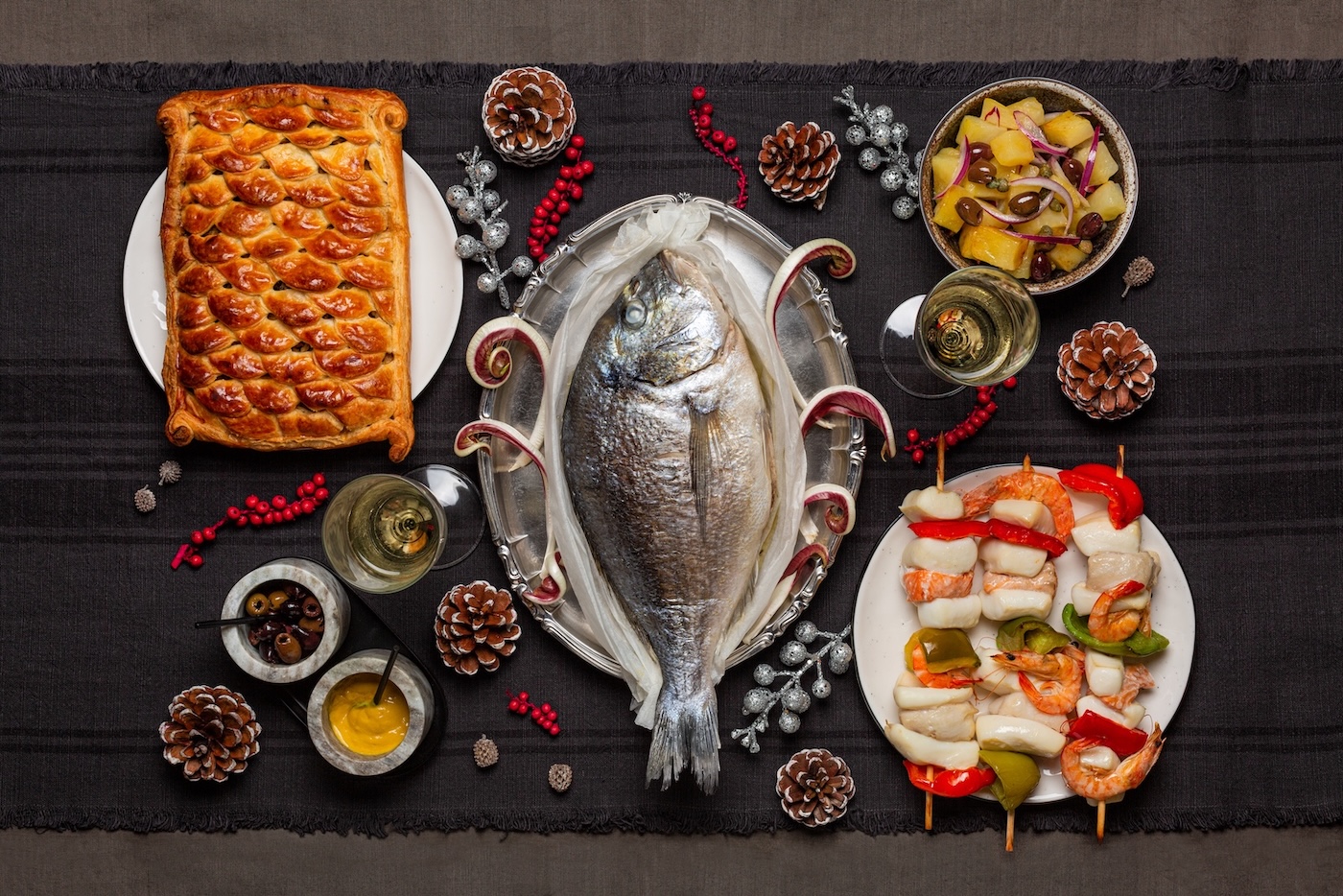

No one does a holiday party better than Italian-Americans. I may be a little biased, but I’ve never gone to a party as fun as my family’s yearly Seven Fishes.
The Feast of the Seven Fishes, “Seven Fishes” or just “Fishes” for short, is a traditional Italian-American Christmas Eve celebration built around the idea of eating seven seafood dishes. It sounds pretty straightforward, but like any family ritual, the rules depend on who you ask.
Some families insist on seven specific dishes. Others say seven separate seafood preparations, even if they use the same fish, totally counts. Others throw the number out entirely and follow what many Southern Italian families have long done: just make an odd number of fish dishes. In reality, no one is going to put the malocchio on you if you mess with the menu.
The Feast traces its roots to La Vigilia, the Catholic Christmas Eve vigil meal rooted in southern Italian tradition, where meat is traditionally avoided. But the seven-dish extravaganza? That’s an Italian-American creation. Abundance in the U.S. reshaped this ritual for many Italian Immigrants. More food, more money, and the symbolic pull of seven — sacraments, days of creation, virtues — turned a humble pre-Mass meal into a celebratory Italian-American blowout.
Seven Fishes is about reminiscing on the year while letting go of whatever you’d like to leave behind. You don’t have to be Italian to celebrate the Fishes; as long as you’ve got a good attitude — and a big appetite — everyone’s welcome at the table.
The feast has even swum its way into pop culture. I still haven’t watched “The Bear” — a gap in my cultural homework, I know — but I’m told their Seven Fishes episode captures the chaos pretty accurately. The film “Feast of the Seven Fishes” also captures the small-town, big-family spirit of the holiday perfectly. Plus, it’s set in my home-state, so I get to enjoy references to local colleges, regional delicacies, and sports teams (Go birds!).
Want more great food writing and recipes? Sign up for Salon’s free food newsletter, The Bite.
That balance of reverence and looseness is exactly what chef Frankie Celenza taps into in his recent holiday episode of “Let Frankie Cook,” his new Tastemade series that blends big flavor with low-stress cooking. You may know him from “Struggle Meals,” where he proved delicious food doesn’t have to be expensive. His new show takes viewers into his home kitchen, where the vibe is elevated but still unfussy.
Frankie Celenza approaches the Feast with a kind of joyful unseriousness — the exact mix of reverence and looseness that makes the tradition so lovable. In his holiday special, he treats the feast as both a love letter to its Catholic, working-class roots and a gentle rebellion against the idea that it needs to be rigid or intimidating.
Celenza grew up with the seeds of the feast long before it officially became a tradition in his family. “I remember growing up, my mom always on Friday saying, ‘It’s Friday, we eat fish,’” he says. “When you look into the Feast of Seven Fishes, it’s sort of an extrapolation of that.” At some point, his mother decided they were going to do Seven Fishes — “like 15 years ago or something” — but the ethos was there all along: thrift, ancestry, the rhythms of Catholic tradition, and eventually, the abundance of American kitchens.
He didn’t even like seafood until puberty — “back then it was only flounder or sole for me” — but as an adult, he’s circled back to the foods of his childhood. “Everything I was fed as a child was just my mother’s interpretation of like a Marcella Hazan recipe,” he laughed. “I always liked my mom’s better than my grandma’s. I don’t know why.”
We need your help to stay independent
In the special, Celenza reframes the feast through a distinctly New York lens. He folds in a smoked whitefish salad — “sort of a play on a New York deli” — and talks about the cultural overlap between Italian- and Jewish-American cooking. He even references a Sebastian Maniscalco line: “Jews and Italians, same corporation, different division.” His wife is Jewish, but he grew up eating bagels and lox long before that. “I think it’s just a New York thing,” he says.
Practicality shapes his approach as much as nostalgia. The first few years his family took on the Seven Fishes, they attempted to serve all seven dishes hot. It was, in his words, “impossible.” He recalls those early years eating calamari straight from the fryer and begrudgingly embracing room-temperature plates. Half the menu in Celenza’s special is designed to be served warm or cold — scapece, anchovy-butter toast (“the temperature does not matter”), smoked whitefish, even a tongue-in-cheek Swedish Fish dessert to round out the number.
Hot dishes get priority. He makes a five-minute acqua pazza — a simple fish braised in a spicy tomato broth — and a salt-baked snapper that looks dramatic when cracked open at the table but is almost impossible to mess up. “You end up making like a clay pot out of salt,” he explains. “Fish is really easy to overcook, of course… but if there’s no place for that steam to go because it’s completely encapsulated, that’s the beauty of the salt.”
Beneath all the technique, he’s really just trying to demystify the feast. His main advice? Don’t overdo it. “Probably the biggest mistake you can make is to try seven new dishes all in one day,” he says. Practice a dish or two. Mix hot and cold. Avoid three pastas with fish. And above all: “Have some fun, drink some wine, and definitely get some laughs in there.”
My family has added things like lobster mac and cheese, crab cakes, and shrimp cocktail to our menu over the years, none of which are exactly “Italian.” The old heads insist on classics like smelts and baccalà, but there’s enough variety that the more “acquired taste” dishes don’t define the night.
Most of my family came to the U.S. from Italy in the mid-20th Century, and as far as I know, they’ve been celebrating the Fishes together every year since. They’re flexible — to a point. My mom once suggested ordering a giant sushi platter instead of cooking, and you would’ve thought she’d suggested we don’t have fish at all. If you don’t have to worry about a table of traditionalists, though, I say order all the sushi you want. I love a tuna nigiri.
“Italy is Italy. I have roots there 100 years ago. I’m American. This is our thing.”
“There’s no hard and true recipe,” says Celenza. I used to avoid the old-school dishes – baccala, smelts, anchovies. Like Frankie, I didn’t “do” seafood until my teens, but now I can appreciate the history behind these recipes. I mean, if my Aunt Lisa is going to spend a week salt-bathing cod for baccala, I can at least take a bite.
Some elements never change. In my family, everyone new to the table — new partners, neighbors, friends — must try a smelt. It’s a rite of passage, a sort of welcoming into the family. Frankie gets that. “It’s sort of like hazing, if you will,” he said. Food binds generations through shared experience, even if the first bite ends in tears or, apparently, smelt-induced gagging.
The core of the holiday is building memories. “You only have to do something two years in a row for it to be a tradition,” Frankie said. “If someone dies and the dish can live on, you can talk about that person. It’s about comfort.”
For my family, the feast is the accordion my dad has played for 30 years, swinging from “Volare” to Taylor Swift to Sinatra without warning; it’s the limoncello shots that multiply as the night goes on; it’s my great-uncle telling us how he used to poke lions at the zoo in Abruzzo; it’s the cousins huddled in the kitchen at 1, 2, even 3 a.m., passing around a stirato like it’s a cigarette.
And maybe that’s why Frankie’s final reflection stuck with me: “Italy is Italy. I have roots there 100 years ago. I’m American. This is our thing… It’s Italian-American. It’s a little guido. I like it. I think we can lean into it.”
The Feast of the Seven Fishes isn’t about perfection. It’s about the loud, loving, messy families who turned a simple vigil meal into something abundant. The food changes. The people don’t.
“Frankie’s Feast of the Seven Fishes” is available to watch now on Tastemade and on Tastemade’s YouTube channel.
Read more
about this topic
