
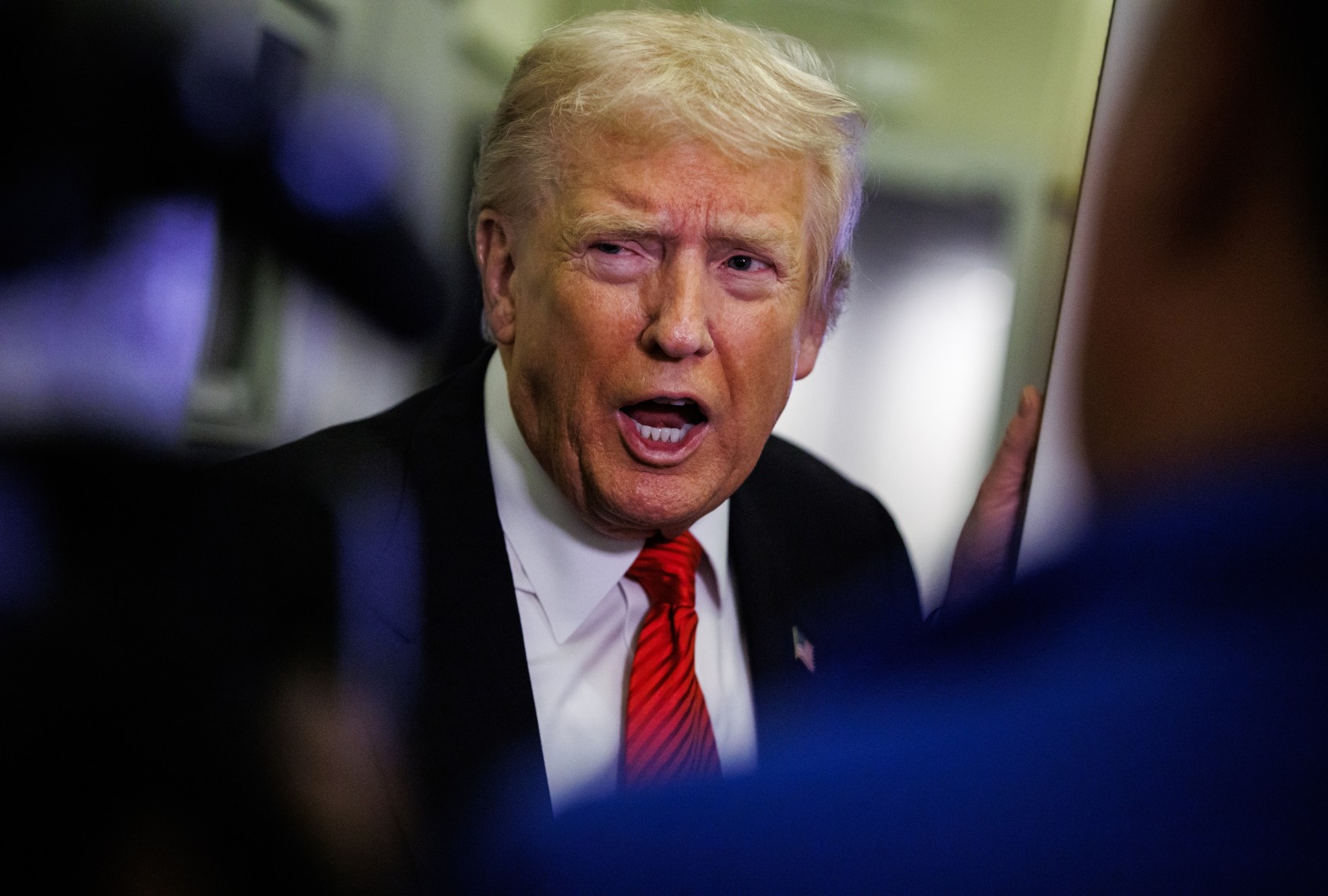

The phrase is meant to humiliate. “Trump Derangement Syndrome,” as the president called it earlier this week, is a way of converting moral objection into pathology, of dismissing concern by diagnosing it as hysteria. Yet after what I encountered, personally, from those who bandy about this diagnosis to silence valid criticism, the term seems worth reclaiming, if only to ask a harder question: If there is derangement in our public life, where does it actually reside?
I recently took to social media to offer a polite reminder that true leadership involves moral consequence, and that Donald Trump does not represent our best civic instincts. I was not heckling or mocking, but what followed was immediate — and instructive.
“What was it like to play Borat?”
“What’s your name? Labia?”
“Go back where you come from.”
“Eat some bacon and you’ll feel better.”
“Yahia Lababidi, you should do society a favor and detonate your suicide vest in your own house.”
There is a particular intimacy to hatred when it addresses you by name.
As a younger man, I left behind a life of familiar rhythms and deep roots in Cairo, Egypt, to pursue the uncertain promise of creative and intellectual freedom. In my early thirties, I made that leap, leaving family, friends and a decade-long career at United Nations Educational, Scientific and Cultural Organization (UNESCO) in search of a life where I could breathe differently. Within a year of arriving on U.S. soil, I was granted a visa for Aliens of Extraordinary Ability, an official recognition that affirmed my cultural work, even as public discourse around Muslims and immigrants was growing harsher. I built a life here slowly, through language and a love for the country strong enough to hold it to its own ideals. That history shapes how I receive both the generosity of America and the contempt that occasionally shadows it.
I saved the comments I received out of morbid fascination with the extent of ugliness — how low strangers will allow themselves to go in defense of their supreme leader, and also as evidence of what is released when contempt is modeled from the top. How quickly xenophobia and Islamophobia surface when they are no longer policed by shame. It’s strange and instructive how readily cruelty presents itself as patriotism when it feels authorized.
It does not take much imagination to see how this authorization travels. When raids are carried out in daylight and families are separated as a matter of procedure, when deportation is spoken of as a form of hygiene, cruelty acquires the tone of duty.
It does not take much imagination to see how this authorization travels. When raids are carried out in daylight and families are separated as a matter of procedure, when deportation is spoken of as a form of hygiene, cruelty acquires the tone of duty. The language hardens and human cost recedes. What might once have been shocking to a person of conscience is absorbed into routine. In such a toxic climate, verbal violence lays the ground for the physical variety, where virtual trolls take the cue from their real life troll-in-chief.
One commenter asked, with feigned innocence, whether I was even “a legal American citizen.” Another suggested I was on the platform because my country lacked clean water. Others told me I had no place here, that real Americans were waiting for me to move — and they would even help me. I marveled at these expulsions.
We often learn more about a public figure from the passions they license in others than from their own speeches. Their followers are a mirror that way. What a leader normalizes, others perform. What a leader excuses, others amplify. In this sense, the abuse I experienced was diagnostic.
Donald Trump is an agent of chaos who thrives on negative emotions. Because language means little to him, and less the truths it represents, he presents himself as the opposite: an agent of good trouble, a disrupter, a breaker of norms, a necessary irritant to a complacent order. Yet when contempt becomes conversational, when exclusion dresses itself as common sense, when Islamophobia is waved off as frankness, we are no longer in the realm of disagreement. We are witnessing a corrosion of the civic imagination.
Anyone who insists that Trump does not traffic in xenophobia or Islamophobia must avert their eyes from the evidence that gathers wherever his rhetoric lands. The hatred is direct, bodily, unembarrassed. It speaks in the second person, telling you where you belong, whether you count, whether your life is expendable.
On Monday, Trump spoke with unsettling casualness about the killing of filmmaker Rob Reiner, allegedly by his own son, reducing a brutal act to something like an anecdote. In a Truth Social post less than a day after Reiner and his wife Michele were found murdered, Trump framed the tragedy through his familiar lens, suggesting Reiner’s death was “due to the anger he caused others…through his massive, unyielding, and incurable affliction known as Trump Derangement Syndrome.”
Want more sharp takes on politics ?Sign up for our free newsletter, Standing Room Only, written by Amanda Marcotte, now also a weekly show on YouTube or wherever you get your podcasts.
Trump doubled down, insisting, “I wasn’t a fan of Rob Reiner at all…He was a deranged person…I thought he was very bad for our country.” Casting a human loss in the language of insult revealed how little moral gravity has to register before it is turned into another battle cry. The moment at once broke through the news cycle and passed quickly, but it revealed how a leader who treats tragedy lightly trains others to do the same.
I know the strength of the United States. I have lived its generosity, its pluralism, its capacity to absorb difference and be enlarged by it. America’s beauty has never rested in purity. It has always resided in encounter. Diversity is a generative force of American life.
Whether in Egypt or in the United States, I have observed how societies diminish themselves when they close their doors and their hearts to others. Beyond politics, this loss is cultural, and even spiritual. A nation that teaches fear as a civic virtue hollows itself out from within.
Reading the astonishingly vicious responses directed at me, I felt something like detachment. These people did not know me, I thought; they were not responding to a person. They were responding to a permission structure. Hate, I realized, is impersonal that way. It travels downward from example to imitation. Remembering this kept the poison from entering my system.
This kind of inward distancing is a habit learned by those who move through the world knowing they may be misread or made to stand in for something larger or other than themselves. It is a way of staying intact without surrendering one’s humanity. It allowed me to see the abuse clearly, without letting it contaminate my spirit.
We need your help to stay independent
Trump, in this sense, is not the disease. He is a symptom of a deeper sickness in the collective psyche. A wound that has not been examined. A resentment that has not been metabolized. He is dangerous, certainly, but also hollow. Even a clown can do immense damage when enough people mistake performance for truth.
What unsettles me is not disagreement. A healthy society can withstand disagreement. What unsettles me is how eagerly people rush to perform the worst versions of themselves when given permission. In that sense, the divided states of America are corroding because contempt has been mistaken for conviction.
Of course, I know well that these voices do not represent all Americans. I have seen too much decency and moral courage, to believe that. Still, for better or worse, we are bound together, and what is modeled at the top ripples outward. Leadership by gaslighting is abdication.
Until this episode, I had not encountered such blind, destructive hatred so directly. Yet I now realize that Islamophobia is real, as is xenophobia. They exist in the confused souls of a swathe of the population, inner Trumps that feel newly emboldened to speak out and mock. I see now that I did not leave Egypt to escape struggle, only to encounter another form of it. Perhaps this, too, is part of my global education. The lesson, it seems, will continue to repeat itself until it is learned.
Read more
about this topic
