
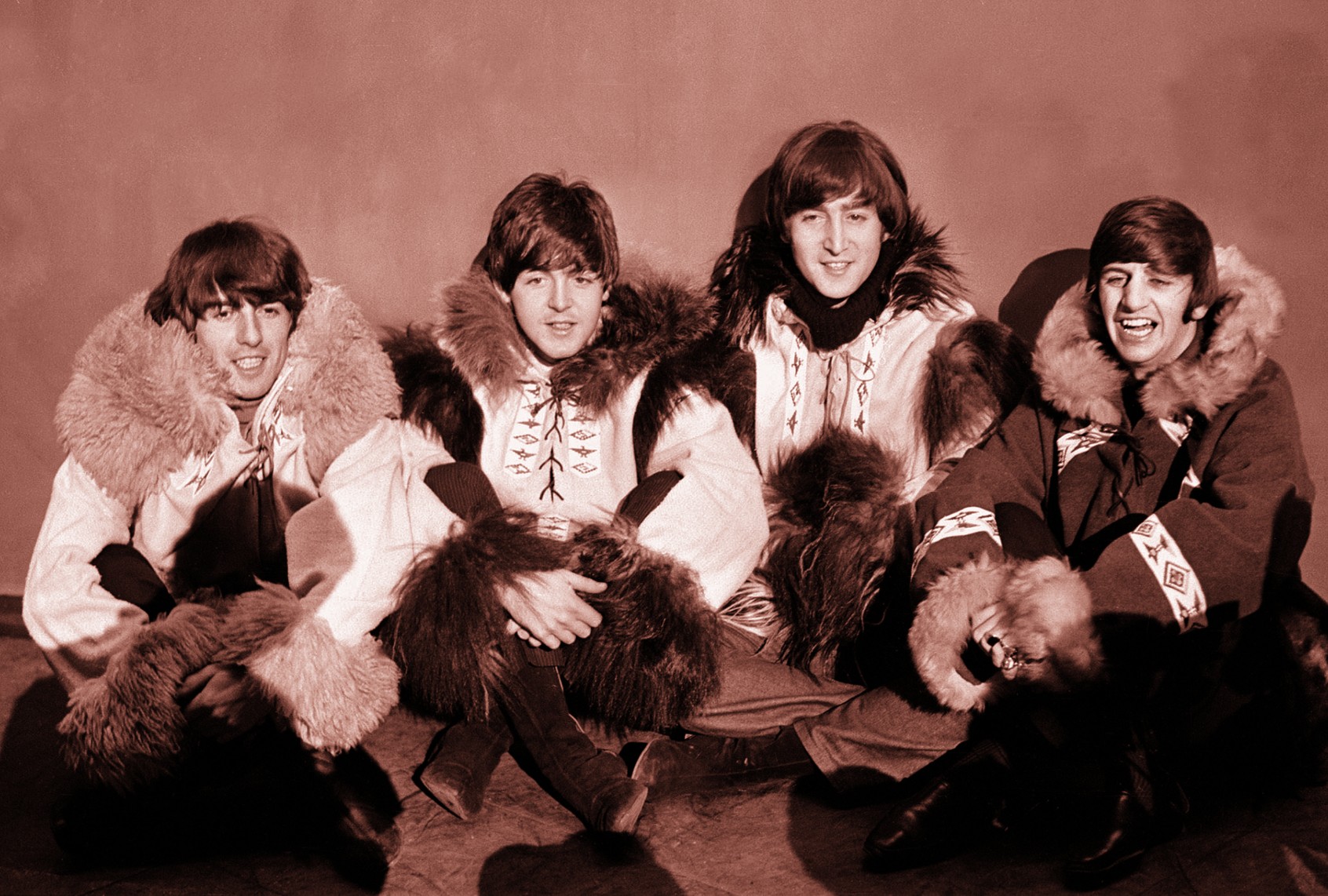

“Hello, this is John speaking with his voice. We’re all very happy to be able to talk to you like this, on this little piece of plastic.”
In 1963, The Beatles made a short holiday recording for their fans: the first Beatles Christmas single: a 7” flexi-disc (a heavy piece of plastic with grooves like a record album) containing what certainly sounded like booze-enhanced, delightfully sloppy versions of “Good King Wenceslaus” and “Rudolph, the Red-Nosed Ringo”) as well as spoken-word messages crafted by a public relations person but enhanced with The Beatles’ particular brand of deadpan humor, inside jokes, and wordplay, along with a healthy dose of goofing around. The holiday singles continued yearly until 1969, and each year, the band took the concept further and further out.
Before you could sit at home and watch six hours of an in-depth documentary about the band, the Christmas singles gave you a window into the Beatles you’d only heard on record and in films. For people who came of age well after the band broke up, it illuminated and enhanced the ideas (or fantasies) you had about them in your head. Most importantly, you got to hear their voices speaking conversationally.
Fans were able to get a (limited) sense of the kind of dynamic and humor between them you’d glimpsed elsewhere. It’s the audio version of the scene in “A Hard Day’s Night” where John Lennon holds a Coca-Cola bottle up to his nose: you have to notice it and know why it’s funny, while everyone else shrugs. It’s an inside joke, but you’re on the inside.
The other benefit of being obsessed with the Christmas singles was that it helped you find the other weirdos. I would run into others who were already acolytes, who would quote memorable lines, like: “Are you enjoying the wine?” or “Matches and candles and buns!” or “Hello, Beatle People!” or “I just haven’t enough pens.” And there are still folks to whom my yearly holiday greeting is “Merry Krimble,” a classic onomatopoeiacal Beatle-ism uttered on the first two singles by Paul and John. I loved it because it was a perfectly non-religious seasonal wish that still sounded close enough to “Christmas” to be widely acceptable, and to people in the know, it was a Bat Signal of cool, or at least close enough to it.
If you were five years old when The Beatles broke up, you were only going to hear the singles if you could find (and could afford to buy) them on the collectors’ market, if you could find an equally pricey bootleg compilation, or if you were lucky enough to live near a FM radio station who would broadcast the singles over the holidays. Thanks to one of New York City’s flagship FM radio stations (either WPIX or WNEW) this teenage Beatles fan was able to hear and eventually tape my own copy. I guarded that tape like it was made of gold, carrying it across continents and oceans, until it gave up the ghost.
There are still folks to whom my yearly holiday greeting is “Merry Krimble,” a classic onomatopoeiacal Beatle-ism uttered on the first two singles by Paul and John. To people in the know, it was a Bat Signal of cool, or at least close enough to it.
When my home-recorded cassette of the Christmas singles wore out, I was always on the lookout for a replacement, and eventually, the internet provided. The recordings were just as funny and weird and interesting as I remembered them; they didn’t seem dated, they didn’t seem superfluous, they weren’t something I was going to grow out of. I was only too delighted to have the singles back in my life again.
Over the years, as The Beatles went through the varying waves of new popularity and coolness, I assumed that at some point, surely there would be an official release. But, alas. The Beatles Christmas Records have never been officially released except as a collector’s edition set of the individual 7” records, which sold out immediately in 2017.
Luckily, thanks to the Internet Archive — which has a streamable and/or downloadable file of a popular bootleg featuring all of the records (and some bonus material) — you can hear all of these hilarious moments yourself.
Let’s dive into the highlights of the individual years.
1963: Deep and crisp and crispy
The very first Christmas single is definitely scripted, but there’s still ample room for the four Beatles to cavort. 1963 is full of classic Mop-Top goodness. The single opens with the sound of jingle bells being briskly rung. The Beatles are singing “Good King Wenceslaus.” John’s voice dominates, in an exaggerated baritone, featuring this edit: “As the snow lay roundabout, deep and crisp and crispy.”
When their rendition concludes, the messages commence. “Hello, this is John speaking with his voice. We’re all very happy to be able to talk to you like this, on this little piece of plastic.” He proceeds to give a brief recap of the year, specifically mentioning how they’d been invited to take part in the Royal Variety show, that infamous evening where he’d suggested that the Queen and other royals in attendance should rattle their jewelry. There’s a pause while all four Beatles whistle “God Save the Queen” in harmony.
Want more from culture than just the latest trend? The Swell highlights art made to last.
Sign up here
Paul McCartney is up next, thanking the fans for all of the packages that have been sent to the band, but specifically mentioning, “Somebody asked us if we still like jelly babies. Well, we used to like ’em, in fact, we loved ’em. And we said so in one of the papers, you see. Ever since then, we’ve been getting ’em in boxes, packets and crates. Anyway, we’ve gone right off jelly babies.” (A year later, when The Beatles would play at the Washington Coliseum, American fans would throw so many jelly beans — the American version, except it has a hard shell, a crucial difference when being hurled from a distance — that images of that night show a stage covered in them.)
Ringo introduces himself as the new guy in the group, but he gets interrupted: “Sing King Wenceslaus,” says what certainly sounds like a very tipsy Paul McCartney. There’s a brief sing-along, which concludes with George Harrison: “Thank you, Ringo, we’ll phone you.”
George has the role of thanking the Beatles’ fan club office staff by name, “Not to mention, Frieda Kelly in Liverpool,” says George. “GOOD OLD FREIDA,” everyone yells. (If you haven’t seen the documentary of the same name, it’s definitely worth a watch.) There’s another reprise of “Good King Wenceslaus” before they sign off.
1964: It’s been a busy year, Beatle Peoples
The 1964 Christmas single opens with the sound of footsteps that rapidly speed up; maybe it’s supposed to sound like some kind of dancing? There’s a kazoo, then some vaguely tuneful humming, a start to “Jingle Bells,” and then the dulcet tones of (not yet Sir) Paul McCartney.
“Hello everybody, this is Paul…I’d just like to thank you for buying our records during the past year. We know you’ve been buying them, because the sales have been very good, you see! We don’t know where we’d be without you, really–”
John: sotto voce, just barely in range: “In the army, perhaps.”
“We hope you’ve enjoyed listening to the records as much as we’ve enjoyed melting them. No, no, that’s wrong! Making them.” It’s obvious that once again, the band all have some kind of printed remarks they’re supposed to be following, but as we saw in the previous year, this is not a barrier to Beatle humor.
John is next, and he just can’t be a straight man, even when he tries: “Thanks to all of you who bought me book . . . And there’s another one out pretty soon, it says here.”
He continues: “It’s been a busy year, Beatle peoples, one way or another. But it’s been a great year — too. (Said with faux dramatic emphasis.) You fans have seen to that. Page 2.”
We need your help to stay independent
They manage to walk a very fine line between sincere thanks and making fun of the ridiculousness of the situation. The Beatles sound like they are genuinely appreciative, just not entirely sold on the need to express their thanks in this particular manner. But they do it by letting you in on the joke — we’re reading a script! Shhhh, don’t tell anyone — and that is what makes these records continue to feel special, 60 years later.
When George has his turn, he’s been given the job of thanking the fans for coming to see “A Hard Day’s Night,” and has some information about the next movie: “The next one should be completely different. We start shooting it in February. This time, it’s gonna be in color.”
Just off mic, Lennon is at it again: “Green.”
Ringo offers his thoughts on the fans’ loyalty as the band toured countries far afield, and then it sounds like four pairs of shoes are running down a hallway: “Happy Christmas! Happy Christmas!” 1964’s single was still full of newness and wonder, but The Beatles definitely sound more confident.
1965: Let’s do a Christmas record
Recorded while the band was in the studio working on what would become “Rubber Soul,” the 1965 single is still a window into what you’d imagine eavesdropping on The Beatles hanging out would sound like, but it’s lost a little of the new sheen of the previous years.
This year, there is no PR-supervised script in hand (or if there is, no one is referring to it). It opens with an exaggerated acoustic version of “Yesterday” (which had been released earlier that fall) and Ringo saying, “Don’t forget, Christmas is coming. Oh, that reminds me, let’s do a Christmas record!”
The same expressions of gratitude for gifts and buying records and descriptions of touring and the band’s other activities, but they definitely sound tired and a little loopy. They briefly go off on a tangent, imitating weather reports and station IDs for the British Forces Broadcasting Service — the kind of reference that in pre-internet days required listening to this year’s message over and over again to try to decipher exactly what they’re talking about.
John Lennon tries to launch into jokey renditions of Barry McGuire’s “Eve of Destruction” and the Temptations’ “It’s The Same Old Song” (both of which were released earlier in the year) only for George and Ringo to remind him: “Copyright, Johnny!” 1965’s single definitely lacks the cohesion of the previous ones, but you can still feel the camaraderie underneath it all.
1966: Pantomime: Everywhere It’s Christmas: “Tell me, are you enjoying the wine?”
Foreshadowing the more experimental direction the band was heading in — this holiday message was recorded in between studio sessions for “Strawberry Fields Forever” — this year, the band has taken the task of the annual Christmas message in hand and created their own mini radio show, with a collection of original songs and comedy sketches — hence the title.
“Pantomime” in the UK refers to a traditional, family-friendly variety show that was usually performed around Christmas time, the kind of specific cultural reference American fans of British bands often found themselves learning about in the service of their musical appreciation.
The record opens with a spirited British vaudeville-esque rendition of an original ditty called “Everywhere it’s Christmas,” which informs the listener that “Everywhere it’s Christmas/at the end of every year.” Then, we immediately segue into what sounds like it’s supposed to be a children’s choir. The voice of George Harrison confirms our suspicion: “Our story opens in Corsica. On the verandah is a bearded man in glasses, conducting a small choir.” Ringo follows with, “Meanwhile, high in the Swiss Alps, two elderly Scotchmen munch on a rare cheese.” The story continues and does not make any more sense than this, but you’re still hanging on every word to see where they take you next.
The highlight of this record is probably “Podgy the Bear and Jasper,” a children’s story voiced by John (as the gravelly-voiced Podgy) and Paul (as the high-pitched Jasper) about two friends who run out of provisions and need to head to the store.
Jasper: “Make a list, and afterwards we’ll go to the shop and buy matches and candles and buns.”
Podgy: “No need to worry, Jasper. You keep saying to yourself, ‘matches’ and I’ll keep saying ‘candles’ until we reach the shop. Then we won’t need to write it down. We’ll remember.”
“Who’ll remember the buns, Podgy?”
“We both will, Jasper. Matches.”
“Candles.”
“Matches.”
(This continues for a bit.)
Later, John and Paul attempt diabolical accents while relating the story of Count Balder and Felpin Mansions, “the eccentric son of Baron Landsberg, the inventor of the rack,” including a variety of sound effects. McCartney (in character) sings a song about a banjo. “They’re all melody, aren’t they?” he asks Lennon as the Count.
This sketch, and the whole tone of this Christmas record, likely owes its origins to The Bonzo Dog Doo-Dah Band, a group of art students who put a band together that combined the British music hall, surrealism and the avant-garde. (The Bonzos would later appear in “Magical Mystery Tour.”) A lively reprise of “Everywhere It’s Christmas” finishes things out.
1967: Christmas Time Is Here Again: O-U-T spells out
Continuing the previous year’s concept of presenting a multi-act story, 1967’s single opens with another new Beatles holiday anthem — “Christmas Time is Here Again” — before the Fab Four present a series of vignettes based on and around the BBC: a group auditioning, an on-air interview, a game show in progress (“You’ve just won a trip to Denver!” Lennon, as obsequious compere, awards to eager contestant Harrison), advertisements for something called “Wonderlust” that can be used on one’s trousers and one’s hair.
A listener making a request for a song (“Plenty of Jam Jars, Baby”) results in a brand-new song sung with considerable gusto for a few lines before petering out. Ringo narrates the mysterious “Theatre Hour,” where someone clearly found the scary music library and decided to make use of it, before another round of the theme song and someone leaning hard on the echo effects button.
Listen carefully, and you’ll hear the unmistakable plummy tones of George Martin, stating, “They’d like to thank you for a wonderful year,” echoed in unison by all four Beatles. You hear the music of “Auld Lang Syne” on an old-timey organ, while John dons a Scottish accent and spins a tale about beasties while a wind sound effect blows in the background. As the product of the group that had just blown everyone’s minds with the release of “Sgt. Pepper’s Lonely Hearts Club Band,” this holiday greeting makes absolute sense.
(“Christmas Time Is Here Again” is one of the four songs credited to all four Beatles; it would be officially released in 1995 as the B-side of “Free As A Bird,” a John Lennon demo finished by Paul, Ringo and George as part of work around the Beatles’ “Anthology.”)
1968: This year of 1968 going on 69
Instead of the “let’s put on a show!’ approach of the previous five Christmas singles, 1968’s single was pieced together from recordings made by each Beatle on their own and handed over to friend Kenny Everett, a BBC DJ who then compiled them into this glorious melange. Like the previous year’s greeting, you can definitely trace elements of it to the band’s recorded output of the previous year, and not just because it references songs from that album, but more because of its disjointed nature.
Ringo opens the single with a spoken hello, before cutting into Paul singing yet another Christmas-themed original, a talking blues: “Happy Christmas, Happy Easter, happy autumn, Happy Michelmas.” This single has the most appearances by actual Beatles songs you’d recognize: “Ob-la-di, Ob-la-da,” “Helter Skelter,” “Birthday” and “Yer Blues.”
John Lennon recites a poem over piano played by Yoko Ono: “Once upon a time, there were two balloons called Jock and Yono. They were strictly in love, bound to happen in a million years,” while Ringo — who had been doing film work beyond The Beatles — plays both characters in a (perhaps semi-autobiographical) sketch about a hysterical fan bothering someone. George Harrison offers spoken holiday wishes before introducing long-suffering road manager, Mal Evans, who offers his own greeting.
John recites another poem (“Once Upon A Pool Table”) as George — whose missive was recorded while he was in the States hanging around Bob Dylan and the Band — introduces Tiny Tim’s stunning version of “Nowhere Man.” The end result is more polished, but feels more detached. Foreshadowing!
1969: “A quiet, peaceful seventies, hopefully, you know”
For their final holiday missive, the individual members once again recorded their contributions separately and sent them to Kenny Everett, who compiled them into this greeting. Paul and George each have a brief original Christmas tune to offer, and not to be outdone, John and Yoko offer their own seasonal duet. Ringo sings a general greeting.
There’s also an extensive field recording of John and Yoko walking around their garden outside, footsteps and crunching leaves, discussing John’s thoughts on Christmas.
John: “We’ve had the swinging sixties, and I was wondering, Mrs. Lennon, how you saw your place in the seventies?”
Yoko: “I think it’ll be a quiet, peaceful seventies, hopefully, you know.”
Ringo chants “Merry Christmas” alternating with “Magic Christian,” and then you hear him say, “It’s just a plug for the film, Ken. Try and keep it on.” (“The Magic Christian” was a film Ringo had made earlier in the year, sharing billing with none other than Peter Sellers.) There’s more John and Yoko dialogue where he says he’d like “a big teddy,” and the two discuss potential Christmas gifts.
1969’s holiday single is choppy and not as cohesive as the previous years, but it remains a fascinating artifact because it is an accurate portrayal of the state of The Beatles at this moment. Although the official break-up announcement wouldn’t happen until April of 1970 (when Paul issued his press release stating he was no longer working with the group), The Beatles had effectively broken up by the point at which the material for this single was recorded, and you can hear the seams fraying at the edges. Is the presence of “The End” meant as a hint? Who knows.
Read more
from music columnist Caryn Rose
