
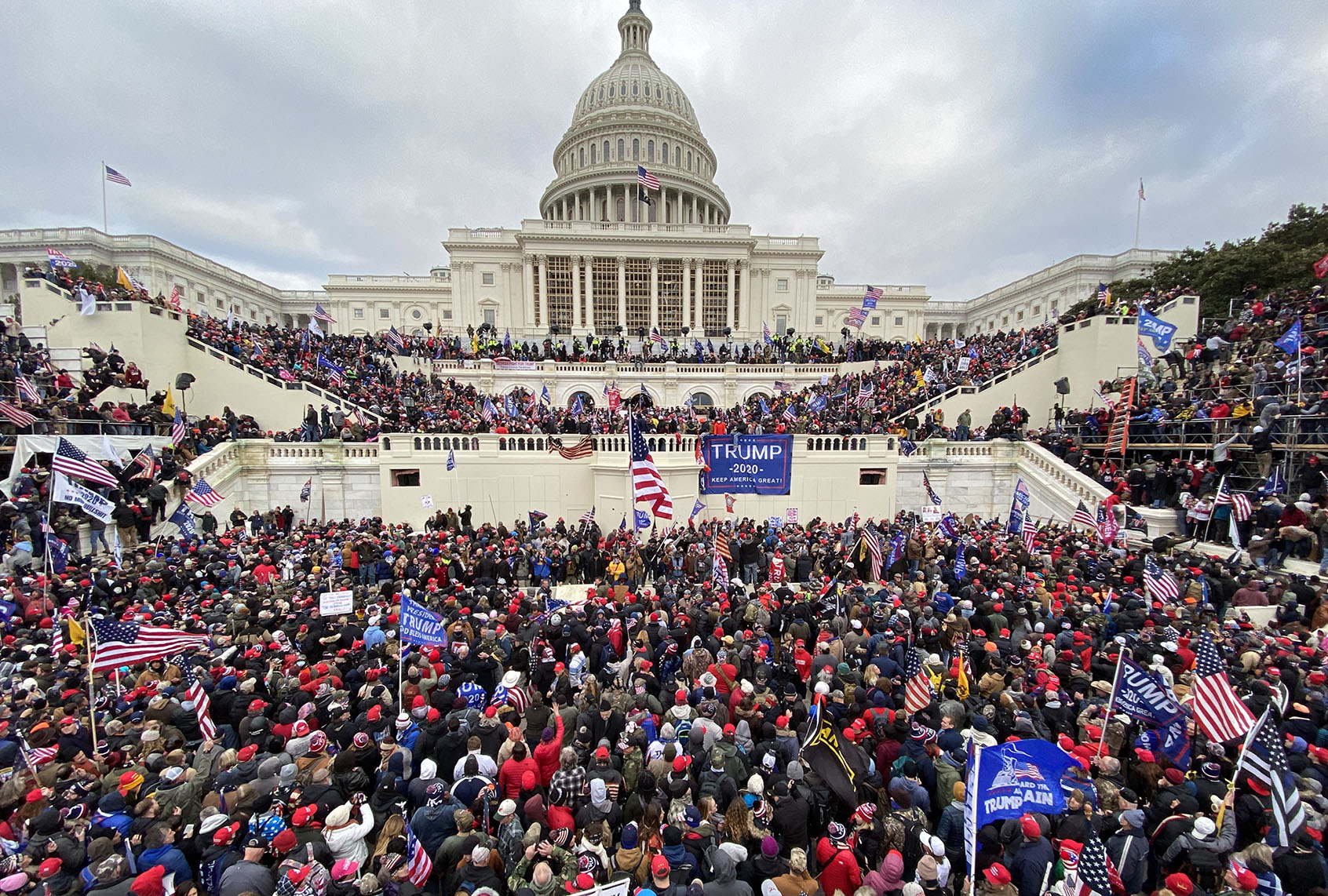

After a mob of President Donald Trump’s supporters stormed the Capitol on Jan. 6, 2021, it appeared the attack would result in a rare moment of reckoning in American politics — at least for a moment. Even hardline GOP politicians had distanced themselves from Trump, then President Joe Biden was in charge and Congress and the Department of Justice were investigating both the attack and the plot to overturn the 2020 election behind it.
Five years later, any accountability, political or legal, that Trump and his allies faced has been erased.
One of Trump’s first acts after assuming office in his second term was to pardon the nearly 1,600 people who had either already been convicted or were awaiting trial for crimes related to Jan. 6. Many of these people had prior criminal records including sexual assault and domestic violence, many were part of far-right organizations like the Proud Boys and many have been charged with additional, unrelated crimes following their release. None of them, however, will have to serve their sentences for storming the Capitol in an attempt to overturn the election results and allow Trump to cling to power.
Likewise, Trump has avoided both legal and political accountability. Trump has effectively excised any Republicans willing to stand up to his false claims that the election was stolen from the party. He easily won the GOP nomination for president in 2024, though he faced multiple prosecutions over the plot to overturn the 2020 election, the first coming in the form of his second impeachment, for which he was acquitted. He was later indicted in Georgia, in a state-level racketeering case and again in Washington D.C. on charges of defrauding the U.S. and obstructing an official proceeding. Both cases stalled out in court and were not tried before the 2024 election.
Since winning re-election, any chance of legal accountability for Trump or the rest of the people who crafted the plot to deny the election results has dissolved. Bennet Gershamn, a law professor at Pace University, said that in his opinion, delay tactics from Trump’s lawyers and his victory in the 2024 election are the primary reasons why Trump has been able to escape any legal consequences.
“Trump was able to escape prosecution because he was elected,” Gershman told Salon. “If you want to say that Merrick Garland dragged his feet a little bit, maybe. If you want to say that the prosecution’s investigation took a little bit more time, I don’t know. I was a prosecutor for a long time, and these investigations are very, very complicated … But at the end of the day, the indictments that were handed down were very strong indictments. The evidence was overwhelming.”
“It’s a sham. Trump is running the show.”
Gersham said that, as a result of the lack of legal accountability for Jan. 6 and Trump’s return to power, the current president has remade the federal legal system in his image, largely with the help of FBI director Kash Patel and U.S. Attorney General Pam Bondi.
“The federal attorney general and U.S. attorneys around the country, they’re all Trump’s MAGA loyalists and they’re doing Trump’s bidding,” Gershman said. “These are all Trump-appointed lawyers who are basically serving Trump. Anything Bondi does is directed by Trump. Everything Patel does is directed by Trump. So American justice, federal criminal justice, it’s a mockery. It’s a sham. Trump is running the show.”
For Gershman, the lack of legal consequences for Trump himself was in part because of the ability of Trump’s lawyers to delay, but also because of the lack of political accountability. According to Peter Loge, the director of the Project on Ethics in Political Communication at George Washington University, this all ties back to the stories that were told in the wake of Jan. 6.
We need your help to stay independent
In the immediate aftermath of the attack, it seemed as though it might end up being a watershed moment in American politics, akin to the assassination of President John F. Kennedy or the Sept. 11 terrorist attacks, in which the vast majority of Americans shared a traumatic experience. Even Sens. Mitch McConnell, R-Ky., and Linsey Graham, R-S.C., had indicated they were moving away from the Trump era.
This quickly collapsed, as conservatives propagated theories claiming that Jan. 6 was the result of negligence by then-House Speaker Nancy Pelosi, D-Ca., or that “antifa” or the FBI were in some way responsible for the mob of Trump supporters who attacked the Capitol.
According to Loge, the alternate histories of Jan. 6 demonstrate that just about anything will be metabolized by the American public roughly along partisan lines.
“If you tend to think that Donald Trump and his supporters are fundamentally anti-democratic and are an existential threat to democracy, you’ll see an event like January 6 as proving that. If you tend to distrust democratic institutions, if you tend to support Donald Trump and think the left is full of power-hungry whatever, then you put January 6 in the context of that explanation,” Loge said. “A big thing happens, and we make sense of it. We make sense of it in a way that fits what we already believe to be true. And by and large, the American people have done that with January 6.”
A series of surveys from CBS News and YouGov, for example, shows how opinion on Jan. 6 has softened among Republicans. The pollster found in January of 2021 that just 21% of respondents approved of the actions of the Jan. 6 mob, while 51% strongly disapproved. Another 28% somewhat disapproved. A survey from January 2024, however, found that 30% of respondents approved of the mob’s actions, while 40% somewhat disapproved and just 30% strongly disapproved.
At the same time that perspectives of the attack have become more positive, Republicans have latched onto conspiracy theories about the Capitol attack. For example, a 2024 survey from the Washington Post on the subject found that 34% of Republicans and 44% of Trump voters believed that it was either probably or definitely true that FBI operatives organized and encouraged the Jan. 6 attack. There is no evidence that the FBI had any role in the attack.
Chioma Chukwu, a nonpartisan government watchdog that has conducted investigations into Jan. 6, described this as the result of a campaign to create an alternative narrative around Jan. 6 among a segment of the public.
“In the aftermath of the attack, investigators conducted a rigorous, comprehensive inquiry into the assault on the capitol and the broader effort to overturn the 2020 election,” Chukwu said. “Instead of reckoning with those findings, powerful interests sought to discredit the investigation, punish the investigators, and rewrite history, substituting propaganda for evidence and denial for accountability.”
This is compounded by the fact that even if a conservative Republican neither feels positively about the events of that day, nor believes novel theories about Jan. 6, they’re still left with a choice about whether an event like this is enough to actually influence their choices at the ballot box.
“Now they’re going to go to the polls, 20, 22 months later, and they have a choice to make. They can either vote for somebody with whom they agree on policy most of the time, who is also attached to this one horrific event, or they can vote for somebody with whom they disagree most of the time, who is not attached to this one horrific event,” Loge said. “When it comes to political consequences, there just aren’t that many places for politics to go after January 6, apart from a primary, and even then, those are 15 months after the event.”
All of this stands in contrast to how other countries have handled similar events. The most straightforward comparison is to the Jan. 8, 2023, storming of federal government buildings in Brazil by supporters of former Brazilian President Jair Bolsonaro.
The story of the attack followed many of the same beats as the lead-up to Jan. 6. Bolsonaro lost an election, sought to undermine the results of that election, and it all came together in an ultimately unsuccessful attempt to overturn them.
The trajectories of the two plots to overturn an election diverged in the wake of the attack; however, with Brazil’s authorities obtaining a conviction of Bolsonaro in September 2025, less than three years after the attack. In contrast, three years after the Jan. 6 attack in the United States, Trump was busy dominating the Iowa caucuses.
Steven Levitsky, the director of the David Rockefeller Center for Latin American Studies at Harvard, told Salon that the difference comes down in large part to a difference in political culture between Brazil and the U.S. Specifically, Levitsky said, the U.S doesn’t have a history of responding to authoritarianism at home.
Start your day with essential news from Salon.
Sign up for our free morning newsletter, Crash Course.
“We just have very, very little experience with dealing with authoritarian threats, and it showed in the wake of January 6,” Levitsky said. “Bolsonaro wasn’t really held politically accountable, but he was held legally accountable. The [Brazilian] Supreme Court was very aggressive in, first of all, sidelining him from future political competition and then prosecuting him for the crime of trying to organize a coup, a serious legal offense in Brazil.”
In the U.S., the Supreme Court paved the way for Trump’s political return, helping to stall his legal cases and ensuring he would remain on ballots in the 2024 election. And, in the U.S., pundits and officials alike mused on whether prosecuting Trump for his efforts to deny the democratic results of an election would qualify the country as a “banana republic.”
Levitsky said, however, that holding executives accountable for attempting to take over the government isn’t something a “banana republic” would do — it’s in fact the opposite. For example, former South Korean President Yoon Suk Yeol is now on trial for a 2024 coup attempt.
“There are many, many other cases of democracy defending itself by aggressively prosecuting those who attack it, and the U.S. really stands apart in doing nothing,” Levitsky said.
Levitsky also pointed out that societies that fail to hold responsible people who attempt to orchestrate a coup have had negative repercussions in the past. He pointed to the February 6, 1934, right-wing anti-government protests in France, as an example.
“They really didn’t hold the right-wing politicians behind the event accountable, and French democracy continued to weaken and many of the participants and organizers behind the uprising attack on parliament in 1934 ended up in the Vichy government in France,” Levitsky said. “We’re not predicting that we are going to be overrun by Nazis, but democracies have to hold those who attack them accountable.”
Read more
about January 6, 2021
