

Over the past week or so, an idea that until very recently was only found among anguished liberals on the outer edges of social media has percolated into the mainstream: The international community must seize upon the upcoming World Cup 2026 tournament in North America — far and away the world’s largest sporting event — as an opportunity to resist Donald Trump’s authoritarian regime.
A Google News search for “World Cup boycott” yields more than a dozen articles published since the killing of Alex Pretti in Minneapolis, in such mainstream outlets as the New York Times, the Washington Post, CNN, the Guardian, Politico and the Los Angeles Times, along with a range of left-leaning and foreign-language publications. Most cite the same limited set of evidence: a public petition in the Netherlands, comments by a single German soccer exec (a noted renegade), headline-grabbing statements by a left-wing legislator in France and a right-wing member of the British Parliament.
Almost none of these articles assert that any such boycott of this gargantuan marketing spectacle and television event — whether by national teams, individual players, large numbers of traveling fans or the world at large — is likely to happen, absent a major new international crisis. (By Saturday afternoon, Germany’s soccer federation had made clear that Die Mannschaft, as its treasured national team is known, would show up in North America as scheduled.) But I’m less interested in debunking this manufactured news moment — or collective act of wish-casting, or whatever it is — than in exploring why it has seized many people’s attention around the world.
On one level, the answer isn’t complicated. Under the second Trump presidency, world opinion has swung even more dramatically against the United States — a process that has unfolded over the last several decades, if we’re being honest, and that Trump accelerated but did not create. At the same time, the institutional crisis so visible in American politics is also global in scale: At home, Congress and the Supreme Court are powerless or supine, but the European Union, the U.N. and the various alphabet organizations of so-called world governance appear indecisive and internally compromised.
Vladimir Putin gambled that no one would have the spine or resolve or willingness to stop him from conquering much of Ukraine, and he was right. Trump gambled that no one would stop him from the wholesale destruction of democratic norms and a paramilitary assault on his own cities, and he was right about that too. Many millions of people in many different places are eager to believe that someone, somewhere, is ready to push back forcefully in the name of human rights and democracy, or at least basic human decency.
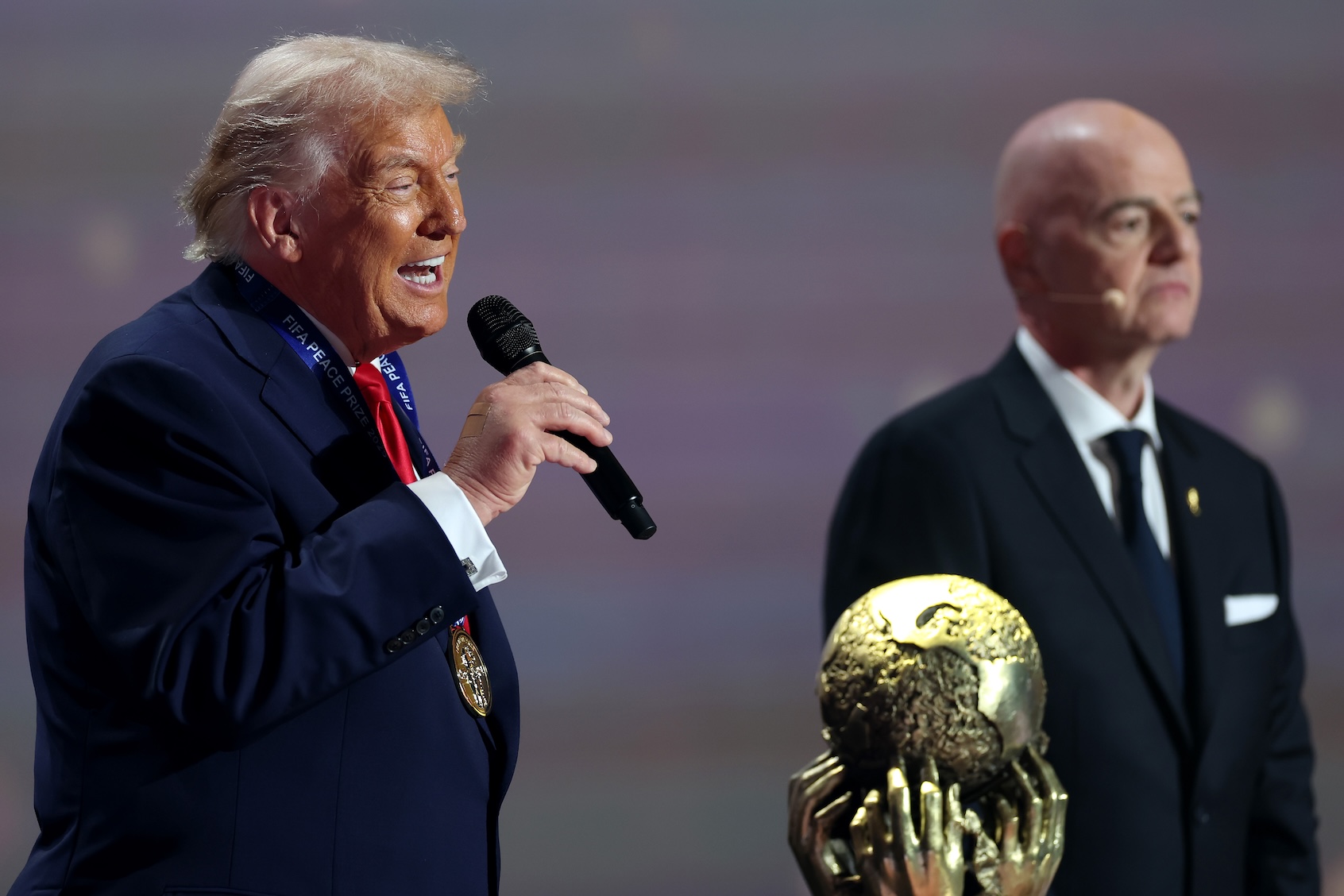
But the sports world, and world soccer in particular, is a hilariously bad place to look. Virtually all the boycott scenarios I’ve encountered to date are no more than world-affairs fanfics, and those who propose them already know that. In the most ambitious and least plausible boycott fantasies, the U.S. will somehow be canceled as host nation, only weeks before the tournament’s mid-June kickoff. No one has tried to explain how that might happen, in institutional terms, and for good reason. It would require an emergency leadership at FIFA, the governing body of world soccer, which brings us to the unhappy fact that FIFA president Gianni Infantino is the same shameless suck-up who recently invented a “peace prize” specifically to award it to Trump. (Which even Trump, a master of fakery, clearly understood was fake.)
In the most ambitious boycott fantasies, the U.S. will somehow be canceled as host nation, only weeks before the tournament’s kickoff. No one has tried to explain exactly how that might happen, and for good reason.
Given that, there’s no point even trying to address the next obstacle, that being the logistical nightmare of rescheduling and moving all World Cup matches now scheduled for U.S. venues (i.e., most of them) to a handful of available stadiums in Canada and Mexico, the tournament’s co-hosts. We also don’t need to ask whether Canadian Prime Minister Mark Carney and Mexican President Claudia Sheinbaum are eager to provoke the unpredictable colossus on their doorstep by pushing their already troubled relationship with TrumpLandia deep into Cold War territory.
Other proposals to weaponize the World Cup against Trump are less overtly fanciful, but ultimately they all rely on extensive amounts of hand-wavium and “wouldn’t this be cool.” More specifically, they require the conjuring of an alternate universe in which FIFA and the major soccer nations a) care more about principles than about their $30 billion-plus global showcase event — the previous two tournaments were in Qatar and Russia, for Christ’s sake! — and b) are willing to antagonize the world’s sole economic superpower, which despite its current national psychotic episode remains an enormous growth market for the sport.
We need your help to stay independent
Consider the boycott scenario floated by Elie Mystal, the Nation’s customarily admirable and useful columnist on justice issues, which begins with fiery won’t-back-down rhetoric — this year’s tournament, he writes, offers “a perfect opportunity for the world to stand against this country’s fascist regime” — before gradually evaporating into nothingness.
FIFA is hopelessly corrupt, Mystal admits, and will do nothing. Western Europe’s big soccer nations may make feeble noises of protest but are still too scared of Trump. So in other words, not happening, right? Not quite, he suggests! A few Latin American teams might be willing to stage a total or partial boycott, perhaps by agreeing to play their matches in Canada or Mexico but not the U.S. (A total non-starter: See my note above re “logistical nightmare.”)
Short of nuclear war (and possibly not even then, depending on where and when that happens) there’s no imaginable circumstance in which Brazil would willingly miss out on the World Cup.
Mystal is right, of course, that the Trump regime poses “a clear and present danger” to visitors from pretty much anywhere in the global South, along with U.S. citizens and legal residents who support those teams. But hang on: One nation he proposes as a potential boycotter is Brazil, the sport’s dominant superpower and five-time World Cup champion. If you know literally anything about world soccer, you know that futebol is more important in Brazil than any possible combination of religion and politics. Short of nuclear war (and possibly not even then, depending on where and when that happens), there’s no imaginable circumstance in which Brazilians would willingly miss out on the World Cup.
It would be ludicrous to claim that sports is independent of politics, but it’s equally ludicrous to pretend that the politics of FIFA and the World Cup haven’t already been compromised beyond repair. Those who cite events of the distant past, such as the U.S.-led boycott of the 1980 Moscow Olympics, may be deliberately missing the point. In the rearview mirror, almost nobody thinks that was a good idea, for either athletics or international relations: It nearly destroyed the U.S. Olympic Committee at the time, damaged the careers of hundreds of amateur athletes and did nothing to end the Soviet occupation of Afghanistan.
Want more sharp takes on politics? Sign up for our free newsletter, Standing Room Only by Amanda Marcotte, also a weekly show on YouTube or wherever you get your podcasts.
It’s true that, much more recently, Russian teams have been barred from most international competitions since the Ukraine invasion, and Israeli teams have been compelled to compete entirely away from home since the Gaza war began. If FIFA had the cojones to make the U.S. team play its home games in Canada — I mean, there’s no way in hell, but I’d admire that.
That won’t happen, and no other organized boycott of World Cup 2026 will happen either — unless, as hinted at above, Donald Trump does something unbelievably stupid to raise the stakes in the meantime. (I suspect someone may have patiently explained to him that seizing Greenland by force would provoke exactly such a crisis.) Still, perhaps all this energy expended on creating a fictional narrative of global solidarity has not been wasted.
Along with our Mexican and Canadian neighbors and the rest of the world, Americans are right to feel conflicted about the grandiose sports-marketing spectacle that will unfold on our continent this summer, amid uniquely unpleasant circumstances. How could we not? The World Cup is fantastic; it’s also a godawful disaster. I won’t pretend I won’t be watching, and hoping for something more than some dazzling play and cleverly crafted beer ads. Will it be peaceful? Will there be a few effective moments of protest? I certainly hope so. The would-be boycotters are challenging us to imagine something more, to glimpse the possibility of a better world and then to make it happen. It’s almost too much to hope for.
Read more
from Andrew O’Hehir
