
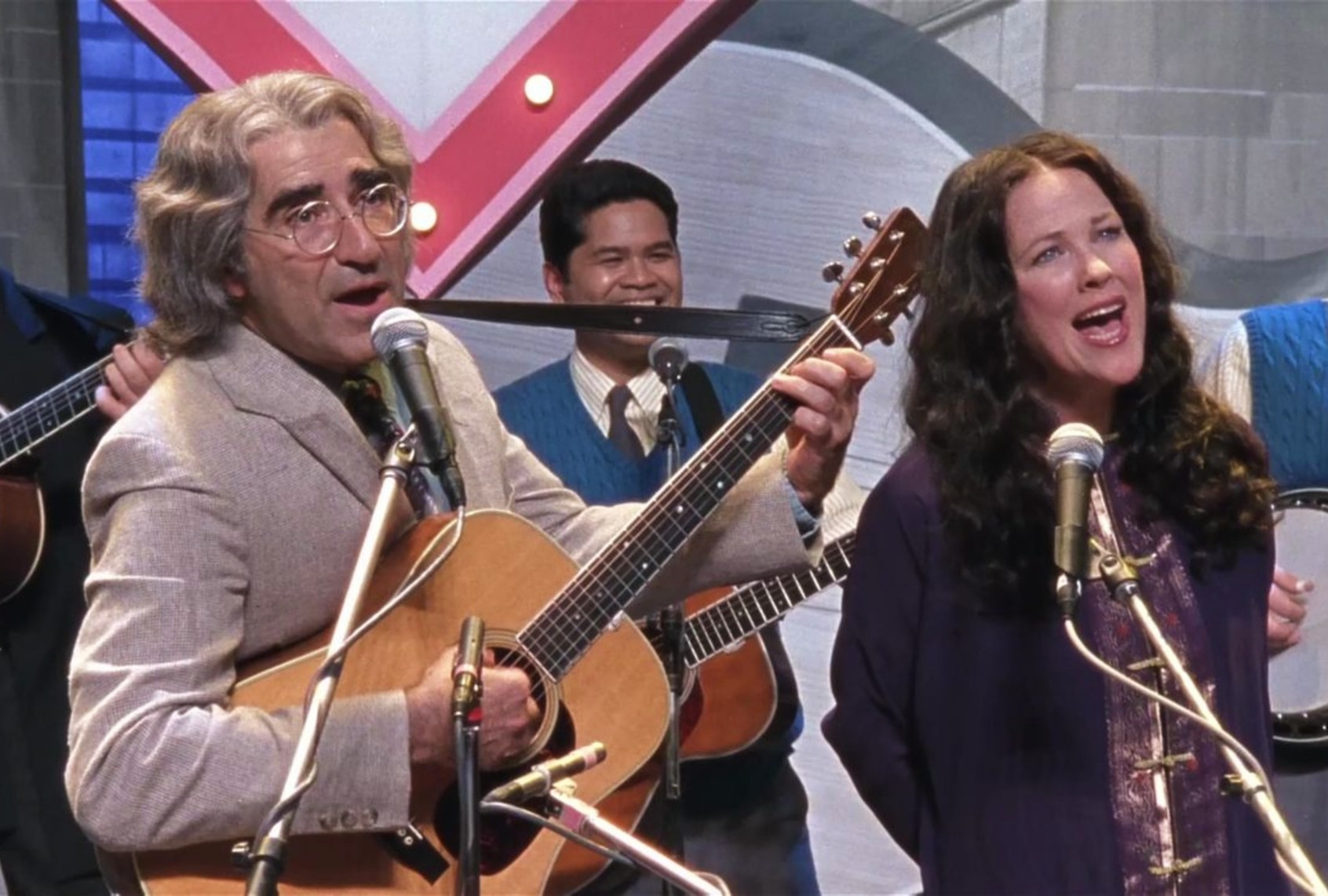

What happens when someone’s life’s work suddenly becomes their legacy? That’s the question Christopher Guest ponders in “A Mighty Wind,” the writer-director’s third film in his series of beloved fake documentaries — Guest hates the term “mockumentary” — when legendary fictional folk music producer Irving Steinbloom dies, leaving decades of influence in his wake. As the ripples of Irving’s death extend across the country, they eventually reach his three most famous folk acts: The New Main Street Singers, The Folksmen and Mitch & Mickey. Despite their distance and grudges, all three bands agree to put their differences aside for a special live memorial concert in tribute to Irving.
The abrupt shift from life to legacy is also what admirers of Catherine O’Hara, one of the best-known and perpetually quotable players in Guest’s troupe, are trying to make sense of after O’Hara’s death last week at the age of 71. The world-renowned Canadian comic actor was the shining star and scene-stealer of every film and television show she was cast in. O’Hara had a preternatural gift. It wasn’t just her sharp comic timing and knack for uniquely memorable character work that made her stand out, but her undeniably affable presence. When O’Hara is on screen, it’s impossible to avert your gaze. She knew how to vamp like no other, using facial expressions and body language like building blocks to create everyone’s favorite characters. And although O’Hara’s work in Guest’s films may not glow with the same festive nostalgia as Kevin McCallister’s harried mother in “Home Alone,” or have the immediate punchy humor of the hilariously out-of-touch Moira Rose in “Schitt’s Creek,” these films concisely spotlight the singularity of O’Hara’s talent.
As Mickey contends with her legacy throughout the film, O’Hara further shapes her own, creating one of the most tender and surprisingly touching characters of her indelible career.
Like all of Guest’s fake documentaries — including other zeitgeist staples like “Best in Show” and “Waiting for Guffman” — “A Mighty Wind” is largely improvised. The film is constructed around an overarching narrative, but merely outlined from scene to scene, allowing actors to play with their characters and adjust their delivery and dialogue in real time. Improvisation is the key to impressing the audience; if the actor only has an idea of what will happen when the camera rolls, the viewer is even less likely to expect whatever jokes fly out of their mouth. Giving actors the freedom to have fun is what makes Guest’s films so hysterical.
But “A Mighty Wind” is special. Unlike most of Guest’s fake documentaries, which sink deep into the microcosmic worlds they parody, the film is far more character-focused. It’s not just about folk music; it’s about the artists — the people, really — who make it. With Mickey Crabbe, the autoharp-strumming, sentimental second half of Mitch & Mickey, O’Hara moved further away from physical comedy than she did in any of Guest’s other films. Though Mickey is still hilariously oblivious, she’s also more soft-spoken and self-assured than any of O’Hara’s roles in Guest’s previous films, drawing a firm line between the two facets of her character that O’Hara walks with astonishing ease. It’s a marvel to watch. And as Mickey contends with her legacy throughout the film, O’Hara further shapes her own, creating one of the most tender and surprisingly touching characters of her indelible career.
Guest wastes no time in his films establishing where all the moving parts will converge. And with “A Mighty Wind,” viewers quickly come to expect that Irving’s memorial concert will be the movie’s grand finale. But what’s most fun is watching each character’s individual road to that final point, and what they’ll learn about themselves along the way.
As happy as Mickey is to take part in the memorial, she’s just as worried that Mitch (Eugene Levy) won’t return with her. “I’d like to think that Mitch would agree to do this with me . . . because I already said yes and I can’t do it alone,” Mickey tells the camera crew interviewing her in her living room. Recalling fond memories of hit albums and runaway successes, she pauses and laments, looking off into the distance. “No, I didn’t think this through. Should’ve talked to him beforehand.” As the studio engineer behind the duo’s final album remembers, Mitch and Mickey squabbled left and right, until one recording session where Mickey started lobbing objects at her partner, causing Mitch to snap. The pair split up soon after, and Mitch went the mopey Bob Dylan route with his first solo album, “Cry For Help,” which contained the ill-performing, telling singles, “If I Had a Gun” and “May She Rot in Hell.”
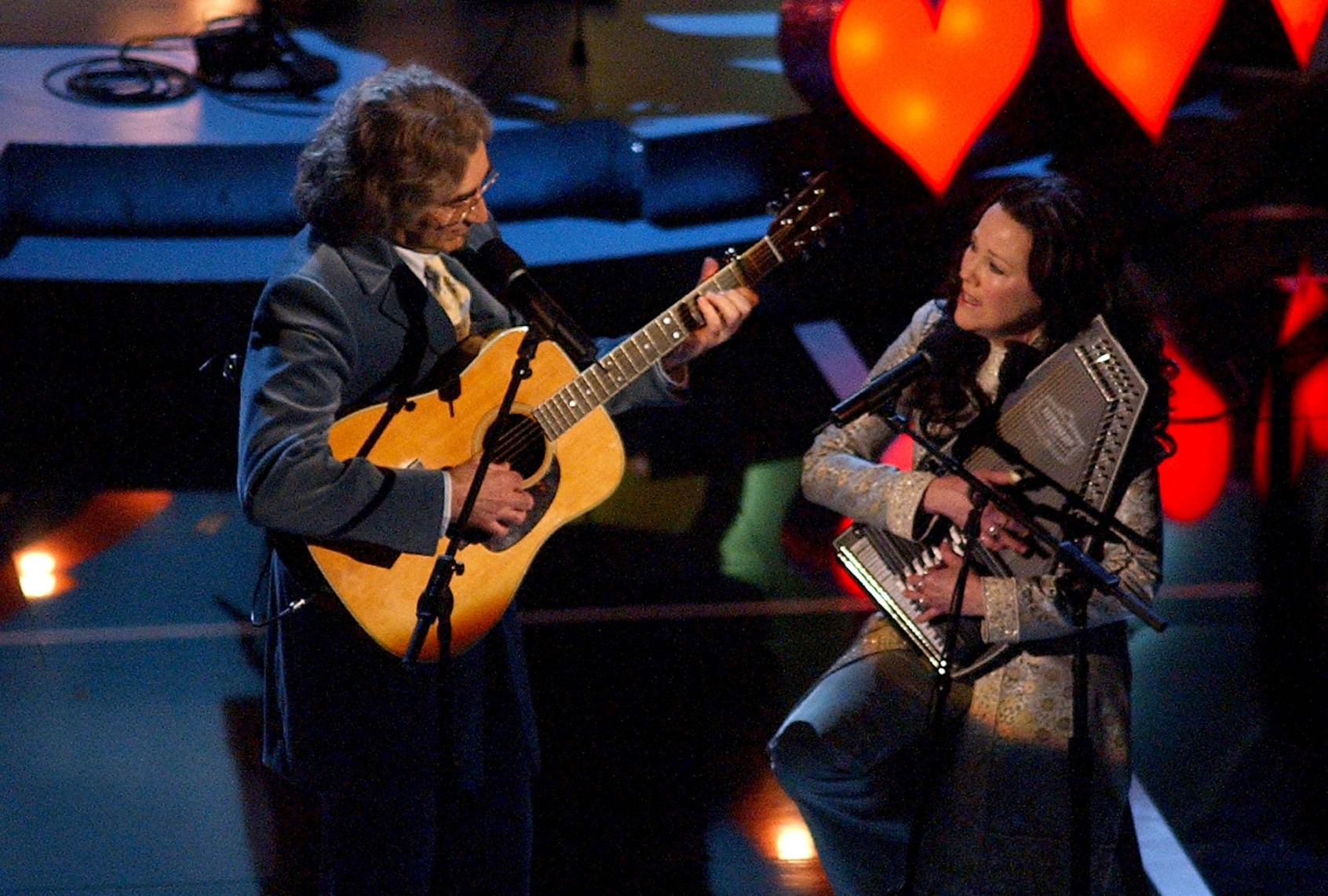
( M. Caulfield/WireImage/Getty Images) Eugene Levy and Catherine O’Hara perform “A Kiss at the End of the Rainbow” from “A Mighty Wind” at the 76th Annual Academy Awards
But time heals all wounds, and after some convincing by Irving’s son, Jonathan (Bob Balaban), Mitch agrees to do the concert, spending the two short weeks leading up to the show at a motel near Mickey’s home. When the two meet again, the remnants of their love fall out from between the cracks. Mickey details the night she met Mitch, when he tried to beat up a man heckling her onstage while she performed alongside her sisters. Frail and little as he was, Mitch wound up in the hospital with his jaw wired shut, only to wake up with a single rose sitting in a vase on his bedside table — an emblem of gratitude and affection from Mickey that would tie the two together forever.
O’Hara and Levy are a perfect pairing, bouncing “yes ands” off each other like the comic professionals and old friends they are. Their rapport is no secret, given that the two spent years performing alongside one another on the Canadian sketch show “SCTV” before continuing their collaboration in Guest’s films, and later in “Schitt’s Creek.” And though Mitch and Mickey fall into the duo’s typical husband-and-wife dynamic, Levy and O’Hara are also subtly commenting on their years of experience creating together and how chemistry evolves when an artistic relationship turns into a real friendship. As “A Mighty Wind” progresses, what Mitch and Mickey’s relationship will look like after the concert ends becomes the film’s binding question, made all the more pressing by the inevitable concert rendition of their hit song, “A Kiss at the End of the Rainbow.” In every live performance during their heyday, the pair ended the song by leaning in for a kiss, making audiences go wild. “We were easy to love because, in a way, we represented true love and romance,” Mickey says.
Being funny — truly, naturally funny — isn’t just about delivering a punchline well or being quick-witted. It’s about knowing how to read the room and the energy in it, about seeing the people around you for who they are; it’s about what people are saying and what they’re not saying. Most importantly, it’s about listening, and O’Hara listens like no other.
Guest relegates the film’s biggest comic moments to the New Main Street Singers and the Folksmen as they prepare their two-song sets, leaving O’Hara and Levy to craft a character history that is just as funny, yet much more poignant. In the final days before the concert, Mitch and Mickey hold a record signing that results in a line out the door and around the block. The success of the record signing leads the pair to reminisce on their glory days. Wondering if there might still be some spark left in their act, Mitch recalls the rush of adrenaline from the cheering fans as they walked onstage. “For me, the best part was just watching you,” Mickey adds. “I look forward to that, Mitch. I’ll be there in the best seat in the house.” The two, once reluctant to look at one another, catch each other’s eyes and hold a smile before Guest cuts.
In this scene, O’Hara gives it all away. Being funny — truly, naturally funny — isn’t just about delivering a punchline well or being quick-witted. It’s about knowing how to read the room and the energy in it, about seeing the people around you for who they are; it’s about what people are saying and what they’re not saying. Most importantly, it’s about listening, and O’Hara listens like no other. Here, she pulls back, letting Levy embody his character and work his way toward the jokes with complete patience. She forms an idea with one of Levy’s sentences, holds onto it, and adjusts it depending on what he says next. You can see the improvisational cogs turning in real time. It’s extraordinary to witness, and it enhances the power of O’Hara’s softer, emotional beats tenfold.
Want more from culture than just the latest trend? The Swell highlights art made to last.
Sign up here
On the night of the concert, everything leads up to the fated Mitch & Mickey performance. And when Mitch leaves the building and ambles out into the New York City streets, it looks as though their number won’t happen. Right when things seem dire, Mitch returns with a single rose, a gift for Mickey, harkening back to the one she brought him in the hospital all those years ago. Moments later, the duo finally takes the stage to perform “A Kiss at the End of the Rainbow.” The rendition is breathtaking, and it’s difficult to hold back tears just hearing O’Hara’s lovely singing voice, something that she never quite got the proper credit for, despite the song being nominated for an Oscar the following year. As the tune approaches its last bars, the Folksmen and New Main Street Singers rush to the side stage to watch, curious to see what will happen. And just before the song’s final line, Mitch and Mickey share one last kiss.
But this is just one night. All of the romance and wistfulness of the concert can’t undo years of heartbreak and resentment. Still, things are different for both Mitch and Mickey. Mitch returns to seclusion but is finally able to write poetry again. Mickey has regained her love of performing, even if it’s at medical supplies trade shows. The kiss might not have rekindled their relationship, but it gave them something more. It was a symbol of forgiveness, of everlasting love, of all of the things we wish that we could change that we cannot. The kiss was the bookend to an era that lingered for years without closure. And by kissing one final time, Mitch and Mickey convey to their adoring public that, though things may change with time, our appreciation for one another doesn’t have to.
We need your help to stay independent.
Early in “A Mighty Wind,” a folk music historian calls Mitch and Mickey’s first kiss “a superb moment in folk music, and maybe a great moment in the history of humans.” That reading, though fictional and maybe even improvised, is just as much about Mitch and Mickey as it is about the people who loved their work. More broadly, it’s an observation about how art affects its audience, and how the emotional connection conjured by something pure, simple and honest can last forever.
Trying to reconcile the death of someone like O’Hara, whose work is so prolific, I keep returning to Mickey, and what she’s come to represent — at least to me. There’s no other character in O’Hara’s venerable career who quite so deftly captures the quiet hope that, when we go, we’ll leave some legacy behind. And yet, O’Hara has so many incredible roles to cherish. Ask anyone, and they’re likely to tell you a favorite O’Hara character that’s different from the last. Maybe that’s an artist’s great gift, to give the world as many things to treasure as possible, and to do it with the total earnestness that O’Hara brought not only to Mickey Crabbe, but to everything she did.
Read more
about Catherine O’Hara’s memorable roles
