
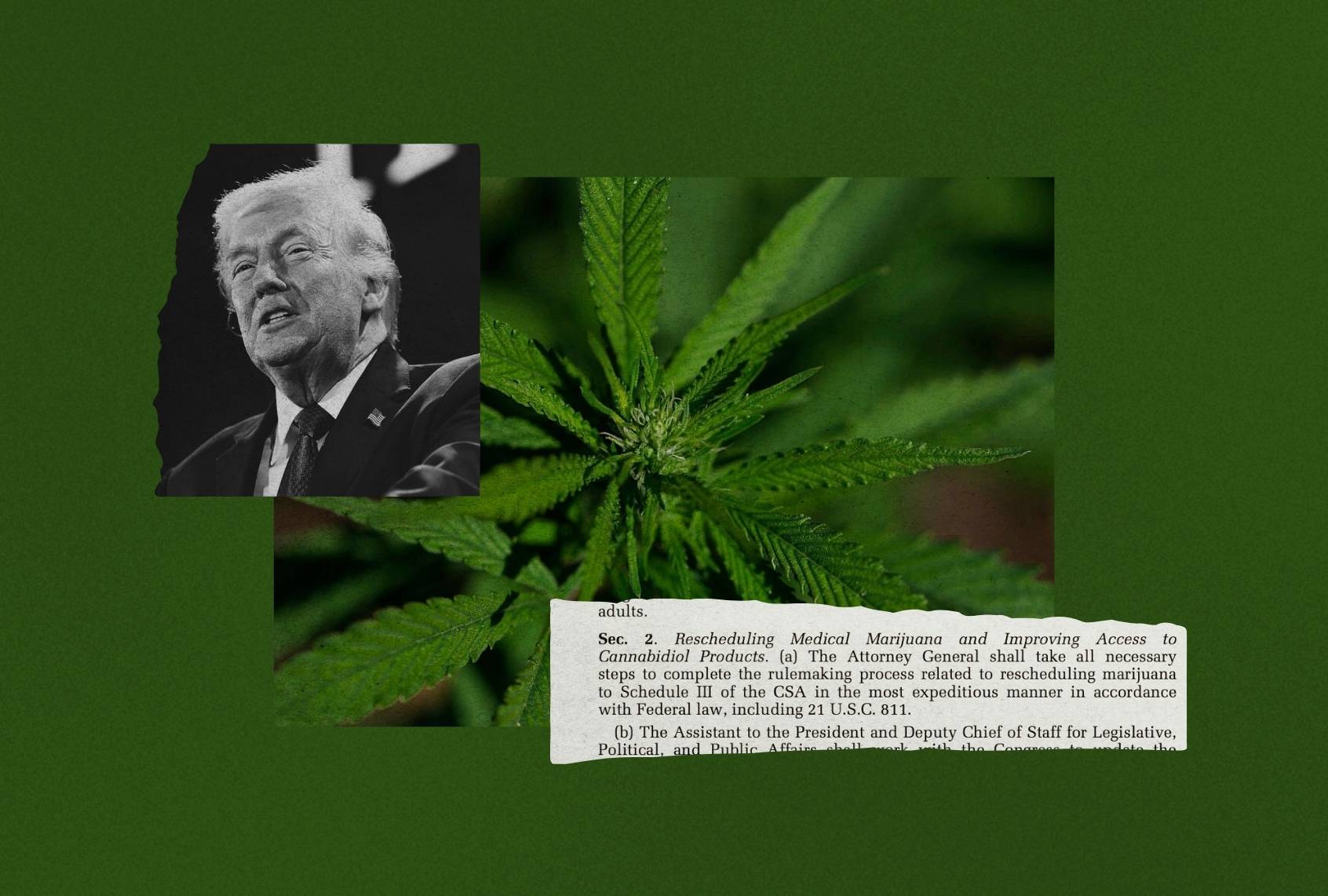

In December, President Donald Trump directed the Department of Justice to fast-track the rescheduling of cannabis, a move that could open doors for research and cut red tape for businesses and consumers. Now the move is looking more like a public relations play than anything else, with opponents within the administration and the conservative movement gearing up for a fight as advocates for rescheduling say they expect it to take years — or decades — to resolve.
Under the Controlled Substances Act, enacted by former President Richard Nixon, drugs are sorted into five different categories or schedules based, at least theoretically, on the risk they pose for harm or addictiveness versus their potential for medical use. Schedule I drugs are the most tightly controlled and allegedly dangerous substances, including heroin, LSD and marijuana, whereas Schedule V drugs like Lyrica are seen as less harmful in the eyes of the government.
As it stands, marijuana extracts from the cannabis plant are lumped into Schedule I, which makes it incredibly complicated and expensive to study the drug and adds all sorts of other restrictions, such as preventing banks from working with cannabis companies. However, on December 18, Trump ordered that “The Attorney General shall take all necessary steps to complete the rulemaking process related to rescheduling marijuana to Schedule III of the CSA in the most expeditious manner.” This would, in theory, remove much of the red tape surrounding a plant-based drug that is enjoyed by nearly 20 million Americans regularly in states that have repealed anti-cannabis laws, conflicting with federal law.
The order drew headlines at a moment when Trump was escalating a military conflict with Venezuela and facing a fast-approaching deadline for the release of the Epstein files related to convicted sex offender Jeffrey Epstein, in which the president was named thousands of times. Now, however, it’s clear that, at least when it comes to this order, language like “most expeditious manner,” doesn’t necessarily mean that anything is changing anytime soon.
Paul Armentano, the deputy director of the National Organization for the Reform of Marijuana Laws (NORML), a cannabis legal advocacy group, told Salon that he expects rescheduling to take years, or longer.
“If parties want to drag this process out, the mechanisms exist within the administrative process that allow them to do so nearly indefinitely.”
“I’ve been on the record for the last three years or so, making it very clear that this is designed to be a very long and drawn-out process,” Armentano said. “When you look back historically at previous rescheduling petitions, of which there have been numerous ones, they have all taken many years until they’ve reached their resolution. And in fact, the longest rescheduling petition, which was filed by NORML in 1972 was not resolved until 1994. So we’re talking a span of multiple decades from the initiation of that petition until its conclusion.”
Almost immediately after marijuana was made illegal, people have pushed for the repeal of these laws, arguing that cannabis-based drugs are far safer and less addictive than alcohol and tobacco, which are not scheduled at all. With the exception of 24 states that have loosened cannabis laws for recreational use, federal law has remained relatively rigid on weed. The current rescheduling push dates back to October of 2022, when former President Joe Biden directed the Department of Health and Human Services to reexamine cannabis’s scheduling status. The government is currently in the middle of the formal rulemaking process, which is handled both by the Drug Enforcement Administration and HHS.
Part of the reason that the rulemaking process takes so long, Armentano explained, is that it’s designed to take an indefinite amount of time, at least if concerned parties, whether they be inside or outside the government, have the will and resources to force it to.
“If parties want to drag this process out, the mechanisms exist within the administrative process that allow them to do so nearly indefinitely,” Armentano said. “Again, that’s not a bug. That’s the way the process was designed.”
We need your help to stay independent
Inside the administration, the move has enemies like Attorney General Pam Bondi, a long-time opponent of cannabis reform and supporter of continued criminalization, who is charged with overseeing the process. As recently as the first Trump administration, when Bondi was still a Florida attorney general, she sat on an opioid crisis board that argued both that cannabis was a gateway drug to opioids and that cannabis use in the 2010s was akin to opioid use in the early 2000s, a problem waiting to explode. The evidence for cannabis as a gateway drug is poor to nonexistent, due to research barriers, including its Schedule I status.
Congressional Republicans are also pushing to keep cannabis on Schedule I, with Sen. James Lankform R-Okla., and Sen. Tedd Budd, R-N.C., attempting, albeit unsuccessfully, to slip language into a 2026 funding bill that would strip the executive branch of the power to reschedule cannabis specifically.
Former allies of Trump are also gearing up for a prolonged legal battle, with the president’s former Attorney General Bill Barr joining the legal team of one of the leading anti-cannabis groups, Smart Approaches to Marijuana, which has supported the continued criminalization of cannabis since 2013.
Notably, cannabis arrests still make up the bulk of all arrests related to drugs, with more than 200,000 people arrested nationwide in 2024, mostly for possession. Even in some states that have legalized adult-use cannabis, like Illinois, cannabis arrests still make up about a third of all drug-related arrests.
Start your day with essential news from Salon.
Sign up for our free morning newsletter, Crash Course.
The focus on rescheduling, for those in the cannabis industry, also represents doubling down on a regulatory framework that doesn’t reflect the way that cannabis is used in the country, nor the risk it poses to users. And, it keeps barriers up to give corporations the upper hand in the industry.
“I don’t think rescheduling is the answer. I think descheduling is actually the answer. We just haven’t got there yet,” Corey Coleman, who co-founded Sky High Brands and founded the Iowa Hemp Coalition.
Coleman highlighted the arbitrary nature of cannabis and hemp regulation, two versions of the same plant but with differing intoxicating effects, subject to wildly different regulations. It’s all based on an arbitrary legal definition related to the potency of a specific THC compound in the dried flower of the plant, as an example of the byzantine rules in the industry, which can stand to benefit big business.
“I think it’s a step in the right direction. You know, the biggest fear with Schedule III then is, you know, it pushes things more towards Big Pharma or the major corporations, making it harder for the smaller business operators that actually started this industry,” Coleman said.
In response to a request for comment from Salon, a Justice Department official said “DOJ is working to identify the most expeditious means of executing the EO.”
Read more
about drug policy
