
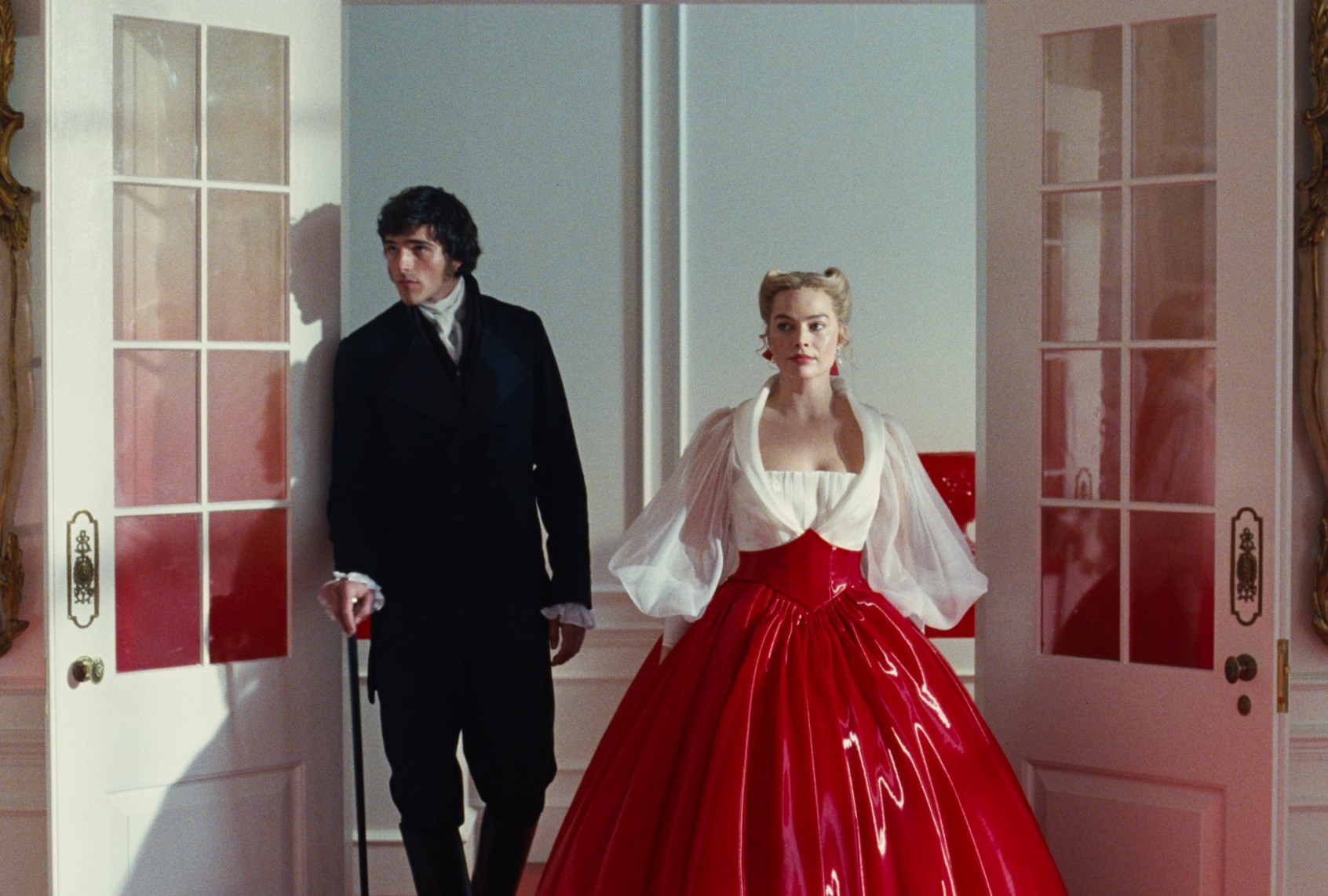

In the months leading up to Emerald Fennell’s adaptation of Emily Brontë’s beloved novel “Wuthering Heights,” one rumor about the writer-director’s new version of the classic story took hold among the public. Eagle-eyed viewers noticed that, in the film’s poster and its trailers, the title was bookended by quotation marks. Some theorized that it was merely an homage to vintage movie posters, pointing out that the posters depict the film’s two leads, Margot Robbie and Jacob Elordi, embracing in a “Gone with the Wind”-esque pose. Others speculated that, due to Fennell’s penchant for audience provocation, the quotation marks were an Easter egg indicating that her take on Brontë’s novel would be far from your great-great-grandmother’s “Wuthering Heights.” Before long, it became a common assumption among the chronically online that Fennell’s version would reveal itself to be from the point of view of a woman — perhaps Victorian, perhaps in another era altogether — reading the book for the first time, its twisted love story playing out in her head and onto the silver screen.
Done correctly, this could be brilliant — a completely fresh and unexpected way to adapt an oft-remade story. But as it turns out, these theories were little more than unfounded speculation from hesitant viewers looking to make sense of the over-the-top visual landscape of Fennell’s film. In an interview ahead of the film’s release, Fennell explained the quotation marks as a way to distance her version from Brontë’s, saying, “I can’t say I’m making [the definitive] ‘Wuthering Heights,’ it’s not possible. What I can say is I’m making a version of it. There’s a version that I remembered reading that isn’t quite real. And there’s a version that I wanted stuff to happen that never happened. And, so, it is ‘Wuthering Heights,’ and it isn’t.”
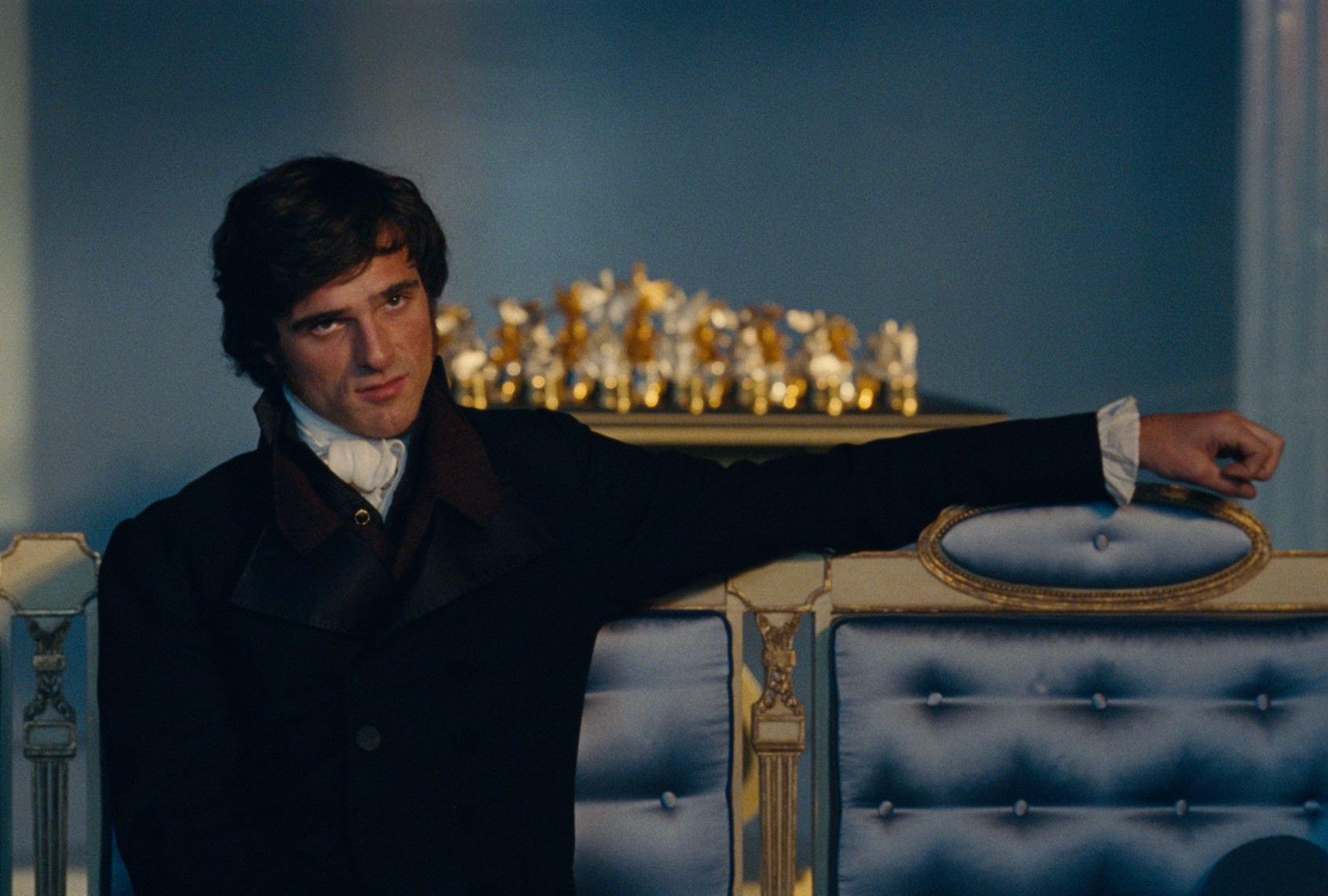
(Warner Bros. Pictures.) Jacob Elordi as Heathcliff in “Wuthering Heights”
By rebuking irony entirely to commit to that vision, Fennell’s film brings Brontë’s novel to life in a way that few book-to-screen adaptations dare to do, reminding us that our fantastical idea of a book can be just as meaningful as the author’s.
Though the theory about the film’s narrative structure might not have played out exactly as many speculated, Fennell’s adaptation is all the better for it. Instead of a finale that reveals the film as a reader’s rendering, Fennell goes so far as to craft a highly visual world that still feels extravagant and imaginative, without the cheap cop out of a final twist. In that respect, her “Wuthering Heights” is a far more audacious and intriguing interpretation than viewers could’ve hoped for.
The film boldly contemplates the atmosphere of Brontë’s novel with both a straight face and a sense of humor. Its anachronisms are earnest and confident. Its deviations from the source material are digressions done with love. Fennell’s “Wuthering Heights” is a soaring, achingly romantic tribute to the rapturous feeling of reading a great book, tearing through every page in a single afternoon. And by rebuking irony entirely to commit to that vision, Fennell’s film brings Brontë’s novel to life in a way that few book-to-screen adaptations dare to do, reminding us that our fantastical idea of a book can be just as meaningful as the author’s.
From the film’s opening sequence, Fennell delights in subverting expectations. She’s keenly aware that her first two films, “Promising Young Woman” and “Saltburn,” were received with as much shock as they were revulsion. Even Tina Fey has joked about Fennell’s fondness for sudden depravity. Knowing that viewers anticipate both sexual intensity and a load of British debauchery — as well as a potentially offensive distortion of their favorite novel — Fennell cleverly plays into the public’s perception of her work. “Wuthering Heights” begins with a slowly intensifying squeaking noise, bellowing out over a blank black frame. It sounds like the rhythmic pounding of an old mattress and bed frame, a trick to fool audiences into thinking it may be Cathy Earnshaw (Robbie) and her star-crossed paramour Heathcliff (Elordi) consummating their love before the film has even properly begun.
Really, this noise is the sound of a dying man hanging in the town square, his weight causing the wood of the gallows to creak while a young Cathy and her paid companion, Nelly (played as an adult by Hong Chau), look on in fear and awe. It’s a scene-setting moment for everything Fennell has planned, an introduction to her rendition of the story that reminds the viewer that, even if they think they know what’s coming when they turn the page, there’s no way to know for sure. There is no choice but to submit to the author (or, in this case, writer and director), immersing themselves in her vision, line by line, word for word.
Want more from culture than just the latest trend? The Swell highlights art made to last.
Sign up here
Those who have read or know the basic plot of Brontë’s novel — or even those who are more intimately familiar with the Kate Bush song of the same name — will quickly find that “Wuthering Heights” hits all of the integral plot beats necessary to adapt the book. Cathy befriends young Heathcliff after her rich, alcoholic father brings him to live and work as a servant on their estate perched atop the windy English moors. The two spend the years picking at each other while secretly growing fond of the other’s company, though never able to act on their feelings due to the difference in their social status. And, as an adult, Cathy marries her neighbor, Edgar Linton (Shazad Latif), whose ward, Isabella (a scene-stealing Alison Oliver), becomes both Cathy’s friend and an eventual part of her undoing when Heathcliff returns with a mysterious new fortune.
Fennell’s images may be literal, sure, but they’re exactly how our minds translate prose and written descriptions into something vivid enough to build an entire world, something every author trusts their readers to do within the confines of a story.
As Fennell trots along Brontë’s tentpoles, she dusts the narrative between these plot points with sensational set pieces and eye-popping costumes. Though staunch Brontë loyalists are bound to be up in arms about these larger-than-life details, Fennell’s rich stylistic elements are what differentiate this “Wuthering Heights” from the countless others that are far more faithful to the book, and thus, much more predictable and trite. Fennell’s eye for image-making is her greatest directorial strength; it’s what keeps her films afloat even when their screenplays struggle to tread water. And here, each frame is a sumptuous feast of texture, light and color — like a swath of sweat-drenched tulle cast out onto the wind and into the fog.
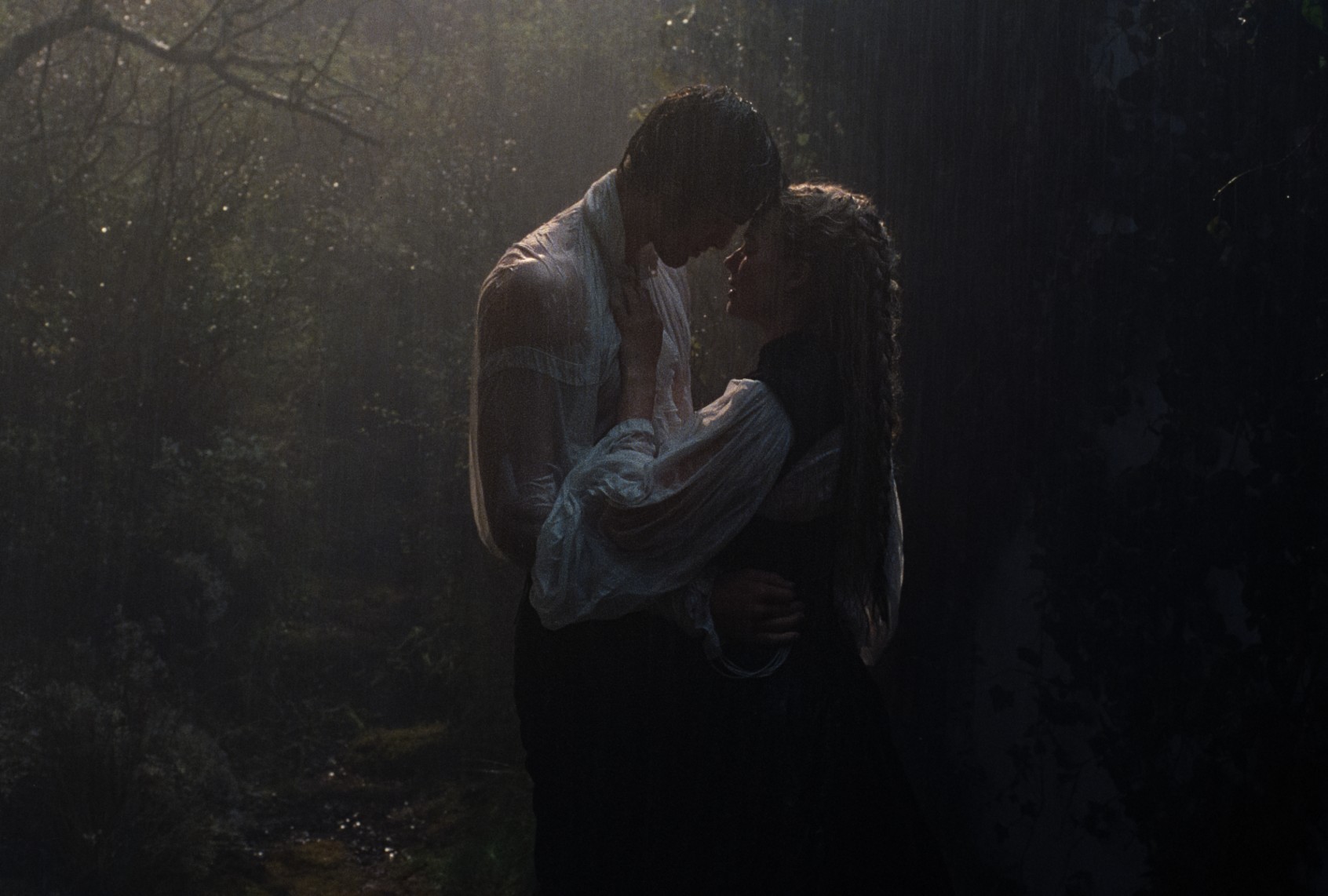
(Warner Bros. Pictures) Jacob Elordi as Heathcliff and Margot Robbie as Catherine Earnshaw in “Wuthering Heights”
But these breathtaking frames don’t appear out of thin air. Fennell is not merely playing fast and loose with her source material, as a skeptic might think; she’s lifting the evocative images of Brontë’s prose and envisioning them as one might when reading the novel. As Cathy and Isabella enjoy their time together, getting to know each other and indulging in delicious summer strawberries, the berries are as large as their heads, a treat to convey the sweetness of their relationship before it sours. Descriptions of Cathy’s fair skin are transmuted into a bedroom at the Linton estate, wrapped in fabric that isn’t just the pink of her flesh but also complete with subtle veins and moles, a reminder of how difficult it will be to leave her gilded cage once she accepts Edgar’s proposal. When her father dies of alcoholism, Cathy finds his body splayed out on the floor, in front of piles of empty gin bottles climbing up the wall so high that they touch the ceiling. These pictures may be literal, sure, but they’re exactly how our minds translate prose and written descriptions into something vivid enough to build an entire world, something every author trusts their readers to do within the confines of a story.
We need your help to stay independent
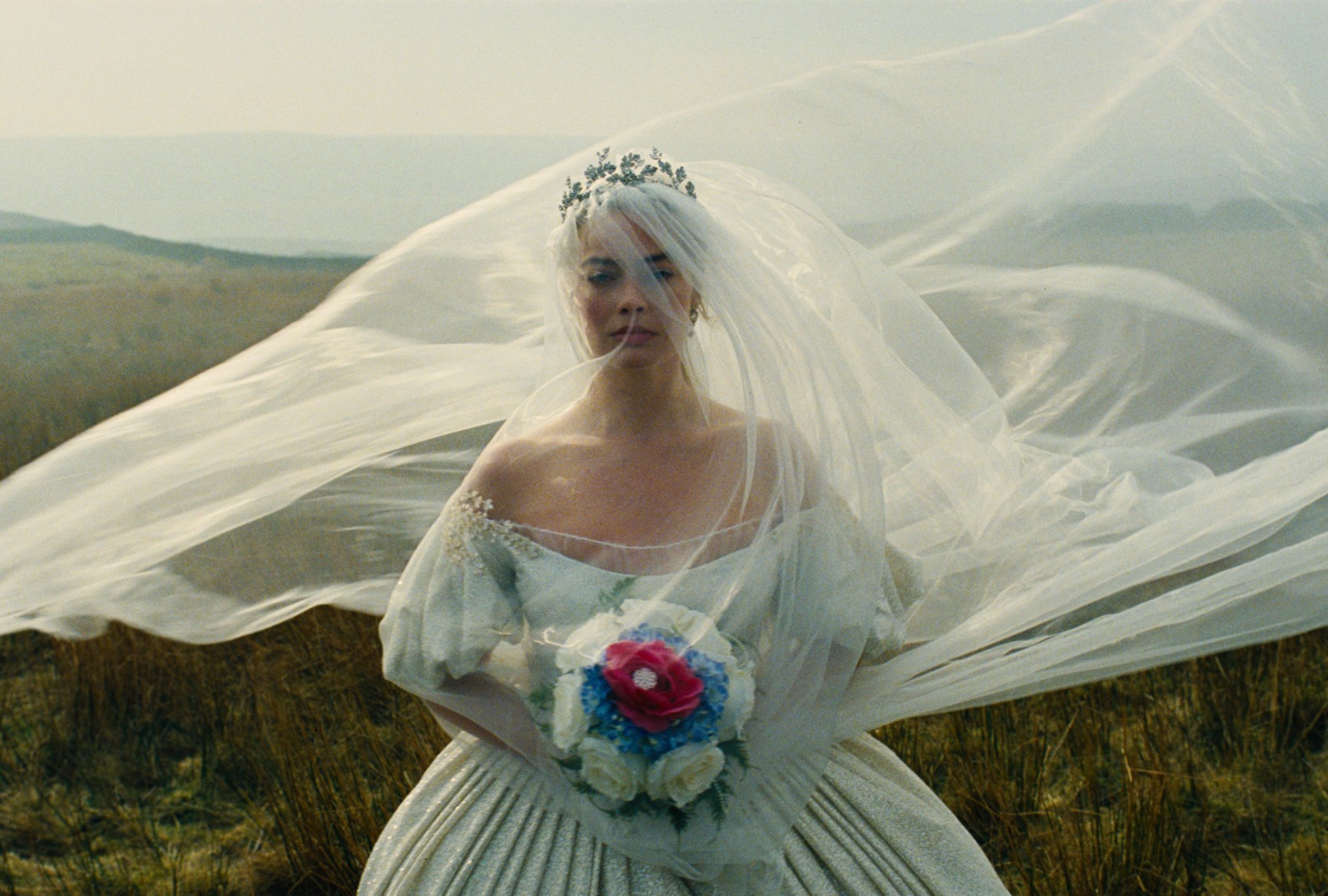
(Warner Bros. Pictures) Margot Robbie as Catherine Earnshaw in “Wuthering Heights”
One might argue that Fennell’s stunning images and the familiar emotions they convey are a happy accident, the result of millions of dollars and a director given carte blanche to play as she sees fit. But much like her previous two films, Fennell isn’t afraid to show her hand. When Cathy first meets Edgar and Isabella, she climbs the wall of their estate and spies on the two having tea in a courtyard, where Isabella is extolling Shakespeare’s “Romeo and Juliet.” As she repeats the plot to Edgar, Isabella is swept up by the love story’s drama and tragedy. She’s reiterating what she’s read with such fervor that she grips the book not like a story, but like a treasure. Shakespeare’s tale has moved her, changed her. And it’s this same story that becomes ruin and rebirth later in the film, as she seeks empty love and carnal pleasure from Heathcliff, inspired by the epic misfortune of a playwright’s greatest work.
Fennell might not be of the same level of Shakespeare — she’s far from it, as she’d surely admit. But much like Baz Luhrmann’s “Romeo + Juliet,” she’s not trying to retell this famous tale; she’s reimagining it as the outsized, grand spectacle it has become in both public consciousness and personal affection. Her “Wuthering Heights” is a great film because it doesn’t try to be anything more than a feeling, transmitted with the utmost sincerity and beauty. It’s that same feeling that’s so deeply impactful for the viewer, the one that will make them want to go straight from the movie theater to the bookstore. “Wuthering Heights” is a reminder of just how effective and everlasting a novel can be; of the places it can take us and the multitude of emotions it can make us feel. If love is a complicated, beautiful and grievous thing, so is Fennell’s “Wuthering Heights.” How very fitting that the habitually plugged-in crowd tried to make sense of those quotation marks surrounding Fennell’s title. Brontë’s book is completely divorced from modern technology. It lives and dies by how much it’s able to make the reader feel. And in her captivating interpretation, Fennell makes her viewers feel everything.
Read more
about romance movies
