
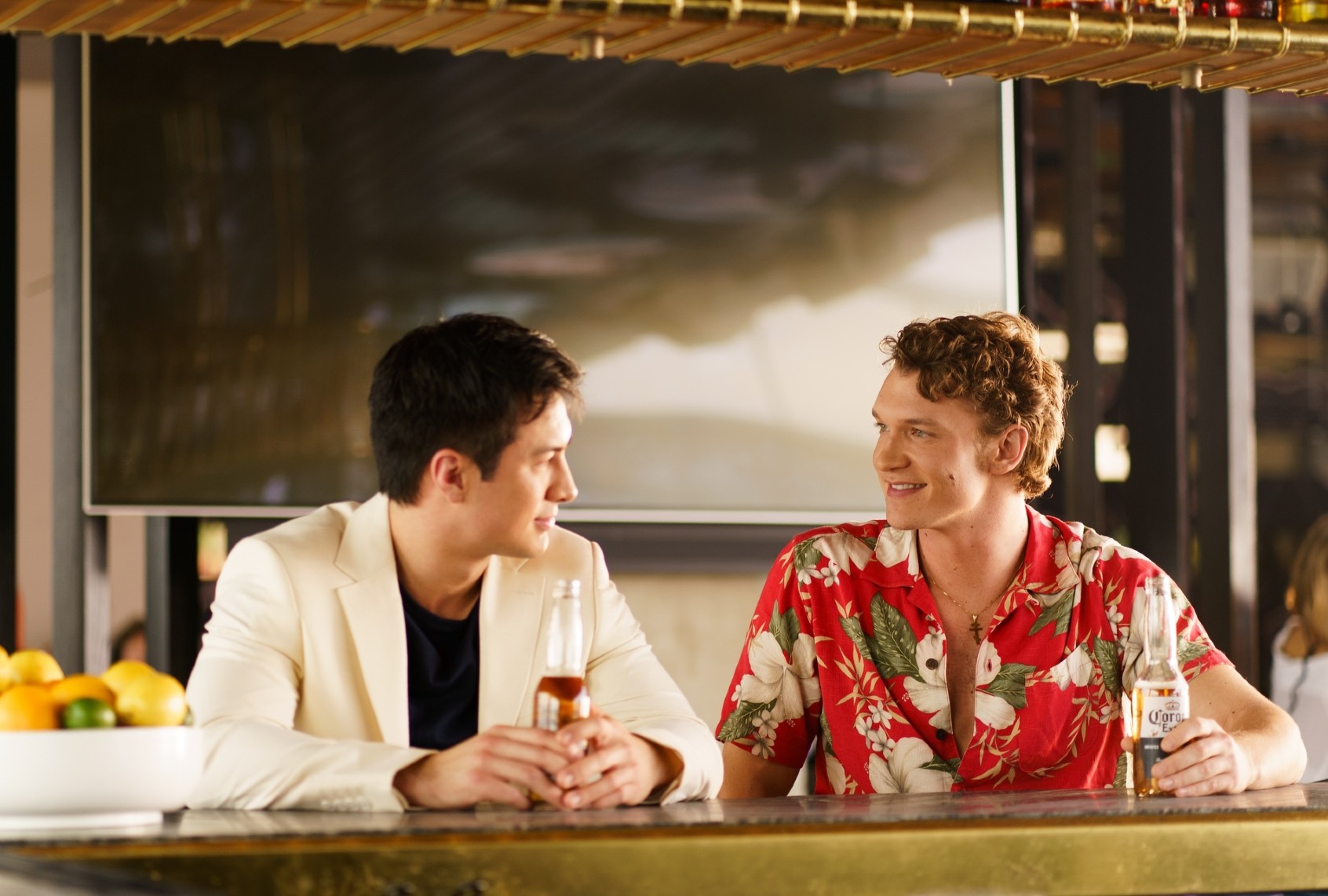

Banana, cake, peach, eggplant, sausage, whipped cream, cherry. Something about certain foods steers the brain towards images of the erotic, and entertainment media knows it.
In visual mediums, food is often shorthand for sex. A cheeky, not-so-sly metaphor. Romance in particular loves edible innuendo. It’s easy to use a juicy, dripping peach or artful dollops of whipped cream as a stand-in for what you really want your audience to be thinking about.
“Heated Rivalry” is different.
In what is arguably the year’s hottest television show, both in popularity and sensuality, food is everywhere. But it isn’t erotic. It isn’t teasing. In a show defined by sex, food becomes the language of vulnerability.
“Heated Rivalry” is a relatively low-budget Canadian television show — based on the “Game Changers” romance novel series by Rachel Reid — that streamed on HBO Max earlier this year. The steamy, enemies-to-lovers show follows two closeted hockey players, Shane Hollander (Hudson Williams) and Ilya Rozanov (Connor Storrie) as they navigate their turbulent situationship on top of their budding professional hockey careers.
Against all odds, “Heated Rivalry” became a breakout hit, reaching 324 million streaming minutes in its first week — that’s ten times the viewership of “Bridgerton” season 4 in the same time frame — shooting its stars and creators to a level of fame that feels unprecedented.
Less than a year ago, Hudson Williams and Connor Storie were waiting tables, now they’re hosting “SNL,” presenting Golden Globes, and carrying the Olympic torch. Hansel wishes he was as hot as these two right now.
We need your help to stay independent
In “Heated Rivalry,” the sex is nearly immediate. Physical intimacy is not the obstacle, emotional intimacy is. And food bridges that gap. Even in the early days of this nearly decades-long situationship, the boys are using food (if you can count water as food) to show their interest in each other.
In episode one, we see Shane and Ilya on Major League Hockey draft day — where they’re the second and first overall picks, respectively. After a suit-and-tie celebration, which neither seems too celebratory about, Shane leaves his hotel room in a huff and escapes to the hotel gym for a late night stationary bike ride. Ilya soon appears on the bike next to him. What ensues next can only be described as the most tantalizing, sexually tense stationary bike race ever recorded on video.
After this first charged encounter, the initial gesture between them is not seduction. It’s nourishment, hydration.
They sit toe to toe on the gym floor, and Ilya offers a red-faced, panting Shane his water bottle. Ilya shakes the bottle a few times, almost daring Shane to take it. He finally gives in, their fingertips graze, Ilya holds the contact just a second too long when accepting the bottle back, and that’s how it begins.
Want more great food writing and recipes? Sign up for Salon’s free food newsletter, The Bite.
On this day, they cemented not only their professional rivalry, but also their prolonged and (at the moment) unexplainable connection to each other. In a genre that often codes food as indulgence, this is maintenance. Care, not consumption.
Shane and Ilya continue sporadically meeting in hotel rooms. They text regularly (under the aliases “Jane” and “Lily”). Even after Shane wins the MLH championship, he’s not thinking about this major career accomplishment. While his teammates are enjoying frenzied, champagne-spraying locker room celebration, Shane’s face is buried in his phone and visibly smirking while texting Ilya.
The tuna melt
Their emotional tip-toeing reaches a breaking point in episode 4 with the tuna melt scene, arguably the emotional hinge of the series. By the time Shane ends up at Ilya’s apartment for the day, the sexual tension is long established. What’s new is the kitchen.
Ilya passes Shane his signature ginger ale across the counter and says, “You like tuna melt?”
“You want to make me a tuna melt?” Shane replies with a slight quirk of his lip.
The scene is quiet, domestic, almost disarmingly ordinary. They eat on the couch. They talk — not about bodies or strategy or rivalry — but about family. About the shape of their lives outside hotel rooms and hockey rinks.
And it’s here, over melted cheese and toasted bread, that Ilya admits something far riskier than desire: that he likes Shane. The sandwich doesn’t escalate lust. It transforms the energy of the room, of the relationship, from erotic heat to a loving warmth. Then they say each other’s first names, a quiet “Shane” and “Ilya” just for each other.
You would think that for two people who’ve known each other for years and have seen and experienced every inch of each other’s bodies this wouldn’t be a big deal, but the first name crosses the line. It takes their relationship out of “two guys who are intrigued by each other and hook up occasionally” into “two guys who know all of each other’s quirks and idiosyncrasies and may just be starting to fall in love, or (even more terrifying) they’re already there.”
Without the tuna melt, I don’t know that Shane and Ilya would’ve had this emotional breakthrough. Using each other’s first names, especially in such an intimate moment, completely changes the nature of their relationships. It breaks down all the walls (no matter how flimsy) the two had tried to set up to deny their feelings for each other. In most romantic media, food heightens sensuality. Here, it marks the moment when desire softens into emotional risk.
Being as dysfunctional as they are and seeing that neither are ready to admit what this relationship is (an actual relationship) and what it means to them, this moment naturally leads Shane into a full on panic, and they don’t talk or see each other for months.
The smoothie
While Shane and Ilya are having their turbulent back and forth of will-they-won’t-they-admit-they-have-feelings-for-each-other, there’s another love story going on: Scott Hunter and Kip Grady.
Their relationship starts with a smoothie. Not champagne, not whipped cream, not a strategically placed strawberry. A smoothie.
After a run through the streets of New York City, Scott Hunter (pro hockey all-star and captain of the New York Admirals) stops in health food store Straw+Berry for a post run drink. That’s where he meets struggling grad student Kip Grady. Kip makes him a special version of the store’s blueberry smoothie (he just adds banana). It’s awkward. Slightly stilted. They’re testing the waters.
Scott starts to linger longer than he needs to. The conversations stretch a little further. Scott keeps coming back — not because he’s suddenly developed a deep passion for (in my opinion) way too watery fruit-based beverages, but because Kip is there.
Food here isn’t flirtation. It’s repetition, ritual, a reason to return back to the person you can’t stop thinking about.
Kip gifts Scott a pair of blue socks with bananas on them, a physical manifestation of the smoothie for when Scott’s not in New York, and he wears them during every game. A small, almost comical callback to the smoothie that started it all. It’s romantic in the way inside jokes are romantic. It’s not sexy. It’s not a metaphor. It’s memory.
In romance media, food often escalates toward seduction. In “Heated Rivalry,” food settles into consistency. It’s how relationships grow roots.
When Kip stays over in Scott’s apartment, Kip still makes the smoothie in the morning. The gesture continues and evolves as their relationship gets stronger. It becomes less about the drink itself and more about what it represents: “I see you. I remember how we started.”
Even though, objectively speaking, that smoothie looks like something I would not be able to keep down, it means something to them. And that’s the point.
In romance media, food often escalates toward seduction. In “Heated Rivalry,” food settles into consistency. It’s how relationships grow roots.
The show refuses the glossy aesthetic of “food porn.” The tuna melt looks like a tuna melt. The ginger ale is flatly branded Canada Dry. The lighting is not indulgent. Nothing drips in slow motion. Nothing is consumed theatrically.
Because this isn’t about appetite. It’s about offering something you made and waiting to see if it will be accepted. That dynamic deepens when viewed through Shane’s characterization.
Shane Hollander is branded by the media and hockey world as the “boring” and “serious” hockey prodigy, especially in comparison to the ladies-man-bad-boy Ilya Rozanov.
He’s rarely without his Canada Dry. He’s on a so-called macrobiotic diet. His teammates tease him for eating what they call “bird food.” He orders the same salmon and brown rice at restaurants. His routines are meticulous. His preferences? Predictable.
Rachel Reid addressed this in an “Ask Me Anything” on Reddit, explaining that while she didn’t initially write Shane as neurodivergent, after her own experience parenting a neurodivergent child, she came to see him differently. By the time she wrote the “Heated Rivalry” sequel, “The Long Game,” Reid noted that she “had a better understanding of Shane” and “realized that, yeah, he’s probably autistic.”
That context reframes everything. The always perfectly folded clothes before sex. The seeming rigidity. The public perception of him as boring or robotic. The fact that people who actually know him always describe him as funny.
Hudson Williams’ quiet portrayal of this character has resonated so well with fans and viewers who also have autism. Anni Malter, a German journalist based in Japan, called Williams’ portrayal of Shane, “one of the most honest and recognizable depictions of an autistic character I’ve seen in a long time.”
“His autism is not framed as a reveal, a problem or a lesson. There is no diagnostic scene, no moment of narrative reassurance. Shane doesn’t even know it himself. And yet, within the first ten minutes of the first episode, it was unmistakable,” Malter wrote in a Substack after interviewing Rachel Reid about the book series and show.
“What ‘Heated Rivalry’ understands – quietly, confidently – is that autism does not announce itself. It reveals itself in patterns, in pressure points, in the way a body moves through the world. And once you know what you’re looking for, you don’t need it explained.”
One obvious pattern for Shane is the food.
Safe foods are common in autistic individuals: predictable textures, reliable flavors, minimal sensory disruption. So when Ilya offers him a tuna melt in episode four — something warm, messy, unfamiliar — and Shane accepts without hesitation, it’s not small.
It’s trust. It’s vulnerability. It’s: “I am letting you disrupt my routine.”
You could argue that the tuna melt is the most intimate thing that happens in that apartment.
A comically large pot of pasta
The most quietly devastating food scene in the show doesn’t happen in a bedroom. It happens at a kitchen table.
After Shane’s father accidentally walks in on him and Ilya at the cottage, everything implodes. Shane spirals. Panic sets in. The secret he’s been carrying for years is suddenly inches from exposure. Shane’s father wordlessly speeds away from the cottage. Shane and Ilya follow right behind. Shane is essentially forced to tell his parents not only that he’s gay but he’s also been in a relationship with who they thought was his arch-enemy for the better part of a decade.
And what does his mother do?
She makes pasta. A massive, almost comically large pot of pasta.
They all sit at the table — Shane, Ilya, Shane’s parents — and the conversation unfolds over noodles.
There’s no metaphor here. No erotic coding. No wink at the audience. Just four people eating dinner. And you can feel, watching it, that everything is going to be okay.
There’s something deeply maternal about it. Something grounding. A silent message of: We are still a family. You are still my son.
Cooking has been shown to mitigate psychological distress and reduce stress levels. Research has shown that engaging in cooking activities can improve emotional wellbeing and decrease anxiety. Preparing food becomes a regulatory act — a way to channel overwhelming emotion into something tactile and nourishing.
Maybe Yuna Hollander didn’t consciously think, Let me deploy culinary therapy in this moment of crisis. Maybe she just did what mothers do.
But the effect is the same.
The pasta becomes a stabilizer. A unifier. The physical act of twirling noodles while discussing something as monumental as coming out diffuses the tension just enough for honesty to survive.
There’s no metaphor here. No erotic coding. No wink at the audience. Just four people eating dinner. And you can feel, watching it, that everything is going to be okay.
We are conditioned to see food in media as sensual. Food is frequently eroticized — aestheticized into spectacle and coded as appetite. “Heated Rivalry” refuses that framework. The tuna melt is… a tuna melt. The smoothie is slightly watery. The pasta is just pasta.
Critics, casual viewers, and obsessive “reheaters” (the nickname fans have dubbed re-watches of the show) have noted how grounded and character-driven the storytelling feels despite the explicit content. The sex is explicit. The food is ordinary. And maybe that’s why it hits so hard.
Because the show doesn’t need food to heighten desire. The desire is already there — loud, obvious, borderline operatic. Food, instead, marks the moments where desire softens into care.
Shane and Ilya are elite athletes. They can take hits. They can endure overtime. They can perform in front of tens of thousands of people. But they cannot, for the life of them, articulate how they feel.
So they cook. They pass water bottles. They make tuna melts. They sit at kitchen tables and eat pasta. They drink Russian vodka.
In a show driven by sex, it would be easy — almost expected — to use food as one more layer of innuendo. But food has no place here as metaphor. Food is the place where they risk being known, seen. It’s how they test the possibility of letting their walls down, of staying.
And when the words “I love you” feel too destabilizing — too irreversible — there is always another, softer confession available: “You like tuna melt?”
Read more
about queer romance
