
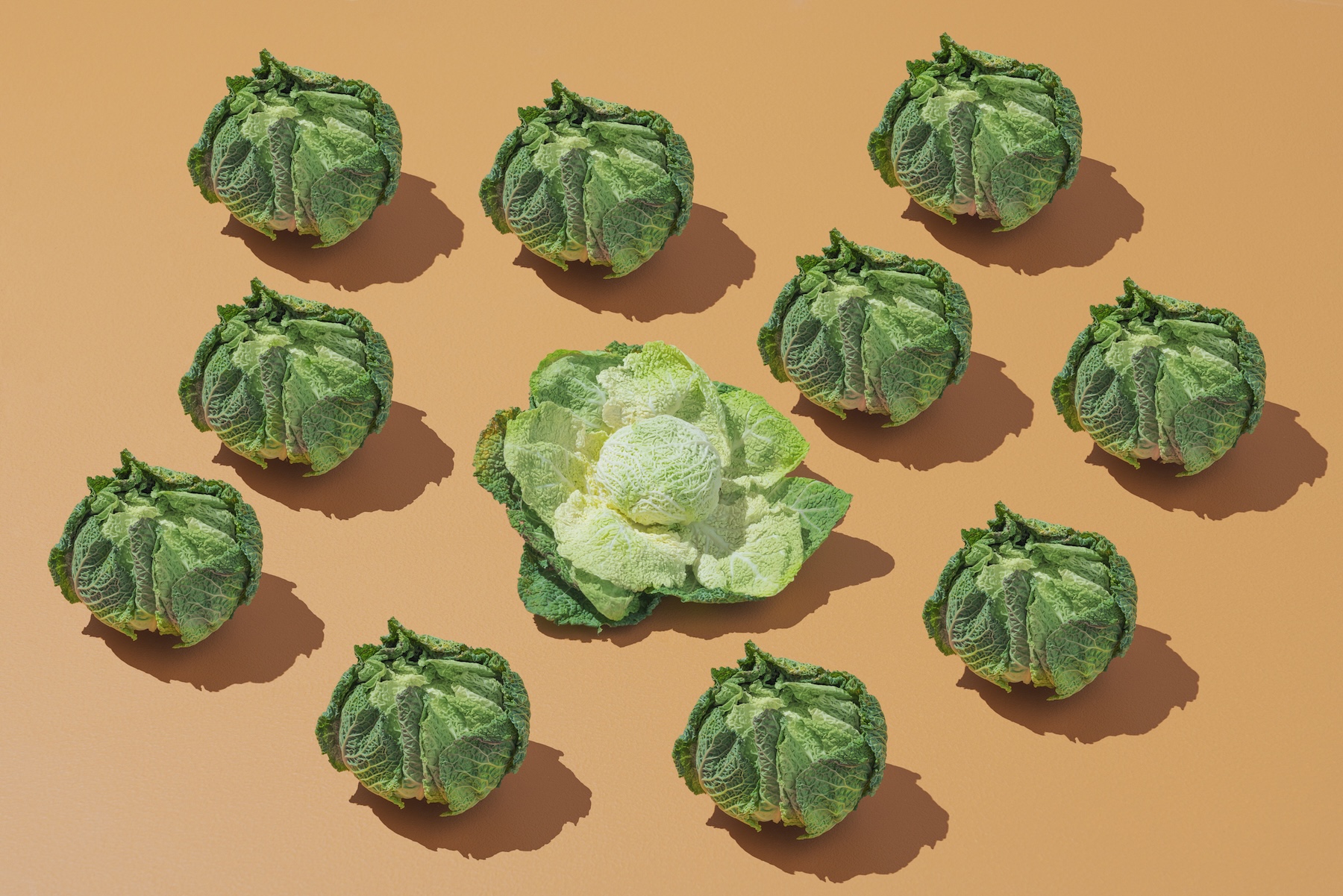

On the outside, a whole head of cabbage is dense, firm and undeniably heavy. Cut into it and you’ll reveal its delicate anatomy — layers of leaves, in shades of light green or purple, all tightly packed into one big ball. Each raw bite is crisp and fresh, squeaky, even. There’s a bit of resistance, too, that’s almost rubbery.
Every few seasons or so, a commonplace produce item, be it a fruit or vegetable, is granted “It Girl” status. Back in 2023, that prestige was bestowed upon tomatoes, which moved beyond the grocery store aisles to become an aesthetic and a way of life with the so-called “Tomato Girl Summer” micro trend. This year, the baton is being handed to a vegetable: the leafy and cruciferous cabbage.
That’s according to Vogue, which declared in January that cabbage is the chicest vegetable of 2026. Why, you may ask? Cabbages, namely their undulating cross-section patterns, have appeared as designs in outerwear and accessories. Cabbages have inspired bags (like the Sandy Liang cabbage bag), designer kitchenware, gaudy decor and high-fashion advertisements. They’ve shown up on restaurant menus across New York. And just this past November, NYC Mayor Zohran Mamdani held a whole cabbage in a campaign video made alongside food content creators and real-life couple Anna Archibald and Kevin Serai, who are cheekily known by their online handle Cabagges.
Cabbagecore, as The Guardian so fittingly describes cabbage’s newfound popularity, is “undeniable.” According to the “Pinterest Predicts” trend report, cabbages are “the new kitchen MVP” in 2026, and there’s data to prove it. Searches for “cabbage dumpling” were up by 110%, while “cabbage alfredo” was up 45% and “fermented cabbage” was up 35%. Folks are simply craving more crunch in their lives.
Although cabbage’s relevance as a cultural icon — and a sexy produce star, as The New York Times deemed it — is worth celebrating, the humble vegetable’s existence is more than a mere hot new trend. 2026 being the official year of the cabbage just makes sense. It’s both timely and necessary, especially in an era of rising grocery prices and heightened awareness of what and how we eat.
“I think one of the really important aspects of cabbages is that they resonate with a lot of people,” says Celine Beitchman, Director of Nutrition at the Institute of Culinary Education (ICE) in New York. “Certainly, they are an economical option, but they are also a comfort food for just about every culture worldwide. That, coupled with their versatility, makes cabbage an easy choice for a lot of people to get with.”
Indeed, Beitchman is right — to an extent. Stuffed cabbages, for example, are a hearty delicacy that transcends geographical borders. In Polish cuisine, it’s known as Gołąbki, often served for Christmas Eve dinner, weddings, or on dining tables year-round, depending on the region. In Ukraine, tender boiled cabbage rolls, generously filled with seasoned ground meat, rice and onions, are better known as holubtsi. And in Germany, blanched white or savoy cabbage leaves stuffed with ground beef and cooked in a cream sauce are called kohlrouladen. There’s also mille-feuille nabe, a Japanese hot pot dish that’s layered with napa cabbage and thin slices of pork belly simmered in dashi broth.
But cabbage consumption, at least in the United States, remains low. Since 2000, per capita consumption of fresh cabbage has declined from nearly nine pounds to an astounding 5.51 pounds in 2023, according to Statista. Per recent data, consumption has been on the rise, albeit at an incredibly slow rate. In 2024, per capita consumption increased by 0.03 pounds to a total of 5.54 pounds. The Packer’s Fresh Trends 2024 survey also found that 37.3% of consumers reported buying cabbage in the past year, compared to 31% in the 2023 survey.
We need your help to stay independent
Interest in cabbage-focused recipes, however, is growing. Earlier this month, The New York Times’ Tanya Sichynsky dedicated an entire newsletter to the vegetable after a reader reached out, asking how they could use up all the cabbage they received from their local farmers’ market. Sichynsky suggested making cabbage parm, winter minestrone with cabbage pesto and tofu and cabbage stir-fry with basil, just to name a few recipes.
Cabbage is one of the world’s oldest cultivated vegetables, dating back over 4,000 years. Part of the Brassicaceae family, cabbage has a historical reputation for being an economical choice of food. According to the “Journal d’un bourgeois de Paris” (The Diary of a Parisian Bourgeois), an anonymous account of everyday life in Paris during the 15th century, “poor people ate no bread, nothing but cabbages and turnips and such dishes, without any bread or salt.” Today, cabbage is still revered for its low price, with cheaper heads of green cabbage currently available for $2.13 to $2.70, making it a go-to vegetable for budget-conscious shoppers.
“You can do a lot with one head of cabbage,” says Beitchman. “It takes maybe a quarter of a wedge to make enough for four or five people to have as a side dish. The fact that you can use it in a lot of ways is pretty cool.”
One of cabbage’s greatest assets is its nutrition profile. Cabbage is rich in Vitamin C and folate, “which is important for DNA synthesis, for your cells to reproduce themselves,” Beitchman explains. Cabbage is also high in water, a vital yet often overlooked nutrient in our foods.
Want more great food writing and recipes? Sign up for Salon’s free food newsletter, The Bite.
Purple, savoy and green cabbage are also high in insoluble fiber, which Beitchman says is “the broom of the digestive system,” allowing waste to pass through more easily. Fiber, it seems, has become the latest buzzword in the dietary space as fibermaxxing, the food trend of loading up on fiber, is predicted to take over 2025’s trend of protein-maxxing. That’s partly due to a fiber gap — not enough people are eating enough daily fiber. The American Society for Nutrition reported in 2021 that only five percent of men and nine percent of women were eating the recommended daily amount of dietary fiber.
As of 2025, sales of fermented products, such as sauerkraut and kimchi, have increased as more Americans seek to improve their overall gut health, The Wall Street Journal reported in November. Sales of fermented foods and ingredients reached $61.17 billion between 2024 and 2025, according to market research firm NielsenIQ.
It’s about time that cabbage deserves its rightful spotlight. Cabbage’s moment is inevitable, per Beitchman. She points to the increase in accessibility of at-home fermentation, fermentation programs at culinary school and cabbage varieties available at the local farmer’s markets in New York City.
Cabbage is everything we need in food right now: affordable, abundant, nourishing. It’s maximalist in a quiet yet practical way, all while providing us comfort and immunity throughout the seasons. Its chicness is familiar yet attainable. Cabbage has long been forgotten among its cruciferous counterparts — broccoli, cauliflower and kohlrabi. This year, let’s enjoy the vegetable wholeheartedly.
Read more
about cabbage:
