
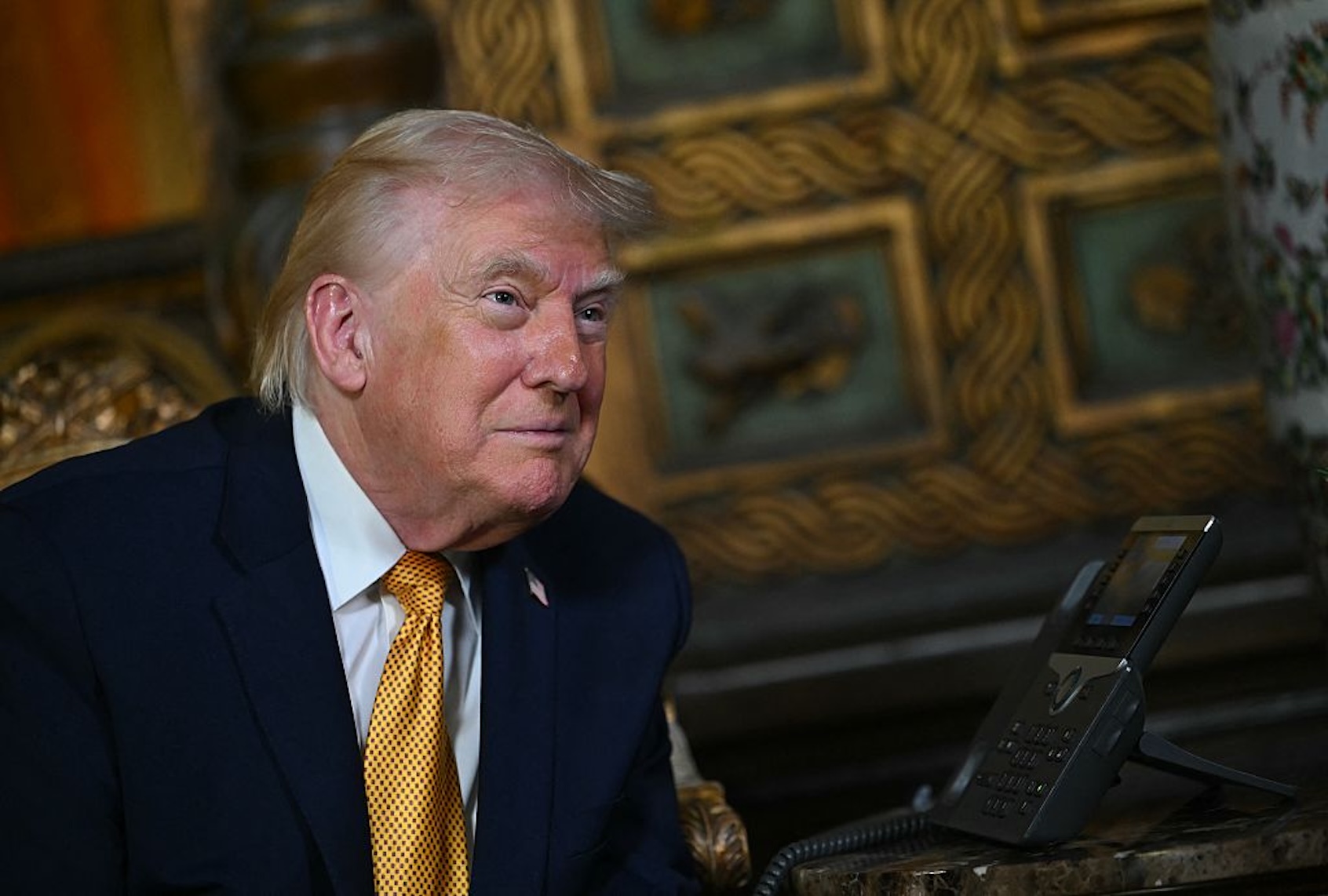

Donald Trump went down to Georgia last week to tout the economy to voters in former GOP Rep. Marjorie Taylor Greene’s district. But there was really only one thing he wanted to discuss. While touring a steel company and stopping in at a restaurant, the president spent most of his time talking about the FBI raid on the Fulton County election offices, his tiresome claims of voter fraud and his new onerous voter identification plans. In other words, it was a typical Trump appearance.
His incessant demands to revisit the 2020 election means he will go down in history as the man who refused to accept his loss and inspired an insurrection. Trump will forever be known as the president who was intent on sowing doubts about the integrity of America’s elections — despite a total lack of evidence and dozens of investigations and judicial findings. When all is said and done, this may be his greatest legacy.
But as much as Trump has taken these cries of voter fraud and rigged elections to an extreme, it is not one of his narcissistic innovations. He merely took what has long been conservative orthodoxy and put his own deceitful spin on it.
But as much as Trump has taken these cries of voter fraud and rigged elections to an extreme, it is not one of his narcissistic innovations. He merely took what has long been conservative orthodoxy and put his own deceitful spin on it. Decades before he came along, the right was pushing the voter fraud myth — and using it as an excuse to suppress the vote.
The South’s discriminatory practices during Jim Crow were justified as fraud prevention. Conservatives claimed that unless a poll tax was instituted, poor people would sell their votes. They believed that Black people, regarded as intellectually and morally inferior, were especially likely to do so. Similarly, some “reformers” in Northern cities went to great lengths to make it difficult for immigrant populations to vote, creating barriers to registration and constantly changing the rules, all in the name of stopping so-called fraud. States openly gerrymandered districts in a way to deny Black people representation and created “whites-only” partisan primaries.
But there was never any real evidence of voter fraud, according to historian Alexander Keyssar. In “The Right To Vote: The Contested History Of Democracy In The United States,” he details how the accusation was simply raised as a method to suppress the votes of groups the people in power wished to disenfranchise and disempower. The desire was a precaution — a reflexive response to the idea that the votes of the poor, along with racial and ethnic minorities, might overwhelm the elite and, once in power, they would use the government to seize their property. This was a key part of the systemic strategy in the Jim Crow South to ensure Black Americans retained their second-class status throughout society — a system that remained in place at least until 1965, when the Voting Rights Act finally guaranteed their right to vote.
The Civil Rights Movement and the subsequent switch of Black voters’ partisan loyalty from the GOP to the Democratic Party led to the Southern Strategy, in which the Republicans exploited racism as an electoral game plan by pandering to the Southern white voter backlash. The strategy’s blueprint formed the basis of modern conservatism’s war on voting rights that has persisted to this day.
Years ago, conservative activist Paul Weyrich put it plainly at an evangelical gathering. “I don’t want everybody to vote,” he said, “as a matter of fact, our leverage in the elections quite candidly goes up as the voting populace goes down.” From that point on, every attempt to make it easier to vote and open up the franchise was met with fierce resistance.
President Jimmy Carter’s proposals for Election Day registration, public financing and abolition of the Electoral College were met with shrieks of horror by GOP activists, who labeled the plan “Fraud and Carter’s Voter Registration Scheme.” The legislation was never taken up by Congress. Ten years later, the motor-voter legislation, which allowed people to register when they renewed their driver’s licenses and car registration, was derided as an open door to corrupting the voting rolls; it was vetoed by George H.W. Bush before finally becoming law under Bill Clinton. After the voting age was lowered to 18, states with GOP legislative majorities created onerous rules for college students designed to keep those younger citizens from voting. But in 2000, when the election of George W. Bush turned on a tiny margin of 537 votes in Florida, Republicans went into overdrive, recognizing that as the country was becoming increasingly polarized they could manipulate rules to ensure themselves an advantage.
Want more sharp takes on politics? Sign up for our free newsletter, Standing Room Only, written by Amanda Marcotte, now also a weekly show on YouTube or wherever you get your podcasts.
The party homed in on one particular form of exceptionally rare voter fraud: voter impersonation. As Michael Waldman at the Brennan Center for Justice pointed out, the potential cost for an individual to impersonate someone at the polls is very high, while the return to a particular candidate is very low — how much can one vote really matter? Throw in the idea of undocumented immigrants committing this fraud and you can see why it’s so absurd. They have nothing to gain and everything to lose. Nonetheless, Bush’s attorney general John Ashcroft pursued dozens of investigations into voter fraud, as did Republican attorneys general across the country, and they came up with nothing.
The GOP’s strategy with crying “voter fraud” has always been to get their base motivated. By the time Donald Trump came on the scene in 2015, his advisers had schooled him on all the right-wing tropes, and illegal immigration and voter fraud were at the top of the list. As the man who had put birtherism — the lie suggesting that Barack Obama was born outside the United States and had thus illegally run for president — on the map, he was a perfect messenger.
We need your help to stay independent
Even before Election Day in 2016, Trump was claiming that the election was rigged and that he would only accept the results if he won. As president, he convened a voter fraud commission to prove that he had not just won the electoral vote but the popular vote as well. Ten years later, he continues to promote that lie as truth. Month in advance of the 2020 election, he teed up the false notion that mail-in votes were fraudulent. We know the rest.
Now we are awaiting the Supreme Court’s ruling in Louisiana v. Callais, a case that could see the Voting Rights Act completely gutted if the conservative justices, as is expected, decide in favor of the state. This is a long-held dream for the American right — and for Chief Justice John Roberts, who served as a young lawyer in the Reagan administration arguing against the act.
As for Donald Trump, he is surely one of the sorest losers in history; his fragile psyche cannot accept defeat. But he had over a century of help with his lies about voter fraud. Conservatives laid the groundwork — and he took it to the next level.
Read more
about Trump’s Big Lie
