
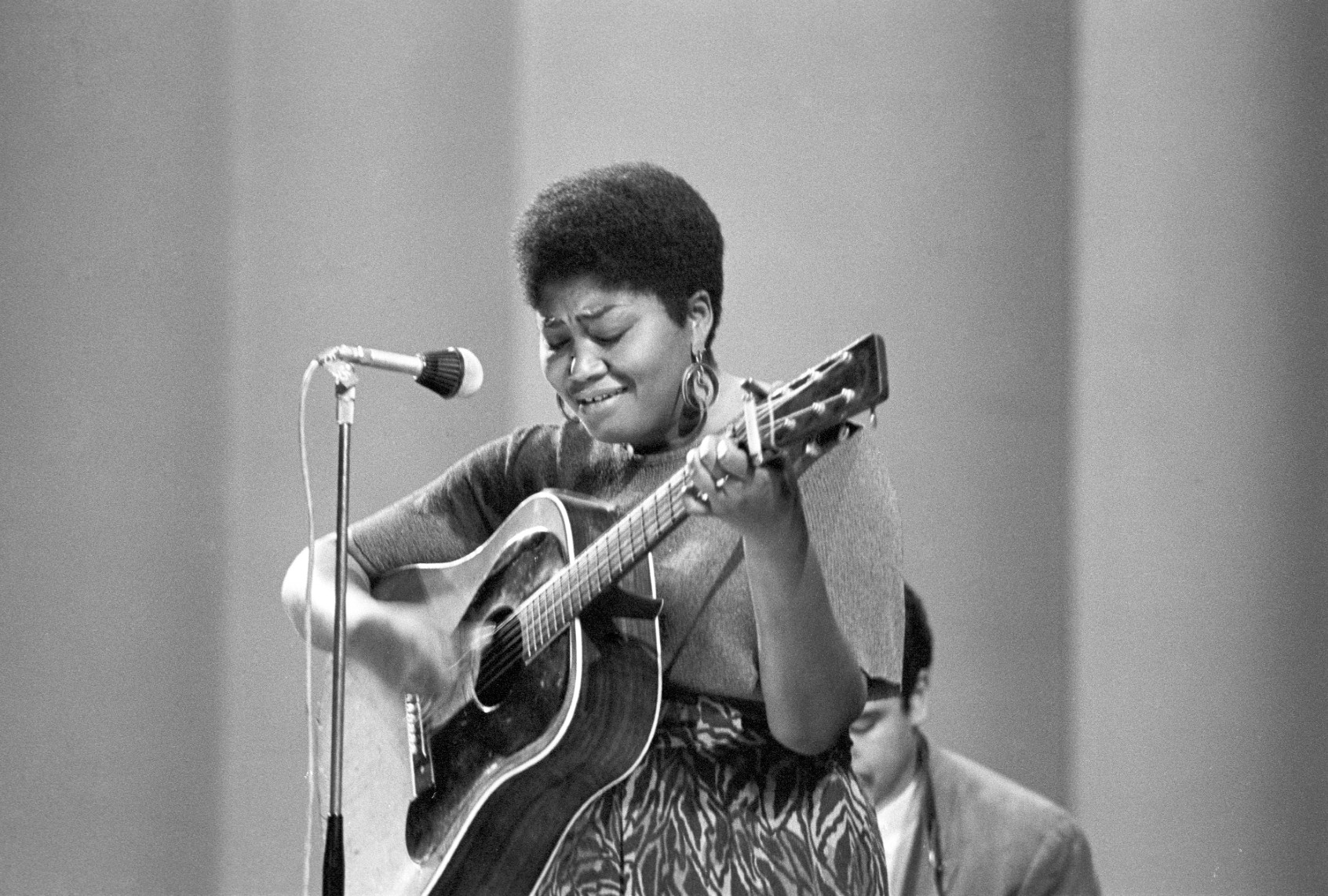

“Highway of Diamonds – Black America Sings Bob Dylan” is the latest release in Ace Records’ “Black America Sings…” series. Ace is a small but mighty UK label that specializes in reissues and vintage catalog material, prioritizing physical releases that feature thoughtful annotations and liner notes. Their previous Dylan entry in the series (2010’s “How Many Roads”) features several of the same artists on “Highway of Diamonds,” and that’s not because they were limited for choice, but because there are simply so many excellent covers to choose from.
The songs on “Highway of Diamonds” span from the early ’60s to almost the ’90’s (“Oh Mercy” is the most contemporaneous of the albums represented, with Bettye LaVette’s brilliant “Everything Is Broken”) and the renditions themselves extend across an even larger continuum; some — like the Staple Singers’ “A Hard Rain’s A-Gonna Fall” — were recorded not long after the originals, but there’s representation in every decade here, which points to the kind of longevity and relevance that any songwriter would envy. Not every presentation is a home run, but they’re all worth more than a few listens.
As the liner notes explain, Dylan is the third-most popular covered songwriter ever, outranked only by The Beatles and Duke Ellington. And an interesting way to approach listening to this volume is perhaps to try to envision a world in which Bob Dylan was making his living as a songwriter, selling his songs alongside the other tunesmiths who’d set up shop in the Brill Building. That’s hard if not impossible to do, given the presence of some of these songs in our lives, but it’s a fun exercise to try to detach the recording from history and evaluate it as a song or as a performance.
An interesting way to approach listening to this volume is perhaps to try to envision a world in which Bob Dylan was making his living as a songwriter, selling his songs alongside the other tunesmiths who’d set up shop in the Brill Building.
Bettye LaVette continues to shine as one of our most underrated interpreters and performers, with a version of “Oh Mercy”’s “Everything Is Broken.” This version gets to the white hot heart of the composition, and sounds as though LaVette truly heard what Bob was trying to say, and came back with, “Oh, this is what you mean, baby.” The directness of the production on this cover does away with Daniel Lanois’ layers — which in 1989, and for Bob, weren’t necessarily bad directions — but they did clutter the message a little, which also may have been intentional.
Nina Simone, even in 1969, carried a power and presence that she had well earned at that point, and her interpretation of “Just Like Tom Thumb’s Blues” feels more grounded at a soul level, so she can simply (okay, it’s not simple, but she makes it seem that way) drop right in and quietly — but powerfully — inhabit the composition, whereas Bob delivers it at a full jittery throttle. You can hear the differences in lives and backgrounds and upbringing, of men and women in the ’60s, of class and Jim Crow, it’s all in there. They’re both equally enmeshed in the piece; they’re both bringing their own individual mojo, and it’s utterly fascinating to hear what she heard and let her take you in the side door on this song so you can see it through her eyes.
Want more from culture than just the latest trend? The Swell highlights art made to last.
Sign up here
The timbre and phrasing of Cassandra Wilson’s 2002 rendition of “Shelter From The Storm” is beautifully grounded in jazz principles, and one could imagine Joni Mitchell taking the song apart in the same manner and sticking the delivery with the same power and pathos that Wilson does with the “Blood On The Tracks” highlight. She retains the delicacy of the instrumentation, but introduces a gorgeous complexity that, in someone else’s hands, would be too much, but here, simply enhances the vocal delivery. It’s not as sharp as the original, but it retains the same hope and promise you hear in Dylan’s voice.
Anything the late Jimmy Scott attempted turned into magic, and that’s exactly what happens here with his cover of “When He Returns,” the closing number on 1979’s “Slow Train Coming.” But Scott’s genius was his ability to hear elements and aspects of compositions that others could not even imagine. The sparse, traditional jazz arrangement is performed by a minimal ensemble (although of course Dylan is only accompanied by piano on the original), and it works not because of its novelty but because Scott’s approach to the song is more complex; you feel like he has a relationship with the person he’s singing about, while for Dylan it’s still more conceptual. It could be a praise number or it could be a love song.
The compilation’s temporal breadth and depth is definitely a highlight here; there are no clunkers and no choices that feel like stretching to fill out a two-disc set.
Natalie Cole can sing anything, and her version of “Gotta Serve Somebody” is lovely, but it does not bring anything particularly new to the conversation. She’s singing a song that was written to be a gospel song from a record that was intended to be a gospel album, but she smooths out all the edges, and presents a solid argument that someone could have probably had a hit with it within the praise music world, if it hadn’t been originally written by Bob Dylan (or if Bob Dylan hadn’t become “Bob Dylan.”)
There’s a valuable clue in the credits for Billy Preston’s version of “It’s Alright Ma (I’m Only Bleeding)”: “Arranged by Paul Riser.” Paul Riser, of course, is the legendary Motown arranger whose work you know from songs like “I Heard It Through The Grapevine” and “Papa Was a Rollin’ Stone” or Diana Ross’ “Ain’t No Mountain High Enough.” So it’s that massive, textured world-building that you hear in the background here, and the arrangement suits Preston’s crossover style between soul and pop perfectly — but in the process, it loses a lot of the grit of the original, and in doing so, subtracts most of its power. His vocal performance almost saves things, but he goes for the big and bright because it’s a style he was a master of. And while it’s not delivering what the original delivers emotionally, it’s still a fascinating example of both Preston and Riser’s gifts.
Funnily enough, Mr. Riser was present at a recent conversation with George Clinton held at the Charles H. Wright Museum of African American History (prior to a celebration of Clinton’s music at the Detroit Opera House back in January), where there was a specific discussion about how much Motown and George Clinton carefully observed and borrowed whatever they could from Dylan, specifically pointing to the rhythms within his vocals.
The great Solomon Burke can sing anything and his interpretation of “The Mighty Quinn” still meets that criteria, but there’s not enough substance for him in the song or the arrangement for it to sparkle. Similarly, “Rainy Day Women #12 & 35” meets the same fate, but when Merry Clayton recorded this variation in 1975, we were in the tail end of flower power and she wasn’t the only singer hoping that a rousing sing-a-long chorus of “Everybody must get stoned” might encourage the same music fans who adored her presence on the Rolling Stones’ “Gimme Shelter” or Lynyrd Skynyrd’s “Sweet Home Alabama.” It’s just not that deep of a song and it doesn’t lend itself to creative reimagining the same way other numbers on this compilation do.
We need your help to stay independent
A much stronger contribution from Clayton can be found in her featured vocal on “The Times They Are a-Changing,” taken from Lou Adler’s 1969 project, “Dylan’s Gospel.” This project, billed to “The Brothers and Sisters,” was a group of talented LA session musicians drafted by Adler, including Clayton, Gloria Jones, Clydie King, Carolyn Willis, Oma Drake (among many others) performing gospel arrangements of Dylan’s most popular songs at the time. (The project was a dismal failure commercially, but was re-released in 2014 by Light In The Attic.) Here, on “Times,” Clayton has the right material along with the right space and support to exercise her instrument to its best capabilities. On the original, Dylan firmly asserts, but the arrangement here is a full-throated declaration and a celebration of the progress made at that point in history.
A 2017 interpretation of “Every Grain of Sand” — the beautiful closing number on the last Never-Ending Tour outing — thanks to Lizz Winstead is gorgeous and soaring, and does the artist and composition justice; the Bo-Keys’ cover of “I Threw It All Away” (from 1969’s “Nashville Skyline”) sounds more vintage than it actually is (2016) but it’s still well-executed; and gospel stalwarts the Caravans beautifully inhabit “Blowin’ In The Wind,” a version recorded back in 1966 and a reminder of Dylan’s presence and participation in the civil rights movement. Again, the compilation’s temporal breadth and depth is definitely a highlight here; there are no clunkers and no choices that feel like stretching to fill out a two-disc set.
There are other huge names here — Aaron Neville (“Don’t Fall Apart On Me Tonight,” from 1983’s “Infidels,”), Sarah Vaughan’s classic rendition of “If Not For You,” and of course, the Staples Singers’ version of “A Hard Rain’s Gonna Fall,” interpreted in classic Staples fashion, adding a country-gospel reading that brings a distinguished solemnity while vanquishing some of Dylan’s own darkness. (Their stunning reworking of “Masters of War” is on the first volume of this series and you should hunt it down if you haven’t heard it.)
There’s a scene in Martin Scorsese’s “Rolling Thunder Revue” documentary where Dylan is speaking about Allen Ginsberg and how Ginsberg had achieved heights that no other modern poet had, and he explains that the role that poetry once filled was now instead taken up by popular song: “We still remember those lines today,” he said, referring to poets at the level of recognition of Whitman. Dylan didn’t quote himself in that particular riff, but he could have, and “Highway of Diamonds” is absolutely another piece of evidence in that regard.
Read more
from music columnist Caryn Rose
