
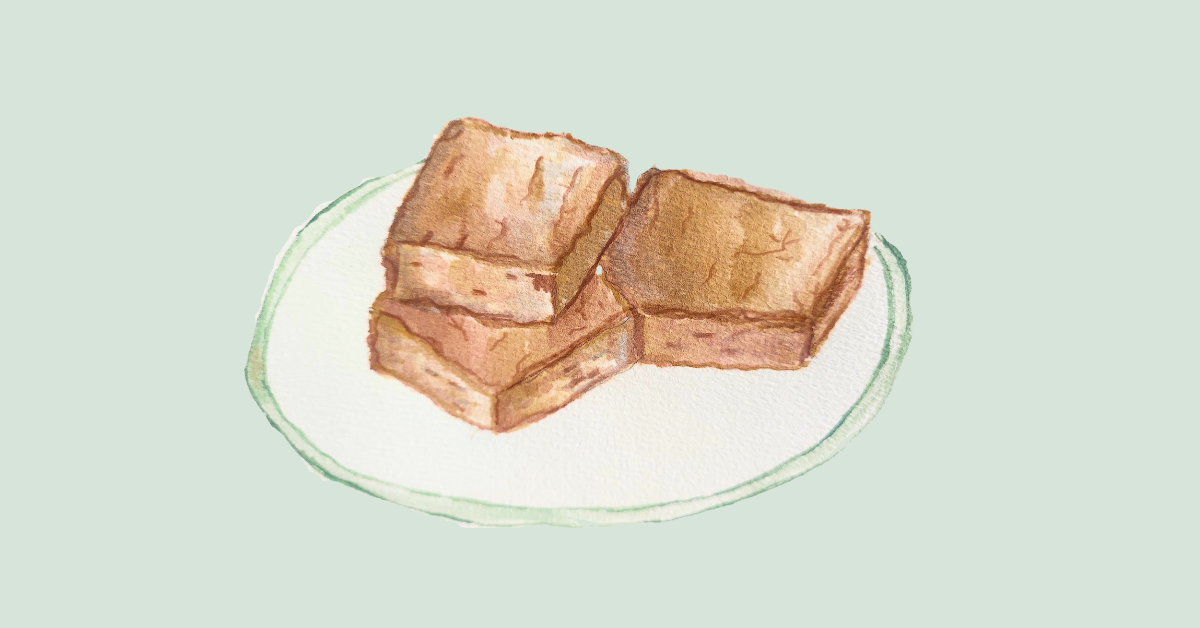

What do we mean when we say “brownie”?
Consult the cookbooks. Scroll the baking blogs. Eavesdrop on pastry chefs with laminated dough under their nails. You’ll encounter a kind of linguistic confetti: cakey, fudgy, moist, dense, rich, gooey, chewy. Everyone swears theirs is the platonic ideal. But here’s the quiet problem: many of these descriptors cancel each other out. Can something be truly cakey and chewy? Light and dense? Lofted and molten?
At a certain point, the brownie starts to feel like a personality test you’re failing. So let’s say this plainly: a brownie cannot be everything. It has to choose a lane. A great brownie isn’t maximalist. It’s decisive. It knows what it is and leans all the way in.
This week, we’re choosing.
So. The only brownie I want.
She is fudgy, but not molten. If you lift a square from the center of the pan, it should hold itself together with quiet dignity — no flopping, no folding, nothing that resembles a dachshund being scooped up stomach-first. Structure matters.
She is decidedly bittersweet. Not cloying, not milky, not trying to be liked by everyone at the bake sale. The chocolate should feel deep and adult, the kind that lingers at the back of your tongue.
There must be salt. Not a polite whisper, either. A noticeable bite. A flicker that sharpens the sweetness and makes you reach instinctively for another square. And finally — non-negotiable — the top. That thin, shiny, papery crinkle. The iconic shell that fractures just slightly under your knife, giving way to the dense interior beneath. If it doesn’t glint in the light, I’m not interested.
This is the brownie we’re making.
Now, a brief digression, because I feel strongly about this.
Want more great food writing and recipes? Sign up for Salon’s free food newsletter, The Bite.
I also believe, deep in my 78% cocoa–loving bones, that once you begin adding things to a brownie — beyond chocolate chunks or chips — you are no longer making a brownie. You are making a bar.
Nuts, I suppose, get a diplomatic pass. Your pecans, your crushed peanuts, your walnuts (none for me, I’m allergic). Though in my experience, they tend to dominate the room. Suddenly, it’s a nut dessert with a brownie supporting role. But start folding in coconut shreds, caramel swirls, candy pieces, cookie dough, marshmallows? We have crossed a border. This is a different genre entirely. And that’s fine. Bars have their place.
This, however, is not that.
So how do we get there?
We need your help to stay independent
Not with theatrics. Not with dramatic flourishes. Just five small, deliberate choices that shift the architecture of the brownie — deepening its flavor, refining its texture, sharpening its edges. Here’s what makes the difference.
Coffee instead of water
(Ashlie Stevens ) Coffee pot
Whether you’re working from a box or from scratch, swap cold coffee for water.
Coffee doesn’t make the brownie taste like coffee. It acts as a kind of bass note — amplifying the darker frequencies of cocoa, intensifying its bitterness and pulling it into focus. The chocolate tastes more like chocolate, less like sugar.
It’s not about adding a flavor. It’s about clarifying one.
Whip the eggs first
That shiny, crinkly top? It isn’t an ingredient. It’s physics.
Beat the eggs and sugar together before adding anything else. You’re dissolving sugar and suspending air — building structure before flour ever enters the room. In the oven, that aerated layer rises and sets into a thin, lacquered shell, delicate but intentional.
Texture isn’t accidental. It’s engineered.
Chunks > chips
I’m a chunks-over-chips person here.
Chocolate chips are designed for stability; they resist melting, cling to their shape. Chopped chocolate — especially a high-quality dark bar — behaves differently. It melts unevenly, creating pockets and streaks that shift from bite to bite.
Uniformity is tidy. Irregularity is interesting.
For brownies, I’ll take interesting every time.
Upgrade the vanilla
(Ashlie Stevens) Vanilla
Vanilla is often treated as background noise. It shouldn’t be. It rounds. It softens the harsher edges of coffee and bittersweet chocolate, adding warmth without sweetness. It’s structural in its own quiet way.
Which is why it’s worth upgrading the vanilla you use. I wouldn’t recommend this if I hand’t done this myself. Recently, I used up my supply of supermarket staple vanilla and splurged a bit on a bottle of Nielsen-Massey Madagascar Pure Vanilla, a favorite of pastry chefs everywhere (and The Barefoot Contessa herself). For reference, a 2-ounce bottle of Great Value vanilla is about $6; this stuff comes in at $10.99 for two ounces.
It’s deep and complex and almost toasty. Is it essential? No.
But when you’re building something precise, even the quiet ingredients matter.
Two salts
Two words: two salts.
Fine salt in the batter for internal balance.
Flaky salt on top for external contrast.
The fine salt integrates; the flaky salt disrupts. That sharp crystalline hit against the fudgy crumb makes the chocolate taste deeper. Not sweeter, but more dimensional. I’ve heard flavor described as tension between ingredients; this is the tension.
None of these moves are flashy. Together, they create a brownie with edges — and intention.
Here’s the recipe:
Ingredients
For the batter:
-
10 tablespoons (140g) unsalted butter
-
6 ounces (170g) high-quality dark chocolate (70–78%), chopped
-
3 ounces (85g) additional chopped dark chocolate
-
¾ cup (150g) granulated sugar
-
¼ cup (50g) light brown sugar
-
2 large eggs, room temperature
-
2 tablespoons cold brewed coffee
-
1 teaspoon high-quality vanilla extract
-
⅔ cup (80g) all-purpose flour
-
¼ cup (25g) Dutch-process cocoa powder
-
½ teaspoon fine sea salt
For the finish:
- Flaky sea salt
Directions
- Preheat oven to 350°F. Line an 8×8-inch metal baking pan with parchment, leaving an overhang for lifting.
- In a heatproof bowl set over barely simmering water — or in short bursts in the microwave — melt the butter and 6 ounces chopped chocolate together. Stir until smooth and glossy. Let cool slightly. Warm is fine. Hot is not.
- In a separate bowl, beat the eggs, granulated sugar, and brown sugar with a hand mixer for 3–4 minutes, until the mixture thickens and lightens slightly in color. This step dissolves the sugar and incorporates air — the foundation of that shiny, crackly top.
- Whisk the coffee and vanilla into the slightly cooled chocolate mixture. Slowly pour the chocolate into the whipped egg mixture, folding gently but thoroughly. Sift in the flour, cocoa powder, and fine salt. Fold just until combined — no streaks, but do not overmix. Fold in the remaining 3 ounces chopped chocolate.
- Spread evenly into the prepared pan and smooth the top. Bake for 22–26 minutes, until the top is shiny and crackled, the edges are set, and a toothpick inserted in the center comes out with moist crumbs (not wet batter).
- Immediately sprinkle flaky salt over the warm surface. Cool completely in the pan before lifting out and slicing for clean, structured squares.
This story originally appeared in The Bite, my weekly food newsletter for Salon. If you enjoyed it and would like more essays, recipes, technique explainers and interviews sent straight to your inbox, subscribe here.
Read more
about this topic
