


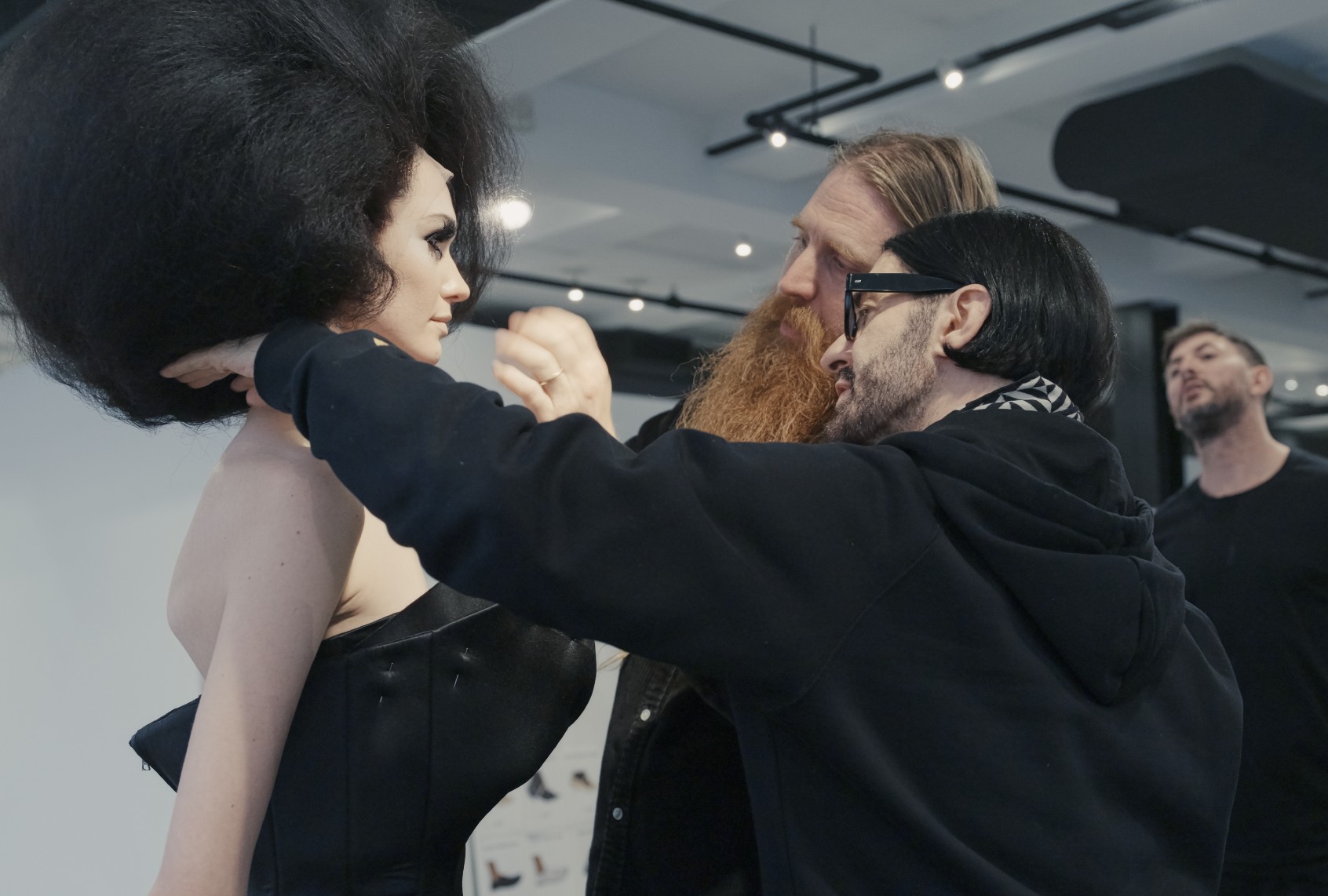
Slumped into folding chairs inside his New York studio, renowned designer Marc Jacobs and his brand’s creative director, Joseph Carter, ponder the mood of Jacobs’ Spring 2024 ready-to-wear collection. Jacobs and Carter had spent days stacking wigs onto more wigs, playing with cartoonishly large shapes from head to toe, trying to see what beauty and accessories might look best with the collections’ oversized garments. Behind the camera, Jacobs’ friend and occasional creative collaborator, Sofia Coppola, asks whether they’re favoring a serious look, or something more eccentric — in line with Jacobs’ reputation. “We’re leaning towards entertainment,” Jacobs says, before a wry smile creeps onto his face. “And joy.”
Fusing couture-level spectacle with crowd-pleasing performance has long been Jacobs’ M.O. Since his early days designing for Perry Ellis, fresh off a winning showcase at the Parsons School of Design’s end-of-term fashion show, Jacobs has relished throwing a wrench in the system. In the early ’90s, a distinct penchant for mischief and a grittily glamorous New York edge quickly earned Jacobs the moniker of fashion’s bad boy. High-end and low-end customers alike adored his frisky, unpredictable spirit — both on and off the runway. And with the new millennium fast approaching, the consumer needed Jacobs’ brand of sartorial insouciance. If the calendar was going to reset, why couldn’t personal style do the same? No one in fashion was as trend-averse as Jacobs. He could be the progenitor of a new look, a Christian Dior for the modern woman. If the customer wanted cool, Jacobs would be their shepherd, skipping hand-in-hand with them into the future with abandon.
(A24) “Marc By Sofia”
As its title suggests, Coppola’s film is less about Jacobs himself and more about how she sees him, and why she loves him. She’s uniquely capable of showing what makes his work special without ever having to tell us.
Coppola knows a thing or 40 about cool, too. Stints in modeling and photography helped the heiress to the Coppola filmmaking dynasty forge her own path in the ’90s, one that stretched through New York’s Lower East Side all the way to magazine cut-out collages, plastered onto every artsy teenager’s wall. By the time Coppola readied her pivotal first film, “The Virgin Suicides,” Jacobs was crowned the powerhouse creative director of Louis Vuitton, tasked with infusing a stale heritage luxury brand with youthful energy. Together, Coppola and Jacobs dominated and defined what indie style looked like at the turn of the century. Any cultural discussion of that era isn’t complete without mentioning them both in the same breath.
That kinship is what makes Coppola’s first documentary, “Marc by Sofia,” such a thrill — and also what occasionally holds the film back. This is not a documentary feature stuffed with detailed historical context, talking heads contemplating Jacobs’ impact, and stretches of runtime devoted to quietly pondering what legacy looks like in an ephemeral business. In fact, the film doesn’t even crack 90 minutes. It’s a swift portrait, painted with an old, fanned-out brush. At times, it almost feels too intimate, as if there’s a familiarity between filmmaker and subject that’s so innately present throughout filming that Coppola forgets not every viewer will come equipped with the same knowledge.
But this rambling structure is also what gives “Marc by Sofia” its edge. Here, Coppola brings her respectable, confident disregard for the outsider’s opinion to the documentary format, churning out a film that feels proud but not pretentious. Her affinity for her subject — an undisguised bias most documentary filmmakers would try to avoid at all costs — is her great advantage. As someone who was not just observing the indie, cool-girl scene, but part of it, Coppola knows all of the right references to call on, clips to pull and songs to license to immerse the viewer in a bygone era. As its title suggests, her film is less about Jacobs himself and more about how she sees him, and why she loves him. She’s uniquely capable of showing what makes Jacobs’ work special without ever having to tell us. As far as fashion documentaries go, “Marc by Sofia” is an ideal punk rock companion to Jacobs’ grunge-driven ethos.
Want more from culture than just the latest trend? The Swell highlights art made to last.
Sign up here
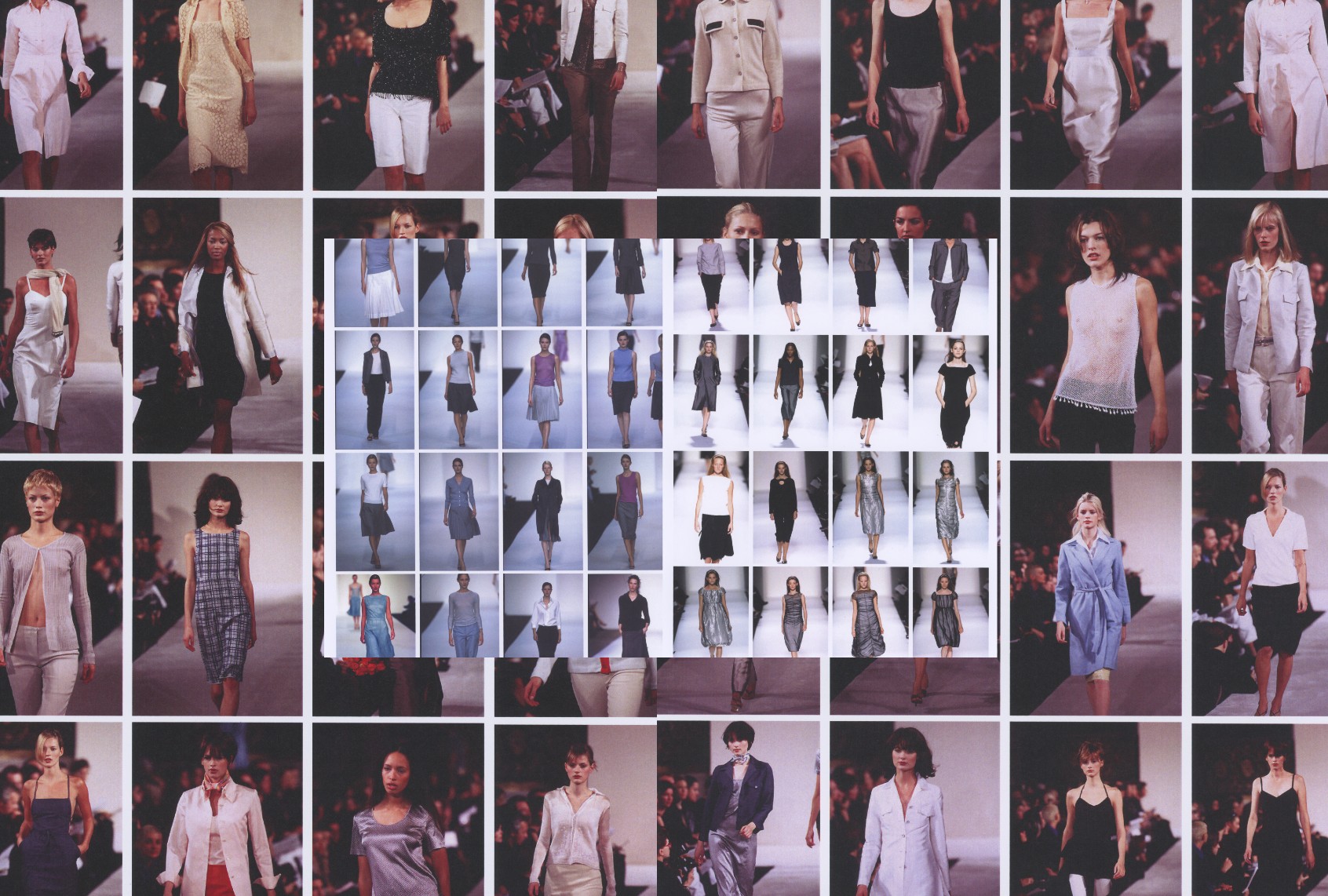
A shabbier perspective is integral to any depiction of Jacobs’ work. While his name may be synonymous with architectural high fashion now, Jacobs’ grunge collection at Perry Ellis was responsible for defining an entire decade’s sense of style, and making the designer garment feel accessible for a new generation. Flannel, knits and leather were Jacobs’ playthings. He worked with textiles and shapes that could be molded and modified for the consumer’s personal style. A Perry Ellis item could complement an existing wardrobe rather than requiring the customer to rebuild their entire closet to fit a single expensive statement piece. And while it didn’t exactly fly off the shelves, its concurrence with the height of the Seattle grunge music scene made the disheveled aesthetic a street-style must-have. Critics were less effusive. Writing for The New York Times, Bernadine Morris famously mused that the collection looked “as if it were put together with the eyes closed in a very dark room.”
The grunge collection may have helped define the era’s style and, in later years, proven Jacobs’ visionary status. But when Jacobs left Perry Ellis shortly after, the narrative that Jacobs was fired from his post was spun in the press, and the story has proliferated ever since — occasionally by Jacobs himself. It’s here where Coppola’s proximity is paramount. When she asks about Jacobs being axed from the brand, he reveals that it’s not entirely true, but that it is an account he enjoys playing up and going along with.
(A24) “Marc By Sofia”
“Marc by Sofia” is a deceptively heartwarming ode to self-expression, and the kind of life that can be cobbled together with an unyielding commitment to individuality.
Whether Jacobs would’ve told this critical detail to another filmmaker is anyone’s guess. But this moment in the documentary isn’t about the revelation itself. Rather, what’s notable is how it’s expressed. Jacobs lets the gossip roll off the tongue, like a charming secret disclosed in passing while in line for the club, just before the bouncer lets you in the door and the subject is forgotten again. The ease and modesty present in “Marc by Sofia” sometimes seem perplexing. Surely, these can’t be two artists whose work is so frequently accused of haughty, style-obsessed self-importance? Here, both Coppola and Jacobs are more relaxed than they have been in either of their respective fields in years. Call it the effect of working with people you not only love, but trust.
The film alternates between chronicling the progress of Jacobs’ Spring 2024 show and diving deeper into his vast references and his relationship with Coppola. Funnily enough, the sequences of Jacobs and his crew putting together their next major show — an awe-inspiring collection of oversized, textural garments displayed at the New York Armory — are less captivating than scenes of the two of them shooting the breeze. Left to talk, Jacobs whirls through stories of past, present and future: anecdotes about his grandmother planning her lunch spot around which department store she’d spend the day at, and memories of Bob Fosse films. Coppola’s use of archival footage brings Jacobs’ yarns to life. Watching the film is frequently like stepping into its subject’s head, just as the next show is about to start. Together, they create a documentary that looks like a moodboard colliding with a fashion archivist’s YouTube video essay. You might call it lazy if Coppola didn’t operate with so much assurance. She alone knows the right song to score Jacobs’ tales about defacing the iconic Louis Vuitton monogram — that unforgettable graffiti, another groundbreaking early 2000s calling card — and his collaborations with Haruki Murakami and Pharrell. I walked out of the theater with at least three new songs for my electro-grime playlist.
We need your help to stay independent
I relent that I’m both a lapsed fashion student and someone who spent their adolescence and early teens marveling at Jacobs’ designs and Coppola’s films. I’m the target, the “Marc by Sofia” mark. But I also frequently find that fashion documentaries, while almost always interesting if you enjoy art and process, are not totally compelling. Sometimes, it’s the lack of access that holds filmmakers back; others, it’s the inability to find the point where history, couture and artistry intersect. “Marc by Sofia” doesn’t struggle with either of those points because, by the film’s nature, they never arise. This is very much an inside baseball film — a very pretty, 87-minute piece of esoterism that would’ve made for a banger trivia night theme at the bar by my former fashion school that didn’t card minors.
The film is also a deceptively heartwarming ode to self-expression, and the kind of life that can be cobbled together with an unyielding commitment to individuality. By the time Coppola gets to the Spring 2024 show, she’s skimmed so quickly through a starter pack of Jacobs’ references, collections, legacy, inspirations and humor that it initially feels like we know next to nothing about the clothes themselves. Then, as Jacobs’ self-professed clown shoes, big garments and even bigger hair glide across the runway — and under Robert Therrien’s perfectly fitting, larger-than-life sculptures — one realizes they’ve got just enough information to put together their own reaction. Coppola builds to a big finish that allows any viewer off the street to be enamored with the garments before them. The audience is invited to examine what the clothes make them feel. In under two hours, “Marc by Sofia” gives a crash course in fashion’s endless possibilities. There is entertainment, and there is joy.
Read more
about this topic
