

In one of my favorite abandoned mall exploration videos — a growing subgenre of YouTube content where creators (illegally) enter derelict shopping malls to explore, film and preserve the deserted structures — the team behind the channel The Proper People stumble onto a gold mine. While rooting through the forgotten contents inside the staff office at the Knoxville Center Mall in Tennessee, the channel’s creators, known only as Bryan and Michael, find a rolling cart stocked with vintage photo albums. Inside, pictures of daily life at the mall from decades past are preserved in perfect condition, organized by date, month and year. For anyone interested in archival media, vintage photography, mall culture or even just plain nostalgia, the discovery is a jackpot. A voice huffs with excitement behind the camera: “We’re going to be here a while.”
There’s a bittersweet irony to that sentiment. In the not-so-distant past, the shopping mall was the premier place for social gathering, a spot where the sweet pull of capitalism united people of all ages and backgrounds. But malls weren’t just a place to buy things; they were structures that housed and enhanced an entire day’s activities. At many a local mall, you could spend hours wandering around from store to store, window shopping here and splurging there, taking a break to grab some sustenance at the food court to fuel you through the sales racks at the next anchor store. In larger locations, like the Knoxville Center Mall, you could even catch a movie or attend high-production events in a sunny atrium, where teen pop stars got their start doing mall tours. You could come with family, friends, or just by yourself. At the mall, you were never alone. You were going to be there a while, and it was exciting.
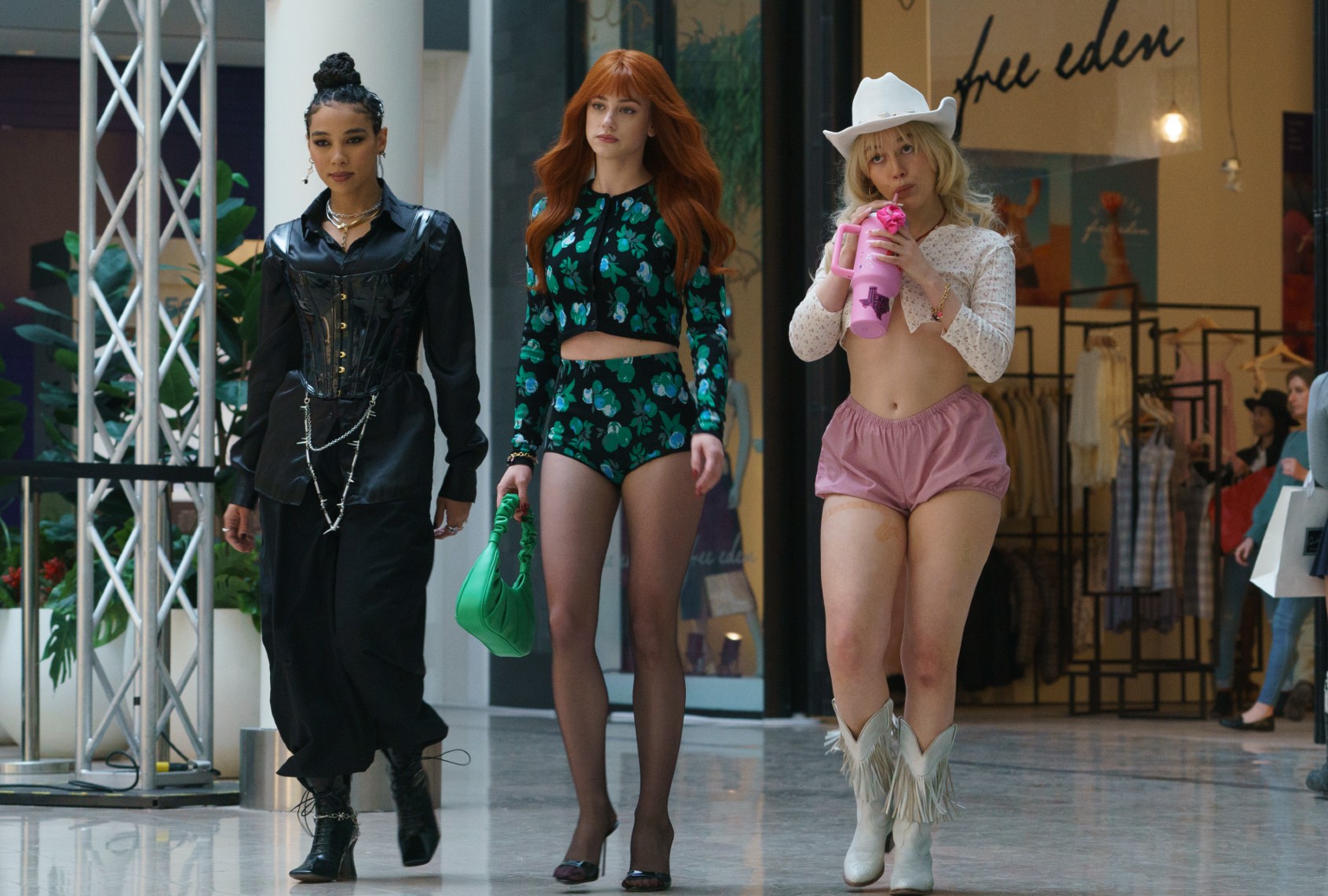
(Sabrina Lantos/Shudder/Independent Film Company) Alexandra Shipp, Lili Reinhart and Victoria Pedretti in “Forbidden Fruits”
While the film is a functional eulogy to the mall before it croaks, “Forbidden Fruits” also serves as a meta indication of how much is at stake if these shopping centers go belly-up, and what we’ll lose with the death of mall media.
The photos in The Proper People’s video depict an even more idyllic version of this age, when the mall was at its cultural peak. There’s a well-attended haunted house put on by D.A.R.E. during the Halloween season, flanked by an entire pumpkin patch in the atrium. A page labeled “Mall Walkers’ Meeting,” dated September 1990, shows at least 50 early-morning speed walkers gathered in the food court. A fashion show showcasing the spring’s new looks available in the mall’s stores. Christmas decor from floor to ceiling. In the comments, the mall’s former patrons and employees reminisce about the structure’s glory days. One person remembers their first kiss outside the mall’s movie theater; another remembers bringing their children to the mall because the kids loved the play areas. One commenter even spotted themself in a photo from one Halloween decades prior, dressed up as a train conductor when kids were invited to come to the mall in costume. Countless memories and stories exist in the pages of these photo albums, left to rot in one of the many American malls scheduled for demolition after dying a slow, painful death.
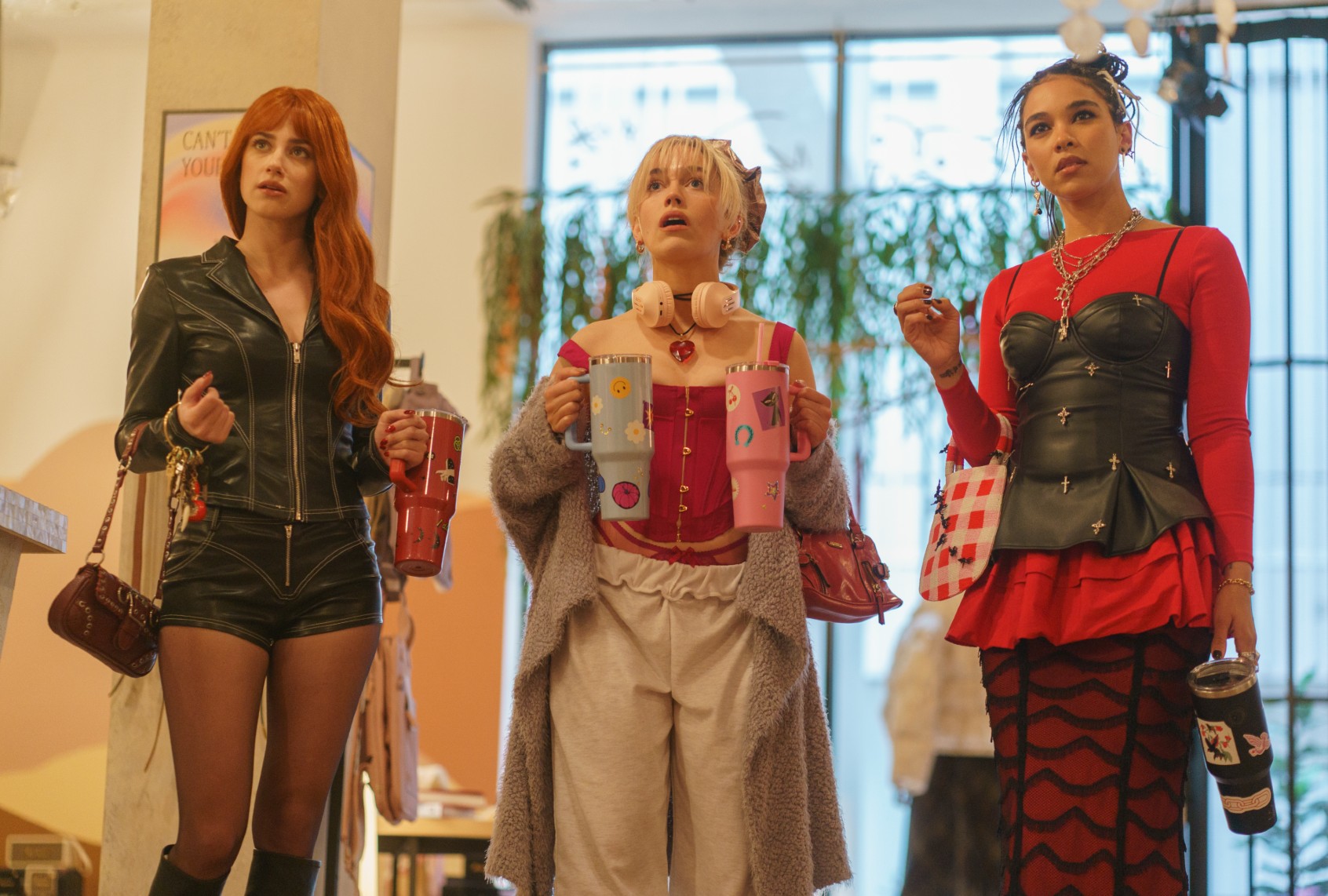
Caught in the dull, gray purgatory between the mall’s heyday and its eventual demise is “Forbidden Fruits,” Meredith Alloway’s strange but undeniably charming horror-comedy, set entirely in a Texas shopping center. At a Brandy Melville-meets-Anthropologie womenswear store called Free Eden, four fruit-named employees — Apple (Lili Reinhart), Cherry (Victoria Pedretti), Fig (Alexandra Shipp) and new hire Pumpkin (Lola Tung) — operate an amateur coven after hours. Their magic (if you can call it that) is strengthened by the hollow bond of performed femininity; being a staunch girls’ girl is the key to untold power and fruitful retail employment.
As a wannabe cult classic, the film is too self-aware to connect as effortlessly as its uber-b*tchy, ’90s-era cinematic influences, “The Craft” and “Jawbreaker.” But as a mall movie, “Forbidden Fruits” blisteringly reflects the liminal, antisocial space the shopping mall has become — a cold, crumbling shell of its once welcoming atmosphere. Alloway highlights and amplifies the transient feeling of walking around a mall in 2026, positioning it as a place where all sorts of unnerving things can happen. While the film is a functional eulogy to the mall before it croaks, “Forbidden Fruits” also serves as a meta indication of how much is at stake if these shopping centers go belly-up, and what we’ll lose with the death of mall media.
Depending on which sources are consulted and how their data is collected, the number of remaining malls in the United States differs. Some analysts examine local, smaller malls alongside large-scale structures, while others only account for “mega malls,” those multi-level behemoths that look like mausoleums to American consumerism. But if we’re talking climate-controlled buildings with concourses and storefronts, most agree there are fewer than 1,000 shopping malls still operational in the United States, with a 2025 report in The New York Times predicting 10-20 mall closures per year. A steady decline in foot traffic has led to increased retail space vacancies, exacerbated by factors such as the pandemic, e-commerce and consistent economic uncertainty. If you’ve been to a shopping mall recently and are old enough to have experienced the mall in its cultural and social prime, you’ve no doubt witnessed a stark difference in ambience.
Want more from culture than just the latest trend? The Swell highlights art made to last.
Sign up here
Filmed largely during off-hours at Toronto’s Sherway Gardens mall, “Forbidden Fruits” deftly captures the eerie feeling of wandering around a modern shopping center. Most active malls have been redone with the steely, impersonal decor of your average fast-food chain: Gray brick and stone surfaces lit by white LED lights and the occasional blast of sunlight leaking in from a skylight in the atrium. Long-gone are the days of tacky yet charming fake foliage and carpeted surfaces with the smell of an Auntie Anne’s pretzel kiosk permanently embedded into their fibers. Everything is modernized to the point of uniformity for the sake of saving money and labor hours. Here, Free Eden’s leading sales team stands out with a dress code of bright colors, pretty patterns and suggestive midriffs. They’re sirens beckoning mallgoers into their store, universally feared and respected by other mall employees.
The teenage politics of mall culture have long been a staple of mall media. Films like “Fast Times at Ridgemont High” and “Mallrats” wonderfully recall how high school diplomacy made its way over to the mall after the final bell rang. There, bullies could co-mingle with their targets in a safer space. Popular kids could taunt the nerds from afar, and vice versa. The mall was the place where note-passing flirtationships culminated in first dates and bad kisses. Many students worked after-school retail jobs alongside college-age managers barely older than their subordinates.
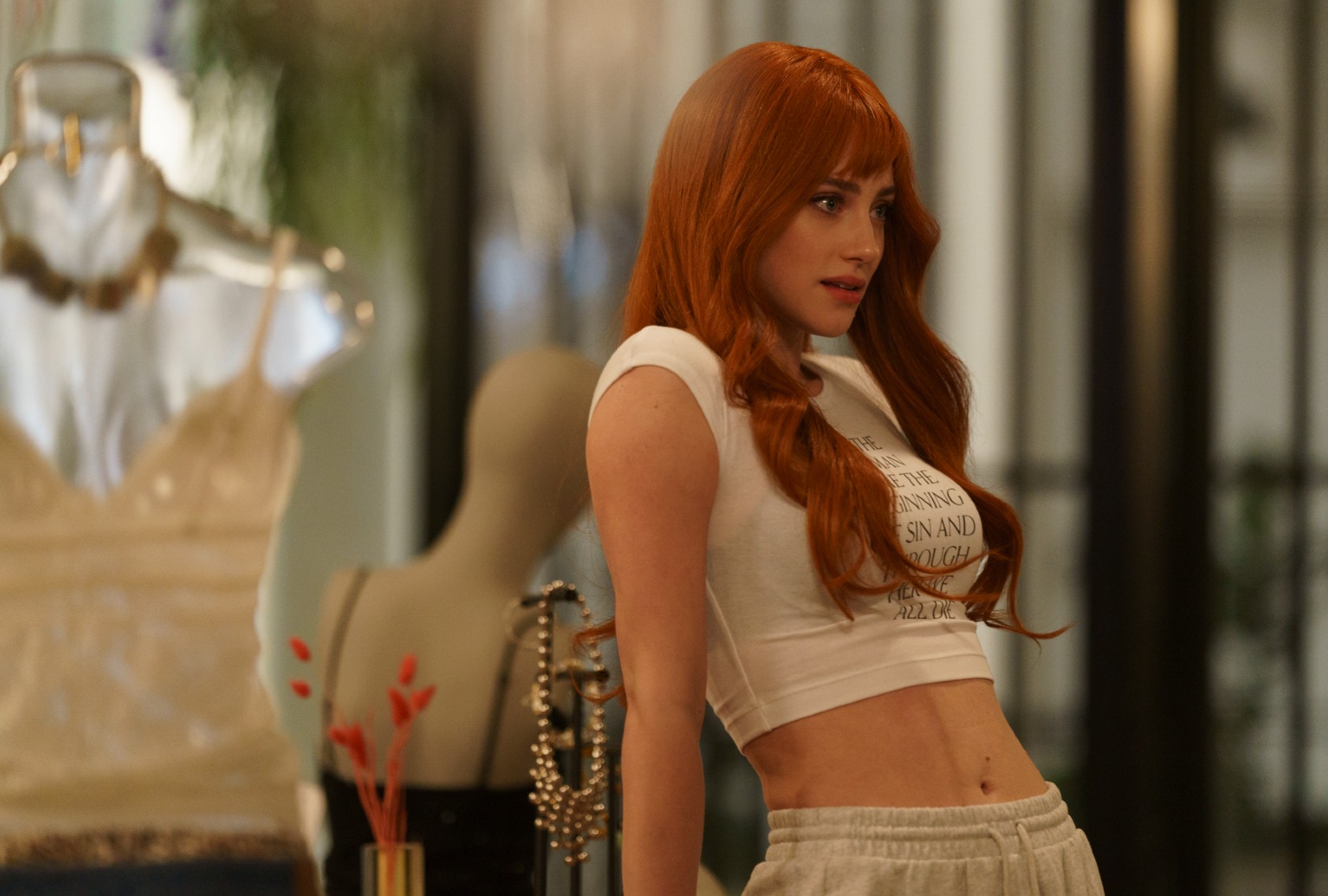
(Sabrina Lantos/Shudder/Independent Film Company) Lili Reinhart in “Forbidden Fruits”
Alloway’s film sees the modern mall as a shrine to what the shopping center once was in American culture, a place where identity could be bought, sold and performed. Malls used to be social watering holes, but they were also symbols of America’s limited definition of what was trendy and cool.
If the mall was once a haven for young people, “Forbidden Fruits” makes it look more like Hell. The Free Eden girls, led by the acid-tongued Apple, exploit the mall movie tropes of yesteryear, pushing them to outsized, overdramatic limits. At first, the group wants nothing to do with Pumpkin, whose job at the pretzel shop Sister Salty’s makes her a pariah for the mall’s cool girls. But when they discover she’s also named after a fruit, it feels like fate, and Apple wastes no time inducting Pumpkin into their makeshift coven, operating in the mall’s basement. There, the four young women practice light magic by pouring fruit juice, blood and a single tear into the season’s newest footwear and drinking from their stylish cauldron.
“Forbidden Fruits” isn’t so much about the power of the coven’s magic as it is the influence the coven has on one another — think “The Craft” without all the hair falling out, slithering snakes and levitating bodies. They’re united by their fabricated girl code, which also happens to be similar to Free Eden’s capitalistic ethos: Care for your fellow woman, lift her, don’t let her be defined by men. It’s wokeness commodified, and the Free Eden customer literally buys into this idea that the principles of womanhood are dictated by the clothes one puts on their back. Each woman in the coven has a distinct archetype that she’s covertly discouraged from straying from, lest she suffer the consequences. Want to be an individual? Buy this, act like that. With a simple set of rigid guidelines, you too can become your own person.
Alloway’s film — co-written by Lily Houghton, who penned the off-Broadway stage play the movie is based on — sees the modern mall as a shrine to what the shopping center once was in American culture, a place where identity could be bought, sold and performed. Malls used to be social watering holes, but they were also symbols of America’s limited definition of what was trendy and cool. It’s no coincidence that in George A. Romero’s 1978 film “Dawn of the Dead,” the zombie apocalypse reaches the mall, just as the mall itself was achieving new popularity. The undead may be searching for fresh flesh hiding out inside the mall, but watching these zombies mindlessly wander into retail paradise is the perfect metaphor for consumerism.
Nearly 50 years later, the mall looks much different, but its purpose is the same — more conspicuous, even. Apple, Cherry, Fig and Pumpkin are groundskeepers at retail’s graveyard, tasked with crafting fulfilling lives for themselves in a dead-end job that could be extinct within 30 years. It’s a map to nowhere, and without enough customers to keep their shifts busy or mall events to distract them, even the group’s popularity within the shopping center’s employee culture has a ticking clock on it. The women are left to fill their days swiping at each other until it turns lethal. It’s smart, but not cleverly written. Still, though the editing is choppy and the thin narrative is incongruous, these shortcomings allow “Forbidden Fruits” to feel like an appropriately robotic testimony to what going to the mall is like today.
We need your help to stay independent
A few years back, I stumbled upon a mall in Massachusetts that many would term a “dead mall,” referring to a lack of anchor stores and retail space housing the strangest stores imaginable. This was in early spring, and a prom dress store had popped up in one of the available shops. One look inside chilled me to the bone. Every garment stood there, hung under fluorescent lights and individually wrapped in plastic like Laura Palmer. There wasn’t a single employee in sight, let alone any customers. The sight of the store, and the manufactured memory of what this mall might’ve looked like at its peak, ruined my day. Things — even the most banal things — change faster than we’re ever prepared for.
Older films set inside malls at night, like “Dawn of the Dead,” “Chopping Mall” or “Night of the Comet,” feel so disconcerting because we were once so used to seeing malls in their bustling prime. One used to have to prepare for weekend Christmas shopping at the mall like they were heading to war. Now, most malls — even the semi-busy ones, the locations that are still doing alright — have this melancholic liminality. The massive, visually arresting structures and unique architecture that offered filmmakers so many opportunities for mall-set movies are almost all gone. We’ve already lost a visual touchstone of cinematic culture, and with it, all the fantasies that the mall could represent within any given narrative. And if the American mall does die for good, we’ll even lose the charming, strange films like “Forbidden Fruits,” that survey the slow demise.
While that inevitable reality greatly depresses me, the eventual death of the mall movie isn’t all bad. There’s value in being able to track the lifecycle of something that came and went within our lifetimes, that was once so culturally prominent but faded faster than we ever expected. Watching the collapse of the mall in real time helps us appreciate things in the moment, rather than being so lost in the retail high that we can’t ever come down. And in the meantime, our memories of the mall persist and grow even rosier through indie film tributes or YouTube exploration videos. Time, as cruel as it is, has a way of making everything beautiful.
Read more
about films that make us nostalgic
