
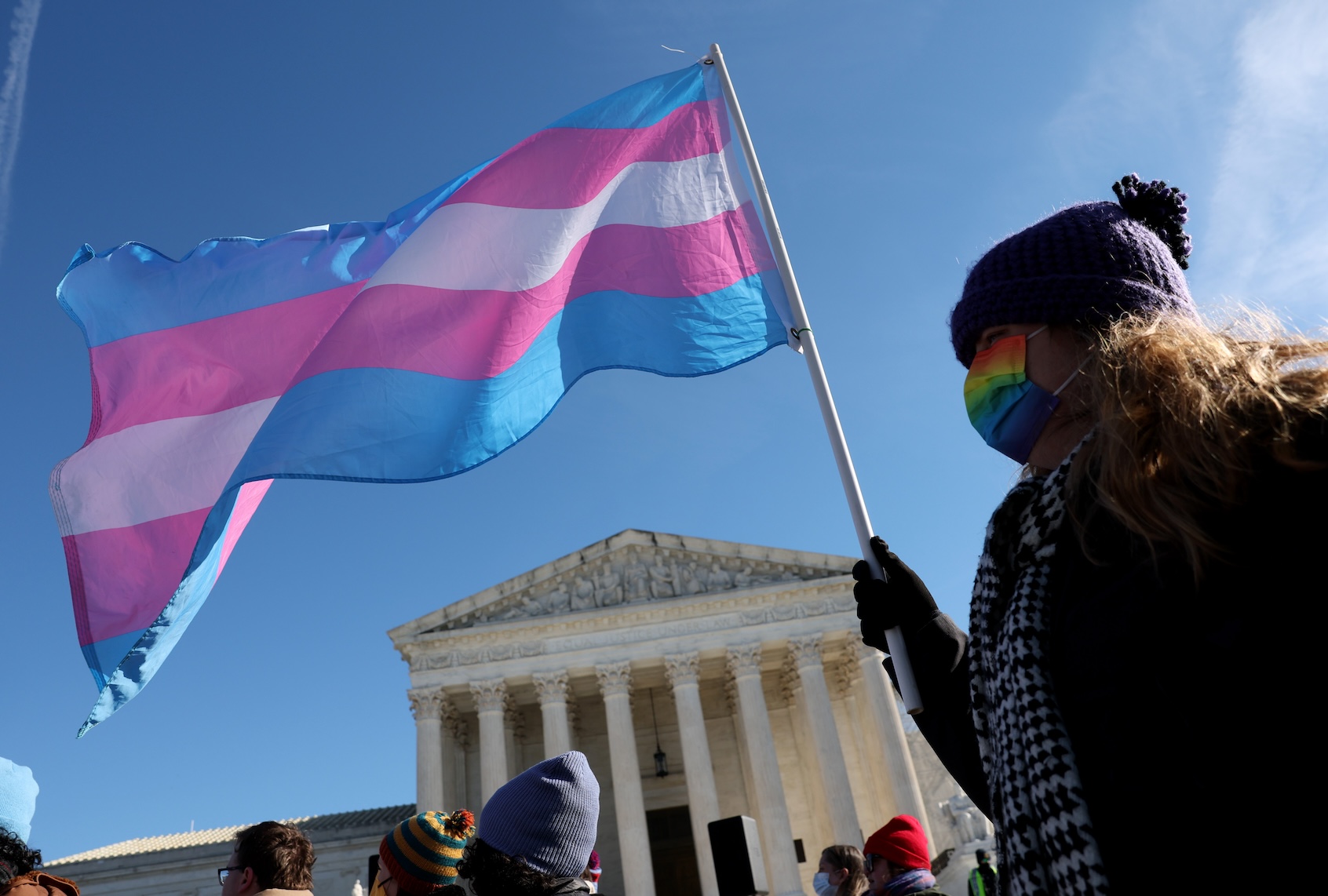

Policy over transgender Americans’ rights is poised to become a key wedge issue during the midterms, and Democratic politicians are already ducking and dodging clear positions. But without concrete stances, the party stands to lose more base voters, strategists say.
“The backsliding shows voters exactly who’s willing to fight and who isn’t,” said Tyler Hack, the founder and executive director of Christopher Street Project, a political action committee that endorses candidates with commitments to protecting trans rights. “Some Democrats soften or side step trans rights. It doesn’t read as strategic. It reads as hesitation in the face of coordinated attacks. Voters, especially young voters and folks in the party space, can tell the difference between leadership and retreat.”
Democrats’ messaging on transgender policy has only become more abstract as politicians gear up for the November midterms and the 2028 election cycle. Democrats in the Senate last month blocked an amendment of the contentious voting identification bill, the SAVE America Act, that sought to bar transgender athletes in women’s sports. Nonetheless, politicians — especially potential 2028 candidates — are still evading questions around trans rights issues.
California Gov. Gavin Newsom, has recently come under fire for his moderation on transgender policy, despite having positioned himself as a staunch LGBTQ+ ally throughout his tenure and signing dozens of bills aimed at increasing protections for LGBTQ+, and specifically, trans Californians.
Last year on his podcast, Newsom spoke with right-wing influencer Charlie Kirk, saying that letting trans women and girls compete on sports teams reflective of their gender identity is “deeply unfair.” He’s since defended and repeated this sentiment. In October, the California Democrat vetoed a bill that would have required insurers to cover and pharmacists to prescribe 12 months of hormone therapy at a time to transgender patients over its potential to raise health care costs, sparking outcry from LGBTQ+ advocates. Newsom also called on the party to be “culturally normal” during a February interview, urging it to stop “spending a disproportionate amount of time on pronouns” and identity politics.
A spokesperson for Newsom told the Advocate that the governor’s “comments and unmatched history supporting the LGBTQ community speak for themselves.”
“When leaders who are supposed to be allies go quiet or change the subject, it doesn’t feel theoretical. It feels like we are being left behind because we are being left behind.”
As high-profile Democrats like Newsom waiver in their transgender rights advocacy, the landscape for trans Americans grows increasingly hostile. In March, Kansas retroactively invalidated IDs and birth certificates of transgender residents, while last year Iowa struck down anti-discrimination protections by removing “gender identity” as a protected class under the state Civil Rights Act. Utah even considered a bill seeking to ban public funding for gender-affirming care for both adults and minors earlier this year. On March 31, which is International Trans Day of Visibility, an Ohio Republican introduced a broad-reaching state bill that includes bathroom restrictions, name and pronoun restrictions and more.
“Trans people aren’t abstract in this conversation,” Hack told Salon. “We’re watching state houses strip away health care, safety protections and basic rights in real time, so when leaders who are supposed to be allies go quiet or change the subject, it doesn’t feel theoretical. It feels like we are being left behind because we are being left behind.”
Newsom’s rightward creep on trans rights stems from that existing strategy for Democrats, one that’s quickly failing the party, said John Neffinger, a Democratic strategist and political consultant at Democracy Partners.
“For years, Democrats’ messaging on transgender rights was either evasive — which suggested there was some problem there Democrats couldn’t deal with — or accusatory — which suggested Democrats thought anyone who had concerns about how transgender issues were being handled was ignorant or bigoted,” he told Salon. “Running away from problems and looking down on people are not what people want from their government.”
Start your day with essential news from Salon.
Sign up for our free morning newsletter, Crash Course.
Republican attacks of transgender rights issues, then, are “more about Democrats than they are about transgender people,” he added. “No amount of Republican spending or campaigning will make most non-trans Americans feel that transgender rights policies are important to their daily lives. But Republican attacks on transgender issues can make Americans think Democrats are out of touch with their priorities.”
The GOP’s use of Democrats’ support for trans freedoms as a political cudgel came to a head during the 2024 election cycle, when Republicans spent more than $200 million in ads attacking then-presidential candidate and Vice President Kamala Harris’s support for trans rights. The Trump campaign itself spent some $17 million on ads criticizing Harris’ support of laws requiring access to gender affirming care for inmates, claiming Harris was for “they/them” and “not you.”
While Harris herself had criticized the ads as a distraction meant to stoke fear in voters, her campaign largely failed to officially address them or run counter ads. Response ads the campaign did draft, the New York Times reported, tested poorly in focus groups and were never aired.
“Democrats did a terrible job of dealing with these issues, mostly because they wouldn’t engage with them at all,” said Lanae Erickson, the senior vice president for social policy and politics for center-left think tank Third Way. “There was so much fear around saying anything at all that the caricature that the Republicans were creating around Democrats stuck.”
“Democrats did a terrible job of dealing with these issues, mostly because they wouldn’t engage with them at all.”
In the aftermath of Harris’ electoral defeat, other moderate Democrats characterized the party as too willing to abandon the middle-ground American for left-wing positions, naming transgender athletes’ participation in sports specifically. Reps. Tom Suozzi, D-N.Y., and Seth Moulton, D-Mass., were among those who sought to blame the party’s 2024 defeats, in large part, on its desire to be politically correct and refusal to state that trans girls shouldn’t play in girls’ sports. These claims were unsubstantiated as post-election polling shows that transgender policies are were often ranked low in priorities for surveyed voters.
Because of their responses, Republicans have decided that attacking Democrats over their support for transgender rights is an effective turnout mechanism for the GOP, especially in an election year when President Donald Trump isn’t on the ballot, the Epstein files release has sparked intense outrage, and policies on immigration, the war in Iran and the economy have alienated so many Americans, Erickson told Salon.
“There are at least six states, probably more, that are likely to have anti-trans initiatives on the ballot because Republicans have realized that their base isn’t particularly energized,” she said.
Erickson suggested that Democrats take a play from Virginia Gov. Abigail Spanberger’s campaign while the time is right. Spanberger, who beat out her Republican opponent during the 2025 election by around 15%, anticipated the anti-trans attacks her opponent would wield against her. The Virginia Democrat purchased ads that got ahead of the attacks by establishing her as a fighter who would protect all of Virginia’s children and spent some $6 million on response ads that addressed her opponent’s claims without throwing transgender Americans under the bus.
“It wasn’t just that those attacks didn’t work. It’s that she was prepared for them and ready to respond that got her through that race,” Erickson said.
We need your help to stay independent
The current landscape also suggests that Democrats can put that strategy to work while Americans sit at an impasse. Polling from Democratic think tank Searchlight Institute found that 70% of voters, including majorities of Republican and Trump voters, support anti-discrimination protections for trans Americans and around 67% support access to gender-affirming care for adults.
But a majority of respondents also have greater reservations in their support of hot-button transgender rights issues regarding children, with 56% believing schools should inform parents if a child questions their gender identity, 58% supporting policies requiring trans athletes to compete on teams matching their birth-assigned sex and 61% supporting restricting minors’ access to hormone treatments and puberty blockers.
Even as Americans splinter on these issues, January Fox News polling’s indication that voters overwhelmingly trust the Democratic Party to handle transgender rights issues over the GOP — 60% to 80% — demonstrates just how important it is that Democrats actually address the issues this election cycle, Hack said.
“What we’re seeing is that supporting trans people isn’t unpopular — it’s that the loudest opposition has gone unanswered in some places,” Hack said. “When leaders clearly make the case grounded in freedom, safety and dignity, voters respond. But when they hedge, it creates a vacuum that bad actors fill.”
“It’s up to our party to to fight back, lead on these issues, show our voters where our values lie, and win these elections,” Hack added.
Read more
about politics
