
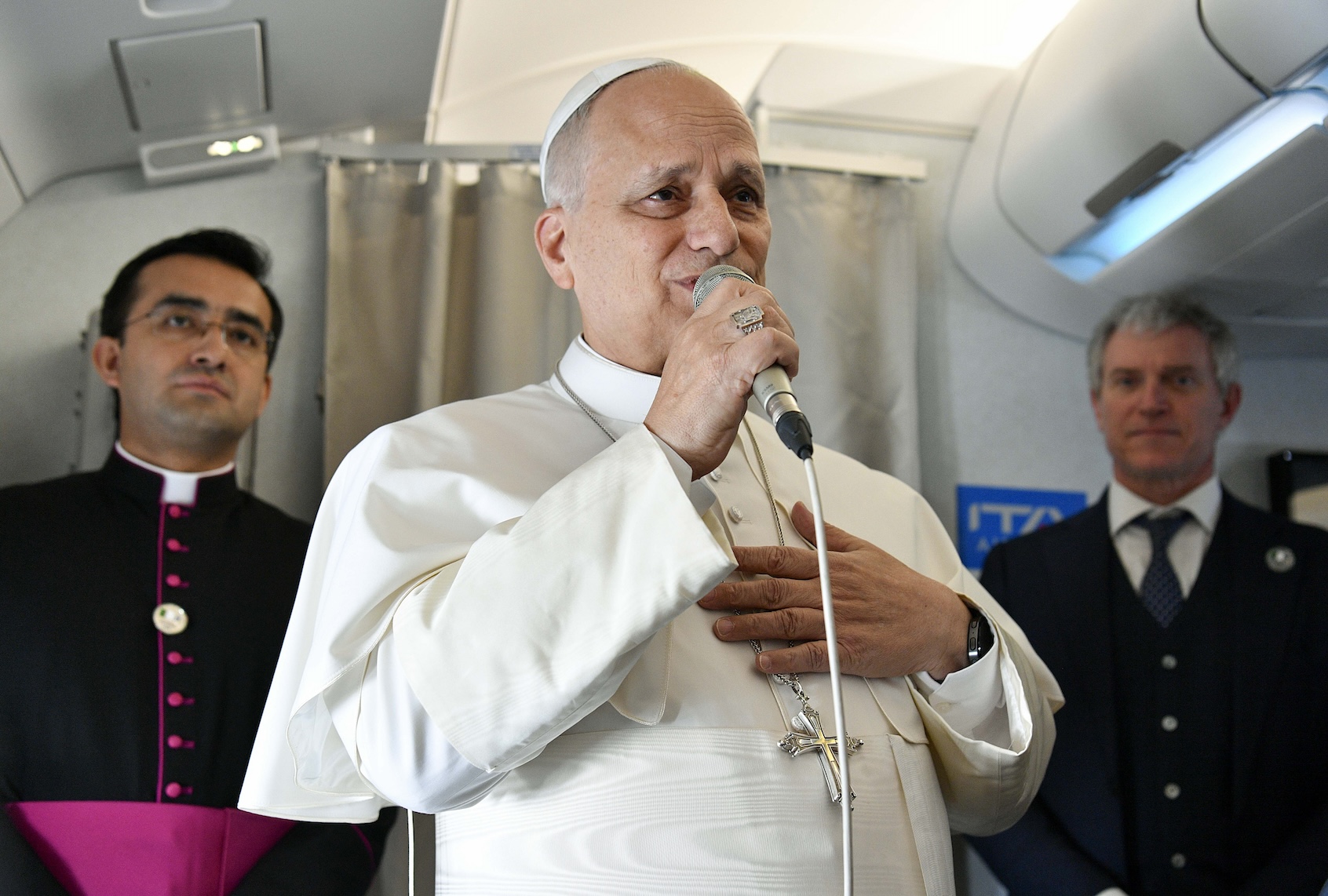

President Donald Trump, whose war with Israel against Iran has drawn criticism from Pope Leo XIV, called the pontiff “weak on crime” and “terrible for foreign policy” in a lengthy Sunday night post to his website Truth Social. Amid growing concerns of Catholic leaders, relations between the president and the head of the Catholic Church hit an all-time low on Monday, with the pontiff saying he has “no fear” of Trump’s scathing remarks, while the president drew intense ire for posting an AI-generated image depicting himself as Jesus Christ.
“I don’t want a Pope who thinks it’s OK for Iran to have a Nuclear Weapon,” Trump wrote, nor does he want “a Pope who criticizes the President of the United States.”
“Leo should get his act together as Pope, use Common Sense, stop catering to the Radical Left, and focus on being a Great Pope, not a Politician,” the president wrote with his typical flair for capitalization.
Leo XIV denied that he had been speaking out against Trump, but rather against the “delusion of omnipotence” that causes wars worldwide.
“I will not enter into debate,” Leo told reporters while on a flight to Algeria Monday. “The message of the Gospel is very clear: ‘Blessed are the peacemakers,'” he said, quoting Matthew 5:9, vowing to seek “ways to avoid war any time that’s possible.”
“I’m not afraid of the Trump administration or of speaking out loudly about the message of the Gospel, which is what the church works for,” Leo XIV said.
However, it was Trump’s posting of himself as Jesus brought about the first calls of blasphemy and heresy. Following his initial post, Trump shared an AI-generated image depicting himself as Jesus Christ healing a sick man, surrounded by faithful Americans and what appear to be angels above him. Trump claimed that it was supposed to be him, “as a doctor and had to do with the Red Cross.”
“It’s supposed to be me as a doctor making people better. And I do make people better,” Trump said on Monday.
The post was later removed after intense backlash, notably from prominent conservatives. Former Republican representative Marjorie Taylor Greene called it “more than blasphemy.”
“It’s an Antichrist spirit,” she wrote on X.
It’s more than blasphemy.
It’s an Antichrist spirit. https://t.co/Lqd9GkBPmO— Marjorie Taylor Greene 🇺🇸 (@mtgreenee) April 13, 2026
Riley Gaines, a conservative activist and vocal opponent of trans rights, expressed shock at the president’s post. “Seriously, I cannot understand why he’d post this,” Gaines said in a post on X. “Does he actually think this?”
Gaines said, “A little humility will serve him well,” warning that “God shall not be mocked.”
The rising tensions between Washington and the Vatican have leading Catholic voices in the U.S. worried about the politicization of faith and a divide within the faithful between the president and the pontiff. When asked for comment, Kelsey Reinhardt, president and CEO of CatholicVote, a conservative political advocacy group, shared a statement on social media with Salon.
“There is no doubt that President Trump’s post insulting Pope Leo crossed, again, a line of decorum that plays an important part in diplomacy and sets the temperature for interactions between the two,” Reinhardt said, adding that Catholics should reject what she called a “narrative” of “the Vatican-vs.-Trump.”
“Too many people are trying to turn a public disagreement into a grand showdown between the two. That is false,” Reinhardt said.
Start your day with essential news from Salon.
Sign up for our free morning newsletter, Crash Course.
Regardless, such a showdown has been festering in the public consciousness since Leo was elected in May 2025, who had criticized the Trump administration’s deportation policies before becoming the Bishop of Rome. The pope has been a vocal advocate for immigrants around the world and has been outspoken in his concerns about climate change, two areas in which he and Trump differ greatly.
One of his first acts as Pope was to call for a ceasefire in the Israel-Gaza and Russia-Ukraine wars, and for humanitarian aid to be given to the “exhausted civilian population and all hostages be freed.” In March, Leo XIV spoke out against those who advocate war in a speech marking the start of Holy Week, in the shadow of the ongoing Iran War.
“God does not accept the prayers of those who choose violence,” he said, invoking Jesus as the “King of Peace.”
Reinhardt said that some of the Pope’s statements are “out of step” with American “political priorities” and are seen by many Americans as taking political sides.
“That does not mean he is ‘anti-American.’ It does not mean he is attacking the United States,” she wrote. “There is no reason this disagreement should become a larger rupture.”
Bill Donohue, president of the conservative Catholic League for Religious and Civil Rights, said that relations between the two “are at a serious juncture” in a statement shared with Salon.
Donohue called Trump’s comments last week about destroying Iranian civilization “reckless” and said Trump’s depiction of himself as Jesus “offensive and immature.”
He said Leo XIV’s desire for peace “is understandable,” though he challenged the pontiff on his prior assertion that peace is “only” achievable through “dialogue.”
“That is simply not true,” Donohue wrote. “Historically, war has frequently resulted in peace, an outcome that comes about when dialogue fails. That is why the Catholic Church is not a pacifist religion — it understands the necessity of ‘just wars.’”
Donohue also called out the pope for his denunciation of Trump’s policies of mass deportation of immigrants, citing 2024 polling that a majority of U.S. Catholics supported the decision. “The American people did vote for mass deportations,” he said, predicting that disagreements between the pope and the president “will continue.”
We need your help to stay independent.
Father Enzo Del Brocco, president of the Catholic Theological Union, of which Leo is an alumnus, said that the two men see the world in “fundamentally different ways.”
“The Christian tradition does not find its hope in domination or force, but in the paradox of the cross,” Del Brocco told Salon. “The Church cannot remain silent when violence is justified in the name of security or when religious language is used to legitimize it,” saying that the church must “defend moral clarity.”
On Monday night, Vice President JD Vance also called on the church to provide moral guidance, but not in the way Del Brocco meant. “It would be best for the Vatican to stick to matters of morality,” Vance said during an interview on Fox News, “and let the president of the United States stick to dictating American public policy.” Vance also defended Trump’s use of himself as Jesus, saying “Of course, he took it down because he recognized a lot of people weren’t understanding his humor in that case.”
Del Brocco stressed that the role of the church is “not to align itself with power, but to illuminate it with the moral demands of the Gospel.”
“When the language of faith is invoked to support power or conflict, Christianity risks contradicting its own center. The role of the Church is not to sanctify political agendas, but to recall every society — especially in moments of crisis — to the dignity of every human person and to the demanding path of peace.”
Read more
about Pope Leo XIV
