

For every academic discipline, there’s something the public can’t get enough of that drives specialists nuts. If you’re an astronomer, it’s people confusing what you do with astrology. If you’re a researcher in psychology, it’s the popularity of the Myers-Briggs personality test. And if you’re an historian of ancient Greece and Rome, like I am, it’s the steady stream of comparisons between the modern world and the Roman Empire.
These analogies simplify more than they explain. They merely project modern anxieties onto the canvas of an imagined ancient Rome. And they’re so common that, most of the time, all you can do is roll your eyes and move on.
That’s harder to do when a major politician brings up Rome as a way to comment on Donald Trump’s war of choice in Iran. Just because such comparisons are almost laughably inept doesn’t mean they don’t have real world stakes.
The politician in question is former British Prime Minister Rishi Sunak, who wrote an op-ed in The Times of London titled “To save the West, remember what Romans taught us.” He doesn’t exactly endorse the Iran war in his essay, although he had earlier expressed regret that “Britain had no affirmative role in the planning or execution of this operation.” But Sunak doesn’t condemn it either. Instead he uses the war as a pretext for urging modern Britain to “accelerate munitions production” in preparation for a “European War” whose antagonists remain largely unspecified. He concludes with a turn to Rome: “If we do not want the West to decline and fall, it is time to remember what the Romans taught us: si vis pacem, para bellum (If you want peace, prepare for war).” A tumultuous and dangerous present, the former prime minister’s reasoning goes, calls for timeless wisdom.
The Latin slogan Sunak cites is familiar enough: It gave its name to the world’s most popular handgun ammunition and to the third installment of the hyper-violent “John Wick” movie franchise starring Keanu Reeves. But it’s a stretch to say that this is something “the Romans taught us.” For one thing, the slogan, as it’s commonly quoted, doesn’t appear in any ancient text. And the work it’s adapted from, Vegetius’ treatise on military theory, was written toward the end of the 4th century C.E. at a time most historians would describe as a period of “decline and fall” — the very thing Sunak seeks to avert — casting further doubt on the credibility of this advice.
But with the kinds of munitions that Sunak seems to covet currently killing thousands of people in the Middle East, I’m less interested in whether his adaptation of Vegetius’ treatise is good history or good advice than in what such citations accomplish rhetorically for those who deploy them.
Sunak’s essay pairs hawkish foreign policy analysis with patriotic nostalgia for how the Royal Navy used to maintain Britain’s position as a “global hegemon.” There’s a grim irony in the child of colonial subjects idealizing the institution that delivered British troops to subdue his ancestors’ homeland. But just as the administrators of the British Empire used the model of Rome to frame its violent colonial occupation as a beneficent, civilizing presence, Sunak’s reference to the alleged wisdom of Roman militarism attempts to lend prestige and dignity to his geopolitical saber rattling and fear mongering.
Want more sharp takes on politics? Sign up for our free newsletter, Standing Room Only, written by Amanda Marcotte, now also a weekly show on YouTube or wherever you get your podcasts.
Sunak, though, is not the first British politician, Conservative or otherwise, to engage in this rhetorical game. At the beginning of his second political career, Boris Johnson wrote a book about Rome and then, as prime minister, stoked xenophobic sentiment by claiming that “when the Roman Empire fell, it was largely as a result of uncontrolled immigration.” Historians were quick to point out that this story is as old as it is simplistic, but for most people, it’s harder to question whether immigrants really are dangerous when you think “the glory that was Rome” proves it.
To be sure, there’s something stereotypically British about citing ancient Rome in speeches and op-eds. So why should we in the United States take any notice?
This move to make violence seem prestigious or glorious is all too common in our own politics too, especially at a time when our own chief executive, as far as knowledge of history goes, makes Sunak or Johnson look like Oxford professors by comparison.
The answer is that this move to make violence seem prestigious or glorious is all too common in our own politics too, especially at a time when our own chief executive, as far as knowledge of history goes, makes Sunak or Johnson look like Oxford professors by comparison.
Johnson’s 2021 xenophobic remark reproduces the central thesis of “The Death of the West,” an anti-immigrant book written by Nixon speechwriter and presidential candidate Patrick J. Buchanan, whose famous speech at the 1992 Republican National Convention helped kick the culture wars into overdrive. The same claims have been made by billionaire and former Department of Government Efficiency head Elon Musk, and podcast host former white house adviser Steve Bannon. Speaker of the House Mike Johnson has claimed that homosexuality caused the fall of the Roman Empire. Most recently, current White House deputy chief of staff Stephen Miller, who is widely recognized as the driving force behind the Trump administration’s brutal anti-immigrant and mass deportation policies, told guests at the funeral of Charlie Kirk that “Our lineage and our legacy hails back to Athens [and] to Rome.”
When you put it that way, it doesn’t sound so bad — if you don’t count the families shattered and lives destroyed by Immigration and Customs Enforcement violence across the nation, and the protestors dead in the streets.
These comparisons are so common because they contribute to what might be termed the “Gladiator” effect, helping politicians make violence seem as glorious or as virtuous as most people imagine Rome to have been. For Sunak, that’s making the British Empire look impressive and strong rather than as a world-spanning empire of oppression and exploitation. For Trump and his administration, this means painting immigrants as the biggest threat to a stable, impressive, valuable, “great” civilization.
We need your help to stay independent.
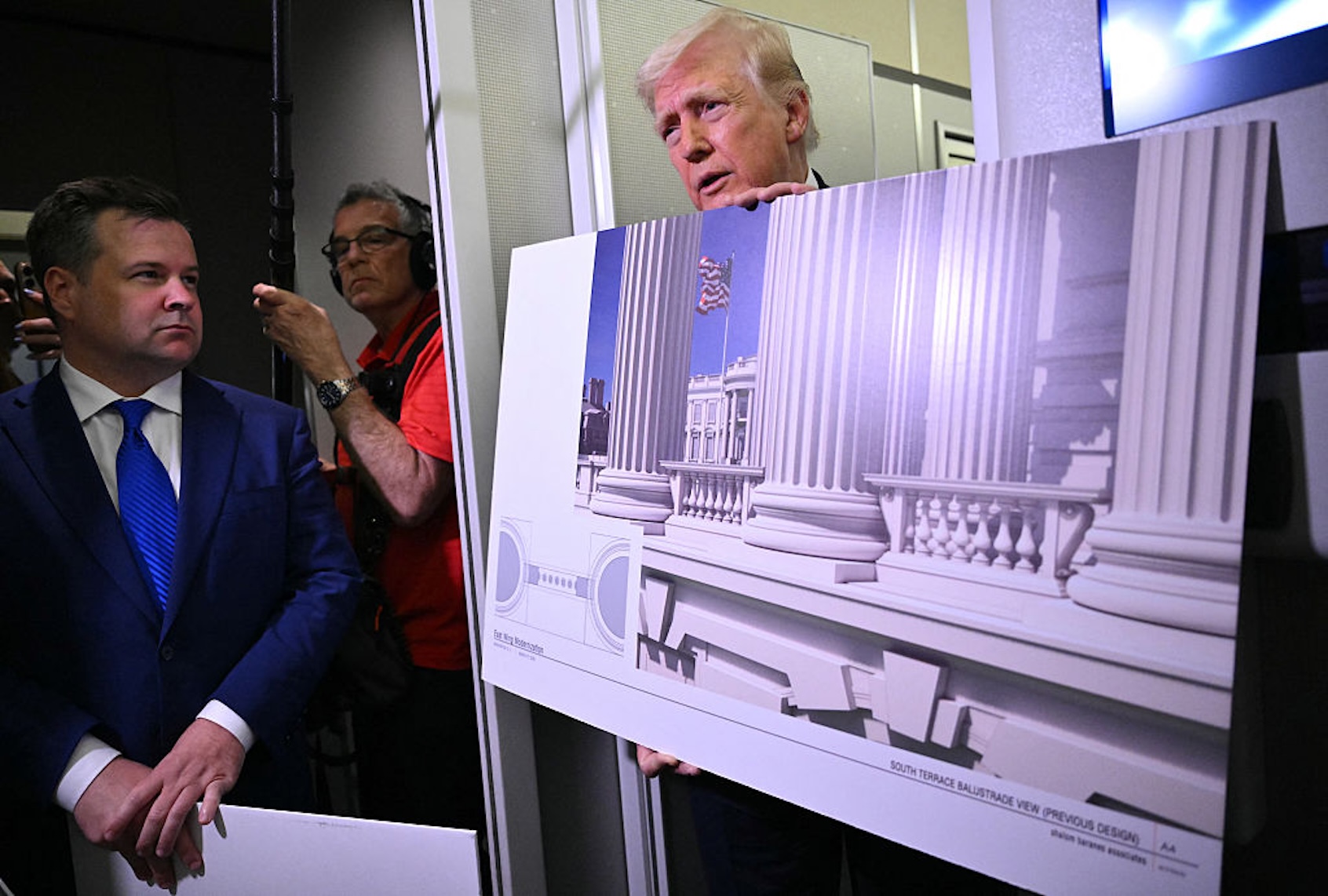
So yes, historians roll their eyes when they see these comparisons between America and the Roman Empire. But in Trump’s America, we can no longer just scoff at them as simplistic or ill informed. This is a president who has issued an executive order mandating “traditional and classical architecture” for federal buildings. A president who has bulldozed a third of White House to make way for a new ballroom that will feature columns like those on the temples that the Roman Empire built to make permanent their presence in conquered lands. A president who wants to build a triumphal arch like those through which Roman emperors led their victory parades, basking in the admiration of crowds as they displayed the spoils of war, including enslaved captives. As ICE officers continue to raid our communities and as Trump continues to threaten further attacks in the Middle East, these turns toward ancient Greece and Rome signal more than our president’s authoritarian bent. He turns to these symbols for the same reasons that notorious dictators and fascists have: to claim prestige and respectability for violent politics.
It’s too much to hope that politicians will stop making these comparisons. They want to sound smart, and too many of them want to disguise the violence their policies enact. But we, at least, can refuse to fall for it, seeing these comparisons for what they are.
Read more
about political rhetoric
