

Although Democrats seem increasingly well-positioned to make significant gains in the House and potentially even the Senate in the 2026 midterms, the party’s collapse in 2024 has sparked an ongoing battle over how to woo the voters they need. New polling data, provided to Salon by Way to Win, a Democratic donor network and strategy group, suggests that the best way to reach key voters may not be in the centrist messaging favored by many in the party, but by a broad anti-corporate, economic and populist message.
The survey of 1,282 likely voters, conducted by Impact Research and Lake Research Partners, asked Sun Belt voters in Arizona, Georgia, Mississippi, Nevada, North Carolina and Texas whether or not they preferred a populist economic message or a traditional centrist message across a variety of issues.
Jen Ancona, the chief strategy officer at Way to Win, told Salon that they focused on the Sun Belt in particular because it is less favorable terrain for Democrats and that the party will need to learn to compete there in future elections.
“The Sun Belt is tougher terrain for Democrats, but it’s necessary to fight on that terrain, and Trump has turned into a millstone around Republicans’ neck, which is really giving Democrats an opening,” Ancona said. “In fact, in Southern battleground districts, the percentage of Democrats saying they are ‘extremely’ motivated to vote more than doubles that of Republicans, 72% to 34% — that’s a massive boon to Democrats.”
Specifically, the poll tested whether voters agreed more with a message that blamed corporations and wealthy insiders for making life less affordable, or a traditional centrist Democrat message, blaming government spending, immigration and leadership steeped in undefined liberal cultural values, with the latter message being favored by many influential pro-business centrist Democratic groups. Notably, the survey found that centrist Democratic voters support an anti-corporate populist message over a conventional centrist message 95% to 5%.
 (Graphic via Salon)
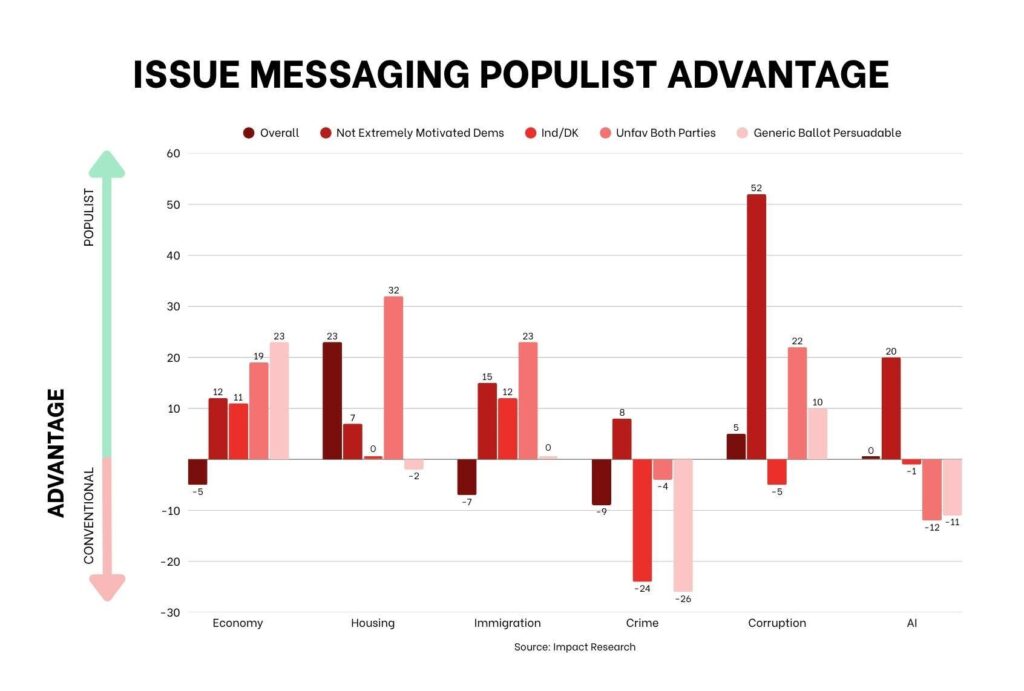
They tested these messages across different subgroups of voters, including low motivation democrats, independents, “double haters” with an unfavorable view of both parties, and voters who are persuadable, at least at the generic ballot level when they are asked to choose simply between a Republican or Democrat.
The survey specifically asked about the topics of the economy, housing, immigration, crime, corruption and artificial intelligence, measuring how voters in each of the four subgroups responded across these six categories. The pollsters found that voters preferred the economic populist message in 16 of the 24 tests.
“The populist message named a clear villain — the ultra-rich and big corporations — while the conventional message did not, simply focusing on middle-class tax cuts.”
Ancona said that one key difference between the conventional message and the populist message is that “the populist message named a clear villain — the ultra-rich and big corporations — while the conventional message did not, simply focusing on middle-class tax cuts.”
In general, the targeted voter groups preferred economic populist messaging across the board on the topic, though the inclusion of Republican voters brought down its overall reception, when compared to more conventional centrist messaging. The worst performance for the economic populist messaging came on the topic of crime, in which most of the target voter subcategories preferred the conventional centrist messaging. One crime, the populist messaging focused on creating safer communities by creating “good schools, jobs, affordable housing, and treatment for mental health and addiction.” The conventional messaging, however, focused on “proven solutions” for fighting crime like “tougher sentences for criminal gun, fentanyl and human traffickers.”
AI was another relative weak spot for economic populist messaging, with most of the subgroups, save low motivation Democrats, preferring conventional centrist messaging, which focused on partnering with the tech industry to “build AI to make sure it protects consumers” without slowing America in its AI arms race against China. The populist messaging, in contrast, focused on “strong federal regulation of AI” in order to “make sure AI benefits all of us, not just tech billionaires who own AI companies.”
Bright spots for economic populist messaging include housing and corruption, with double haters far preferring the economic populist messaging on housing. Similarly, unmotivated Democrats far preferred economic populist messaging on corruption, signaling that a corruption-focused message blaming corporations and wealthy elites could be a turnout winner for the party.
We need your help to stay independent.
Luke Martin, a partner at Impact Research, one of the pollsters who conducted the survey, told Salon that he views the high-level takeaway as being that economic populist messaging is broadly popular among some of the most important voter blocs — especially in the states where Democrats need to do the most building of their voter base. He also noted that this sort of populist platform is also already being picked up by Democrats from across the ideological spectrum.
“Even candidates that wouldn’t have traditionally been a progressive or populist candidate have started adopting some of this language,” Martin said. “If you look at candidates again that have been viewed more traditionally as moderate, somebody like Angie Craig [in Minnesota], I think, is doing a really good job of using populist messaging framework to talk to voters, even though she is herself not somebody who is traditionally seen as a progressive candidate.”
Martin said that he sees this as part of a broader realignment in the Democratic Party, which is shifting away from a left versus centrist focus and towards a top versus bottom focus, which has made the previous strategy of simply putting up a moderate centrist in hard-to-win districts outdated.
“I think in a lot of ways, Trump changed that equation a little bit, and sort of showed the power of using more populist rhetoric to appeal to lower-income non-college voters, especially white non-college voters, in an effective way,” Martin said.
Start your day with essential news from Salon.
Sign up for our free morning newsletter, Crash Course.
Despite Democratic gains in the generic ballot nationally, voters still largely prefer Republicans in all of the surveyed Sun Belt states, except Georgia, where voters preferred Democrats by 3 points. Across the battleground districts in these states, which were oversampled for the purposes of this poll, Democrats were even further underwater than across the Sun Belt as a whole, with battleground district voters preferring Republicans by 7 points in the generic ballot. This essentially means these battleground districts are less friendly terrain for Democrats than the states they’re in as a whole.
There was, however, a bit of hope in the generic ballot findings for Democrats in these states, because across most of the Sun Belt states, save Mississippi and Nevada, the most motivated voters heading into 2026 skewed heavily towards Democrats, especially in battleground districts, where Democrats enjoyed a 15-point advantage among extremely motivated voters. Given that midterm elections are often decided by voter turnout as much as by persuasion, this could mean that Democrats are headed towards overperforming expectations in these states come November.
“This is about driving up the margins in tough districts, and pinpointing which Democratic messages actually connect, motivate and persuade the softest parts of our coalition, such as less motivated Democrats and voters who don’t like either party,” Ancona said.
Read more
about politics
