
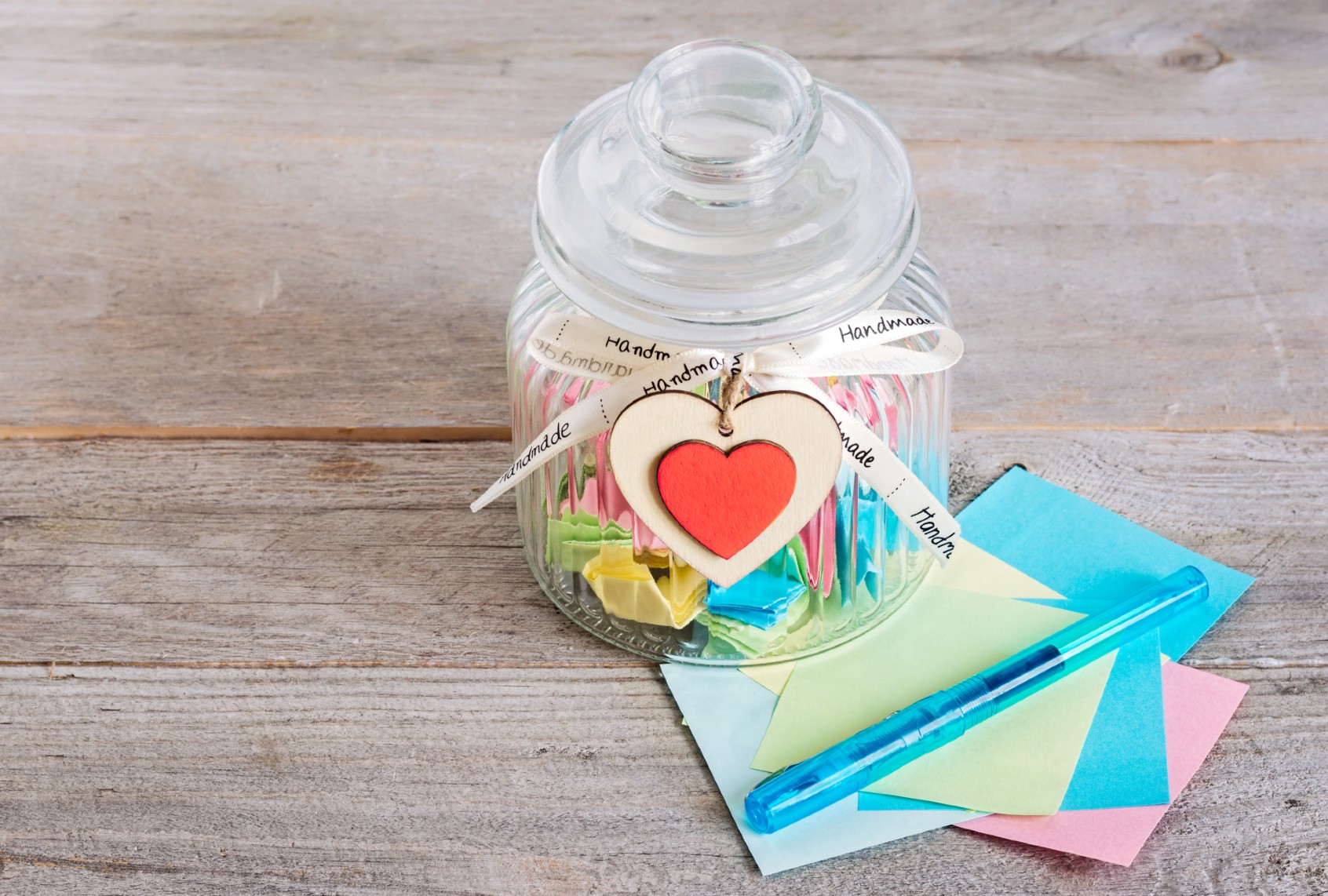

The first time Freda, 38, spent Christmas with her then-boyfriend’s family, there was a gift bag with her name on it under the tree. Inside was an empty Mason jar with a pink, glittery lid, a stack of pale-pink note cards and a ballpoint pen. This, Freda was informed by her boyfriend’s sister, was a joy jar. At the start of the new year, she could jot down accomplishments and small but meaningful moments on the cards, and then fold them up and deposit them into the jar every day or a few times a week; by the start of the next one, she would have a jar filled with notes that captured fun times and fond memories, and a record of wins like “50-day Wordle streak” and “made pizza from scratch.” “I thought it was cheesy at first,” she says, but admits that having a place to record a handful of pleasant but nonessential things helped her slow down and appreciate moments that, in the midst of nursing school, work, and her first real relationship, she’d otherwise have forgotten.
A little more than a year later, Freda and her boyfriend broke up, and she emptied the jar, threw away its contents, and put it on the free table at her apartment complex’s spring yard sale. Stripped of context, it sat there until the end of the day. “My roommate said something jokey like, ‘Oh geez, no one took your joy jar,’ and a guy who overheard her was like, ‘Your what jar?’ I [thought], yeah, I guess that doesn’t really sound right.”
If you also don’t know what the hell a joy jar is, please don’t feel out of the loop. A quick search online suggests that the term, besides sounding generally unsettling, doesn’t seem to have any fixed meaning. There are DIY instructions for jars like Freda’s, complete with psychology-backed arguments for the practice as a way to counter the negativity bias of quotidian human experience. “If you want to balance out your negativity bias, you need to deliberately spend time thinking about the positive experiences in your life. For every one negative experience you need . . . five positive ones” in the jar, advises “Think Like a Coach” author Jude Sclater’s blog, Think With Jude.
If you also don’t know what the hell a joy jar is, please don’t feel out of the loop. A quick search online suggests that the term, besides sounding generally unsettling, doesn’t seem to have any fixed meaning.
Google’s AI search asserts that joy jars are “64-ounce plastic jars filled with new, age-appropriate toys, games and activities designed to bring joy and encouragement to children fighting cancer” and “sent to hospitals, oncology camps, or directly to children’s homes” by the Jessie Rees Foundation, a charity named for the 12-year-old girl who, before her own 2012 death from brain cancer, began creating the jars for fellow cancer patients. On Etsy, the term “joy jar” yields thousands of results that include a $24 “Personalized Kindness Joy Jar — Positive Affirmation and Memory Gift” (“Share joy in the sweetest way with our Joy Jar — a thoughtful gift filled with personalized notes, memories and uplifting messages. Designed in our signature Kind Words Count style, this joyful jar helps you spread positivity day after day”) and a $40 “The Gift that Means Everything DIY Jar” (“Personalized 365 Reasons I Love You Jar DIY Kit / Custom Love Notes Jar / Anniversary Gift for Him or Her”).
There’s the Jar of Joy Personalized Scripture Scroll, filled with miniature rolled-up Bible verses customized to address the recipient personally. (“I have loved you Brenda, with an everlasting love; I have drawn you with unfailing kindness.” — Jeremiah 31:3) There are witchy joy jars filled with moss, dried flowers and crystals, tasty joy jars containing single-serving jar cakes and joy jars meant for Thanksgiving gratitude or Sweet-16 congratulations.
There are even joy jars that play fast and loose with the very term “joy jar.” I recently got a press release touting a “brilliantly simple marriage hack” meant to “increase joy in your relationship by writing down things that your spouse does that take away joy” — things like, say, “not putting the toilet seat down” and “asking where something is without looking for it first.” “Pull one note out a week!,” enthused the copy. “The goal is to clear the joy jar, with no ugly discussion needed, and add more joy to your life (and marriage)!” It seems to me that “joy jar” is a less-than-accurate term for a gender-coded receptacle packed with notes like “PICK UP YOUR DANK SOCKS” and given to one’s partner — gripe glass or even beef bowl would make more sense. But as any savvy marketer knows, piggybacking on established SEO is a much safer bet than coining something new and specific.
The fact that a joy jar can, depending on the social-media platform or search engine, refer to anything from a plastic tub of games and activities donated to young cancer patients to a cork-topped canister of religious affirmations to a deeply passive-aggressive way for couples to avoid “ugly discussion” about relationship shortcomings seems like as good an analogy as any for an internet stuffed with cookie-cutter quotes, identikit influencers, AI-generated product descriptions and algorithmic echo chambers. The joy jar is everything and nothing, an entity that’s simultaneously ubiquitous and specialized. An empty vessel waiting to be filled with meaning, it has no single purpose and can thus be sold to everyone, anywhere, as whatever they might want or need it to be. It is the void that, once identified as a repository of content, takes the shape of a consumer product.
Want more from culture than just the latest trend? The Swell highlights art made to last.
Sign up here
Anecdotally, they are everywhere. One parent reports that a joy jar stuffed with candy and Starbucks, Target and AMC gift cards fetched triple digits at an elementary-school auction; another reports that one of her children wrote “joy jar” — shakily, in paint pen — on a container of buttons and gave it to her as a birthday gift. (“We both like the sound of buttons in a jar.”) The question isn’t: “What’s a joy jar?” It’s: “What isn’t a joy jar?” In the annals of things made inescapable by social media, the joy jar is an outlier, even a cipher: It doesn’t have the built-in virality of a buzzy but lamentable trend like the Stiletto Challenge, the revelatory prescriptiveness of a one-weird-trick video, or the acquisitive dopamine rush associated with a Labubu or Lucky Scoop.
It seems to me that “joy jar” is a less-than-accurate term for a gender-coded receptacle packed with notes like “PICK UP YOUR DANK SOCKS” and given to one’s partner — gripe glass or even beef bowl would make more sense.
Plus, it’s endlessly adaptable: One person’s joy might be affirmations or bits of scripture, but nothing in the rule book says you can’t also fill it with the names of books you’ve read or shows you’ve streamed, dinner ideas, bizarre bits of overheard conversations and places you want to visit. “My wife and I didn’t have a baby book, so when our daughter said funny things, as kids do, we wrote them on Post-its and put them in an empty jar on the mantel,” says Dan, 46. “Then when she got older, it became the family ‘swear tax’ jar, because my wife and I are both pottymouths and it was a way to be accountable [to our kid].”
Keli, a fortysomething jewelry designer and assemblage artist, keeps a lot of her craft supplies in jars, and always has an eye out for cute receptacles. Recently, a free box in her neighborhood yielded a comically oversized plastic wine goblet emblazoned with “Joy.” Keli emphasizes that she’s not a fan of the “Live Laugh Love” school of home decor (a longstanding pet peeve is kitchen signs that declare “Eat” or “Nourish”), but something about the “Joy” goblet in the free box needled her, and she took it back to her studio. It now waits patiently to be filled with clasps or beads or letterpress blocks. “I don’t know that I’ve ever used the word joy,” she muses, “but I think it’s growing on me — the more I think about how rare it is right now, out in the world, the more I want to, you know, embrace it.”
We need your help to stay independent.
Freda, for one, understands where Keli is coming from. She regretted dumping out the contents of her first joy jar way back when; the breakup with the boyfriend whose family gave her the jar, she says, made her feel like its contents were connected to him — “but the memories were mine, and [they] might have been nice to keep.” Her second joy-jar experience, meanwhile, has been less fraught. One day, a recently married colleague brought in a wedding gift that she wasn’t sure what to do with, a cylinder of glass delicately etched with the word JOY in looping script. Freda assured the colleague that she had the perfect use for it, and since then, she and her colleagues put snacks, sheet masks and the occasional rude drawing in the jar and take turns hiding it in each other’s desk drawers and gym bags.
“It’s unserious, but it’s also a fun surprise,” she says. And really, isn’t that one way to describe joy itself?
Read more
about this topic
