
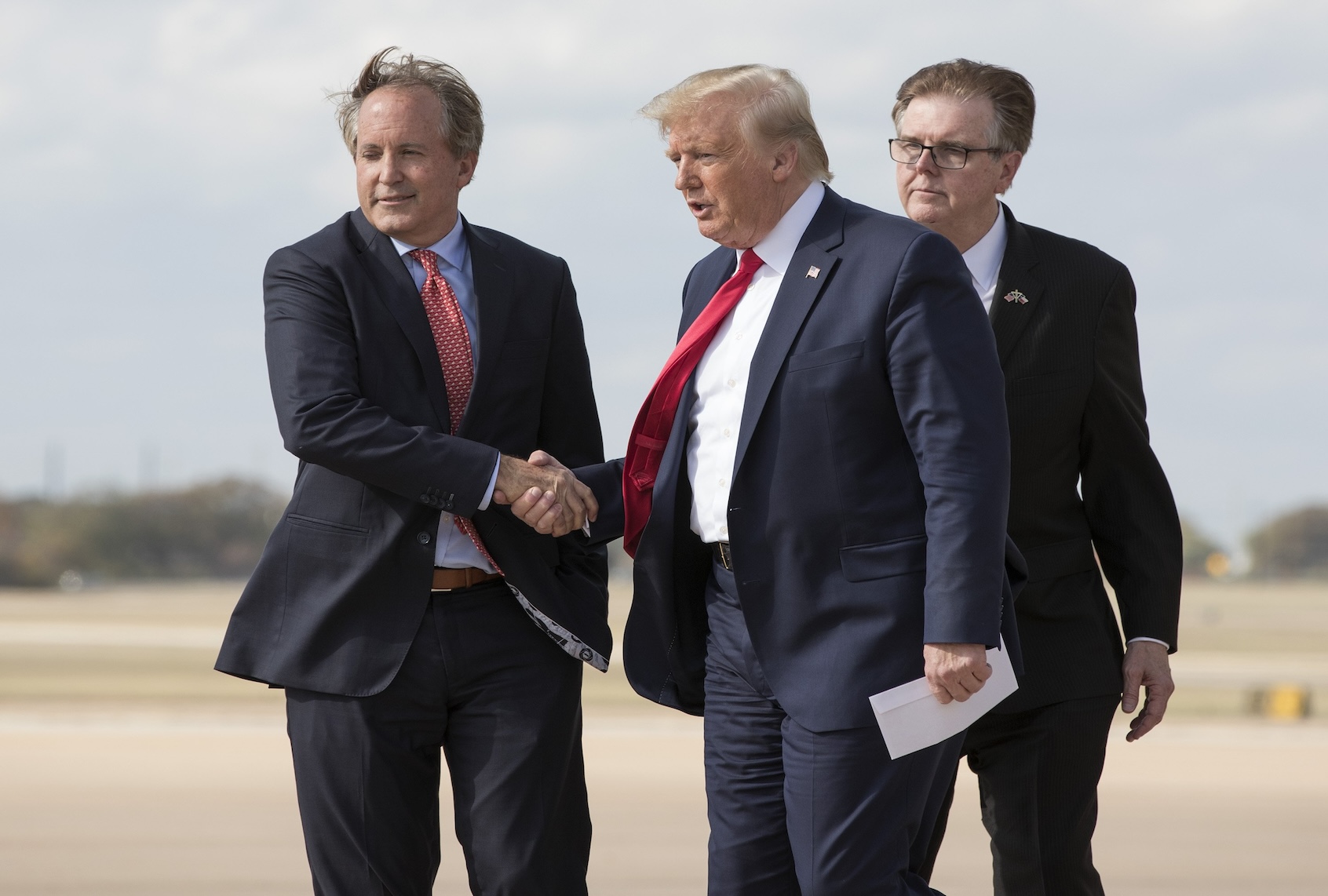

A senior senator who voted with President Donald Trump’s agenda 99% of the time. One of Texas’ most conservative lawmakers. A three-term state representative endorsed by Gov. Greg Abbott.
All lost their runoff elections Tuesday night to Trump-endorsed opponents, a decisive sweep that serves as a fresh reminder that the Texas GOP remains in complete lockstep with the president.
Once led by chamber of commerce conservatives who preached small government and big business, the Texas Republican Party has been conquered over the last 15 years by a hard-charging, uncompromisingly conservative faction, operating on the vanguard of the nation’s culture wars and driven by a sense of perpetual insurgency.
Trump’s endorsements up and down the ballot have only served to accelerate the GOP’s transformation from the party of longtime Sen. John Cornyn to the home base of Attorney General Ken Paxton and his supporters.
In trying to fend off Paxton’s primary challenge, Cornyn touted his fealty to the president and the MAGA movement and disavowed his own call a few years earlier for the GOP to move on from Trump. The senior senator and his allies poured tens of millions of dollars into eking out a first-place finish in the March 3 primary, and tens of millions more for the runoff, even as most polls had Paxton projected to win. But in the midst of early voting, Trump endorsed Paxton, reviving all those times Cornyn hadn’t been Team Trump.
“John Cornyn is a good man, and I worked well with him, but he was not supportive of me when times were tough,” Trump wrote on social media. “John was very late in backing me in what turned out to be a Historic Run for the Republican Nomination, and then, the Presidency, itself, both of which were Landslide Victories and, more importantly, gave us the Country that we have today — THE GOLDEN AGE OF AMERICA.”
With the Trump wind at his back, Paxton won by 28 points, despite being outspent nine to one across the entirety of the campaign. In a trio of congressional runoffs, Trump’s endorsed candidates won by an average 27-point margin.
“President Trump’s endorsement is worth its political weight in gold,” U.S. Rep. Brandon Gill posted on social media Tuesday night. “There’s nothing more powerful in GOP politics, and it’s not even close.”
“Fealty to the president”
At Paxton’s victory party Tuesday night, Gill had a message for the cheering, chanting, dancing crowd: “We are so back.”
But for a 32-year-old Texas conservative, was it ever really over?
In 2012, when Gill was 18 years old, Ted Cruz took down then-Lt. Gov. David Dewhurst to become the GOP Senate nominee, a seminal victory for the insurgent Tea Party movement that had taken over the party’s grassroots and was on its way to controlling state government.
Running under the Tea Party banner, Steve Toth was elected to the Texas House that year, unseating a longtime GOP incumbent after being advised by many in the Capitol, he said, not to bother with a challenge. Like Cruz, Toth was wildly outspent yet won by a wide margin. He remembers feeling like that election was a turning point for the party, where voters made clear that “rhetoric was not enough,” he said.
“It should have been a wakeup call for the old guard, that the old way of doing things wasn’t going to be enough to keep them in office,” he said.
The years since have been marked by a rancorous power struggle for the soul of the Texas Republican Party, where the hardliners, who paint themselves as the perennial underdogs, just keep winning.
Two years after the Cruz earthquake, Paxton was elected attorney general and Dan Patrick, who says he is a “Christian first, conservative second and Republican third,” became lieutenant governor. Two years after that, with Patrick chairing his Texas campaign, Trump won his first term, creating a powerful new standard-bearer for the party to rally behind — and forging an alliance that Patrick would use to hasten the Texas GOP’s rightward lurch.
“What’s been clear in the recent history in state and national politics is that the main qualification that matters, especially when voters don’t have strong opinions about either candidate, is fealty to the president and association with the MAGA universe,” said Joshua Blank, research director for the Texas Politics Project at the University of Texas at Austin.
The new type of MAGA Republican Trump was cultivating — aggressive, ideological, proudly politically incorrect and, above all, loyal — looked a lot like the grassroots movement already brewing in Texas. The two blended into one, with Texas delivering for Trump in 2016, 2020 and 2024, and Texas Republican voters holding onto an 82% approval rating of the president, even as his ratings wavered nationwide.
Trump has used that clout to help his allies prevail in primaries. Paxton first chased the president’s endorsement ahead of his 2022 reelection bid, when he secured Trump’s backing over a crowded field of primary challengers that included Land Commissioner George P. Bush. Paxton went on to soundly defeat Bush in a runoff.
The president has also increasingly waded into down-ballot legislative races, in many cases backing candidates aligned with Patrick. At a rally in Conroe that year, Trump openly acknowledged the endorsement pipeline, saying Patrick would call him with requests and he would respond, “Absolutely, Dan. Whatever you want, Dan.”
Some of Trump’s recent maneuvers have helped dramatically reshape the Legislature’s course. In 2024, he endorsed a hard-right challenger to Texas House Speaker Dade Phelan, a bitter rival of Patrick’s. A Republican, Phelan oversaw scores of conservative victories, but also Paxton’s impeachment and a failure to pass Abbott’s coveted school voucher program. Phelan scraped out a win in the runoff, but more than a dozen other House Republicans were ousted that year, many by Trump-endorsed challengers running on explicit pledges to oppose Phelan’s control of the speakership. A battered Phelan eventually abandoned his bid for the gavel.
Most of the insurgent freshmen also vowed to support Abbott’s voucher push, which had stalled under bipartisan opposition. To get it across the finish line last year, Trump called into a meeting of Texas House Republicans to encourage them to vote for the $1 billion program, and offered up his blanket endorsement for any member who helped pass it. All but two Republicans fell in line.
Last summer, lawmakers redrew the state’s congressional map to more strongly favor Republicans at the president’s request, even though many, including Abbott, were initially hesitant.
Toth, who was involved in the grassroots push long before Trump waded into politics, said the president is just accelerating work that was already underway.
“He’s a phenomenon of populist politics,” Toth said. “He didn’t create this movement. He tapped into what was already happening. And the voters are behind what he’s supporting, not just him.”
MAGA allegiance: not always enough
But for Republicans who have diverged even marginally from Trump, the blowback from the MAGA movement has been significant. In March, Toth ousted U.S. Rep. Dan Crenshaw, who went against the president by saying he lost the 2020 election and speaking out against the attack on the U.S. Capitol on Jan. 6, 2021. He was the only House Republican from Texas seeking reelection who wasn’t endorsed by Trump; he lost to Toth, who hewed closely to the president during the campaign, by 15 points.
In the race to succeed Paxton as attorney general, allegiance to Trump also played a central role, even though he didn’t endorse.
U.S. Rep. Chip Roy, one of the frontrunners and a dyed-in-the-wool small-government conservative, had clashed with Trump over certain White House priority bills that he felt increased government spending or overstepped the federal government’s proper role. He said Trump engaged in “clearly impeachable conduct” on Jan. 6, and campaigned for Florida Gov. Ron DeSantis’ failed 2024 presidential bid.
When he entered the race for attorney general, Roy said he and Trump had mended fences, pointing to the president’s remark last summer that Roy is “not easy, but he’s good.” But Roy’s opponent in the runoff, state Sen. Mayes Middleton, hit Roy hard for the moments in which he wavered from the president. Branding himself “MAGA Mayes,” Middleton spent more than $17 million spreading the word that Trump “doesn’t trust” Roy, as one of his biggest ad buys said.
It worked. Despite a surge in funding at the end to circulate his countermessaging, Roy lost to Middleton by 10 points Tuesday night. In a statement, Roy said he had tried to “do things the right way.”
“It matters that leaders stand up and say what needs to be said no matter the consequences — or we stand to lose it all in the pursuit of political expediency,” Roy wrote.
Even in races where both candidates declared full-on MAGA allegiance, Trump threw his weight around. In two such runoffs, both to decide nominees for newly redrawn GOP strongholds, Trump sided against lawmakers who helped create the districts they were now running for. In the San Antonio-area 35th Congressional District, the president backed political newcomer Carlos De La Cruz, who vowed to be “President Trump’s wingman,” over three-term state Rep. John Lujan. Lujan, who was backed by Abbott, lost by 15 points.
In the new 9th Congressional District, the president endorsed Alex Mealer, an Army veteran and former GOP nominee for Harris County judge. Abbott endorsed Mealer’s opposition, fifth-term state Rep. Briscoe Cain, saying the two “worked side-by-side” on key legislation.
Cain is one of Texas’ most conservative state legislators, who has been on the front lines of the chamber’s most aggressive pushes on abortion, gun rights, immigration and election integrity. An unwavering Trump supporter, he chairs the hardline House Freedom Caucus and voted to redraw the congressional map.
He lost to Mealer by 37 points.
Disclosure: University of Texas at Austin has been a financial supporter of The Texas Tribune, a nonprofit, nonpartisan news organization that is funded in part by donations from members, foundations and corporate sponsors. Financial supporters play no role in the Tribune’s journalism. Find a complete list of them here.
This article first appeared on The Texas Tribune.
Read more
about politics
