
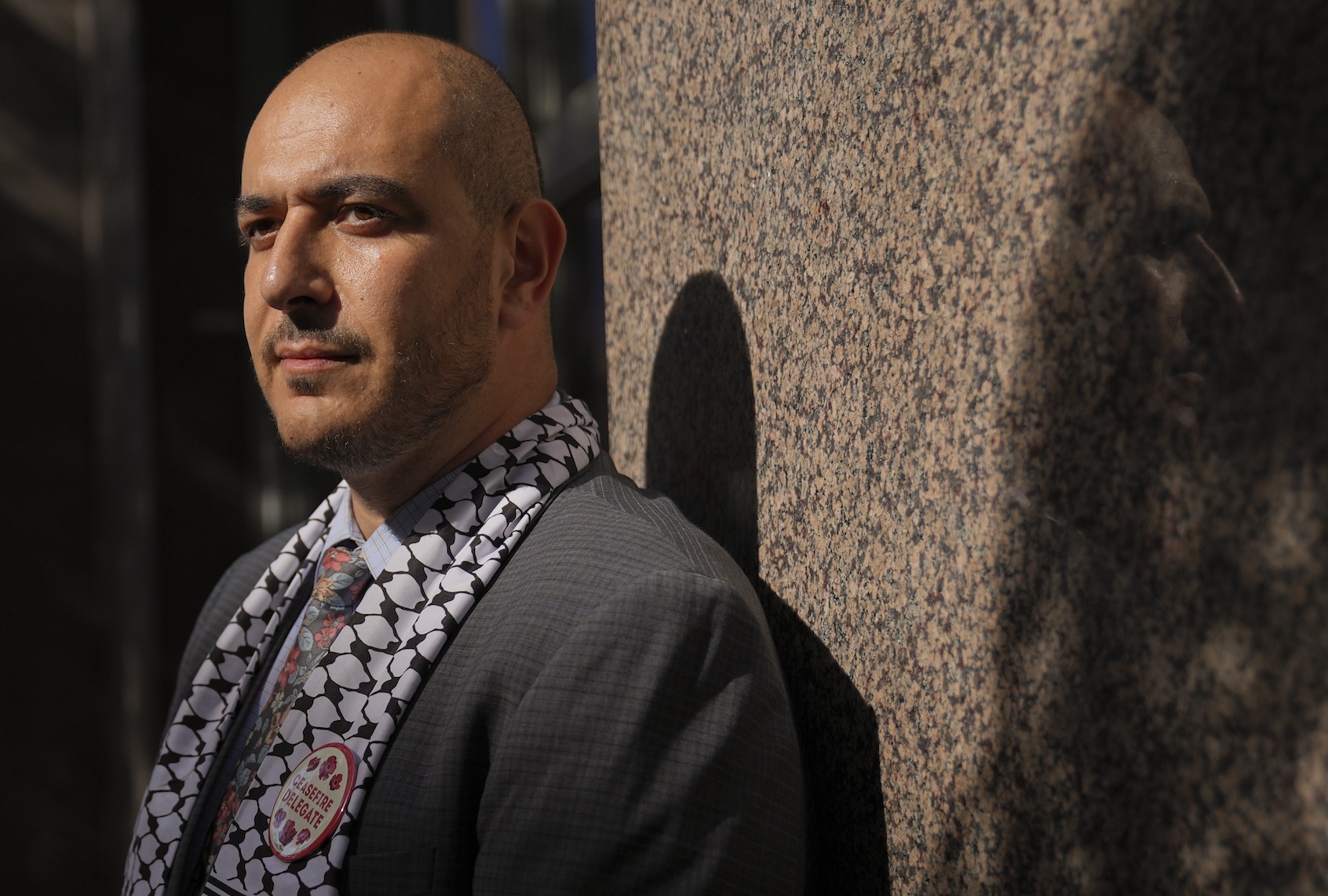

Abbas Alawieh is no stranger to politics. The Michigander spent years as a top aide to progressive ex-Rep. Andy Levin, D-Mich, and Squad members Rep. Rashida Tlaib, D-Mich., and former Missouri Congresswoman Cori Bush. He developed political strategy as a chief of staff, authored bills as a legislative director and worked across the aisle to help deliver results to their constituents. His work largely kept him behind the scenes — until 2024.
Alawieh gained national recognition amid the United States’ support for Israel’s war against Gaza, which a United Nations Commission has since declared a genocide, as a co-founder of the Uncommitted Movement during the 2024 election cycle. The anti-war effort sought an end to the violence through a campaign urging Americans to vote “uncommitted” in their state’s primary to show the Democratic Party the votes they risked losing if they didn’t change course. The campaign’s success resulted in some 30 uncommitted delegates attending the Democratic National Convention that August to represent the more than 700,000 Americans who demanded an end to U.S. material support for Israel.
Alawieh insists he wasn’t the leader of the movement, but there’s no denying he stood at the forefront of it — and was also subjected to the post-election fallout that pushed him and other Uncommitted leaders out of the public eye as President Donald Trump prepared to take office for a second time. Now, just under two years later, he’s stepping in front of the podium to build a campaign for Michigan state senate of his own, and he’s hoping Democrats will actually follow his lead this time.
“The Democratic Party isn’t speaking to the needs of working families more broadly. I feel like anytime I hear about family in the context of our national politics, it’s the Republicans claiming the idea and using it as a way to divide people,” Alawieh told Salon, arguing that Democrats need to reclaim the concept in order to be successful. “So the opening message of my campaign is, ‘My name is Abbas Alawieh. Family is everything to me, and I’m running to represent every single person in Senate District Two like they are family to me.'”
Ahead of the Michigan primary on Aug. 4, where he’s set to face off against state Rep. Erin Byrnes, D-Mich., Alawieh spoke with Salon about his political lane change, the legacy of the Uncommitted Movement and what he believes the Democrats are still missing.
This interview has been edited for length and clarity.
What inspired you to go from this relatively behind-the-scenes, former high-ranking legislative aide to a Democratic candidate for state senate in your home district?
When I was a chief of staff on Capitol Hill in 2022, I was witnessing from afar the community that I grew up in — working-class communities in southeastern Michigan — being organized by far-right elements using hate and fear around book bans and other anti-LGBT nonsense to convince people that if you ban one book or the other, that’s how you grow your political power. I’m bald, but if I had hair, I would have been pulling it out. It was so difficult to witness that and ask every Democratic official I knew what the party was doing about it, only to learn that the party was doing nothing. For a long time, the Democratic Party has been ceding ground to the politics of the far right or to the politics of disillusionment in key working-class and immigrant communities.
“For a long time, the Democratic Party has been ceding ground to the politics of the far right or to the politics of disillusionment in key working-class and immigrant communities.”
The experience of helping lead a national pro-peace, anti-war effort further demonstrated to me that the party was nowhere to be found on the ground talking to people about not only what their pain feels like but also what it would look like for them to have representation that actually addresses their material needs locally. The combination of those factors made me feel like it is important for us to step up and become the leaders ourselves. By us, I mean any person who understands what economic pain feels like in our country and has a deep understanding of why it’s important that our values as peace-loving people be reflected in our politics.
I’m ready to represent the communities that I grew up in and love to prioritize investments that alleviate the pain that too many working families are experiencing. I am pitching myself as someone who understands deeply why that needs to be prioritized. I am a kid who grew up on Medicaid and food assistance and understand what it feels like when you don’t know whether you’re going to be able to afford your bills month to month. And in a moment when so much of our national politics is dominated by whatever new war Donald Trump is starting, I have the expertise that, unfortunately, too many people in the community that I grew up in have, which is understanding why investing and taking care of people at home rather than destroying people’s homes abroad ought to be our political priority.
What, then, sets you apart from the other Democratic candidate you’re running against, state Rep. Erin Byrnes, as well as the overarching Democratic establishment in Michigan?
We need Democratic elected officials who have demonstrated that they are able to move voters who the party has lost, and I believe strongly that my experience — both at the federal level and my organizing experience — demonstrate that I’m someone who can bring a broad coalition of people together and be a bridge between the party that oftentimes is completely disconnected from the working class.
I’m proud to be running as the candidate who’s never taken corporate money, and I think that ought to be the standard for elected representation of working-class communities and of communities across the state.
Start your day with essential news from Salon.
Sign up for our free morning newsletter, Crash Course.
I also believe strongly that, in a moment when so many of the attacks on our local communities are coming from the federal level, my experience as someone who has extensive federal relationships, who’s worked with both Republican and Democratic administrations to protect vulnerable communities, who’s written bipartisan legislation on issues that confound too many of our elected officials, like bipartisan immigration legislation that I worked on with Congressman Andy Levin and Congressman John Moolenaar.
I believe that style of leadership is going to be critical, not just for piercing through the hyper-polarization that we’re seeing in our politics, but also for delivering the kind of leadership that is about not just voting the right way, but showing up on the ground when vulnerable communities need you.
For me, over the course of this campaign, that has meant that when our immigrant neighbors have been targeted and disappeared, I am working with frontline advocates to raise money to bail people out of ICE detention. I’m the candidate showing up at their home with Mediterranean food after they get out and then the next day going to the protests to stop the proliferation of ICE detention centers here that would lead to further criminalization of young people and working-class immigrants across southeastern Michigan. That kind of leadership that’s going to both write the bill inside the halls of power and step outside and directly support and aid working-class communities on the outside is a style that I think we need more of at the state level.
The other thing I’ll mention, too, is that this is a very diverse working-class district. It also happens to include more Arab and Muslim Americans in one senate district than we’ve ever seen before. I could not have imagined that, during the course of this campaign, I would experience the personal loss of having our family home on my mom’s side of the family destroyed, only to be proceeded by having our family home on my dad’s side of the family destroyed, both by the Israeli military. I’m running in a district where not just one or two, not just 10 or 20, but hundreds, if not thousands, of community members are living that same reality, many of whom are experiencing the loss not just of their homes, but their loved ones. I’ve attended numerous funerals and memorial services for family members killed by the Israeli military during this campaign, [more] than I can count. I think it’s a very unique experience to be running to represent a community that’s experiencing this level of pain, and to be in it with so many of them.
I think that the most credible anti-war, pro-peace messengers in our national politics will be the people who demonstrate that they are laser-focused on meeting the material needs of local families right here in our country, and that’s what I want to be: a legislator focused on making sure that people have access to Medicaid, can afford food and get unemployment insurance claims addressed. That it’s easy for people to start a small business and grow their families right here in the communities that they love. That hyper-local focus is the best I can think of to do in a moment when international politics have gone to the genocidal place it has been dragged to.
The diverse makeup of your district and the Democratic Party’s lack of shifting from its support of Israel, despite the war in Gaza, and now the attacks on your home country of Lebanon — how do these actions impact the community you serve and hope to represent? Also, how do you see yourself addressing this anti-war, pro-peace facet of your work should you be elected to the state senate?
When I launched my campaign, the first question that I was asked by mainstream media is — the implication was, as an Arab American from East Dearborn — “what makes you think that you can represent white people in Taylor?” And my response to that is, I know the pain as a working-class kid, I know the pain of getting kicked off of Medicaid and not knowing whether or not you’re going to be able to access the medical treatment that you need for your asthma. That is a specific pain that I know, and that pain feels the same, whether you are an Arab kid or whether you’re a white kid or whether you’re a Black kid in Detroit. I think we need a broad, multiracial movement of people who fundamentally understand that we have shared interests and that the fact that our electoral and political system is rigged in favor of the very wealthy donors and against the interests of the working class, is something we all have to work on together if we’re going to change it.
“The launch of the Uncommitted Movement was very explicit about the need to prevent a Trump presidency, and it was very explicit about warning the Democratic Party about the fact that many voters had shifted on this issue, and that the party needed to catch up.”
I’m running to represent a very diverse district, yes, and the opportunity that it presents is cohering a message that speaks to communities that feel left behind by the Democratic Party. My sense is in 2028, the Democratic Party is going to have to grapple with how it wins back working-class voters it lost in 2024. Having leaders who insist on bringing various communities together, insist on the Democratic party being a broad coalition is going to be really important. Beyond that, as someone who isn’t just interested in kumbaya, but as someone who is interested in an explicitly a pro-working class, pro-peace, anti-war politics, I think the best thing that we could do as peace-loving people here in the state of Michigan is continue to demonstrate to the national political parties that if you want to win in Michigan, voters in Michigan love peace and don’t much care for endless war.
Any presidential hopeful or otherwise who is interested in winning Michigan, a key swing state, really ought to think long and hard and engage thoughtfully with the question of how they will communicate to Michigan voters that they will be candidates who prioritize the needs of Michiganders over the needs of pro-war donors who want and push for endless war.
Speaking of presidential candidates and paying attention to Michiganders’ pro-peace, anti-war perspective, it brings me to the Uncommitted Movement, which you, along with Layla Elabed, started first as Listen to Michigan in early 2024 to press the then-Biden campaign for an Israeli-Hamas ceasefire and enforce an arms embargo, lest he risk a November victory, and that expanded with the Harris campaign. We saw that it was successful during primary season, but it fell out of favor after the DNC protests, not necessarily with the public, but in terms of the response from Washington. Notably, you and other movement leaders encouraged people to still vote an anti-Trump ticket, which, in the overarching populace, confused some and made others feel like it diverted some of the messaging. But now that we’re years removed, how do you remember the Uncommitted Movement, its failures and successes?
The launch of the Uncommitted Movement was very explicit about the need to prevent a Trump presidency, and it was very explicit about warning the Democratic Party about the fact that many voters had shifted on this issue, and that the party needed to catch up. It also ought to be noted that many of us, myself included, voted for Vice President [Kamala] Harris, said so publicly, faced a fierce pushback publicly with no backing from the party, and still were trying to do what was strategically necessary in a moment when the Harris campaign was telling us we don’t need or want the Uncommitted Movement’s endorsement. The Uncommitted campaign was also a campaign of 2024 — it’s not a campaign that exists right now. I’m not the leader of the Uncommitted Movement, so I don’t want to claim any sort of position or power that I don’t have.
It’s clear looking back at 2024 that the party was wildly out of step with the majority of its voters, not just on Gaza, but on issues that working and middle-class voters across the country really cared about, including and especially the economy. The people running our party failed voters miserably. When Democrats lost in almost all of the 83 counties that exist in Michigan, it signifies that it’s not just one issue that can be blamed for a loss. When Democrats lost every single swing state in the entire country, it signals that it’s not just one issue that lost Democrats the election. It’s very clear that the work of the uncommitted movement and the broader movement for a ceasefire across the country has touched the hearts and minds of voters, who, by and large, in poll after poll, are insisting that support for endless war, support of genocide against the Palestinian people, or ethnic cleansing against Lebanese people is out of step with where they are.
It’s also important to understand the Uncommitted Movement as an attempt to reach voters that the party had already lost and that was successful at reaching voters that the party had lost. I think that moving forward the party really ought to bring in and engage leaders who’ve demonstrated that they’re capable of reaching disaffected voters. We would be smart to do that, rather than to push people away, and you know, I think that there are interesting examples of leaders who insist that we shouldn’t give up on voters who’ve voted for Trump in the past, and they’ll point to white working-class voters, for example. I also think that we should extend that to voters of color, who, when we articulate proactive messages that tell people how the party can benefit them and their families, we have a shot at pulling away from the politics of disillusionment or the politics of the far right.
With respect to the Uncommitted Movement, what were some of the most important lessons you took from your organizing during that primary and election stretch, and how are you implementing them in your current campaign?
A key lesson was that there are a number of voters who feel completely disillusioned with the party, and the party is failing to reach those voters, and that we need to run campaigns that speak directly to the needs and the pain of those voters to ensure that we are building a bridge in our direction. Rest assured there are very well-funded campaigns coming from the far right that are trying to capitalize on the fact that the Democratic Party has has turned off a lot of voters in a state like Michigan.
We need your help to stay independent.
Another key lesson from the from the Uncommitted Movement that I took away is — to become Oprah Winfrey for a moment — there was always a silence or silencing that happened in national political conversations, specifically as it relates to questions of war and peace, that we were able to pierce through with the Uncommitted Movement and touch the hearts and minds of Americans nationwide in a way that I think increased the general awareness and empathy towards the people on the receiving end of the bombs that our country sends overseas. That is a very fundamental shift.
The fact that you had, through the Uncommitted Movement’s work, people like myself who survived those bombs ourselves, speaking to a massive audience through the mainstream media was a very significant development that I think contributed to the shift in public opinion toward peace and against war and genocide that we’ve seen over the last few years. It’s very clear, we’re seeing a shift when, when 40 members of the United States Senate are voting to block either weapons or bulldozers to an Israeli government that is then using those things to violate the human rights of Palestinian and Lebanese civilians. The shift is massive, and the social movements for a ceasefire of 2024 and beyond have contributed to that shift.
How it’s shown up for me in my campaign is I’m running in a district where so many community members are directly impacted by the foreign policy decisions of our government. So many of them, when I knock on their door, their main question to me is, “What can you do about the fact that our families are being bombed and that our homes are being destroyed?” My answer is: The best thing we can do is continue growing the political power of the working class in this country, because the working class of this country does not want endless war. The working class of this country wants a politics that invests in care over violence. My campaign for state senate is a part of that, a part of the larger push for a politics that invests in care over destruction.
I wanted to return to one of the things you said earlier, the first question that the mainstream press asked you when you launched your campaign, and flip it. What message do you have for those who see you, your record and your work, and question your ability to succeed in state office?
I wish this weren’t the case, but my favorite thing in the world is working the legislative process to deliver for a community, and I am itching to get back to doing that work. I did it on behalf of communities in Michigan before, and in doing so, delivered or helped deliver hundreds of millions of dollars for lead pipe replacement, helped keep 11 million people housed during the pandemic, helped push for sensible bipartisan immigration reform. These are experiences that make me well-positioned to, in the hyperpolarized political climate that we live in, advance a politics that’s about the things we can work together on. I think that would benefit our politics in Michigan in general and benefit our Democratic Party in particular.
Read more
about politics
