
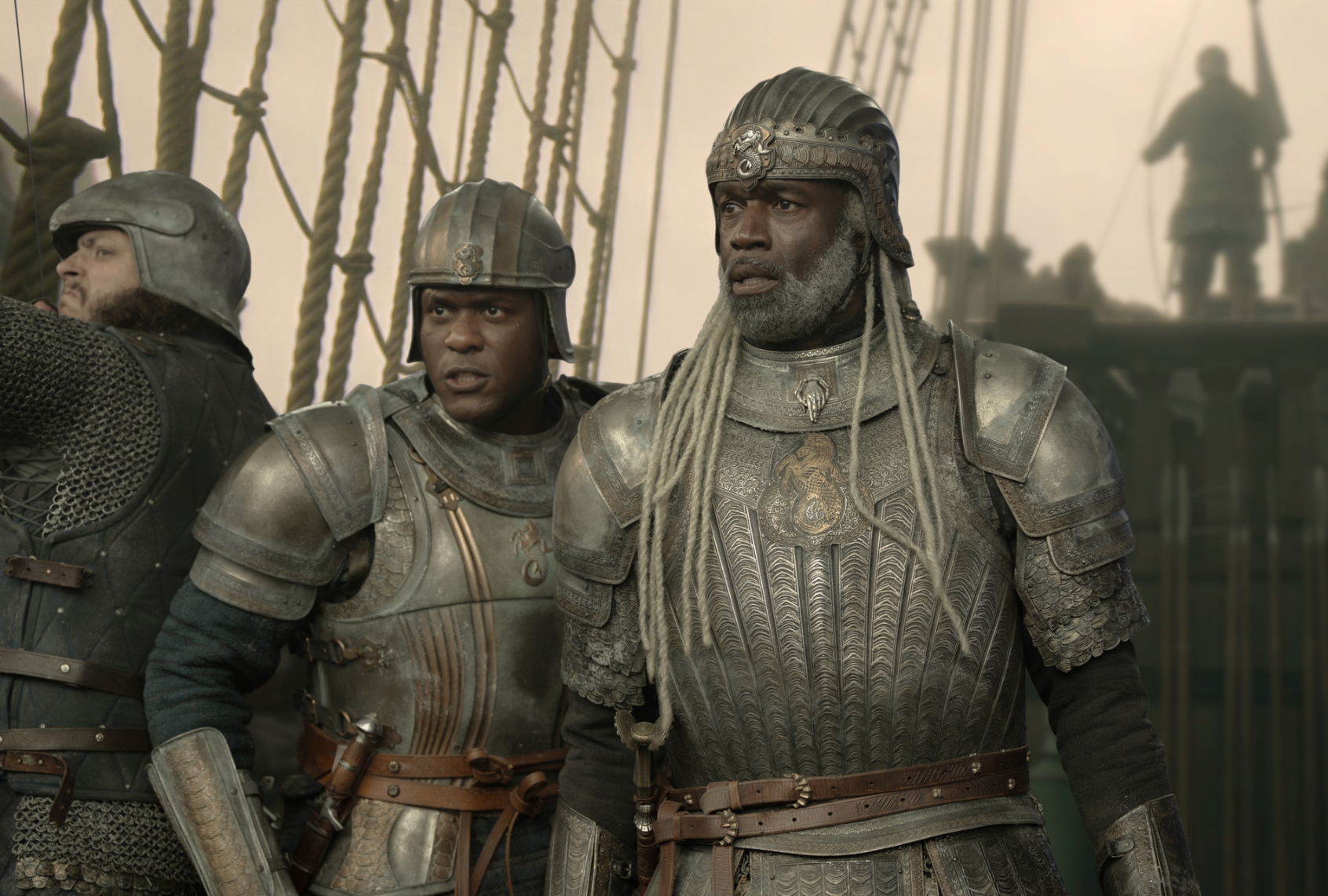

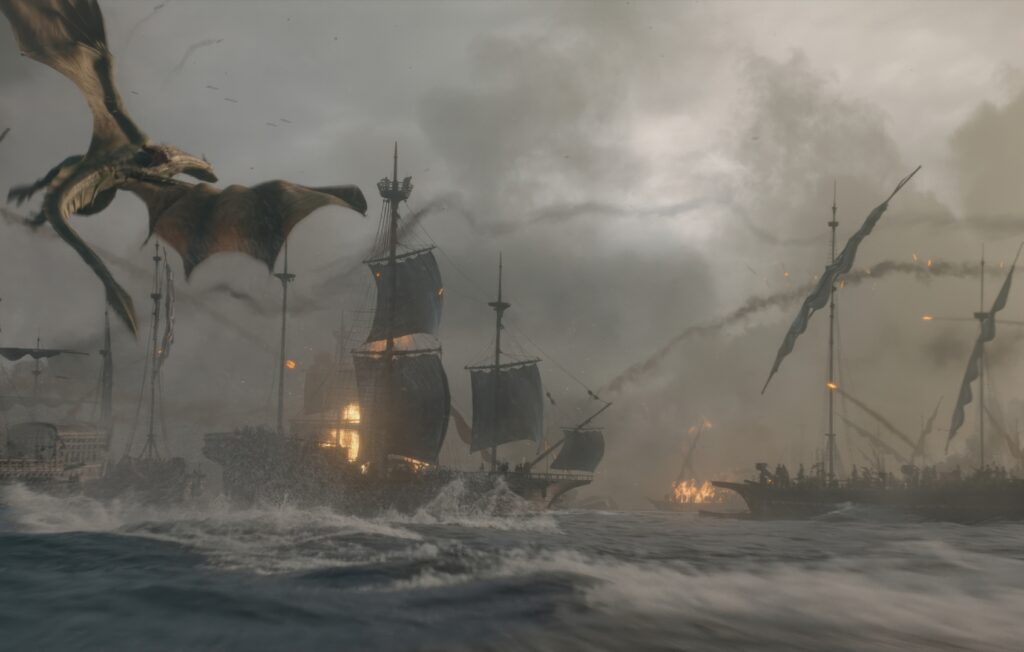
This. Dragonfire, chaos, annihilation – this is what we wanted from “House of the Dragon.”
Remember that once the flames have died down, the sailors stop slipping around in each other’s entrails and you come to terms with the sheer scale of horrific, hideous death wrought by a single clash between two Targaryen factions.
When the first two seasons came and went without showing us this level of explosive, gruesome violence, viewers rebelled. We wondered, often loudly, why we kept showing up if Rhaenyra (Emma D’Arcy), Daemon (Matt Smith), Aemond (Ewan Mitchell) and the rest of the dragonriders kept holding back on the “dracarys” of it all. Now that it’s here, surely action seekers will be pleased.
But Steve Toussaint and Abubakar Salim, who play Lord Corlys Velaryon and his bastard son Alyn of Hull, suggest that in hindsight, we may look upon the first two seasons a bit more kindly. Especially from the perspective of this moment, when the Iran war is still active.
“One of the things that I was so pleased about, particularly about Season 2,” Toussaint told me in a recent conversation, “was that we spent so much of that season trying to avoid war, trying to find a way around war. Because war is not frivolous.”
But it’s exciting to view from afar, isn’t it?
Nobody expects “House of the Dragon” to be an educational exercise, or even an overt cautionary tale, any more than “Game of Thrones” was intended to be. They are, at the end of a Sunday night, high fantasy spectacles based on a fictional land with a complex history that was created by author George R.R. Martin.
Toussaint likens them to one of TV’s greatest prime time soap operas: “It’s like when I was a kid, and we watched ‘Dallas.’ None of us were oil-rich billionaires, but you understood how it felt to be the son who was looked over.”
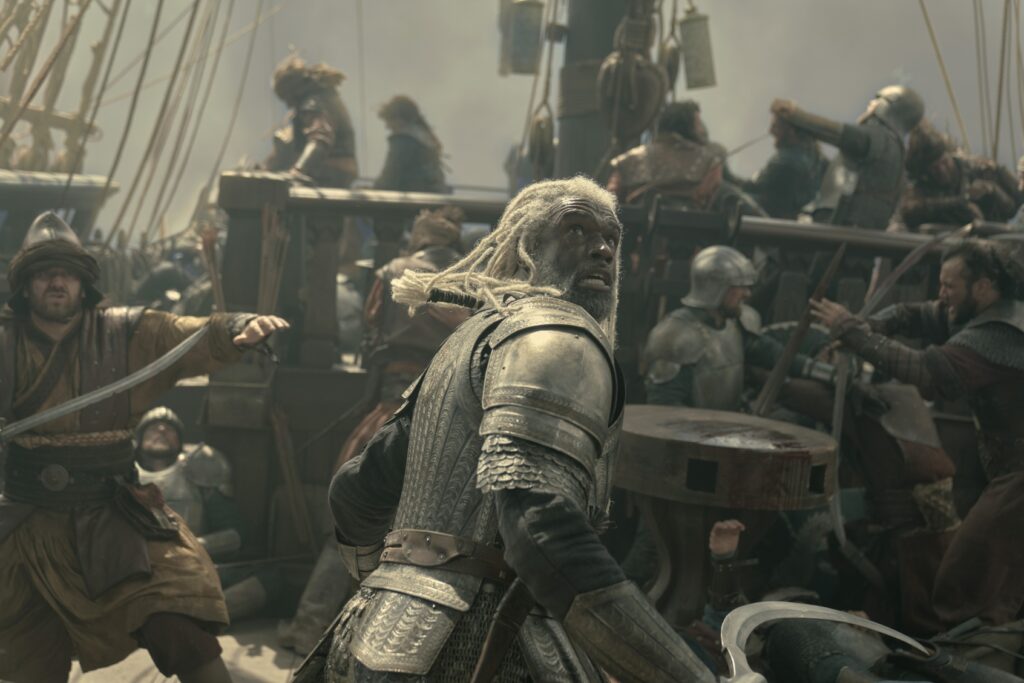
(Ollie Upton/HBO) Steve Toussaint in “House of the Dragon”
Empathizing with war’s toll may be an altogether separate proposition. HBO had no clue that the show’s return following a two-year hiatus would coincide with a conflict in the Middle East that arose from President Donald Trump’s suspicion, unsupported by U.S. intelligence data or the International Atomic Energy Agency, that Iran was close to having a nuclear weapon. And in fairness, most of the audience won’t be thinking about that when they sit down to watch the season premiere.
“I think it is such a big deal to order somebody to war, to cause devastation and destruction, and then assume we can all just get over it.”
Some might, though. At the recent ATX TV Festival, where Toussaint and Salim joined showrunner Ryan Condal and their costars Harry Collett and Bethany Antonia for a “House of the Dragon” panel, Condal drew a few parallels between the show’s fantasy beasts and monstrous weapons of modern warfare.
“What this show contends with, which the original ‘Game of Thrones’ did not contend with at least, until the very end, is this idea that there are nuclear weapons in play,” Condal told the audience in Austin, Texas. “And there are nuclear weapons in play on both sides. So, really, you have this classic Cold War standoff of mutually assured destruction. Of course, the characters in the show would not have those words. But we, as a modern audience, we can see that.”
We need your help to stay independent.
Martin based the novels that comprise “A Song of Ice and Fire” on the Wars of the Roses, the savage succession battles between the Lancasters and the Tudors over who had a rightful claim to the British throne. The inciting conflict simmered for decades, starting in the late 14th century, before erupting into a series of civil wars lasting more than 30 years.
That’s ancient history to most of us, making it fertile loam for speculative interpretation. That doesn’t mean there isn’t anything to be learned from true history or its fictionalized version dressed up in dragons and magic.
 (Courtesy of HBO)
“War, from what I’ve read, tends to be people sitting somewhere very safe, men usually, ordering other people’s children to go and kill each other at no cost to themselves,” Toussaint observed during our chat. “I think if we paid more attention to trying to find other ways, we wouldn’t be in the situation that we’re in today.
“I have no interest, believe me, in throwing shade at any particular leaders,” he added. “But I think it is such a big deal to order somebody to war, to cause devastation and destruction, and then assume we can all just get over it.”
The storied Battle of the Gullet, the bloodiest sea skirmish in Westeros history, opens the third season and places Corlys and Alyn in the thick of it, with father and son taking on Sharako Lohar (Abigail Thorn) and her Triarchy fleet. With Rhaenyra’s dragons on their side, the Velaryon armada should have the upper hand.
But war is messy. As one battered, traumatized survivor declares at the battle’s conclusion, “If this be victory, I hope I never see another.”
Want more from culture than just the latest trend? The Swell highlights art made to last.
Sign up here
There is the war that Rhaenyra and Daemon wage on Alicent Hightower (Olivia Cooke) and her sons, Aemond and Aegon II (Tom Glynn-Carney), whom she maneuvered to thwart Rhaenyra’s claim to the Iron Throne. But there’s also a more personal war playing out between Corlys and Alyn, locking a father in conflict with the son he ignored for years. Salim says that both show the dangers of allowing pride to fester and swell unchecked.
“The good thing about fantasy and sci-fi is that it’s a great sort of vehicle or conduit to reflect the state of the world which we’re in, and all themes that we kind of explore in the world of today,” Salim said. “They put it in a place where we can kind of escape, but also still be affected by it. I think that the reason why this story and the world are so popular is because no matter where or who you are, there are lessons to be learned from it,” he said.
The biggest one, Salim opined, is the cost of what can happen when you let yourself be run or dictated by ego or by pride.
Toussaint echoed that. “Forget the dragons, forget all that stuff for the moment. And what it’s about is people — it is about you and me looking at each other, into another’s eyes to see if they are telling the truth.”
He continued, “I remember George said at the very beginning, ‘There are no good and bad people in this.’ . . . It’s all of us as human beings going, ‘I just want someone to see me.’ And I hope that is one of the things that breaks through. Yes, there are lovely dragons, and we do cut people’s heads off, but I think ultimately that’s it.” Perhaps the fog of war will clear enough for us to see that — if it is indeed what enough of us are looking for.
“House of the Dragon” returns for its third season Sunday, June 21 at 9 p.m. ET/PT on HBO and HBO Max.
Read more
about the action in Westeros
