


Greg Dulli and his Afghan Whigs are back with “Soft Control.” The new Whigs record is a strong collection of material that stands solidly amongst the existing catalog of v2 Whigs albums, with big rockers, piano ballads, and tape loops neatly nestled against guitar feedback. It also brings stellar guitar work, a new drummer and features Dulli’s vocals in a way you haven’t heard them previously.
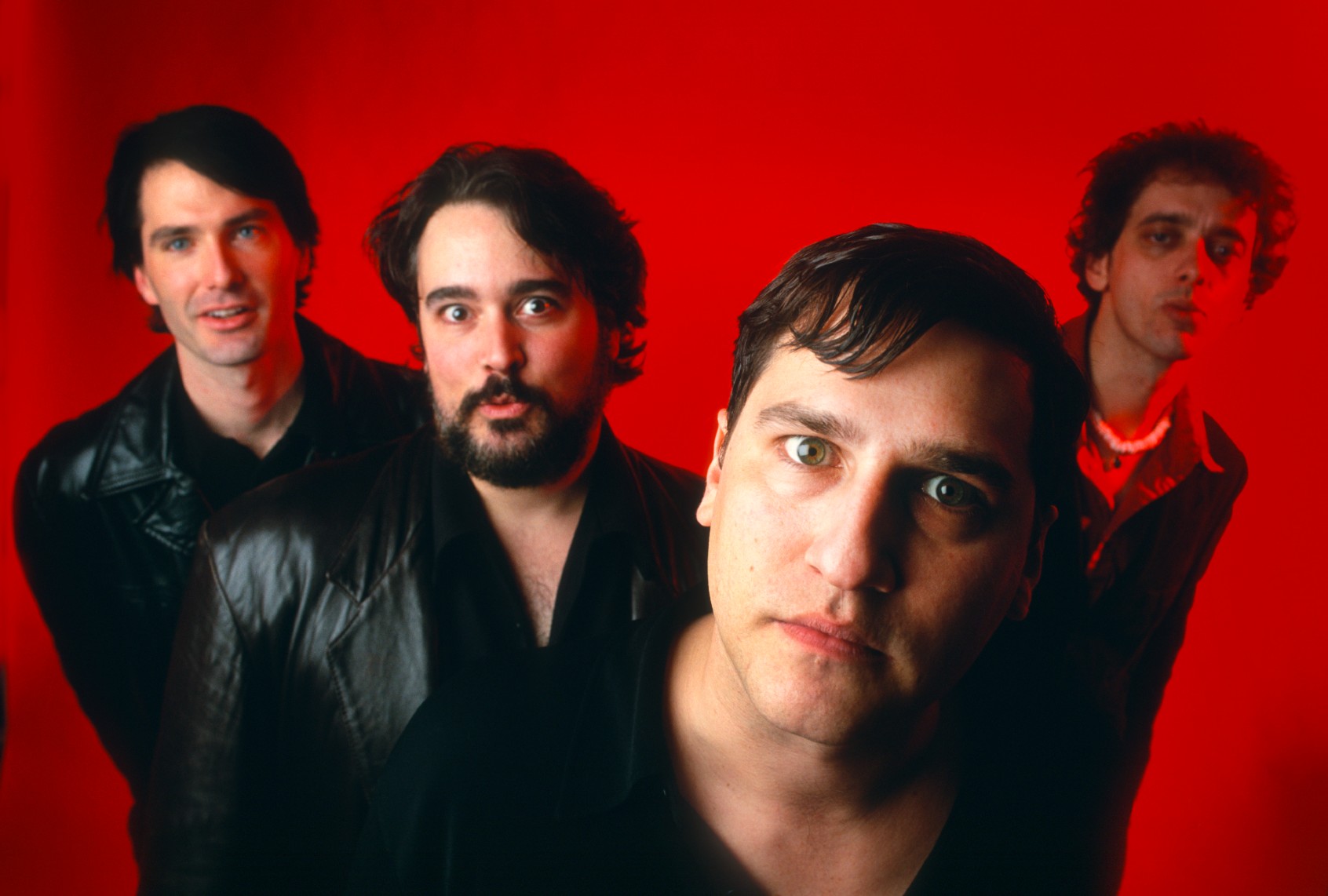
2026 is also being claimed as the 40th anniversary for this particular band of brothers, and it is indeed 40 years since the original ensemble first formed: Dulli alongside bassist John Curley (still present and accounted for), guitarist Rick McCollum, and a succession of drummers across the decades. The current lineup features Dulli, Curley, musical Swiss Army Knife Rick T. Nelson, guitarist Christopher Thorn and new drummer Bryan Lee Brown.
As the principal songwriter, what you hear on any Greg Dulli record is where he is at that moment in time.
The Afghan Whigs were in official existence until 2001, when they amicably parted ways. The ensemble with the three core members reformed briefly back in 2012, and the Whigs have been an ongoing concern since then, operating under the late Mark E. Smith’s ethos of, “If it’s me (in this case, Mr. Dulli) and your granny on bongos, it’s the Afghan Whigs.” (Smith, of course, made that statement about the Fall, who went through over 60 musicians over its 40-year duration.) It’s a benevolent dictatorship.
The Whigs records made post-breakup — hence the v2 designation — retain many of the elements of the band’s soul-meets-classic rock trademark style, while incorporating many of the more modern R&B/electronic hallmarks of the projects that occupied Dulli’s time post-Whigs v1: the Twilight Singers and the Gutter Twins, the latter being essentially the Twilight Singers but with Mark Lanegan (of blessed memory) on vocals. But it’s a vibe, not a formula; as the principal songwriter, what you hear on any Greg Dulli record is where he is at that moment in time.
“Soft Control”’s biggest delight is how fantastic Dulli’s voice sounds, and how prominent it is in the mix. Dulli has lived a life — he’s never been shy or apologetic about his use of controlled substances in the past, and they’re the kind of thing that can take its toll on your voice with continued use, not to mention the simple accumulation of years. Dulli’s voice has always been commanding but now it has depth and a richness. You can hear clear and compelling evidence of this on the opening track, “Jungle Roux,” in the beguiling falsetto on “Duvateen,” or the fascinating vocal treatment on “My Lover.”
Dulli told Salon that he’s been mindful about taking care of his instrument. “I definitely used the classic tea and honey. I add cayenne pepper to my tea and honey, though. I do that because someone told me, rightly or wrongly, that it opens the capillaries in your vocal cords and is beneficial, and I’ve been doing it for 20 years,” Dulli said. “And I also warm my voice up now, where in the old days, I never warmed my voice up. I just smoked and drank and misbehaved and went out there and winged it.”
Want more from culture than just the latest trend? The Swell highlights art made to last.
Sign up here
He continued: “I would say that my voice began to improve when I started singing with Mark Lanegan. Because if you’re singing with Mark Lanegan and something’s off, you’re the problem, because that dude had perfect pitch . . . So doing that, having to keep up with that guy, I had to work on my singing. And so that was a big step. But in particular on this album, I will say my vocals are probably louder than they’ve been on any record I’ve been a part of. And that’s Christopher Thorn. So he’s the one who really pushed my voice in the mixes.”
Thorn’s name may be familiar to fans of the ’90’s because he was the guitar player in Blind Melon. He came into the Whigs orbit behind the board for 2017’s “In Spades” and by 2022’s “How Do You Burn?,” he was co-producing. On guitar, Thorn offers a sound that can be as classic as you need it to be while immaculately executing new Whigsian concoctions. He’s somehow both understated — he’s not showboating, even when he would be entitled to — and authoritative. You can hear it in the intro to “House of I,” which has some very textured, modern-sounding power chords in the intro that immediately grab your attention, another indelible Whigs trademark — not their mere presence, but their crispness and tone. You know immediately you’re going to hear the Afghan Whigs.
“On this album, I will say my vocals are probably louder than they’ve been on any record I’ve been a part of,” Dulli told Salon.
The opening track, “Jungle Roux,” is another stellar example of this. That intro synth loop is very Whigs v2, in that it feels like it got borrowed from the Twilight Singers, as is the gently hypnotic backbeat and the female vocals. But what makes it familiar is that moment when the drums kick in and Dulli’s vocals are immediately in your ears, smooth yet commanding. It’s two parts Prince, one part Soul Train. His voice isn’t fighting the mix to be heard, and the result is ear-opening.
Another place where Dulli’s vocals are at the forefront is on “My Lover,” where the lead vocal has a stylized texture that feels like Dulli even if it doesn’t sound like him.
“It feels sort of like if Elvis was still alive, this is what he’d sound like,” Salon commented to Dulli.
“Wow. Well, I’ll take that every time,” Dulli responded, sharing that the inspiration for that song was Edwyn Collins’ 1994 modern soul pastiche, “A Girl Like You.” Like the Collins hit, “My Lover” sounds like it could be a cover of something old and rare, because it’s perfectly, classically constructed, with a bass line like a heartbeat, driving it along.
“House of I” was one of the two songs from the new record that were featured in the mini-tour this past spring, where the record wasn’t out yet and they were getting a new drummer (the truly excellent Bryan Lee Brown) broken in. “House of I” is the kind of classic banger the Whigs were famous for: a solid groove that choogles along until the guitars merge in, and then the vocals arrive, which pick up speed and intensity as the song progresses. Then there’s a piano bridge dueting with a guitar riff, and then, doo doo / doo doo / doo doo — old heads will feel that vocal line is coming, because it’s precisely the kind of trademark component that is foundational to how Dulli builds his songs. It’s not that it’s revolutionary, it’s that he makes it seem both fresh and familiar.
“Duvateen” is worth talking about some more because it’s a stellar exemplar of how John Curley firmly commands the rhythm section. It’s another one of those quiet storm numbers; everything is still vibrating at a very high level. But he’s just singing better than ever — the falsetto wouldn’t hide flaws, it would just emphasize them.
Baby, won’t lie-
I want a cigarette
Fu*k me twice-
I’m bangin nicorette
We need your help to stay independent.
(Gie Knaeps/Getty Images) Greg Dulli, John Curley, Rick McCollum and Ancienne Belgique of Afghan Whigs
The days of Dulli needing a contraption on his mic stand that both held his drink and his ashtray are long gone, and those who once indulged can definitely identify with this wistful statement. And in case you didn’t know, “duvateen” is the fabric they use on movie sets to completely block out the light. According to Dulli, the title came from a running list of possible titles he keeps on his phone, and isn’t meant as a hidden layer of meaning. “I didn’t try to fit the title to the words or anything like that. I mean, if you want to, in a larger sense, ‘Duvateen’ could represent the void, but it literally came from a conversation about my past. It could correlate that way, but there’s no overarching purposeful use of it.”
So if you see “77” on this track listing and think it might be a distant relative of “66” (from the “1965” album), your imagination could probably devise a half dozen ways it fits that description — it has a similar kineticism, but that’s about where that exercise ends. It’s a great example of the more impressionistic lyrics on this record; they’re still telling the same kind of stories but with more compression, more editing, retaining what’s essential and rejecting anything extraneous. There’s a glorious power scream at the end that parallels similar unrestrained, slightly unhinged sounds from the guitars.
The days of Dulli needing a contraption on his mic stand that both held his drink and his ashtray are long gone, and those who once indulged can definitely identify with this wistful statement.
“Loose Talk,” the album’s penultimate track (and according to Dulli, the final song written and recorded for the record), is another vocal standout. It’s the big arena rocker (at least in your dreams, it is). The chorus is made for singing along, Dulli’s voice absolutely soaring, accompanied by enormous crescendos that keep ratcheting up the tension and the excitement and then a beautiful guitar line comes threading through to take you to the outro.
It’s definitely the kind of song that should close down the night, and Dulli promises that the track is on the list of new songs the band hasn’t played yet that will make an appearance in the short 20+ date U.S./European tour that kicks off in September in the UK and November in the States. “We don’t have a ton of shows, so learning 35 songs is kind of, like — I don’t know about that,” he tells Salon. “But we’re definitely bringing like eight more songs into the show, both new ones and old ones. So it’ll be a different show than we did in the spring.”
“Soft Control” is a brighter record than one has come to expect from Dulli — not happier, not optimistic, just brighter. So how does Greg Dulli keep making art while the world burns?
“I have written songs since I was a teenager. It has been a passion of mine; it’s been an escape of mine. It’s been a way to entertain myself, console myself, turn myself on. So when you have something like that in your life, and it does all of these different things for you, and it still does decades later, there, that is the gift. It is the gift I give myself because all these things are all for me until I’m done with it and then I turn it over and then it’s not mine anymore.”
“Soft Control” is out now. The Afghan Whigs are on tour in support beginning in early September overseas and in early November in the States.
SIDEBAR: 40 YEARS OF THE AFGHAN WHIGS
So while the band got its start in 1986, the truth is that there’s actually a 13-year gap hidden in there. But Dulli and Curley are calling it 40 years, so we’ll honor that. Here’s a brief rundown of the other nine records released under that banner:
1988 / “Big Top Halloween”: This record is out of print and like many other records of similar obscurity, its reputation far outpaces the actual music on it. You could easily be a card-carrying Whigs fan without ever listening to this. It sounds like the Afghan Whigs trying very hard to be The Replacements, and does not remotely resemble everything that came after it. Anyone who requests a song from this record is just trying to show off.
1990 / “Up In It”: It’s the sound of youth, of clenched teeth, testosterone, and probably some stimulants, wrapped in absolute glee.
1992 / “Congregation”: This is the beginning of the glint of understanding, of the first firm feet on the ground of what would become Planet Whigs, the coalescence of the sound. This record is absolutely foundational: “I’m Her Slave,” “Turn On The Water,” “This Is My Confession,” “Miles Iz Ded” (hidden in the run-out groove like “Train In Vain”) and, of course, the Whigs’ “Jesus Christ Superstar” cover, “The Temple.” This is a severely underrated album because the songs that aren’t mentioned are just as good.
1992 / “Uptown Avondale” EP: The Whigs had a T-shirt back in the day that copped the Motown logo of the map of Southeastern Michigan with a star on Detroit; instead it was Ohio and Cincinnati. THE NEW SOUND OF YOUNG AMERICA, they shamelessly copped, and frankly they were entitled to it, that kind of bold and punk rock appropriation of the mainstream symbol that was at the literal heart of what they were trying to do. This was their last release on Sub Pop and it is best known for its desperate rendition of “Come See About Me,” the almost industrial cover of Freda Payne’s “Band of Gold,” and yet another hidden track, a remix of “Miles Iz Ded” (here billed as “Rebirth of the Cool”) a song that had already become the song the fans showed up praying for. It took a different shape (and length) every time it was performed.
1993 / “Gentlemen”: The album that cemented the band’s success, recorded at Ardent in Memphis, a devastating tale of heartbreak and betrayal, but there’s no redemption or resolution. There is no fairytale ending to “Gentlemen”; the subjects in question deal with their sh*t and keep moving on with their lives, carrying the damage and the scars and maybe a couple of lessons learned, maybe a few decisions to not do certain things the next time. Sonically, it is the logical destination based on the sum of the first two and a half records, that now patented Whigs sound that mashes together soul and rhythm and blues and Motown and Stax and ’70s classic rock with a dash of heavy metal. One of the essential albums of the decade.
1996 / “Black Love”: If you love a classic noir film, have I got the record for you! This record features an even stronger throughline than its predecessor. It goes deeper and darker, and the subject matter isn’t just broken hearts this time around. The difference between the two is that “Black Love” offers denouement and deus ex machina in the form of the three closing songs: “Bulletproof,” “Summer’s Kiss,” and “Faded,” a three-song mini-rock opera inside the larger story. It’s enormous and ambitious, but it is also 100% successful. There’s more subtlety, more shades of gray, and while it doesn’t have a happy ending either, it offers ecstatic redemption.
1998/”1965”: After two heavy concept records (and a fair amount of personal upheaval), “1965” is a collection of concept songs, where each one is completely unrelated to the one that precedes or follows it but for three to five minutes opens up an entire universe. Probably the most commercial of the v1 Whigs albums.
2014 / “Do to the Beast”: There isn’t an enormous sonic leap between the last Twilight Singers album and this first offering from the reconstituted Whigs. If you joined the party during the reign of the Twilight Singers, this won’t sound drastically different; if you ignored the Twilight Singers but were waiting to relive “Gentlemen,” too bad.
2017 / “In Spades”: The last record for stalwart guitarist/Dulli right-hand Dave Rosser, who left the planet in 2017. Most, if not all, of Dulli’s songs have storylines that are cinematic, but this record feels like the one where he was crystallizing that on an individual track basis. It was the first album they recorded live in the studio since the ’90s, and that aspect elevates almost every song on this record; they all feel incredibly vibrant.
2022 / “How Do You Burn?”: This is an album full of heavy, crunching guitars and deep rhythms, not as consistent as other records that came before or afterwards, but just as ambitious.
Read more
from music columnist Caryn Rose
