
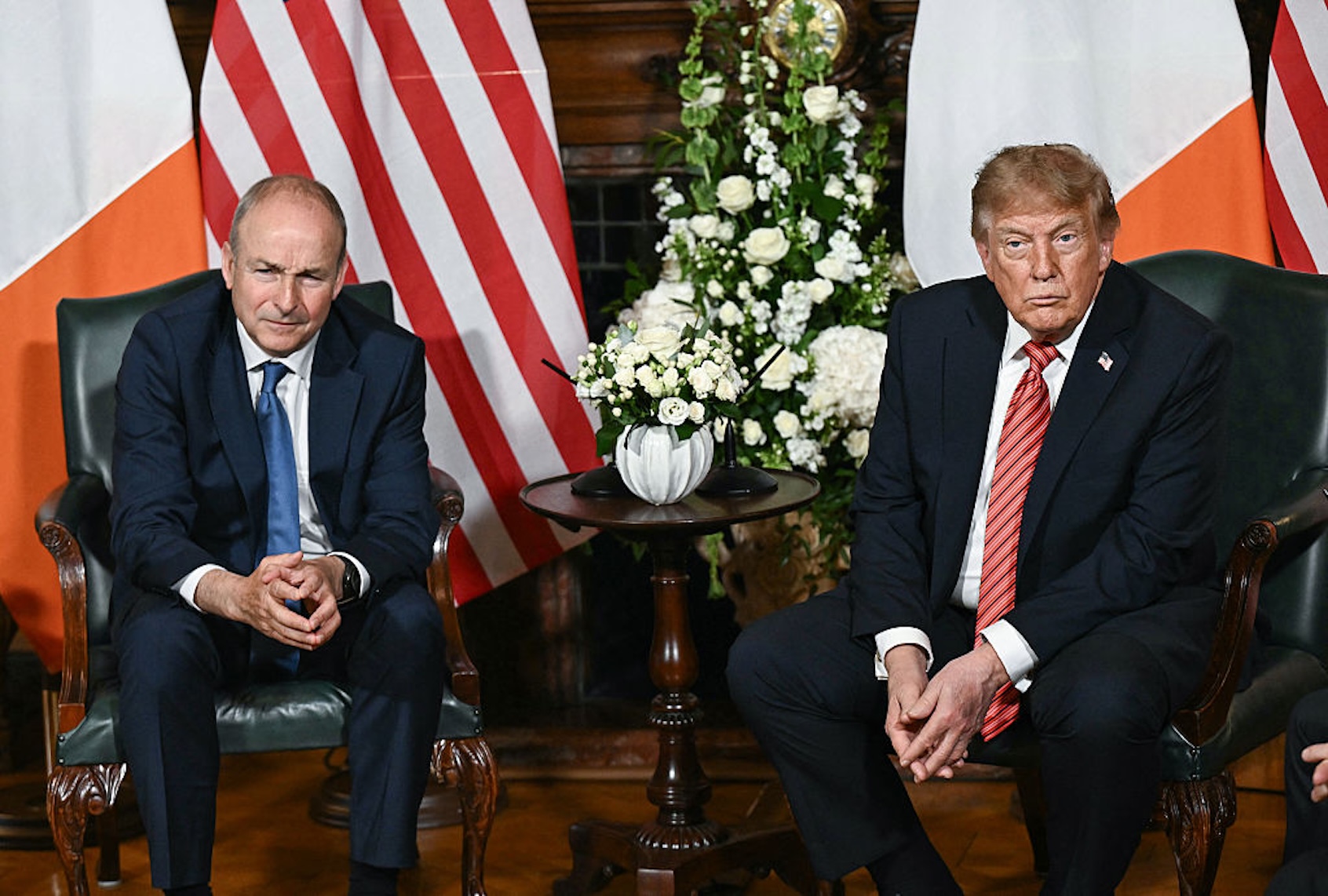

If Donald Trump is widely perceived at home as a sleepy, failing president trapped in crises of his own making and heading toward a midterm wipeout, his ability to command media attention and bewilder onlookers appeared undiminished during a two-day trip to Ireland this past weekend.
This wasn’t even an official state visit, just another of the business-meets-pleasure excursions that have become routine during the Trump administrations, and that no previous president would have ever contemplated. He was mostly there to attend the final two rounds of the Irish Open golf tournament, being contested at a resort he owns in County Clare. (Irish golfer Shane Lowry won the tournament, which under other circumstances would have been the week’s biggest story in that sporting-mad nation.)
Thousands of anti-Trump demonstrators turned up both in Dublin and on the periphery of Trump’s golf club — and were almost entirely ignored by international media. That largely happened because Trump blundered into the third rail of Irish politics during a brief handshake meeting with Irish Taoiseach (or prime minister) Micheál Martin, declaring his support for the reunification of the independent Republic of Ireland and the statelet of Northern Ireland, which is part of the United Kingdom. To quote the AP report:
“I don’t want to cause any problems but I’d love to see it unified,” Trump told a reporter who sought his opinion on the issue. “It’s going to happen eventually. It may as well happen now.
“I think it would be a fantastic thing,” the Republican president said, adding that “the U.K. will have something to say about it, obviously.”
To call this a vexed question is putting it mildly. For both historical and political reasons, it’s a question most mainstream Irish political figures, especially Martin and his wobbly governing coalition, are eager to avoid. When most of Ireland gained partial independence from the British Empire in 1922 after centuries of discord and several years of violent insurrection, six northeastern counties — whose population was predominantly Protestant and British-identified — were carved out to remain attached to the U.K.
That arrangement was initially understood by most people involved, including the British government, as a temporary expedient to avoid ethnic and religious conflict. Instead it rapidly became an entrenched fact on the ground, as well as a vivid example of the law of unintended consequences. Northern Ireland was managed for decades as a quasi-apartheid state where the Catholic or “nationalist” minority was economically marginalized, politically disenfranchised and frequently subjected to state violence. To cut a very long story short, that eventually led to the “Troubles,” the violent three-way conflict between rival paramilitary groups and the British army that lasted from the late 1960s through the Good Friday Agreement of 1998.
We need your help to stay independent.
One curious consequence of all that history is that Trump’s remarks on Irish unity have befuddled ardent unionists or “loyalists” in the Protestant community of Northern Ireland. To this day they tend to identify with right-wing causes both at home and abroad, and many have embraced both the MAGA movement and the Israeli government as ideological fellow travelers.
It’s a safe bet that Trump understands little or none of that context and wouldn’t care, nor does he grasp the awkward position of his hosts in the Republic. Martin’s political party, Fianna Fáil (somewhat hilariously, “Soldiers of Destiny”), is officially dedicated to the cause of Irish unification, and indeed was founded partly on that basis in the late 1920s by Éamon de Valera, who went on to become the dominant political figure of 20th-century Ireland. Today it’s a centrist grouping with no distinctive ideology, and while all parties in the Republic nominally support Irish unity, that’s been shoved to the back burner in order to preserve the fragile peace in “the North.” Unification is simply not a pressing concern for most people in a relatively affluent European society that faces a housing shortage, a healthcare crisis and the social pressures of immigration.
Start your day with essential news from Salon.
Sign up for our free morning newsletter, Crash Course.
Trump was offered several opportunities to walk back his remarks on Irish unity before flying back to Washington on Sunday, and gleefully reiterated them instead. It’s plausible that he was seizing the sharpest available stick to poke British Prime Minister Andy Burnham — who has provoked Trump’s ire by breaking ranks on Israel — but even more likely that he enjoyed causing an uproar and becoming the center of attention.
He threw a parting gift out the door of Air Force One, in the form of an offhand promise to end U.S. tariffs on Irish whiskey, but not on any other distilled spirits produced in the E.U. It’s not at all clear that’s something he can do, but since when has that mattered?
Read more
from Andrew O’Hehir
