

It was a turning point in 21st-century history. Or it was an act of cynical political calculation. Heck, there’s no law that says it can’t be both.
British Foreign Secretary Ed Miliband took the floor in the House of Commons on Sept. 8 to deliver one of the most remarkable speeches heard there in many years. It wasn’t a magnetic performance; nobody’s likely to compare Miliband to Winston Churchill or Barack Obama as an orator. He’s a policy-driven intellectual with degrees from Oxford and the London School of Economics, long identified with the “soft left” of the British Labour Party. (His father, Ralph Miliband, was an important Marxist intellectual.)
Still, the normally rowdy opposition benches of Westminster remained quiet while Miliband read his remarks directly off the sheets of paper in front of him. You can’t blame him for wanting to get it right: He was announcing a major shift in foreign policy, and specifically a significant break in the “special relationship” between Britain and the United States.
Under new Prime Minister Andy Burnham, he said, the British government would “introduce an import ban” on goods produced in Israel’s illegal settlements on the occupied West Bank, as well as sanctions on “specific companies and individuals” who provide services, financing or land for settlement expansion.
Furthermore, the U.K. was not acting alone. Within minutes, Miliband’s office issued a joint statement with the foreign ministers of Canada, France and nine other European nations. In cautious language that no doubt required many person-hours of negotiation and fine-tuning, all 12 countries promised to “introduce” or “support” laws restricting “trade in goods with settlements which are illegal under international law,” or at least confirmed that they are “actively considering these and other measures.”
If you can feel the real-world impact of these potential sanctions (which is not large to begin with) evaporating amid all that bureaucratic hedging, you are not wrong. Several European nations — including Belgium, Ireland, the Netherlands, Norway and Spain — have already restricted trade with the Israeli-occupied West Bank. Other nations among the 12 may lack the political will or internal cohesion to do so anytime soon. Germany and Italy, two of the three largest countries in the European Union, did not sign the joint declaration and have made no such promises.
Speaking as “a proud British Jew” and a lifelong supporter of the state of Israel, Miliband described the Israeli occupation of the West Bank in harsher terms than any major Western government official has ever used.
But whether these governments follow through on these admittedly vague pledges, and whether that results in material change in the Middle East, is at least partly beside the point. If Miliband’s speech and the accompanying announcements were largely symbolic, the symbolism was nonetheless powerful.
Miliband was speaking as “a proud British Jew” and a lifelong supporter of the state of Israel, he said. (His parents were World War II-era refugees from Poland, and his maternal grandfather died in a Nazi camp.) He went on to describe the Israeli occupation of the West Bank in harsher terms than any major Western government official has ever used. Israeli officials were turning “a blind eye” to the “forced displacement of Palestinians” in West Bank villages, Miliband continued, calling it “ethnic cleansing … perpetrated by settler terrorists.”
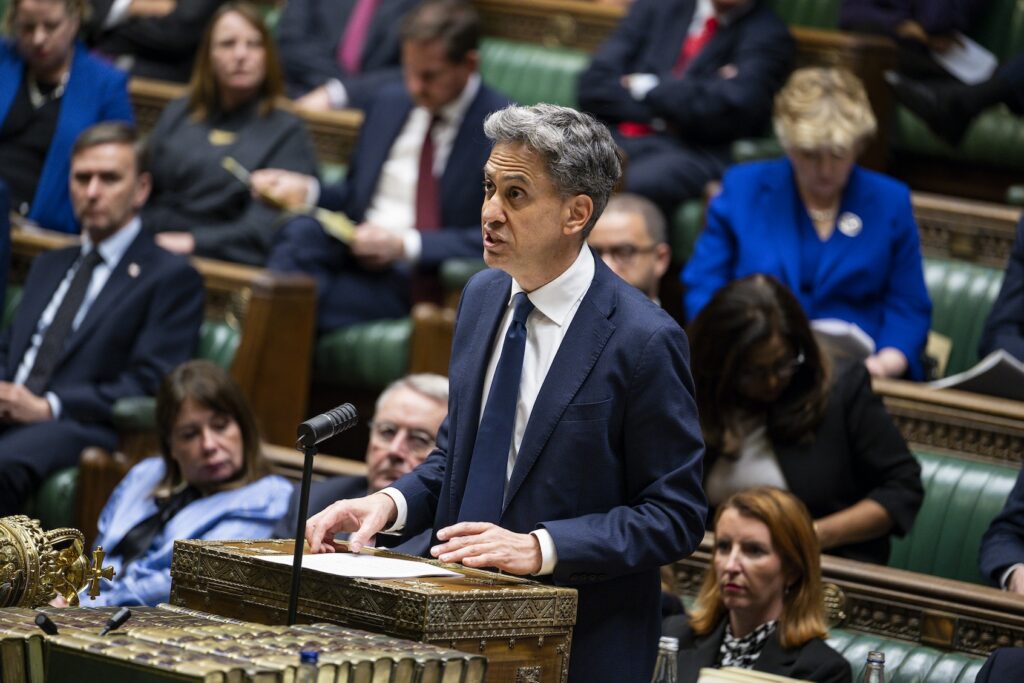
(House of Commons) Foreign Minister Ed Miliband in the House of Commons on Sept. 8, 2026.
There is no accurate way to measure the seismic impact of those words, which goes far beyond the limited potential effects of the proposed sanctions. Benjamin Netanyahu’s government had known that some expression of British displeasure was incoming, but they did not expect to hear a Jewish foreign minister accuse them of condoning or permitting acts of terrorism. Laconic Israeli commentator Itamar Eichner wrote the next morning that “Jerusalem had prepared for rain, but what arrived yesterday was a full-blown storm.”
If it’s too early to assess the global political ramifications of this dramatic shift, one thing is clear: Within weeks of defenestrating former Prime Minister Keir Starmer — who had alienated much of the British left, Joe Biden-style, by his reluctance to criticize Israel’s Gaza war — Andy Burnham has declared his independence.
Specifically, Burnham has forged an alliance with Canadian Prime Minister Mark Carney and French President Emmanuel Macron, in obvious defiance of the wobbly American colossus and its visibly decompensating president. According to a “readout” (or official briefing) issued by Downing Street, Burnham called Donald Trump before Miliband’s speech to tell him what was coming. He did not, it appears, request permission or ask for advice.
One should not read too much into a single event, but once again the symbolism is compelling. At least for the moment, Burnham has shattered the post-9/11 diplomatic consensus that tied U.S. allies to the disastrous policies of the “war on terror.” He seems to be the first British leader since Brexit to conceive of a new global role for the U.K., which is no longer a superpower on its own but can still be the driving force in a multinational coalition with near-superpower status.
We need your help to stay independent.
For the first two decades after the terrorist attacks of September 2001 (which this writer experienced first-hand as a Manhattan resident), the crusade against “radical Islam,” an indefinable enemy that was both everywhere and nowhere, became a transcendent imperative for the transatlantic alliance. The U.S. launched one war that was approximately justifiable, at least at first, and then another on entirely false premises. America’s allies joined the fight in Afghanistan and largely stayed away from Iraq (only Australia, Britain and Poland joined the “coalition of the willing”), opening a tactical and political rift that continues today.
But even beyond the 20 years of massively counterproductive warfare, the American obsession with combatting jihadist terrorism distorted global policy at least as much as the anticommunist fervor of the Cold War had done in earlier decades. All sorts of temporary alliances were forged with unsavory or undemocratic partner states — including, as it happens, Russia and Iran, who both feared Sunni radicalism of the al-Qaida or ISIS varieties nearly as much as America did.
We might speculate that the global pathologies of the “war on terror” years created a permission structure that allowed the nationalist far right in Israel to seize power, banish or crush the peacenik left and transform the state from the anxiously contested democracy of the 1970s and ‘80s into an expansionist fortress nation. American presidents from Bill Clinton onward have found Netanyahu a maddening and untrustworthy partner, but have done nothing to stop his aggressive campaigns of illegal settlement or to staunch the flow of arms to his regime.
Perhaps the “war on terror” years created a permission structure that allowed the nationalist far right to seize power in Israel, banish or crush the peacenik left and transform the state from the anxiously contested democracy of the 1970s and ‘80s into an expansionist fortress nation.
No doubt that’s an oversimplification. All parties involved must share blame for the bitter violence and deep mistrust of the Israeli-Palestinian conflict, which long predates 9/11. So does the quixotic and increasingly pathetic quest for a “two-state solution,” which was understood by the Bush and Obama administrations as a crucial element in diffusing or defeating terrorism. (That was reasonable enough: Osama bin Laden specifically cited U.S. support for the Israeli occupation as a central motivation for the 9/11 attacks.)
There’s not much to be said in favor of Donald Trump’s delusional and incoherent foreign policy, except perhaps that when it comes to the Middle East, a certain dark realism entered the chat. During the first term, Trump’s team tried to end-run the fading 2SS dream and forge a grand alliance between Israel and Saudi Arabia, with the goal of carving up the region into spheres of influence while crushing or isolating Iran. Joe Biden’s administration altered the rhetorical tone but pursued essentially identical goals.
You have to wonder how New York Times columnist Thomas Friedman feels now about his fulsome 2024 paeans to the “Biden Doctrine,” which he suggested might arrive at any moment. (“It’s Big,” promised an especially regrettable headline on Jan. 31 of that year.) Friedman was, as usual, channeling mainstream foreign policy dogma, which briefly held that constructive change might emerge from the chaotic aftermath of the Oct. 7, 2023, Hamas attack on Israel and the subsequent carnage in Gaza.
Biden’s supposed doctrine, never to be revealed amid his imploding presidency, was meant to unite the Israelis and Saudis in a proxy war against Iran and then lead, through some undisclosed and miraculous process, to the creation of a “credible, legitimate, effective, demilitarized Palestinian state.” Trump’s Iran war two years later, it would seem, represents the Biden Doctrine boiled down to Machiavellian essentials and colliding with post-Gaza reality: a pointless quagmire with only half-hearted Saudi support, and no prospect of a Palestinian state in the foreseeable future.
On several previous occasions I have written here about the late Jean Baudrillard’s infamous post-9/11 essay, “L’esprit du terrorisme,” in which he argued that the attacks did not represent a civilizational clash between “Islam” and “the West,” which were meaningless abstractions, but rather a self-destructive internal conflict within liberal democratic society: “The West, in the position of God, has become suicidal, and declared war on itself.” He went on to make the uncanny prediction that, in response to the threat of terrorism, the Western world would sacrifice its supposedly central “ideology of freedom” in favor of “a police-state globalization, a total control, a terror based on ‘law-and-order’ measures.”
Want more sharp takes on politics? Sign up for our free newsletter, Standing Room Only by Amanda Marcotte, also a weekly show on YouTube or wherever you get your podcasts.
Baudrillard’s premises struck many people as outrageous (or at least “too soon”) in 2002, but become more difficult to reject with every passing year. One could read the decade-long collective degradation of the Trump presidency, Israel’s descent into nihilistic self-parody and the blatant stupidity of the Iran war as a maximal expression of this suicidal tendency within the capitalist democracies. That, in a word, is what Andy Burnham and his friends are trying to escape.
The newborn Anglo-Franco-Canadian alliance may not endure for long — Macron is in his last year in power, with right-winger Marine Le Pen waiting in the wings — and its members have at least one eye on domestic politics. Burnham and Carney are seeking to acknowledge widespread public outrage at home over Israel’s reported conduct and to fend off attacks from the left, while trapping their conservative opponents in unpopular pro-Israeli positions.
Furthermore, its professed goals are not exactly realistic. At this point, talking about a two-state solution, as the joint foreign ministers’ statement last week does from its title onward, is like predicting the second coming of Christ or the classless society of true communism. No one can tell you it won’t happen, but the odds any of us will live to see it are pretty low.
But that language is no doubt necessary for diplomatic reasons, and perhaps also for philosophical ones. Telling the truth about Israel’s actions in the West Bank, as Miliband and Burnham perceive it, also required trying to imagine a better future, even an unlikely one. More important still, it required cutting the umbilical cord that has tied the entire Western world to America’s deadly downward spiral. It was an important start, but the real work lies ahead.
Read more
from Andrew O’Hehir on WTF is actually going on
