

Within the canon of adult animation,“The Simpsons” gets most of the credit for predicting the future, but “South Park” has at least one unnervingly good entry in the category.
In the 2014 episode “Gluten Free Ebola,” residents begin violently dying after consuming gluten, and the USDA springs into emergency mode. The solution comes to Cartman in a dream, courtesy of Aunt Jemima: the food pyramid is upside down. He calls Washington. There are only minutes until dinnertime on the East Coast. Scientists flip the pyramid. “Nutrition is stabilizing!” someone cries. By the end, the federal government has one final piece of advice for the president: have some steak with his butter.
Twelve years later, Robert F. Kennedy Jr. wandered directly into the bit. In January, as the federal government unveiled new dietary guidelines and brought back the food pyramid — inverted this time — Kennedy posted an edited version of the episode in which an animated version of himself delivers Cartman’s revelation: the pyramid is upside down. The resemblance might have ended there, except Kennedy recently told an interviewer that he eats beef twice a day, generally grass-fed strip steak. Reality, having already borrowed the premise, apparently decided to keep workshopping it.
One freakishly accurate joke is merely a freakishly accurate joke. But food has been turning up in “South Park” for decades as a kind of trapdoor: open it and, underneath dinner, there is usually some elaborate American contraption involving money, virtue, aspiration or somebody in authority telling you what is good for you. This is admittedly separate from Scott Tenorman’s parents being made into chili, and from the episode-length love letter to Casa Bonita that eventually helped turn Trey Parker and Matt Stone into actual restaurant owners.
Mostly.
None of which is to suggest “South Park” has aged without bruises; its equal-opportunity approach to offense has often involved punching down, even as the cultural understanding of who is “down” has changed around it. Food, though, has often given the show a cleaner target: not the person at the table, but everything that determines what lands there.
A year after “Gluten Free Ebola,” “The City Part of Town” found South Park yearning for a Whole Foods. Not because the town suffered from an acute shortage of organic kale, exactly. Randy Marsh argues that the store would “instantly validate us as a town that cares about stuff,” which is how South Park ends up inventing SoDoSoPa: an artisanal district of cafés, brick walkways and tasteful little lights constructed around Kenny McCormick’s visibly crumbling house. The poverty stays; it simply acquires ambience.
(The premise has held up. At a community meeting I attended this week, the possible loss of a Whole Foods tenant caused considerable consternation. I was, naturally, sitting near the snack table; by a certain point, the crinkle of chip bags and the peeling back of a tub of cut fruit had taken on the character of dissent.)
When Kenny’s father asks what everyone is doing outside his home, Randy is wonderfully concise: “We’re gentrifying. It’s all good.”
Once you notice this particular habit of the show, it becomes difficult to stop noticing it.
We need your help to stay independent.
Food on “South Park” has a funny way of refusing to remain food. Whole Foods becomes a referendum on whether a neighborhood has arrived. Gluten becomes a crisis of institutional expertise. Plant-based meat becomes corporate theater. Ozempic becomes a guided tour through American health care. The joke keeps changing, but the mechanism is remarkably stable: start with what somebody wants to eat, and pretty soon you are talking about who has money, who has status, who gets believed and who gets to make the rules.
By 2019, the mechanism had become almost perfectly circular. In “Let Them Eat Goo,” South Park Elementary decides to replace its cafeteria meat with a plant-based substitute after Cartman suffers two heart attacks. Enter the Goo Man, founder of Incredible Meat, whose sales pitch has the refreshing candor of someone who knows exactly what business he is in.
“I take plants, and I process them into goo,” he tells the children. “I’m a goo man.”
He has factories. He has trucks. His goo can become tacos or hot dogs or, presumably, whatever else the institutional contract requires. The school gets its ethical upgrade; the industrial food system barely has to change clothes.
Randy Marsh, meanwhile, discovers the same opportunity from the opposite direction. After trying an Impossible Burger at Burger King, he is astonished less by the technology than by the market for it: people will apparently pay a premium for food he thinks tastes terrible if it comes with the right environmental story attached. Soon he is attempting to turn the waste from his marijuana farm into plant-based burgers of his own.
This is one of “South Park’s” favorite arrangements: everyone has correctly identified one small piece of the scam and nevertheless becomes part of it. The Goo Man knows he sells processed goo. Randy knows virtue can command a markup. The school administrators want to buy something that makes lunch feel more responsible. Nobody has to be particularly naïve for the cycle to work.
Cartman, naturally, is the one who finally makes peace with the arrangement. He had assumed everyone was trying to force him to eat healthy food; what changes his mind is discovering that the meat substitute is factory-made, heavily processed and salty — in other words, comfortingly similar to the food he already likes. “I just didn’t want my food to change,” he explains.
If the new garbage happens to be more ethical and sustainable than the old garbage, he can live with that. It is a bleak little consumer triumph: the system has managed to make a moral improvement feel exactly like the thing it replaced.
Five years later, when “South Park” turned to GLP-1s, the product really had changed. The surrounding machinery, less so. In the 2024 special “The End of Obesity,” a doctor recommends semaglutide for Cartman after diet and exercise fail to meaningfully improve his health. What follows is a fourth grader’s tour of the American health-care system. By the time Kyle and Butters return to their friends, Butters reports that he “almost died” navigating it, while Kyle offers a terser diagnosis: “They just purposely make it difficult for people to pay for what they need.” His proposed workaround is beautifully deranged and, by then, somehow logical: order raw semaglutide from a factory in India, watch some videos online and make the injections themselves. “Who needs hospitals and insurance,” Kyle asks, “when we have TikTok and YouTube?”
Naturally, the workaround creates another system. Kyle decides to produce more of the homemade drug for people who cannot afford it; a government crackdown follows; Randy and the other adults start robbing pharmacies; and a cartel of cereal and snack-food mascots, threatened by the prospect of Americans eating less, eventually attacks the boys’ overseas supplier while masquerading as body-positivity activists.
The last detail was not exactly invented from whole cloth. A month before the special aired, reporting described major food companies, including General Mills, working with dietitians and influencers who used anti-diet and anti-food-shaming language while promoting highly processed foods, alongside industry lobbying and opposition to proposed labeling rules. The cartoon turned the dynamic into an armed raid by cereal characters, but the basic instinct — watch a useful moral vocabulary become commercially useful — was already recognizable.
Want more great food writing and recipes? Sign up for Salon’s free food newsletter, The Bite.
The smaller joke is sadder. Randy, secretly taking a GLP-1 himself, insists to his wife Sharon that his newly diminished appetite is simply evidence of superior habits. He is doing Pilates. He is working out. He is, as he puts it, “just tryin’ to be better.” The drug disappears from his account of his own body so that discipline can take its place. This may be the sharper recurring joke beneath all the goo, grocery stores and government agencies: in “South Park,” people are forever finding a product that changes something material, then inventing a moral story to explain why the result reflects who they were all along.
So it feels almost too tidy that, in this week’s episode, Cartman is right back where “The End of Obesity” found him. He tearfully tells his mother that other kids have been calling him “chubby wubby” and asks whether he might get a bicycle so he can exercise. This being Cartman, what he actually wants is an e-bike fast enough to function more or less like a motorized scooter.
The cycle has closed with almost insulting neatness: a new intervention, a new moral vocabulary, a new consumer workaround — and Cartman, once again, looking for a way to change without changing very much. “South Park” has always liked food for this reason. Even when an episode is not really about eating, food is often nearby as shorthand for whatever new identity a character is trying on. (In 2010’s “Crème Fraiche,” Randy’s Food Network obsession becomes so consuming that the family’s eventual intervention involves putting Cartman on stilts in a chef’s coat and passing him off as Gordon Ramsay.)
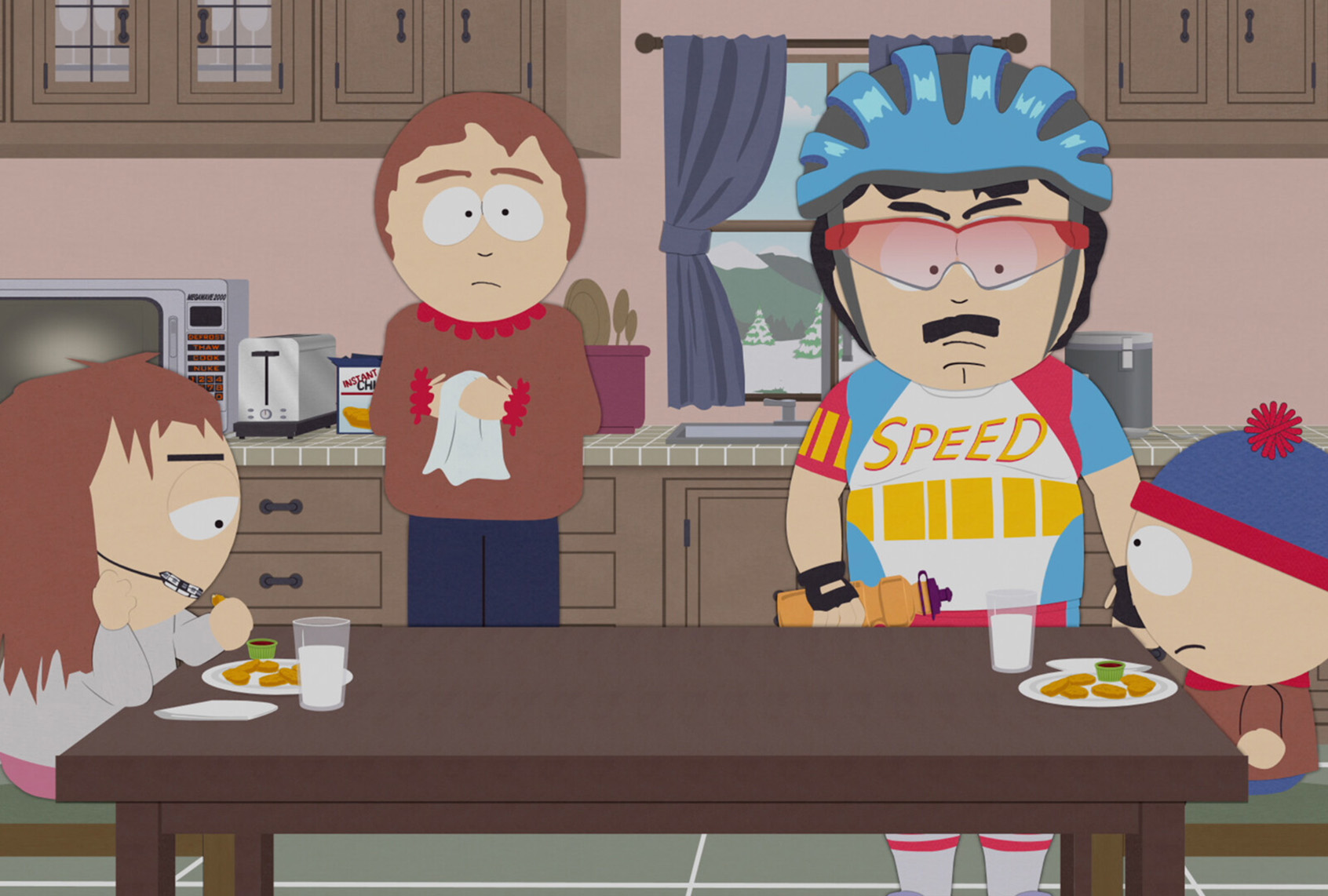
This week, Randy’s identity is “real cyclist,” which puts him at war with the packs of e-bike-riding kids now clogging South Park’s bike lanes.
Before long, Jamba Juice has effectively become his biker bar: reusable sports bottles thump against tables, aggrieved men hold court over their workouts, and a shortage of whey protein produces the kind of outrage once reserved for a saloon running dry. “Then get us some pea protein!” one cyclist demands. “You know who you’re dealing with?” By that point, nobody needs to explain what the protein powder means. The product is the tribe; the order is the performance; the smoothie shop is a clubhouse.
Nearly three decades in, “South Park” still knows that if you want to understand what Americans think they are becoming, you could do worse than look at what they’re ordering.
Read more
from Ashlie D. Stevens
