Editor: Mark Benjamin
Updated: Today
Topic:

Afghanistan

Why are we still in Afghanistan?

The country poses no threat to the U.S., but the war costs lives, drains the treasury and makes enemies
Reuters/Asmaa Waguih
U.S. marines fire during a Taliban ambush as they carry out an operation to clear an area in Helmand province, October 9, 2009.

One of the enduring oddities of the American foreign policy debate is that asking the most obvious questions is all but forbidden. For example, how does Afghanistan pose a threat to the United States?

Certainly not in any military sense. The impoverished, largely illiterate Afghans have no army apart from the one U.S. and NATO forces, with very limited success, are trying to train. No air force, no navy, no offensive military capacity whatsoever.

From the U.S. perspective, Afghanistan is the absolute end of the earth. Indeed, it's not a nation at all. The idea that well-intentioned Westerners can create an efficient central government on, say, the Swiss model, where none has ever existed, much less one acceptable to Afghanistan's many warring tribes, sects and ethnic factions, is almost certainly a delusion.

Here's the reality, as explained by a theater manager in somewhat Westernized Kabul to the New York Times: "The Afghan people are not mentally united ... An Uzbek will never vote for a Tajik. A Tajik will never vote for a Pashtun." The prevailing view, reporter Sabrina Tavernise found, appears to be that President Hamid Karzai's recent election victory was both fraudulent and inevitable.

Almost nobody believes a recount would solve anything. "Even if every Afghan casts their vote for (runner-up) (Abdullah) Abdullah, he won't be president because the foreigners don't want him to be," another man told her. "Nobody respected the people's vote."

Afghans see the Karzai government as organized thievery with a Pashtun accent. Period. Thus while veteran Washington Post columnist Jim Hoagland is likely correct that President Obama's seeming indecision about sending 40,000 more American soldiers there is actually a squeeze play to pressure "Karzai into sharing power with more honest, competent Afghans," it's also apt to show more illusory than real results.

Granted, Obama's current dilemma is yet another fine mess bequeathed to him by the epic incompetence of George W. Bush. But it's a political rather than a military threat Obama faces. Terrorists can't defeat the United States; they can only cause American politicians to self-destruct in fear of taking blame for future atrocities.

Had the United States and its allies not diverted manpower and resources from Afghanistan to a futile, unnecessary war in Iraq, the counterinsurgency techniques proposed by Gen. Stanley McChrystal to persuade Taliban fighters to put down their weapons might have worked.

Eight bloody years on, however, what motivates the insurgency has been captured in an extraordinary series by David Rohde, the New York Times reporter rescued after seven months as a Taliban prisoner.

While his "captors harbored many delusions about Westerners," Rohde writes, U.S. antiterrorist policies had galvanized them. "They said large numbers of civilians had been killed in Afghanistan, Iraq and the Palestinian territories in aerial bombings. Muslim prisoners had been physically abused and sexually humiliated in Iraq. Scores of men had been detained in Cuba and Afghanistan for up to seven years without charges."

Rohde witnessed Taliban militants weeping over a NATO airstrike that killed scores of Afghan women and children. "To Americans," he writes "these episodes were aberrations. To my captors, they were proof that the United States was a hypocritical and duplicitous power that flouted international law.

"When I told them I was an innocent civilian who should be released, they responded that the United States had held and tortured Muslims in secret detention centers for years. Commanders said they themselves had been imprisoned, their families ignorant of their fate. Why, they asked, should they treat me differently?"

And yet they did. Because his kidnappers saw Rohde as a valuable commodity, he was housed comfortably, provided with toiletries, fresh food and water, newspapers and a short-wave radio. While often threatened, Rohde was never tortured; his captors even took him to a remote spot in the mountains to shoot a video making his plight appear worse than it was.

Although it infuriates some Americans to hear that "terrorists" have recognizable human motives, understanding them is also crucial to what Gen. McChrystal hopes to achieve there: separating ethnic Pashtun insurgents from al-Qaida fanatics by offering what his report calls "reasonable incentives to stop fighting and return to normalcy, possibly including the provision of employment and protection."

U.S. intelligence officers have told the Boston Globe that an estimated "Ninety percent (of Afghan fighters constitute) a tribal, localized insurgency ... Ten percent are hardcore ideologues fighting for the Taliban."

And what if a U.S. president recognized that destroying mud villages and killing children in distant Afghanistan isn't making America safer? That endless war creates endless enemies? What if he showed enough political courage to say that 100 percent security from terrorism isn't possible? That the mad, quixotic attempt to achieve it is sacrificing the lives of our best and bravest while it bankrupts the treasury?

Who in the world would be angry with him except the Washington war lobby and Osama bin Laden?

© 2009 Gene Lyons. Distributed by Newspaper Enterprise Association

Intelligentsia against intelligence

How did we end up with know-nothings for wise men?
David Broder, left, and Jackson Diehl

In the parlance of our times, the term "idiocracy" means a nation run by idiots -- and the term "idiot" is defined by the dictionary as "an utterly foolish or senseless person" who exhibits "a mental age of less than 3 years old."

There are obvious reasons to believe America is becoming an idiocracy -- a series of horrendous government and business decisions strongly suggest that we've seen the ascension of utterly foolish, senseless people, many with the mental age of infants (yes, W., I'm looking at you). And if there remained any flicker of hope that we aren’t turning into a full-on slobbering idiocracy, that hope was snuffed out last week by two of the Washington intelligentsia's most respected voices.

First came a now-famous column about Afghanistan by the Washington Post's David Broder. The "dean" of the press corps attacked President Obama not for choosing any particular policy, but for simply taking time to meticulously consider his options in the Central Asian quagmire. "The urgent necessity," Broder asserted, "is to make a decision -- whether or not it is right."

This was followed by Jackson Diehl, the Post's foreign policy "expert." He wrote that the White House’s assiduous Afghanistan deliberations are not a sign of reassuring prudence after the bring-it-on Bush years, but instead a "compelling cause for unease about this president." Diehl's rationale for such an incendiary statement? He alleged (without proof, of course) that "there is unanimity in the Pentagon and considerable agreement in Congress and among the NATO allies" that a military escalation has to happen -- and therefore Obama "knows (the pro-escalation) course he must take" but "can't bring himself to embrace it."

Let's set aside the nauseating spectacle of two well-heeled journalists, comfortably protected far away from the front lines, demanding a president immediately send thousands of soldiers to their potential deaths without regard for blood-and-guts consequences. Let's just, if we can, put that grotesque immorality in a corner and pretend it's not important -- and let's go to the deeper, even more disturbing message.

As leading opinion-makers, Broder and Diehl are paid to carefully ponder issues and then offer their considered thoughts. That's not part of what they're supposed to do -- it's what they are singularly employed to do. It's how they earn their living and credibility -- indeed, it's their entire raison d'être. And yet, these leading lights of the intelligentsia are overtly preaching anti-intelligence, insisting the president must avoid taking time to think through his actions.

This isn't interpretation -- it's what these Beltway sages are literally saying. Broder is explicitly demanding Obama make a knee-jerk decision -- any decision -- even if it has catastrophic consequences. Likewise, Diehl is calling for Obama to immediately risk thousands of American lives simply because that's what Diehl believes the establishment wants.

Let's be clear -- these are just two of many similar examples. Today, screeds calling for leaders to prioritize lightning-fast decisions over measured deliberations are increasingly commonplace in the Washington intelligentsia, even after an Iraq debacle brought on by the same ideological know-nothingism.

The trend is deeply disturbing. It's one thing for talk-show-host wannabe Sarah Palin or carnival-barking provocateur Glenn Beck to glamorize willful ignorance -- that's been the narcissistic act of celebrity court jesters since the dawn of history. But it's an entirely different thing when hostility to intelligence and to the basic process of thinking itself emanates from the very professional thinkers who lead the nation's intelligentsia.

When that happens -- when the supposed guardians of political cognition and empiricism begin publicly flaying leaders for taking time to fully evaluate potential decisions -- it's a sign our country is becoming the ignorance-deifying idiocracy we should all fear.

© 2009 Creators Syndicate Inc.

The war industry's drums are beating

The pressure is on President Obama to act quickly in Afghanistan. But why?
AP
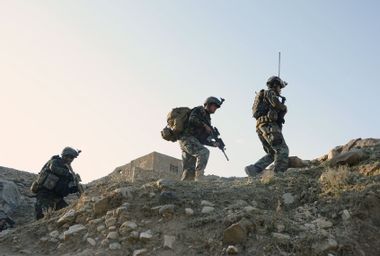
U.S. soldiers on patrol near the town of Pul-i-alam, Logar province, Afghanistan, Nov. 18, 2009.

Hurry, hurry. There's no time for thinking; it's time to act. Washington's permanent war lobby has worked itself into a veritable lather. The proper Pentagon press leaks have been made, Op-Eds written, talk show commandos deployed.

No less influential a military mind than the Washington Post's David Broder declares that even a bad decision about Afghanistan would be better than a postponed decision. Conceding that "a flood of leaks" has shown that "the perfect course of action does not exist," Broder nevertheless counsels haste. "[T]he urgent necessity," he writes, "is to make a decision -- whether or not it is right."

Read that again. Better to do something stupid, the man says, than for President Obama to ask too many tough questions.

Not even about such seemingly consequential matters, according to White House counter-leaks, as the Afghan government's epic corruption, whether or not Gen. Stanley McChrystal's counterinsurgency plan includes an exit strategy, and how the United States can sustain a troop "surge" in Afghanistan estimated to cost $1 million, per soldier, per year.

There's another sentence to read twice. One million tax dollars to support each American soldier in Afghanistan, every year. A substantial proportion, alas, spent flying coffins home to Dover Air Force Base.

Almost every time you turn on the television, somebody's carrying on about the projected trillion-dollar cost of Democratic health-insurance reforms -- derived by multiplying the $100 billion yearly cost by 10, and often by ignoring the projected $11 billion yearly savings to the U.S. budget deficit.

Pentagon spending this year alone, however, columnist David Sirota points out, is projected at $673 billion, for a 10-year total of $6.73 trillion. That's assuming costs don't rise. (Fat chance.) Giving McChrystal the soldiers he wants, along with training and equipping an Afghan army of dubious loyalty, is projected to cost an additional $40 billion to $50 billion each year. Yet nobody's supposed to ask how anything that happens in that remote land could possibly justify the costs.

Time was when Republican politicians sneered at "nation-building" -- particularly in remote places like Afghanistan that aren't nations to begin with. Today, however, to think is to "dither." Virtually every pundit in Washington appears to have accepted former Vice President Dick Cheney's formulation. Never mind Cheney's own eight-year record in Afghanistan: The time for action is now.

But why? Are the barbarians at the gates? Hardly. There are no battlefronts, no standing armies, and no immediate military threat to the United States. U.S. intelligence estimates that maybe 100 ragtag al-Qaida fighters remain scattered across the Afghan outback.

For all its brutality, the Taliban rebellion is mainly a localized, nationalist effort to expel foreigners -- one reason Gen. McChrystal hopes to be able to pacify them, as his mentor Gen. David Petraeus bought off Iraqi insurgents. With winter approaching, Taliban fighters will soon be forced into semi-hibernation. Any U.S. buildup will take at least a year to complete.

The big rush, in other words, has less to do with military necessity than with Washington political theater: specifically, the war lobby's ability to force President Obama's hand. Actually, "war industry" might be more apt. It's both more concise than the "military-industrial complex" President Eisenhower warned against and it takes into account the "privatization" of military jobs once done by soldiers -- such as driving supply convoys (Halliburton), guarding embassies and other U.S. facilities (Blackwater) and training Afghan soldiers (DynCorp International).

One needn't accept World War I-era radical Randolph Bourne's formulation that "war is the health of the state," to worry about the connection between corporate warfare and corporate welfare: corporations that donate to political campaigns, hire ex-politicians (such as Cheney) and generals (too many to count) as executives and board members, not to mention as lobbyists, publicists, etc. Sometimes over the table and sometimes under.

Only last week, we learned that yet another big Washington hawk had a secret piece of the action. According to the New York Times, following on research by Norwegian journalists, Peter Galbraith, the Clinton administration's ambassador to Croatia and a leading Democratic voice urging the U.S. invasion of Iraq, stands to gain "perhaps a hundred million or more dollars" from a previously undisclosed stake in Iraq's oil industry. The son of the late economist J.K. Galbraith, in March 2009 he was made the U.N.'s second-in-command in Afghanistan at the insistence of the Obama White House.

Remember when only leftist crackpots and Arab conspiracy theorists said invading Iraq was more about oil than democracy?

Following upon David Barstow's 2008 Pulitzer Prize-winning New York Times exposé about blatant conflicts of interest among Pentagon-coached retired generals posing as disinterested "military analysts" on every TV news network you can think of, Americans can no longer afford to be blasé about the war industry.

They're selling us endless war the way they sell cellphones and Viagra.

The question is: How much is President Obama buying?

© 2009, Gene Lyons. Distributed by Newspaper Enterprise Association

Paying off Afghanistan's warlords

Favoritism and corruption are the essence of the government the U.S. has helped "reconstruct" since 2001
This article previously appeared at TomDispatch.com.

KABUL, Afghanistan -- Every morning, dozens of trucks laden with diesel from Turkmenistan lumber out of the northern Afghan border town of Hairaton on a two-day trek across the Hindu Kush down to Afghanistan's capital, Kabul. Among the dozens of businesses dispatching these trucks are two extremely well connected companies -- Ghazanfar and Zahid Walid -- that helped to swell the election coffers of President Hamid Karzai as well as the family business of his running mate, the country's new vice-president, warlord Mohammed Qasim Fahim.

Some of the trucks are on their way to two power stations in the northern part of the capital: a recently refurbished, if inefficient, plant that has served Kabul for a little more than a quarter of a century, and a brand new facility scheduled for completion next year and built with money from the U.S. Agency for International Development.

Afghan political analysts observe that Ghazanfar and Zahid Walid are striking examples of the multimillion-dollar business conglomerates, financed by American as well as Afghan tax dollars and connected to powerful political figures, that have, since the fall of the Taliban in 2001, emerged as part of a pervasive culture of corruption here. Nasrullah Stanikzai, a professor of law and political science at Kabul University, says of the companies in the pocket of the vice-president: "Everybody knows who is Ghazanfar. Everybody knows who is Zahid Walid. The [government elite] directly or indirectly have companies, licenses, and sign contracts. But corruption is not confined just to the Afghans. The international community bears a share of this blame."

Indeed, the tale of the "reconstruction" of Kabul's electricity supply is a classic story of how foreign aid has often served to line the pockets of both international contractors from the donor countries and the local political elite. Unfortunately, these aid-financed projects also generally fail -- as the Kabul diesel plants appear destined to -- because of a lack of planning and the hard cash to keep them operating.

The Rise of a Power Broker

Abdul Hasin and his brother, the vice-president, offer a perfect exemplar of the new business elite. The two men are half-brothers, born to the two wives of a well-respected religious cleric from the village of Marz in the Panjshir valley north of Kabul.

In the early 1980s, Fahim, the older brother, joined the mujahedin forces of Ahmed Shah Massoud in the struggle against the Soviet occupation of Afghanistan. In 1992, three years after the Soviet army withdrew in defeat, Fahim was appointed head of intelligence in Afghanistan by the new President Burhanuddin Rabbani in the midst of a fierce and destructive civil war among the victors. When the Taliban took control of the country a few years later, Fahim became the intelligence chief for the Northern Alliance, also led by Massoud, which controlled less than a third of the country. On Sept. 9, 2001, two days before the World Trade Center was attacked, Massoud was assassinated by al-Qaida operatives and Fahim took control of the Northern Alliance, which the U.S. would soon finance and support in its "invasion" of Afghanistan.

A number of popular accounts of that invasion, such as Bob Woodward's book "Bush at War," suggest that the Central Intelligence Agency directly gave Northern Alliance warlords like Fahim millions of dollars in cold, hard cash to help fight the Taliban in the run-up to the U.S. invasion. "I can take Kabul, I can take Kunduz if you break the [Taliban front] line for me. My guys are ready," Woodward quotes Fahim telling a CIA agent named Gary after pocketing a million dollars in $100 bills.

Once the Taliban was defeated, Fahim was invited to become vice-president in the transitional government led by Hamid Karzai, a position he held for two years. It was at this juncture that Fahim's brothers, notably Abdul Hasin, started to build a business empire -- and not long after, good fortune began to rain down on the family in the form of lucrative "reconstruction" contracts.

In January 2002, while Fahim took whirlwind tours of Washington and London, meeting Gen. Tommy Franks, who had commanded U.S. forces during the invasion, and taking the salute from the Coldstream Guards, his younger brother was putting together a business plan. Soon thereafter, Zahid Walid, a company named after Abdul Hasin's older sons, not so surprisingly won a series of lucrative contracts to pour concrete for a NATO base as well as portions of the U.S. embassy being rebuilt in Kabul and that city's airport, which was in a state of disrepair.

On a plot of land in downtown Kabul reportedly "seized" for a song by Fahim, Abdul Hasin also financed the construction of a high-rise building dubbed "Goldpoint," which now houses dozens of jewelry shops. Soon, the company was importing Russian gas, and not long after that, Abdul Hasin set up the Gas Group, a company that ran a plant in the industrial suburb of Tarakhil that marketed bottled gas to households and small businesses.

In the winter of 2006, Zahid Walid won a $12 million contract from the Afghan ministry of energy and water to supply fuel to the old diesel plant in northwest Kabul, according to data published on the Web site of the government's central procurement agency, Afghanistan Reconstruction and Development Services. In the summer of 2007, the company won another $40 million diesel-supply contract, and last winter it took on a third contract worth $22 million.

On Oct. 19, I visited Zahid Walid's heavily guarded headquarters in the wealthy Kabul neighborhood of Wazir Akbar Khan, not far from the even more heavily fortified U.S. embassy. There, Ramin Seddiqui, the managing director of the company's diesel-import business, filled me in on another exclusive contract the company had secured from the Afghan government only days before for an additional $17 million. Zahid Walid is now to supply diesel fuel to the new 100 megawatt diesel power plant being built by Black & Veatch, a Kansas construction company, with money from USAID.

Most senior Afghan government officials and political figures are loath to discuss how Zahid Walid has won all these contracts -- at least publicly. On a recent visit to the Ministry of Commerce, I asked Noor Mohammed Wafa, the general director of oil products and liquid gas, about them. He promptly claimed that he had never even heard of the company. He then shot a glance at my Afghan assistant and said in Dari: "That's Marshal Fahim's company, isn't it?" When I asked whether the rules were different for powerful political figures -- as everyone in Kabul knows is the case -- Wafa politely denied any suggestion of favoritism in the awarding of import licenses.

In fact, dozens of people assured me in private on my most recent visit to Kabul that favoritism and corruption are the essence of the Karzai government the U.S. has helped "reconstruct" over the last eight years.

A White Elephant Power Plant in Kabul

While Zahid Walid has won close to $100 million in diesel contracts from the Afghan government in these years, there is hard evidence that the money for this once-needed fuel is now essentially being squandered. Earlier this year, KEC, an Indian company, completed the first of two high-voltage power lines from neighboring Central Asian countries that will bring cheap and reliable electricity into the capital.

The initial 220 kilovolt power line from Uzbekistan -- a $35 million project -- follows the same path as Zahid Walid's diesel trucks over the Hindu Kush. The comparison, however, ends there. True, the Indian engineers who constructed it had to survive the brutal snows in the Salang pass, but they are now done. On the other hand, the truckers continue to take the treacherous daily drive through the tunnel that connects northern Afghanistan to the south, bringing Turkmen diesel to Kabul at 22 cents a kilowatt hour. Meanwhile, the Uzbek electricity, traveling effortlessly through KEC's transmission lines, costs the Afghan taxpayer a mere six cents a kilowatt hour.

To add insult to injury, much of the diesel is meant for the USAID power plant at Tarakhil that has become a symbol of the sort of massive and widespread reconstruction waste and abuse that has gone on in this country for years. The plant, built by Black & Veatch, is now projected to cost $300 million, three times the price of similar plants in neighboring Pakistan. In addition, it will only be capable of supplying one-third of the power the Uzbek power line can deliver far less expensively. Nor will the Uzbek line be the only source of cheap electricity. KEC's engineers have broken ground on a second power line -- this one from Tajikistan -- that will supply 300 megawatts of electricity to Kabul, three times what the Tarakhil plant will produce at a bargain basement construction cost of $28 million.

"At full capacity, we burn 600,000 liters a day," Jack Currie, the Scottish manager of the Tarakhil plant told me as I toured it in late October. "And just how much will that cost the Afghan taxpayer?" I asked. "Well," replied Currie, "you can assume a dollar a liter of diesel." I quickly calculated and arrived at an annual total of $219 million per year, not including the plant's maintenance costs (estimated at another $60 million a year). Currie looked astonished when I mentioned the figure.

I took these numbers to Mohammed Khan, a member of the Afghan parliament and chair of its energy committee. "Will you approve the funds for this diesel power plant?" I asked. The soft-spoken Khan, a trained electrical engineer who worked for many years in the Kabul Electricity Department, answered simply: "No. Not unless we have an emergency."

So why build a power plant that, in terms of kilowatt hours made available, costs 26 times as much as the Indian-built power line? Anwar-ul-Haq Ahadi, Afghan's former finance minister, recalls the process. The idea, he says, originally came from then-U.S. Ambassador to Afghanistan Ronald Neumann, who dreamed it up in April 2007 shortly before he left the country. He apparently envisioned it as a strategic alternative to the Uzbek power line. After all, at that time the repressive Uzbek regime had denied Washington the use of what was seen as a key military base in Central Asia, Karshi-Khanabad, and so functionally kicked U.S. troops out of the country. Naturally, then, it was also seen as an unreliable political partner for the U.S.-backed regime of Hamid Karzai.

Following up, USAID officials told the Karzai government that they could build a diesel plant in Kabul in just over two years for $120 million. It would, the ambassador indicated, be functional just in time for the 2009 elections, allowing Karzai to claim that he had provided power to the electricity-starved capital. The Afghan president readily agreed to the plan, instructing anxious officials at the ministry of finance to approve the scheme in early 2007. He even agreed to put $20 million of Afghan funds into the project -- after being assured that the U.S. would pay for the rest.

Over the next two years, while Indian engineers raced the Americans to provide power to Kabul (ultimately winning handily), the ministry of energy and water was having a hard time keeping the lights on during Kabul's harsh winters. And while the city waited for these promised sources of power to come online, the new political-business elite, with its specially set up companies like Zahid Walid, was winning government-issued contracts to supply diesel to the old Kabul power plant -- and making money hand over fist.

Zahid Walid was hardly the only politically well-connected business to clean up: Ghazanfar, a company from Mazar-i-Sharif, also won $17 million in diesel-supply contracts in the winter of 2006-2007, and then an astonishing $78 million in new contracts for 2008-early 2009. Not surprisingly, Ghazanfar turns out to be run by a family that is very close to President Karzai. (One sister, Hosn Banu Ghazanfar, is the women's minister and a brother is a member of parliament.)

In March 2009, the Ghazanfars opened a new bank in the capital, plastering the city with giant billboard advertisements featuring a cascade of gold coins. Less than six months later, the bank wrote out a $2 million interest-free loan to Karzai for his election campaign, paying back the favors his government had done for them over the previous three years.

Afghanistan as a Patronage Machine

This week, Mohammed Qasim Fahim will be sworn in as the next vice-president of the new government of Afghanistan. Under an agreement with USAID, this new government is required to spend Afghan money to buy yet more diesel for the Tarakhil power plant, which in turn will put money exclusively and directly into the vice-president's brother's pocket.

Hamid Jalil, the aid coordinator for the Ministry of Finance, points out that wasting money on unnecessary projects like Tarakhil has helped to hobble Afghanistan's progress in the last eight years. "The donor projects undermine the legitimacy of the government and do not allow us to build capacity," he says, adding in the weary tone you often hear in Kabul today, "Corruption is everywhere in post-conflict countries like ours."

Former Afghan Finance Minister Ashraf Ghani summed up the whole profitably corrupt system that has run Afghanistan into a cul-de-sac this way. "It's not crazy, it's absurd," he says. "Crazy is when you don't know what you're doing. Absurd is when you don't provide a sense of ownership and a sense of sustainability."

Pratap Chatterjee is an investigative journalist and senior editor at CorpWatch. He is the author of "Halliburton's Army: How a Well-Connected Texas Oil Company Revolutionized the Way America Makes War" (Nation Books, 2009) and "Iraq, Inc." (Seven Stories Press, 2004).

Dr Ali Safi contributed research and reporting for this article. A video story by Chatterjee related to this one can be seen at Britain's Channel 4 News

© 2009 Pratap Chatterjee 

Obama wants more Afghanistan options

President wants revised choices after plans produce dissent among White House team

President Barack Obama won't accept any of the Afghanistan war options before him without changes, administration officials say, amid an argument by his own ambassador in Kabul that a significant U.S. troop increase would only prop up a weak, corruption-tainted government.

Obama's ambassador, Karl Eikenberry, who is also a former commander in Afghanistan, is voicing strong dissent against sending more forces, according to an administration official. This puts him at odds with the current war commander, Gen. Stanley McChrystal, who is seeking thousands more troops.

Eikenberry's misgivings center on a concern that bolstering the American presence in Afghanistan could make the country more reliant on the U.S., not less. He expressed them in forcefully worded cables to Washington just ahead of Obama's latest war meeting Wednesday.

The officials spoke on condition of anonymity to discuss administration deliberations.

The developments underscore U.S. skepticism about the leadership of Afghan President Hamid Karzai, whose government has been dogged by corruption. The emerging administration message is that Obama will not do anything to lock in an open-ended U.S. commitment.

U.S. Secretary of State Hillary Rodham Clinton said Thursday that she is concerned about Afghanistan's "corruption, lack of transparency, poor governance (and) absence of the rule of law."

"We're looking to President Karzai as he forms a new government to take action that will demonstrate -- not just to the international community but first and foremost to his own people -- that his second term will respond the needs that are so manifest," Clinton said during a news conference in Manila with Philippine Foreign Secretary Alberto Romulo.

Obama is still expected to send in more troops to bolster a deteriorating war effort.

He remains close to announcing his revamped war strategy -- troops are just one component -- and probably will do so shortly after he returns from a trip to Asia that ends Nov. 19.

Yet in Wednesday's pivotal war council meeting, Obama wasn't satisfied with any of the Afghanistan war options presented by his national security team, one official said.

The president instead pushed for revisions to clarify how and when U.S. troops would turn over responsibility to the Afghan government. In turn, that could change the dynamic of both how many additional troops are sent to Afghanistan and what the timeline would be for their presence in the war zone, according to the official.

Military officials said Obama has asked for a rewrite before and resisted what one official called a one-way highway toward commander McChrystal's recommendations for more troops. The sense that he was being rushed and railroaded has stiffened Obama's resolve to seek information and options beyond military planning, officials said, though a substantial troop increase is still likely.

The president is considering options that include adding 30,000 or more U.S. forces to take on the Taliban in key areas of Afghanistan and to buy time for the Afghan government's small and ill-equipped fighting forces to take over. The other three options on the table are ranges of troop increases, from a relatively small addition of forces to the roughly 40,000 that McChrystal prefers, according to military and other officials.

The war is now in its ninth year and is claiming U.S. lives at a record pace as military leaders say the Taliban has the upper hand in many parts of the country.

Ambassador Eikenberry, who was the top U.S. military commander in Afghanistan for two years ending in 2007, is a prominent voice among those advising Obama, and his sharp dissent is sure to affect the equation.

The options given to Obama will now be altered, although not overhauled.

Military officials say one approach is a compromise battle plan that would add 30,000 or more U.S. forces atop a record 68,000 in the country now. They described it as "half and half," meaning half fighting and half training and holding ground so the Afghans can regroup.

"The government of Afghanistan has to accept greater responsibility for its own defense," Clinton said Thursday. She had no comment on the Eikenberry memos.

The White House says Obama has not made a final choice, though military and other officials have said he appears near to approving a slightly smaller increase than McChrystal wants at the outset.

Among the options for Obama would be ways to phase in additional troops, perhaps eventually equaling McChrystal's full request, based on security or other conditions in Afghanistan and troop levels by U.S. allies there.

The White House has chafed under criticism from Republicans and some outside critics that Obama is dragging his feet to make a decision.

Obama's top military advisers have said they are comfortable with the pace of the process, and senior military officials have pointed out that the president still has time since no additional forces could begin flowing into Afghanistan until early next year.

Under the scenario featuring about 30,000 more troops, that number most likely would be assembled from three Army brigades and a Marine Corps contingent, plus a new headquarters operation that would be staffed by 7,000 or more troops, a senior military official said. There would be a heavy emphasis on the training of Afghan forces, and the reinforcements Obama sends could include thousands of U.S. military trainers.

------

Associated Press writers Matthew Lee in Manila, Philippines, and Pamela Hess in Washington contributed to this report.

Bombing in Charsadda kills 34, exposes local rifts

Conflict within Waziristan is a reminder that not all Pashtuns are extremists
For more from Juan Cole, visit his blog Informed Comment.
AP
Police officials survey the site of a suicide bomb explosion in Charsadda, located about 12 miles northeast of Peshawar.

A suicide bomber detonated his payload in a market in Charsadda, a half hour drive northeast of Peshawar in Pakistan's North-West Frontier Province. The Los Angeles Times quotes Prime Minister Yousuf Reza Gilani saying that the bombing was a desperate response to the success of the Pakistani army's campaign against the Pakistani Taliban in South Waziristan.

Reuters has video.

The violence also has a local political significance. In the February 2008 parliamentary elections, the Awami National Party, a secular Pashtun party, became very popular and won the province. In the run-up to that victory, in January, 2008, hard line devotees of political Islam set off a bomb at an ANP rally in Charsadda that killed 20 persons. From 2003 until 2008, the North-West Frontier Province was ruled by the United Action Council (Urdu acronym MMA), a coalition of 6 small fundamentalist parties that included at least one party close to the Taliban, despite its willingness to sit on parliament under Gen. Pervez Musharraf.

The fundamentalists resent having been displaced by the secular Pashtun sub-nationalist ANP, and this bombing of Charsadda is probably a further piece of thuggery aimed at punishing the Pashtuns for voting secular. Asfandiyar Wali Khan, the president of the Awami National Party, and other high provincial officials condemned the attack. Wali Khan said, "These barbaric elements have no religion and faith. The government is determined to eliminate terrorism and our struggle will continue."

Such violence is often read in the West as a confirmation of the bigoted view that Muslims in general are unusually violent. Even in Pakistan, it is read as a sign of alleged Pashtun tendencies to violence and barbarism. In fact, a bombing like that in Charsadda is part of a low-intensity, drawn-out civil war among the Pashtuns themselves, with a small rural radical fringe targetting urban, ideologically moderate groups and institutions.

In fact, the Awami National Party has its origins in Pashtun support for Mahatma Gandhi's nonviolent campaign for independence from the British; that is, it began as a pacifist party. The idea of pacifist Pashtuns is so preposterous in today's atmosphere of anti-Pashtun prejudice that it is typically missing from journalistic accounts of politics in the NWFP.

Meanwhile, the fighting in South Waziristan continues, with Pakistan claiming to have killed 12 militants on Tuesday.

Digging in for the long haul in Afghanistan

The Pentagon's building boom in Afghanistan indicates a long war ahead
This article previously appeared at TomDispatch.com.

In recent weeks, President Obama has been contemplating the future of U.S. military operations in Afghanistan. He has also been touting the effects of his policies at home, reporting that this year's Recovery Act not only saved jobs, but also was "the largest investment in infrastructure since [President Dwight] Eisenhower built the Interstate Highway System in the 1950s." At the same time, another much less publicized U.S.-taxpayer-funded infrastructure boom has been under way. This one in Afghanistan.

While Washington has put modest funding into civilian projects in Afghanistan this year -- ranging from small-scale power plants to "public latrines" to a meat market -- the real construction boom is military in nature. The Pentagon has been funneling stimulus-size sums of money to defense contractors to markedly boost its military infrastructure in that country.

In fiscal year 2009, for example, the civilian U.S. Agency for International Development awarded $20 million in contracts for work in Afghanistan, while the U.S. Army alone awarded $2.2 billion -- $834 million of it for construction projects. In fact, according to Walter Pincus of the Washington Post, the Pentagon has spent "roughly $2.7 billion on construction over the past three fiscal years" in that country and, "if its request is approved as part of the fiscal 2010 defense appropriations bill, it would spend another $1.3 billion on more than 100 projects at 40 sites across the country, according to a Senate report on the legislation."

Bogged down at Bagram

Nowhere has the building boom been more apparent than at Bagram Air Base, a key military site used by the Soviet Union during its occupation of Afghanistan in the 1980s. In its American incarnation, the base has significantly expanded from its old Soviet days and, in just the last two years, the population of the more than 5,000 acre compound has doubled to 20,000 troops, in addition to thousands of coalition forces and civilian contractors. To keep up with its exponential growth rate, more than $200 million in construction projects are planned or in progress at this moment on just the Air Force section of the base. "Seven days a week, concrete trucks rumble along the dusty perimeter road of this air base as bulldozers and backhoes reshape the rocky earth," Chuck Crumbo of the State reported recently. "Hundreds of laborers slap mortar onto bricks as they build barracks and offices. Four concrete plants on the base have operated around the clock for 18 months to keep up with the construction needs."

The base already boasts fast food favorites Burger King, a combination Pizza Hut/Bojangles, and Popeyes as well as a day spa and shops selling jewelry, cellphones and, of course, Afghan rugs. In the near future, notes Pincus, "the military is planning to build a $30 million passenger terminal and adjacent cargo facility to handle the flow of troops, many of whom arrive at the base north of Kabul before moving on to other sites." In addition, according to the Associated Press, the base command is "acquiring more land next year on the east side to expand" even farther.

To handle the influx of troops already being dispatched by the Obama administration (with more expected once the president decides on his long-term war plans) "new dormitories" are going up at Bagram, according to David Axe of the Washington Times. The base's population will also increase in the near future, thanks to a project in progress recently profiled in the Freedom Builder, an Army Corps of Engineers publication: the MILCON Bagram Theatre Internment Facility (TIF) currently being built at a cost of $60 million by a team of more than 1,000 Filipinos, Indians, Sri Lankans and Afghans. When completed, it will consist of 19 buildings and 16 guard towers designed to hold more than 1,000 detainees on the sprawling base, which has long been notorious for the torture and even murder of prisoners within its confines.

While the United States officially insists that it is not setting up permanent bases in Afghanistan, the scale and permanency of the construction under way at Bagram seems to suggest, at the least, a very long stay. According to published reports, in fact, the new terminal facilities for the complex aren't even slated to be operational until 2011.

One of the private companies involved in hardening and building up Bagram's facilities is Contrack International, an engineering and construction firm that, according to U.S. government records, received more than $120 million in contracts in 2009 for work in Afghanistan. According to Contrack's Web site, it is, among other things, currently designing and constructing a new "entry control point" -- a fortified entrance -- as well as a new "ammunition supply point" facility at the base. It is also responsible for "the design and construction of taxiways and aprons; airfield lighting and navigation aid improvements; and new apron construction" for the base's massive and expanding air operations infrastructure. The building boom at Bagram (which has received at least a modest amount of attention in the American mainstream press) is, however, just a fraction of the story of the way the U.S. military -- and Contrack International -- are digging in throughout Afghanistan.

Rave reviews for Kandahar

In March, according to Pentagon documents, Contrack was awarded a $23 million contract for "the design and construction of [an] Intelligence, Surveillance and Reconnaissance ramp, Kandahar Airfield, Afghanistan." Last year, in the Washington Post, Pincus reported that a planned expansion at the airfield, also once used by the Soviets and now a major U.S. and NATO base, was to accommodate aircraft working for a Task Force ODIN -- an Afghanistan-based version of the Army unit that used drones and helicopters to target insurgents planting IEDs in Iraq. Today, Task Force ODIN-Afghanistan -- the acronym stands for "observe, detect, identify and neutralize," with a nod to the chief Norse god -- is up and running, and still reportedly piloted out of "Bagram in one of two small, nondescript ground control stations." Whether ODIN aircraft are also operating out of Kandahar Airfield is -- like so much information about the U.S. military in Afghanistan -- unclear. Certainly, though, many more NATO and U.S. aircraft will be flying out of the base once Contrack, as it notes on its Web site, completes its "[d]esign and construction of replacement runways with asphalt and touch down areas with concrete pavement" and "rehabilitation of 6 existing taxiways," among other projects.

Contrack's Kandahar contract is set to be fulfilled by late December, but like Bagram, the base already gives every appearance of permanence. "It's one of the busiest single runways in the world," Capt. Max Hanlin from the 2nd U.S. Army Division's 5th Stryker Brigade told Agence France-Presse recently. Originally built to house 12,000 troops, Kandahar Air Base now supports 30,000 or more NATO and U.S. personnel. Some do battle in the inhospitable terrain of the surrounding region, while others have never been outside the wire and while away their time in the base's cafes and small shops (where troops reportedly can buy, among other items, belly dancer costumes), party in the "Dutch corner," play roller hockey in the base's central square, or dance the night away at a Saturday rave. "They are shaking glowsticks as if they have no concept of the mines and the war outside," said one U.S. officer, watching troops on the dance floor.

In recent days, U.S. forces announced a decrease in recreational perks and an imposition of more austere circumstances -- salsa and karaoke nights have already been cut at Kandahar -- prompting worries by NATO allies that their recreational facilities will be overrun by entertainment-starved U.S. troops.

A mob of FOBs

It seems that no one outside the Pentagon knows just exactly how many U.S. camps, forward operating bases, combat outposts, patrol bases and other fortified sites the U.S. military is currently using or constructing in Afghanistan. And while the Americans have recently abandoned a few of their installations, effectively ceding the northeastern province of Nuristan to Taliban forces, elsewhere a base-building boom has been under way.

In April, Contrack was awarded another $28 million contract for work on airfields -- to be performed at unspecified sites in Afghanistan. In June, Florida-based IAP Worldwide Services was awarded a $21 million contract to enhance electrical power distribution at the U.S. Marines' still-growing Forward Operating Base (FOB) Leatherneck in Helmand Province, a Taliban stronghold. Scheduled for completion in June 2010, that project is only part of IAP's work, which has involved "almost two dozen power plants at U.S. Army bases in Afghanistan and Iraq" that, according to the company's promotional literature, its teams have "delivered, installed, operated and maintained."

FOB Dwyer, also in Helmand Province, is fast becoming a "hub" for air support in southern Afghanistan, according to Capt. Vincent Rea of the Air Force's 809th Expeditionary Red Horse Squadron. To that end, Marine Corps and Air Force personnel are building runways and helipads to accommodate ever more fixed-wing and rotary aircraft on the base. The two services collaborated on the construction of a 4,300-foot airstrip capable of accommodating giant C-130 Hercules transport aircraft that increase the U.S. capability to support more troops on more bases in more remote areas.

"With the C-130s coming in more frequently, more Marines can travel at a given time and will definitely help Camp Dwyer and other FOBs and COPs (Combat Outposts) to build up," says Capt. Alexander Lugo-Velazquez of Marine Light/Attack Helicopter Squadron 169. In September, the Air Force reported the completion of the first phase of a six-phase construction project at FOB Dwyer which will eventually include additional fuel pits and taxiways, increased tarmac space, and the lengthening of the runway to 6,000 feet. In October, according to government documents, the Army also began soliciting bids -- in the $10 million to $25 million range -- for construction of fuel storage and distribution facilities at FOB Dwyer. These, like the infrastructure upgrades at Bagram, are not scheduled to be completed until sometime in 2011.

In Helmand, as well as Farah, Kandahar and Nimruz provinces, between June and September the Marine Expeditionary Brigade-Afghanistan alone established four new forward operating bases, "10 combat outposts, six patrol bases, and four ancillary operating positions, helicopter landing zones and an expeditionary airfield." In October, defense contractor AECOM Technology signed a $78 million, six-month extension contract with the Army to "provide general-support maintenance as well as the operation of maintenance facilities, living quarters and offices at two U.S. military bases as well as forward operating bases and satellite locations" in Afghanistan.

Defense contracting giant Fluor has also been hard at work landing lucrative deals in Afghanistan. In March, the Army reported that, in accordance with President Obama's spring surge of troops, Regional Command East in Afghanistan had tasked Fluor to expand four existing forward operating bases and, if need be, build another eight new ones.

In Regional Command South, it was reported that "[e]mergency work to expand eight FOBs [wa]s underway after being competitively awarded to Fluor under LOGCAP IV." This is the current version of a military program first instituted by the Pentagon in 1985. It has been the key means by which military logistics and supply functions have been turned over to private contractors. (The previous version of the program, LOGCAP III, was awarded solely to Kellogg, Brown and Root Services or KBR, then a division of the oil services giant Halliburton, primarily in support of U.S. operations in Iraq, Afghanistan and Kuwait and was plagued by scandals.)

In Afghanistan, companies like Fluor are clearly digging in. Fluor, in fact, describes itself as "co-located with the U.S. Army in Afghanistan, where the team coordinates, provides oversight, and implements Fluor's execution plan to provide the necessary resources and labor to accomplish this mission" of "providing multi-functional base life support and combat services support (CSS) to the U.S. and Coalition Forces in Afghanistan."

The company is "simultaneously constructing and managing the expansion of eight Forward Operating Bases [...] in Southern Afghanistan. This includes the construction of an FOB to accommodate 17,000 to 20,000 U.S. Military personnel." Fluor, no doubt, expects to be "co-located with the U.S. Army in Afghanistan" for a long time. In July 2009, the defense giant was awarded a $1.5 billion contract for LOGCAP IV services in Afghanistan; in October, the Army reported that the LOGCAP program was responsible for erecting 6,020 units of containerized housing known as relocatable buildings or RLBs in Regional Command South.

In July, under an existing LOGCAP IV contract, scandal-tainted defense contractor DynCorp International, along with partners CH2M Hill and Taos Industries, received a one-year $643.5 million order to "provide existing bases within the Afghanistan South AOR [area of responsibility] with operations and maintenance support, including but not limited to: facilities management, electrical power, water, sewage and waste management, laundry operations, food services and transportation motor pool operations," as well as "construction services for additional sites." With an eye to the future, the Pentagon has included four one-year options in the contract, which, if taken up, would be worth an estimated $5.8 billion.

Just recently, the Australian military indicated it was also digging in for a long stay, announcing a $37 million upgrade of its main base near Tarin Kowt in Oruzgan Province, to be completed by mid-2011. As at other NATO facilities, increasing numbers of U.S. troops have been operating out of Tarin Kowt recently and, in late September, the U.S.-based company Kandahar Constructors signed a $25 million deal with the Pentagon for runway upgrades there, also to be completed in 2011.

Speaking the language of occupation

In 2009 alone, after many billions of dollars had already gone into the construction, expansion and maintenance of U.S. bases in Afghanistan, American taxpayers were called upon to pay for more than $1 billion in construction contracts -- and based on the evidence at hand, including those future options, this may prove just a drop in the proverbial bucket.

All of this has been happening without a clear plan laid out in Washington for the future of U.S. military operations in that country, without a legitimate national government in Kabul, and of course with no shortage of infrastructural repairs needed at home. Americans curious to know much of anything about the Pentagon's Afghan building boom beyond Bagram would have found little on the nightly news or in major newspapers. It has essentially been carried out in the dark, far away, and with only the most modest reportorial interest.

Forget for a moment the "debates" in Washington over Afghan war policy and, if you just focus on the construction activity and the flow of money into Afghanistan, what you see is a war that, from the point of view of the Pentagon, isn't going to end any time soon. In fact, the U.S. military's building boom in that country suggests that, in the ninth year of the Afghan war, the Pentagon has plans for a far longer-term, if not near-permanent, garrisoning of the country, no matter what course Washington may decide upon. Alternatively, it suggests that the Pentagon is willing to waste taxpayer money (which might have shored up sagging infrastructure in the U.S. and created a plethora of jobs) on what will sooner or later be abandoned runways, landing zones and forward operating bases.

The building and fortifying of bases in Afghanistan isn't the only sign that the U.S. military is digging in for an even longer haul. Another key indicator can be found in a Pentagon contract awarded in late September to SOS International, Ltd., a privately owned "operations support company" that provides everything from "cultural advisory services" to "intelligence and counterintelligence analysis and training" to numerous federal agencies. That contract, primarily for linguistic services in support of military operations in Afghanistan, has an estimated completion date of September 2014. 

Page 1 of 62 in Afghanistan Earliest ⇒

Afghanistan in the news

Loading...

Currently in Salon